eBook - ePub
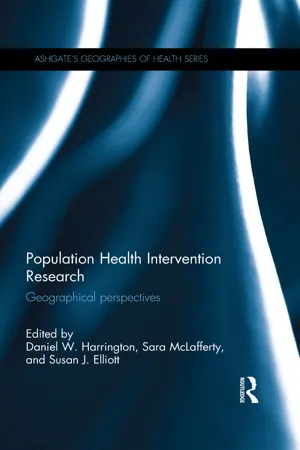
Population Health Intervention Research
Geographical perspectives
- 206 pages
- English
- ePUB (mobile friendly)
- Available on iOS & Android
eBook - ePub
Population Health Intervention Research
Geographical perspectives
About this book
Health geographers are well situated for undertaking population health intervention research (PHIR), and have an opportunity to be at the forefront of this emerging area of inquiry. However, in order to advance PHIR, the scientific community needs to be innovative with its methodologies, theories, and ability to think critically about population health issues. For example, using alternatives (e.g. community-based participatory research) to traditional study designs such as the randomised control trial, health geographers can contribute in important ways to understanding the complex relationships between population health (both intended and unintended consequences), interventions and place. Representing a diverse array of health concerns ranging across chronic and infectious diseases, and research employing varied qualitative and quantitative methodologies, the contributions to this book illustrate how geographic concepts and approaches have informed the design and planning of intervention(s) and/or the evaluation of health impacts. For example, the authors argue that geographically targeting interventions to places of high-need and tailoring interventions to local place contexts are critically important for intervention success. Including an afterword by Professor Louise Potvin, this book will appeal to researchers interested in population and public/community health and epidemiology as well as health geography.
1 Introduction
As a scientific subdiscipline, health geography is a dynamic and reflective field that frequently applies a critical lens to its own position in the academic landscape (Kearns and Moon, 2002). This has been particularly evident through the “cultural” and “spatial” turns that have occurred since the latter part of the twentieth century (for a full treatment see Kearns and Moon, 2002; Brown, McLafferty, and Moon, 2009; Luginaah, 2009). Indeed, many will already be familiar with the emergence of health geography from the spatial-analytic thrust of “traditional” medical geography. This has been complemented through the application of critical social theory to interrogations of the influences of places on health, using a range of quantitative and qualitative epistemologies (Andrews and Moon, 2005). Concurrently, there has been an expansion of thematic areas of research that span, but are not limited to: population health, social inequities, disability and ageing, healthcare, housing, environmental risk and exposure, and chronic and infectious disease (Luginaah, 2009). The diverse approaches available to geographers offer unique perspectives for critically analyzing how spaces and places can shape the ways in which health is experienced by, and shaped by, individuals or groups of individuals. The point of this volume is to explicitly highlight the contributions that geographers can make and have been making to an important and emerging field of scientific inquiry: population health intervention research.
Studies published over decades of work from health geography and across other, related disciplines (e.g. epidemiology, public health, health promotion, community health) have shown important variations and inequities in health, health behaviors, and social determinants of health between and within populations and geographies. Importantly, geographers have advanced the understanding of how variations in health are influenced by context, and how health is experienced in the various socio-cultural, physical, economic, and political environments in which people live. While descriptive and analytic studies have produced crucial knowledge about the relationships between the social determinants of health and population health, more recently there has been an increased emphasis on studying population health interventions (Hawe and Potvin, 2009). We echo the arguments of others that geographers, and those from other disciplines, should assign equal effort to using evidence to try to narrow inequalities and inequities in health (Dunn, 2014). Certainly, this direction aligns with the population health approach (Rose, 1985; Public Health Agency of Canada, 2012) that underpins much of the empirical research in health geography and other closely aligned fields.
Population health interventions are policies or programs that act upon population health (directly or indirectly) towards altering an established course, be it absolute health burden, inequality, or inequity (Hawe and Potvin, 2009). A classic example from health promotion would be the introduction of the three-point seat belt in the late 1950s. Fitting automobiles with seat belts could be considered a program, as would social marketing efforts to increase population awareness of the benefits of their use. Whereas legislated mandatory seat-belt use and the enforcement of seat-belt laws would be considered policy interventions, together these interrelated policies and programs have proven to be impactful, cost-effective interventions that have saved over one million lives, globally (World Health Organization, 2009). This example clearly illustrates the concept of shifting the distribution of injury and automobile-related mortality by reducing exposure to risk at a population level (Rose, 1985).
The impacts of other population health interventions may not be as clear, depending on the complexity of the intervention. That is, if an intervention system has multiple components or targets multiple aspects of health, it may be difficult to identify or attribute any effects to one particular part (Craig et al., 2008). Further, an intervention may have differential impacts on different segments of the population or unintended consequences. As such, the traditional gold standard for evaluating clinical interventions through randomized controlled trials may not be feasible or even appropriate on a population level (Hawe et al., 2004; Glasgow et al., 1999). Rather, it is often necessary to approach population health interventions with a diversity of methods and disciplinary knowledge. In this way, it is important to gain a deeper understanding of not only what interventions work (Frank, 2012), but also – to paraphrase Macintyre et al., (2002) – what interventions work for which populations and in what places. It is likely unsurprising that this latter point is where we feel health geographers can make a significant contribution.
The geography of population health intervention research
With an understanding of what constitutes a population health intervention, we take the opportunity here to describe population health intervention research (PHIR), and explicitly identify a place for geographers in PHIR as a scientific endeavor. PHIR has been defined as:
Research that involves the use of scientific methods to produce knowledge about policy and program interventions that operate within or outside of the health sector and have the potential to impact health at the population level. (Canadian Institute for Health Information, 2014)
These may include policies or program interventions that are not primarily designed to change health or health behaviors in the general population, but nonetheless have the potential to impact population health. For example, increasing access to public transit as a mechanism for easing traffic gridlock and reducing commuting times may concurrently increase active transportation (e.g. walking or cycling to transit stations) that could contribute to increasing daily physical activity and reducing stress, both important determinants of health outcomes such as cardiovascular disease and excess body weight.
If we understand that PHIR uses scientific methods to understand policies and programs that have the potential to impact population health, it follows that these generally operate by modifying upstream conditions that determine population health (Rose, 1985). It is somewhat interesting, then, that the PHIR definition (perhaps unintentionally) appears to privilege policies and programs related to the health sector by drawing attention to these through a specific reference. In practice, however, interventions that are effective in ‘shifting the curve’ by addressing the social determinants of health may be more aptly based in sectors other than health such as employment, education, social support services, healthy child development, transportation, or the built environment (Frankish, 2012; Public Health Agency of Canada, 2015). Then, if population health interventions encompass changes in these sectors, the influence of the social, economic, physical, or political environments in which health is shaped is quite clear. This provides a cozy place where geographers may see themselves contributing to PHIR and simultaneously provides justification for the efforts of all who contributed to this volume.
What type of knowledge is needed to understand population health interventions? Hawe and Potvin state “all systematic inquiry and learning from observing an intervention’s process or implementation, impact or outcome is encompassed in ‘intervention research’” (2009: I-9). Echoing this, Frankish explains “PHIR aims to capture the value and differential effects of interventions, the processes by which they create change, and the contexts within which they work best” (2012: S3). Both definitions deconstruct population health interventions into two discernible and equally important components that are targets for research. The first is specifically concerned with changes in health outcomes or determinants of health at the population level that can be attributed to the presence or intensity of an intervention. An outcomes evaluation is generally concerned with answering questions of intervention efficacy: did the intervention work? The second refers to the processes by which the intervention impacts on population health. According to Glasgow and colleagues’ RE-AIM framework (1999), comprehensive evaluations should include assessment of five dimensions in order to understand why (or why not) an intervention impacts population health: reach, efficacy, adoption, implementation, and maintenance (Table 1.1). While outcomes evaluations are generally focused on reach and efficacy, other dimensions of an intervention can be unpacked through a process evaluation. Settings are central in health promotion theory (Green et al., 2000), and assessment of adoption, implementation, and maintenance in particular are key to understanding the settings in which interventions are executed. Ultimately, both outcomes and process evaluations are necessary for fully understanding if interventions work, how interventions work, whom they work for, and where they work best.
Table 1.1 The RE-AIM framework
| Dimension | Definition |
| Reach | Proportion of the target population participating in or exposed to the intervention |
| Efficacy | Success rate: changes in population health |
| Adoption | Proportion of settings adopting the intervention |
| Implementation | Fidelity: the extent to which the intervention was implemented as planned |
| Maintenance | The extent to which the intervention is sustained over time |
Adapted from Glasgow et al. (2009).
This volume
The unofficial grandfather of medical geography, John Snow, conducted a classic example of PHIR in the mid-1800s. More than a century later, geographers are well situated for advancing population health intervention research, and we argue that geographers have an opportunity to be at the forefront of this emerging area of inquiry. In order to advance PHIR, the scientific community will need to be innovative with its methodologies, theories, and ability to think critically about population health issues. In particular, geographers can contribute in important ways to understanding the complex relationships between population health, interventions, and place.
Some have already taken up this charge, and this volume is meant to highlight that work and accentuate the inherently geographical nature of PHIR. We have solicited contributions representing a diverse array of methodologies applied to a broad range of health issues, from both emerging researchers in health geography (and closely related disciplines), as well as established scholars. Most are university-affiliated, though several are established scientists working in government public health organizations. All are well connected to the world of science-policy bridging. The contributors are primarily from North America, though efforts were made to ensure the inclusion of contributors who conduct PHIR in different contexts and communities around the world.
In organizing this volume, we have attempted to highlight topical and methodological connections between chapters, as well as broader themes linking geographical perspectives and PHIR. With respect to broad themes, chapters in the first half of the book emphasize geographical perspectives in planning and implementing public health interventions, whereas latter chapters focus more on program evaluation. Early chapters speak in general terms about the importance of space and place, and related concepts such as mobility and vulnerability in planning public health interventions for specific health issues. The central argument is that interventions should reflect the place-based processes that give rise to health inequalities and thus reflect distinctive population- and place-specific circumstances. In addition, the research conducted in these chapters illustrates the use of geographic data and methods in spatially targeting interventions on areas of high need and in supporting partnerships to develop effective intervention strategies. Chapters in the latter half of the volume build on these themes in addressing the evaluation of particular public health interventions, including bednets for malaria control, smoking cessation policies, and school nutrition programs. Through detailed case studies and natural experiments comparing health outcomes before and after intervention, the authors identify important place-based variation and sensitivity to local context that requires attention in the planning and implementation processes.
The organization of chapters also reflects our effort to highlight the richness and diversity of geographical contributions to PHIR. By juxtaposing chapters addressing specific health concerns – HIV/AIDS, vector-borne disease, obesity, and physical activity – we expose geographers’ diverse methodological and conceptual perspectives on the causes of specific health concerns and the planning and implementation of appropriate and effective interventions. Varying scales of analysis, from global and regional viewpoints to the local spaces of daily life, reveal the range of social and environmental forces that shape people’s health and constrain and facilitate intervention.
The first substantive chapter by Barb Riley, Kerry Robinson, Martin Taylor and Cameron Willis underscores the importance of partnerships in population health. This is an outstanding writing team in the area of PHIR, with two of the authors (Riley and Willis) affiliated with an academic think tank related to population health impact, a third (Robinson) in a senior policy position at the national public health agency in Canada and the fourth (Taylor) a career academic researcher and administrator who can be considered a pioneer in the subdiscipline of health geography. In this chapter, these authors draw on their tremendous experience as researchers to explore the relative contribution(s) of geography to three major research projects involving large-scale population health partnership initiatives across a range of spatial scales. These include: (1) the Community Intervention Trial for Smoking Cessation (COMMIT), a multi-site community-based trial; (2) the Canadian Heart Health Initiative, a 20-year program that involved partnerships between public health leaders and researchers; and (3) the Public Health Agency of Canada’s (PHAC) multi-sector partnership program designed to promote chronic disease prevention and healthy living through novel public-private partnerships. This chapter provides useful insights on the role of geography and geographers in enhancing population health through partnerships.
Community partnerships, and their roles in shaping effective public health interventions, are a central theme in Olson et al.’s chapter on the Milwaukee Vacant Land Inventory. As in many cities in North America, Milwaukee’s low-income neighborhoods are dotted with vacant properties – a legacy of deindustrialization and population decline. Olson and co-authors argue that these properties have complex implications for population health. On the one hand, they diminish opportunities for social interactions and engagement in communities that already face a myriad of health concerns, while at the same time, they represent enormous untapped potential for developing health-promoting spaces for recreation, relaxation, cultivation, and many other purposes. The authors discuss the development of a GIS-based inventory of vacant lots that incorporates both qualitative and quantitative indicators of attributes, quality, and land use for each property. A framework is presented describing opportunities for community involvement in directing the redevelopment process to support and foster community well-being. The use of GIS in cataloging and characterizing vacant properties and supporting community participation in developing interventions is an innovative feature of this chapter.
Geospatial data and methods can be important tools in developing and targeting public health interventions, especially when the data reveal patterns of ill-health that may be hidden from view. This key point is illustrated in Oppong et al.’s chapter which examines spatial and social inequalities in HIV/AIDS survival in Dallas County, Texas. Using data on survival time among people diagnosed with HIV/AIDS, the authors assess disparities in survival by race and ethnicity across groups of neighborhoods with different levels of socio-economic disadvantage. In addition to revealing racial disparities in survival, the data and analysis also dispute the concept of a strict socio-economic gradient in survival by indicating that those infected with HIV living in neighborhoods of moderate socio-economic status (SES) have shorter life spans than those living in higher or lower SES neighborhoods. The authors suggest that federal health programs such as Medicaid and Ryan White HIV intervention activities benefit those living in low SES areas and improve their health outcomes. Although the chapter does not investigate the interventions themselves, it highlights the importance of understanding linkages between social and spatial vulnerability in HIV/AIDS research and the need for data-driven approaches that may reveal people and places where interventions are most needed.
Following Oppong and colleagues’ chapter, Nathaniel Lewis takes a critical lens to sexual health and HIV prevention for gay men and men who have sex with men (MSM) in newcomer communities. Lewis has undertaken a systematic review of interventions in North America, to assess the types of interventions being used in this population, their (perceived) effectiveness, and the degree to which interventions address elements of resettlement and the migration experience. First, by employing systematic review Lewis highlights the usefulness of this methodology for contributing to PHIR (as previously indicated by Potvin, 2012). He argues that whil...
Table of contents
- Cover
- Half Title
- Title Page
- Copyright Page
- Dedication
- Table of Contents
- List of figures
- List of tables
- Notes on contributors
- 1 Introduction
- 2 Partnerships for population health improvement: geographic perspectives
- 3 The vacant land inventory: an approach to support vacant lot redevelopment for population health improvement in Milwaukee, WI, USA
- 4 Spatial analysis of HIV/AIDS survival in Dallas County, Texas
- 5 From cultural clashes to settlement stressors: a review of HIV prevention interventions for gay and bisexual immigrant men in North America
- 6 Making a place for health in vulnerability analysis: a case study on dengue in Malaysia and Brazil
- 7 The geography of malaria control in the Democratic Republic of Congo
- 8 Natural experiments for reducing and preventing chronic disease
- 9 Shaping the direction of youth health with COMPASS: a research platform for evaluating natural experiments and generating practice-based evidence in school-based prevention
- 10 Exploring the implementation process of a school nutrition policy in Ontario, Canada: using a health geography lens
- 11 Food retail environments in Canada: evidence, framing, and promising interventions to improve population diet
- 12 Transforming local geographies to improve health
- References
- Index
Trusted by 375,005 students
Access to over 1.5 million titles for a fair monthly price.
Study more efficiently using our study tools.
Frequently asked questions
Yes, you can cancel anytime from the Subscription tab in your account settings on the Perlego website. Your subscription will stay active until the end of your current billing period. Learn how to cancel your subscription
No, books cannot be downloaded as external files, such as PDFs, for use outside of Perlego. However, you can download books within the Perlego app for offline reading on mobile or tablet. Learn how to download books offline
Perlego offers two plans: Essential and Complete
- Essential is ideal for learners and professionals who enjoy exploring a wide range of subjects. Access the Essential Library with 800,000+ trusted titles and best-sellers across business, personal growth, and the humanities. Includes unlimited reading time and Standard Read Aloud voice.
- Complete: Perfect for advanced learners and researchers needing full, unrestricted access. Unlock 1.5M+ books across hundreds of subjects, including academic and specialized titles. The Complete Plan also includes advanced features like Premium Read Aloud and Research Assistant.
We are an online textbook subscription service, where you can get access to an entire online library for less than the price of a single book per month. With over 1.5 million books across 990+ topics, we’ve got you covered! Learn about our mission
Look out for the read-aloud symbol on your next book to see if you can listen to it. The read-aloud tool reads text aloud for you, highlighting the text as it is being read. You can pause it, speed it up and slow it down. Learn more about Read Aloud
Yes! You can use the Perlego app on both iOS and Android devices to read anytime, anywhere — even offline. Perfect for commutes or when you’re on the go.
Please note we cannot support devices running on iOS 13 and Android 7 or earlier. Learn more about using the app
Please note we cannot support devices running on iOS 13 and Android 7 or earlier. Learn more about using the app
Yes, you can access Population Health Intervention Research by Daniel W. Harrington,Sara McLafferty,Susan J. Elliott in PDF and/or ePUB format, as well as other popular books in Physical Sciences & Geography. We have over 1.5 million books available in our catalogue for you to explore.