Travel often inspires the creation of narratives about journeys and destinations, more so with the increasing availability of online platforms, applications for smartphones and tablets, and various other social media technologies. This book examines travel blogs and their associated social media as a form of self-presentation that negotiates the tensions between discourses of travel and tourism. As such, it addresses how contemporary travellers use online platforms to communicate their experiences of journeys and destinations, and how the traveller/tourist dichotomy finds expression in these narratives. Addressing the need for more in-depth analysis through a study of blogs, this exploration of networked narratives of an individual's travel experience considers personal motivations, self-promotion, and self-presentation as key factors in the creation of both personal and commercial travel blogs. As this text applies concepts such as self-presentation and heteroglossia, it will be of interest to both students and scholars of tourism, new media, sociology, cultural studies, and discourse studies.
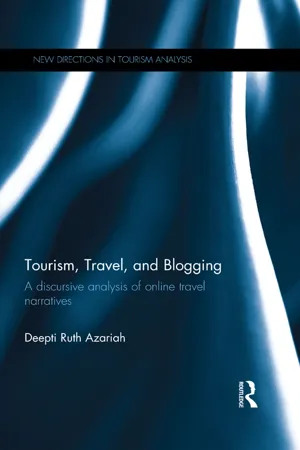
eBook - ePub
Tourism, Travel, and Blogging
A discursive analysis of online travel narratives
- 180 pages
- English
- ePUB (mobile friendly)
- Available on iOS & Android
eBook - ePub
1 Introduction
Tourism, travel, and blogging
More often than not, it is preferable to be perceived as a traveller than a tourist, or so researchers and writers of travel narratives would have us believe (Fussell 1980; Galani-Moutafi 2000; McCabe 2005; O'Reilly 2005). Travel is associated with authenticity, adventure, and spontaneity. Tourism, on the other hand, has the less desirable connotations of being planned and superficial. This view is emphatically encapsulated in American historian Daniel J. Boorstin's observation that: ‘The traveller was active; he went strenuously in search of people, of adventure, of experience. The tourist is passive; he expects interesting things to happen to him. He goes “sight-seeing”….’ (1992, p. 85).
These associations are not particularly new – the question of a distinction between travel and tourism and whether such a dichotomy does indeed exist has long engaged academic debate in tourist studies (Franklin and Crang 2001). Following the rise of mass tourism, this has found expression in many works of travel literature. Writers such as G. K. Chesterton and William Wordsworth have denigrated the tourist and deplored the decline of real travel. Other more contemporary theorists have suggested that that the traveller no longer exists, but has been supplanted by the mass tourist (Fussell 1980; Urry 2002). This book adds to this longstanding discussion with its exploration of how the tensions between travel and tourism are discursively expressed and negotiated in a relatively new form of travel-related communication – the travel blog.
Travel has long inspired writing. Over the centuries, it has generated texts both fictional and promotional, ranging from the travel books, diaries and photographs that recount personal holiday experiences or record journeys of exploration to the brochures, guidebooks, postcards, and posters that are integral to commercial tourism. More recently, social media platforms such as blogs, social networks, microblogs and photo-sharing services, and applications for mobile phones and tablets have made it easier for those who travel to publish and publicise personal narratives of their travel experiences. This has introduced a variety of new discursive forms to an already extensive body of travel-related communication. Blogs have proved particularly popular. Generic platforms such as Blogger and Wordpress and travel-specific blogging sites such as TravelBlog, TravelPod, BootsnAll, MyTripJournal and OffExploring have enabled individuals to capture their travel experiences in words and images and share these with a large and diverse online audience. These online narratives incorporate various narrative techniques and discourses, the examination of which is the central purpose of this book.
In order to understand how discourses of travel and tourism inform travel blogs, it is first necessary to understand these texts as a narrative form. Blogs, otherwise known as weblogs, evolve from the traditions of diary writing and like their forerunners are usually serialised topical and personal narratives (McNeill 2003; Serfaty 2004a; Sorapure 2003; Van Dijck 2004; Walker Rettberg 2014). Interestingly, there is an allusion to travel in the terms ‘blog’ and ‘weblog’, which originate from the word ‘log’, referring to the nautical record of a journey (Walker Rettberg 2014, p. 30). Travel blogs resemble early travel diaries in that they are usually written as public documents intended for others to read. Yet, some significant differences also exist. The authors of the latter were, in general, renowned individuals whose travel narratives were usually sanctioned by the state. Moreover, unlike diaries, entries in a blog appear in reverse-chronological order, usually contain hyperlinks to other online resources and generally allow readers to comment on the content (Bruns and Jacobs 2006; Walker Rettberg 2014). In comparison with personal diaries and early travel diaries, blogs are, for the most part, participatory rather than exclusive and democratised rather than elitist. As such, they are personal narratives, yet they are also public by nature.
Given their personal yet public quality, it is hardly surprising that blogs are often interpreted from the symbolic interactionist perspective, which stresses the importance of social context to the concept of self. Erving Goffman's conceptualisation in The Presentation of Self in Everyday Life (1969) of social interaction as a stage performance has proved an appropriate metaphor for understanding how individuals position themselves online and interact with their audiences (see, for example, Bullingham and Vasconcelos 2013; McCullagh 2008; Papacharissi 2009; Pinch 2010; Reed 2005; Robinson 2007; Sanderson 2008; Schmidt 2007; Trammell and Keshelashvili 2005). Within this context, blogs may be described as a narrative form of self-presentation. Blogging in this sense is a ‘performative act’ (Baumer et al. 2011). Blogs themselves are ‘straightforward indexes of self’ available to a wide audience (Reed 2005, p. 27). As Jan Schmidt notes, ‘publishing a blog is a way of self-presentation that has to meet certain expectations about personal authenticity while maintaining a balance between staying private and being public’ (2007, p. 1413), which conclusion succinctly articulates both the social aspects of these texts and the needs of their audiences while also emphasising the centrality of the self in the narrative.
Extending this view to travel blogs, this book examines these narratives principally as forms of self-presentation since the description of travel experiences often involves the presentation of a traveller self. However, this is but one of many other roles that travel bloggers may occupy – other examples discussed in this book include adventurer, explorer, foodie, travel writer, tour guide, travel advisor, technology expert, teacher, and so on. It is necessary, therefore, to acknowledge that this self-presentation comprises multiple voices and many discourses including those of travel and tourism. This ‘presentation of multiple personas’, as Holland and Huggan (1998, p. 16) term it, through the interchange of narrative positions is characteristic of most travel narratives. Such an online self has often been described as being multifaceted or ‘threaded’ (Hevern 2004, p. 322). The possibly disparate positions it occupies are indicated by the different narrative voices in which the self speaks, sometimes within the space of a single blog entry.
This book proposes that the multifaceted online self of a travel blogger can be critically interpreted through juxtaposing Goffman's self-presentation and Russian discourse theorist Mikhail Bakhtin's heteroglossia (the presence of multiple discourses) and polyphony (multiple narrative voices). The combination of these two concepts in the academic interrogation of online self-presentation is little used but hardly innovative (for examples, see Hermans 2004; Hevern 2004; Sanderson 2008; Serfaty 2004b). In Goffman's terms, individuals adopt several faces, each a different aspect of the same self, to meet the needs of the particular social situation they are in and the audience they interact with. From a Bakhtinian point of view, such an online self is polyphonic for speaking in multiple voices, each corresponding with the narrative roles it occupies. Travel blogs are polyphonic when the voices of the author, readers, advertisers, and web hosts interact with each other. They are heteroglossic for incorporating narrative forms and styles associated with various social spheres particularly those associated with travel as opposed to tourism. Approaching travel blogs from the combined theoretical perspectives of Goffmanian self-presentation and Bakhtinian discourse thus facilitates a deeper and meaningful interrogation of an online self that plays multiple narrative roles.
Often, the features of the online platform, in this case the blog, facilitate the performance of the different narrative roles online. In saying this, the book subscribes to Trevor Pinch's conclusion that in the presentation of self in any social situation ‘the staging of the interaction, the mediation of the interaction and its performance depend crucially on the detailed material and technological arrangements in place’ (Pinch 2010, p. 414). In other words, a considered employment of the formal features of a travel blog in the staging of a narrative role, such as that of a traveller, and interacting with the audience witnessing this performance are both fundamental to the presentation of the online self. These features include discursive elements such as the title banner, the home page, the ‘About Me’ section, and the entries, all of which are usually created and customised by the bloggers themselves. These indicate the various aspects of a travel blogger's online self, such as the itinerant adventurer implied by Wandering Earl (Baron 2016) or the culinary tourist in Forks and Jets (Rees and Rees 2008). Other elements such as the comments box below each entry, widgets that distribute content to linked platforms such as a Facebook page or a Twitter stream as well as hyperlinks to other similar websites and blogs facilitate the performance of various roles through social interaction. Hyperlinks to other travel-related blogs, in particular, enable the display of a network of connections to like-minded individuals, a technique that Donath and boyd have observed to be characteristic of online self-presentation (2004). Accordingly, this book examines how individuals use such online tools and features, the affordances1 of various blogging platforms, arguing that these are integral to the presentation of the travel experience and a traveller self in an online narrative.
A matter of discourse
Although the travel blogs examined in this book generally present multiple personas to a single online self, from a discursive point of view, the presentation of the self as a traveller rather than a tourist is of particular interest; first, as this distinction has been repeatedly questioned by tourism academics, and second, because it introduces tensions in the narrative (Franklin and Crang 2001). The traveller is generally defined, against the tourist, as being a more sophisticated individual who seeks unique off-the-beaten-path experiences instead of the destinations marketed by the tourism industry. Likewise, while contemporary research often uses ‘travel’ and ‘tourism’ interchangeably, the two terms suggest very different contexts. Travel is generally regarded as more authentic for being adventurous, spontaneous, and involving some degree of hardship and therefore being more worthy of admiration than tourism, which is perceived as being superficial, passive, devoid of any real risk and commercially motivated (Fussell 1980; O'Reilly 2005).
These differences are generally expressed through specific narrative techniques. Several analyses of forms of travel-related communication indicate that individuals use a certain language to present the self as a traveller and associate their experiences with travel as opposed to tourism (Dann 1999; O'Reilly 2005; McCabe 2005). Conversely, tourist discourse has clearly identifiable narrative features that reflect its commercial associations and promotional purpose (Dann 1996). Both discursive styles are manifest in a number of travel blogs, which position the blogger as a traveller but are also featured on tourism website Lonely Planet (2016) or are commercialised in other ways.
It seems reasonable therefore to argue that in order to understand how individuals present themselves in travel blogs and how these texts negotiate discursive tensions, it is necessary to identify and establish specific narrative techniques, social contexts, and themes associated with discourses of travel and tourism. By subscribing to Jaworski and Coupland's interpretation of discourse as ‘language reflecting social order’ (1999, p. 3), it is possible to demonstrate how blogs about travel can provide a broader picture of some of the practices or views associated with travel and tourism. Specific activities related to tourism or travel shape the narrative that is the travel blog. For example, taking an iconic photograph of a popular destination signifies that one is a tourist just as going off the beaten path communicates the idea that one is a traveller. Similarly, Jaworski and Coupland's broad view of discourse as consisting not only of written and spoken words but also of ‘non-linguistic semiotic systems’ (1999, p. 7) such as performance art, painting, photography, sculpture, etc. facilitates the examination of travel blogs as narratives incorporating many forms – diary-like entries, photographs, advertisements, and a range of paratextual elements such as titles, title banners, and a variety of other visual elements. Each of these corresponds with social contexts relevant to the practice of either travel or tourism via which an audience may recognise the figure of the travel writer, the touristic photographer, or the promoter of commercial tourism. Several existing studies of backpacker narratives, travel writing, and other forms of travel-related communication outline the narrative forms and techniques used to distinguish travel from tourism (Elsrud 2001; Noy 2004; O'Reilly 2005). Extrapolating from these, it is possible to arrive at a general framework for travel discourse that can be applied to the study of travel blogs. Similarly, a significant body of research stems from Graham Dann's work on the ‘language of tourism’ and John Urry and Jonas Larsen's investigation of a ‘tourist gaze’ as exhibited in advertisements, brochures, photographs, posters, and a variety of other similar travel-related texts that organise touristic consumption of place. These studies provide a useful starting point for identifying tourist discourse in both the words and images of travel blogs (Dann 1996; Urry and Larsen 2011).
The language of travel
Several critical discussions of travel-related communication demonstrate how those who describe their journeys often disassociate themselves from the figure of the tourist and the commercial tourism industry, preferring instead to position themselves as travellers. A study of discussions between backpackers by Greg Richards and Julie Wilson finds that the obvious strategy of identifying one's self as a traveller is a predominant theme (2004). An excellent point of reference is Graham Dann's demonstration of how three authors of travel books – Paul Theroux, Ted Simon and Nick Danziger – manipulate space and time in their narratives to ‘write out’ the tourist and present their experiences as travel (Dann 1999). They do this by describing travel as being timeless, solitary, and focused on the journey rather than the destination.
Several other studies of descriptions of travel, as opposed to touristic, experiences validate these observations. For instance, David Dunn ...
Table of contents
- Cover
- Half Title
- Title Page
- Copyright Page
- Dedication
- Table of Contents
- Lists of figures
- Acknowledgements
- 1 Introduction: tourism, travel, and blogging
- 2 A pioneer in the blogosphere: Tony Wheeler’s Travels
- 3 The voice(s) in the paratext: presenting the author(s) of sponsored travel blogs
- 4 With the reader in mind: self-presentation and the independent travel blog
- 5 Beyond the borders of the blog: the networked self of the independent travel blogger
- 6 Worth a thousand words (or more): framing the discursive tensions in travel photographs
- 7 Mapping the travel blog: conclusions on the discourses of travel and tourism
- Index
Trusted by 375,005 students
Access to over 1.5 million titles for a fair monthly price.
Study more efficiently using our study tools.
Frequently asked questions
Yes, you can cancel anytime from the Subscription tab in your account settings on the Perlego website. Your subscription will stay active until the end of your current billing period. Learn how to cancel your subscription
No, books cannot be downloaded as external files, such as PDFs, for use outside of Perlego. However, you can download books within the Perlego app for offline reading on mobile or tablet. Learn how to download books offline
Perlego offers two plans: Essential and Complete
- Essential is ideal for learners and professionals who enjoy exploring a wide range of subjects. Access the Essential Library with 800,000+ trusted titles and best-sellers across business, personal growth, and the humanities. Includes unlimited reading time and Standard Read Aloud voice.
- Complete: Perfect for advanced learners and researchers needing full, unrestricted access. Unlock 1.5M+ books across hundreds of subjects, including academic and specialized titles. The Complete Plan also includes advanced features like Premium Read Aloud and Research Assistant.
We are an online textbook subscription service, where you can get access to an entire online library for less than the price of a single book per month. With over 1.5 million books across 990+ topics, we’ve got you covered! Learn about our mission
Look out for the read-aloud symbol on your next book to see if you can listen to it. The read-aloud tool reads text aloud for you, highlighting the text as it is being read. You can pause it, speed it up and slow it down. Learn more about Read Aloud
Yes! You can use the Perlego app on both iOS and Android devices to read anytime, anywhere — even offline. Perfect for commutes or when you’re on the go.
Please note we cannot support devices running on iOS 13 and Android 7 or earlier. Learn more about using the app
Please note we cannot support devices running on iOS 13 and Android 7 or earlier. Learn more about using the app
Yes, you can access Tourism, Travel, and Blogging by Deepti Ruth Azariah in PDF and/or ePUB format, as well as other popular books in Business & Hospitality, Travel & Tourism Industry. We have over 1.5 million books available in our catalogue for you to explore.