- 270 pages
- English
- ePUB (mobile friendly)
- Available on iOS & Android
eBook - ePub
About this book
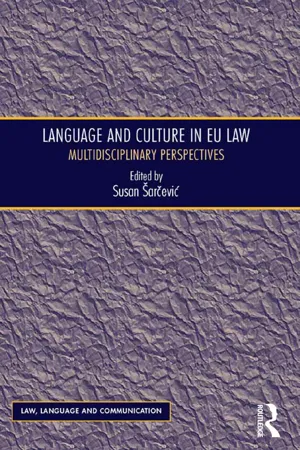
Written by distinguished legal and linguistic scholars and practitioners from the EU institutions, the contributions in this volume provide multidisciplinary perspectives on the vital role of language and culture as key forces shaping the dynamics of EU law. The broad spectrum of topics sheds light on major Europeanization processes at work: the gradual creation of a neutralized EU legal language with uniform concepts, for example, in the DCFR and CESL, and the emergence of a European legal culture. The main focus is on EU multilingual lawmaking, with special emphasis on problems of legal translation and term formation in the multilingual and multicultural European context, including comparative law aspects and an analysis of the advantages and disadvantages of translating from a lingua franca. Of equal importance are issues relating to the multilingual interpretation of EU legislation and case law by the national courts and interpretative techniques of the CJEU, as well as the viability of the autonomy of EU legal concepts and the need for the professionalization of court interpreters Union-wide in response to Directive 2010/64/EU. Offering a good mix of theory and practice, this book is intended for scholars, practitioners and students with a special interest in the legal-linguistic aspects of EU law and their impact on old and new Member States and candidate countries as well.
Information
Chapter 1
Language and Culture in EU Law: Introduction and Overview
Introduction
The accession of Croatia to the EU on 1 July 2013 provided an opportune occasion for European scholars and EU practitioners to gather at the Jean Monnet Inter-University Centre of Excellence in Opatija for a multidisciplinary conference to discuss the vital role of language and culture as driving forces in the dynamics of EU law. The chapters in this volume are based on the papers presented at the conference although all of them have been expanded and fine-tuned. Each chapter examines certain aspects of the unique role of language and culture in shaping EU law, which is founded on the principles of linguistic and cultural diversity. The goal therefore is not only to investigate the multilingual and multicultural character of EU law, but first and foremost to show how multilingualism and multiculturalism have influenced its development.
Since EU law is made by the EU institutions but must be integrated into national law and applied by the national courts, the linguistic and cultural processes at work have a direct impact on both EU and national law. The pluralistic character of the authorship enables the multi-levels of these interactive processes to be examined from a multitude of perspectives. First, there are ‘insider’ and ‘outsider’ perspectives. Quite logically, the insider perspectives are provided by the practitioners who work in the EU institutions and have a hand in shaping these processes from within, while the scholars from European universities present the perspectives of ‘outsiders’ who are active participants in these processes at national level. Second, the views presented are multidisciplinary in nature thanks to the mixed backgrounds of the authors who include both lawyers and linguists representing a wide variety of specialist domains. The academic authors on the legal side are from the areas of European private and public law, comparative law and philosophy of law, on the linguistic side from translation studies, terminology studies, cultural studies and communication studies. The practitioners from the EU institutions also have mixed backgrounds: a lawyer-linguist from the legal department of the Council and a linguist from the Commission’s Directorate-General of Translation (DGT) who is a specialist for quality management.
The individual chapters cover a broad spectrum of topics, all of which shed light on two complementary but also contradictory strands running throughout the book – the linguistic and cultural diversity of EU law, on the one hand, and the desire and need to build unity in diversity, on the other. Two dynamic processes of Europeanization are at work to achieve this goal: the creation of a common language for expressing EU law that will be equally ‘foreign’ to all Member States (chapters 5, 6, 7, 8)1 and the construction of a common European legal culture of shared values and standards (chapters 2, 6, 10).2 Another common leitmotif that stands out is the vital role to be played by educators and universities in shaping these processes with the aim of building a ‘common culture’ through the Europeanization of legal education (chapters 2, 5 and 10).3 From the insider point of view, a ‘shared culture’ already exists and is founded in the treaties of primary law (Chapter 3). At the level of secondary law, outsiders, especially comparative law scholars, have joined forces throughout Europe in an attempt to create a common terminology in areas of private law as a precondition for achieving greater harmonization aimed at removing barriers to cross-border transactions (Chapter 2).4 As a result, considerable progress has been made over the past decade by the completion of the academic Draft Common Frame of Reference (DCFR),5 which has been followed up by the Commission’s Proposal for a Common European Sales Law (CESL) (Chapter 5).6
These efforts have resulted in a new variety of a neutralized English7 which is taking on the role of a lingua franca. Instead of diminishing the need for translation, the use of a neutral lingua franca opens up new frontiers for legal translation in which EU translators have the task of deculturalizing their national languages in order to create a common EU legal terminology to express uniform concepts Union-wide (chapters 5 and 8). An insider explains how EU translators are dealing with this problem in a case study of the translation of the CESL (Chapter 9). Different approaches are taken on the issue of translation strategy and the role of comparative legal analysis in EU translation (chapters 7 and 9).8 Although insiders boast of ‘absolute concordance’9 between the equally authentic texts of EU legislation, obviously such equivalence cannot be achieved in practice. As a result of the inherent imperfections of legal translation, the Court of Justice of the European Union (CJEU) must strike a proper balance to ensure the uniform interpretation and application of EU law, while respecting linguistic and cultural diversity and the right of EU citizens to legal certainty (chapters 2 and 4). In practice, the main burden of applying EU law falls on the national courts, some of which have come up with innovative methods of coping with the increasing number of official languages (Chapter 4).10 Uniform law can be achieved only by establishing autonomous EU concepts. However, the multilingual and multicultural character of EU law raises serious questions as to the viability of the autonomy of EU concepts, a premise of EU law established by the case law of the CJEU (chapters 6 and 10). Judges of new Member States face multiple problems when called upon to apply EU law,11 which provides a testing ground for the reliability of the translations of the acquis produced during the pre-accession period (chapters 11 and 12).12 Linguistic and cultural diversity also plays a role in the area of criminal justice, where action has been taken at EU level requiring all Member States to provide court interpreting of ‘sufficient quality’ to all accused persons and suspects (if needed), thus guaranteeing their right to a fair trial (Chapter 13). Looking into the future, all actors participating directly or indirectly in the production, interpretation and application of EU multilingual legislation at EU and national level, insiders and outsiders, old and new Member States, are encouraged to cooperate in shaping the linguistic and cultural processes driving the dynamic development of EU law, taking care at all times to strike a proper balance between unity and diversity.
The book is divided into three parts. Part I lays the groundwork by reflecting on the relationship between law, language and culture in the EU and by introducing the main topics. Emphasis is placed on challenges in EU multilingual lawmaking and the interpretation of EU multilingual legislation and case law at national level. The key role of language in the Europeanization of private law takes centre stage, as does the call for a European legal culture. Legal translation is presented as a tool of comparative legal analysis playing a significant role in the harmonization of European private law.
Part II focuses on translation in the multilingual and multicultural context of EU law. The first two chapters deal with theoretical issues, the last two are practice-oriented. The theoretical discussion is opened with thought-provoking reflections on the paradoxical relationship between language, translation and the autonomy of EU law. While it is generally agreed that a comparative approach is required in EU legal translation, a hypothetical situation depicting the two classic approaches to translation strongly suggests that too much comparative analysis is an unnecessary burden for EU translators and even for lawyer-linguists. In this respect, the insider perspective reminds us that high quality translation in all language versions is a precondition for the proper functioning of EU law and that readability and comprehensibility are also criteria for assessing quality. All translators must deal with new problems arising as a result of the increased use of English as a lingua franca, which is an inevitable pragmatic solution that brings not only advantages but also disadvantages.
Part III shifts the focus to concepts, terminology and court interpreting. The stage is set by raising the sensitive issue of the viability of the autonomy of EU concepts, a premise of EU law which is of crucial importance for ensuring uniform interpretation and application Union-wide. Attention is then shifted to the new Member States and problems encountered by candidate countries in their endeavour to create the entire vocabulary of EU law in their national language for the purpose of translating the acquis. Following a multilingual approach to EU term formation, the important issue of terminology harmonization is dealt with at the level of the term and the concept. Finally, all Member States are encouraged to cooperate in developing uniform standards for court interpreting in order to ensure successful implementation of Directive 2010/64/EU.
Part I: Law, Language and Culture in the EU
Michele Graziadei opens the discussion in Chapter 2 by calling for a new European legal culture. In retrospect he attributes past failures of legal scholars to ‘map the development of a new European legal culture’ to the fact that they ignored the multilingual dimension of EU law. In his opinion, multilingual legislation opens the door to an understanding of law that places greater emphasis on the normative forces and communicative practices underlying the development of law across Europe. Commenting on the application of EU multilingual legislation by the CJEU and its effects on citizens, he reminds us that the wording of a text serves only as the starting point for interpretation, which is primarily teleological in nature. While this enables the CJEU to establish a uniform meaning despite linguistic divergences between the authentic language versions, it also leads to legal uncertainty for EU citizens and can even clash with the principle of equal authenticity, which is contrary to the very purpose of multilingual legislation. According to Graziadei, one of the many preconceptions of lawyers about the relationship between law and language is the idea that law is inextricably linked to the language in which it is expressed, thus implying that different languages cannot express the same law. In his view, such preconception is not warranted. Instead, he sees the main reason for divergent interpretations of EU multilingual legislation in the failure to establish uniform concepts and a uniform referential system at EU level. Legal harmonization across Europe cannot succeed unless all those responsible for achieving the uniform application of EU law share a common understanding of EU legislation. To this end, he encourages the ongoing work by the EU legislator, legal scholars and the CJEU to establish a uniform set of common concepts shared Union-wide. Furthermore, the successful ‘drafting’ of multilingual legislation requires the ability to foresee how the terms used in the different language versions will be interpreted in practice. This underlines the important role of comparative legal linguistic work, which, in his opinion, is essential for the development of legal translation studies and intercultural communication in multilingual Europe. This leads the author to conclude that ‘the birth of a new legal culture in multilingual Europe’ will be the product, among other things, of a new awareness of ‘sophisticated linguistic needs’.
Chapter 3 by Colin Robertson shifts the perspective to that of an ‘insider’, an EU lawyer-linguist engaged many years in checking and revising draft EU multilingual legislative texts before final adoption. In his analysis of the interfaces of law, language and culture in EU multilingual law, Robertson gives us a close-up view of the dynamics of EU law by explaining how EU multilingual law is made in the EU institutions, with special emphasis on legal and linguistic considerations that come into play during the legal-linguistic review of a text in a single language (vertical dimension) and the alignment of all language versions (horizontal dimension) so as to ensure terminological consistency within a single language and across languages, as well as the ‘best possible quality in all language versions and the closest equivalence in message between them’. The author provides a wealth of information on the relationship between EU and national law, the sources of EU concepts, inevitable cultural shifts in meanings that pose a risk to readers who are versed only in the national legal culture, the effects of linguistic borrowing on the national languages as a result of the translation process, and much more. As a long time ‘insider’ in the EU institutions, there is no doubt in Robertson’s mind as to the existence of an EU legal culture: ‘The shared culture of the EU is founded on the primary treaty texts. These are negotiated and signed by the Member States. They have a double function since they are rooted in the legal culture and language of international law, but they create the legal system and culture of EU law.’ As regards the structure of the chapter, each of the interfaces of law, language and culture is examined from four viewpoints: law, language, policy and action, which the author originally imagined as providing methods for checking and revising legislative texts legal-linguistically but later also used for the purpose of analysing terminology. In addition to scrutinizing the production of EU legislation, Robertson offers insight into the second vital stage in the life of every EU legislative text, that is, its interpretation and application by the courts, thereby providing a transition to the next chapter.
Focusing on the multilingual interpretation of EU legislation and case law, Chapter 4 by Mattias Derlén examines the important role of the CJEU and above all that of the national courts of the Member States, which he regards as the ‘key players in the practical application of EU law’. Derlén’s two labels ‘single text’ and ‘single meaning’ signify opposite approaches to multilingualism in legislation and case law that have left their mark on the multilingual interpretation of EU law by national courts. According to Derlén, legislation follows ‘full multilingualism’, where all languages are ‘de jure equally authoritative’ and all language versions together in dialogue are regarded as expressing a ‘single meaning’. On the other hand, CJEU judgments are authentic in one language only. Thus, the multilingual regime of CJEU case law is characterized by the idea of a ‘single text’, indicating the ‘existence of a de jure original’ that, at least in theory, is ‘alone decisive in interpretation’. Drawing on cases decided by national courts in five Member States, he shows that national courts use both of the above approaches when interpreting EU law, however, ‘without adhering to the distinction between legislation and case law’. Although the single meaning approach is now required by settled case law and is considered crucial for ensuring the uniform interpretation and application of EU law, it is challenged by the existence of two de facto originals: English in legislation and French in case law. Moving beyond the English-dominated drafting of EU legislation, Derlén explains the language regime of CJEU case law, pointing out that CJEU judgments are still drawn up exclusively in French, translated into the language of the case, if it is not French, and then into the other languages. Since French remains the sole working language of the CJEU, it has retained a notable grip on the interpretation of EU case law, despite the fact that, for practical purposes, judgments are authentic only in the language of the case. Today, as Derlén concludes, national courts are caught in a realm of uncertainty, forcing them to come up with innovative methods of dealing with the multilingual character of EU law and the increasing number of official languages. In numerous cases they are blending the two approaches of a single meaning and a single text, as a result of which the ‘role of official languages in the interpretation of legislation and CJEU case law is in a state of flux’.
Chapter 5 by Barbara Pozzo introduces the topic of legal translation from the perspective of a comparative lawyer. As the author points out, ‘Legal translation has always been considered an important tool for comparative law analysis’. In comparative law, trans...
Table of contents
- Cover Page
- Half-Title Page
- Title Page
- Copyright Page
- Table of Contents
- List of Tables
- List of Contributors
- Acknowledgements
- List of Abbreviations
- Language and Culture in EU Law: Introduction and Overview
- Part I: Law, Language And Culture In The EU
- Part II: Legal Translation In The EU
- Part III: Terms, Concepts And Court Interpreting
- Index
Trusted by 375,005 students
Access to over 1.5 million titles for a fair monthly price.
Study more efficiently using our study tools.
Frequently asked questions
Yes, you can cancel anytime from the Subscription tab in your account settings on the Perlego website. Your subscription will stay active until the end of your current billing period. Learn how to cancel your subscription
No, books cannot be downloaded as external files, such as PDFs, for use outside of Perlego. However, you can download books within the Perlego app for offline reading on mobile or tablet. Learn how to download books offline
Perlego offers two plans: Essential and Complete
- Essential is ideal for learners and professionals who enjoy exploring a wide range of subjects. Access the Essential Library with 800,000+ trusted titles and best-sellers across business, personal growth, and the humanities. Includes unlimited reading time and Standard Read Aloud voice.
- Complete: Perfect for advanced learners and researchers needing full, unrestricted access. Unlock 1.5M+ books across hundreds of subjects, including academic and specialized titles. The Complete Plan also includes advanced features like Premium Read Aloud and Research Assistant.
We are an online textbook subscription service, where you can get access to an entire online library for less than the price of a single book per month. With over 1.5 million books across 990+ topics, we’ve got you covered! Learn about our mission
Look out for the read-aloud symbol on your next book to see if you can listen to it. The read-aloud tool reads text aloud for you, highlighting the text as it is being read. You can pause it, speed it up and slow it down. Learn more about Read Aloud
Yes! You can use the Perlego app on both iOS and Android devices to read anytime, anywhere — even offline. Perfect for commutes or when you’re on the go.
Please note we cannot support devices running on iOS 13 and Android 7 or earlier. Learn more about using the app
Please note we cannot support devices running on iOS 13 and Android 7 or earlier. Learn more about using the app
Yes, you can access Language and Culture in EU Law by Susan Šarčević in PDF and/or ePUB format, as well as other popular books in Politics & International Relations & International Law. We have over 1.5 million books available in our catalogue for you to explore.