- 610 pages
- English
- ePUB (mobile friendly)
- Available on iOS & Android
eBook - ePub
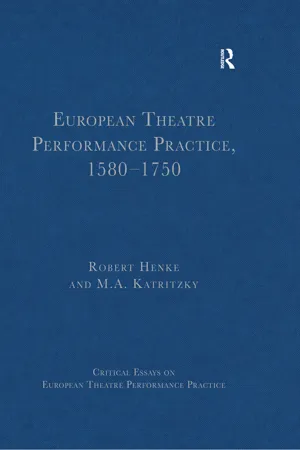
European Theatre Performance Practice, 1580-1750
About this book
This volume presents foundational and representative essays of the last half century on theatre performance practice during the period 1580 to 1750. The particular focus is on the nature of playing spaces, staging, acting and audience response in professional theatre and the selection of previously published research articles and book chapters includes significant works on topics such as Shakespearean staging, French and Spanish theatre audiences, the challenging aspects of the evolution of Italian renaissance acting practice, and the 'hidden' dimensions of performance. The essays provide coherent transnational coverage as well as detailed treatments of their individual topics. Considerations of theatre practice in Italy, Spain and France, as well as England, place Shakespeare's theatre in its European context to reveal surprising commonalities and salient differences in the performance practice of early modern Europe's major professional theatres. This volume is an indispensable reference work for university libraries, lecturers, researchers and practitioners and offers a coherent overview of early modern comparative performance practice, and a deeper understanding of the field's major topics and developments.
Information
Part I
Playing Spaces
[1]
The Changing Scene: Plays and Playhouses in the Italian Renaissance
Michael Anderson
Almost exactly a century separates the publication of the editio princeps of Vitruvius' De Architettura (probably in 1486) from the completion of Italy's first permanent theatre constructed on Vitruvian principles. To this day the Teatro Olimpico in Vicenza can impress the visitor with a sense of the classicising spirit which revived the drama of Greece and Rome in Renaissance Italy. Yet, as has often been observed, Andrea Palladio's theatre seems to lie outside the main line of historical development in the sixteenth and seventeenth centuries. By the time of its opening, public playhouses built on different principles were in regular use in Paris and Madrid as well as London, and in Italy itself the Teatro Olimpico's monumental frons scaenae failed to set the pattern for the theatrical architecture of the succeeding century. The history of theatre building in sixteenth-century Italy often looks at odds with the intense activity in the writing and staging of plays, the development of stage effects and illusionistic scenery, and the emergence of professional companies of players who emulated and were eventually to replace the courtly performers of the commedia erudita. In the following pages some explanation for the apparent delay in the provision of purpose-built homes for the newly-developed drama will be attempted.
If only because of the bitter denunciation of spectacula by the early Christian fathers, the existence of theatres in the pagan world had been known to the Middle Ages, but this awareness was accompanied by no more than a confused understanding of the nature of those theatres or of the performances held in them. In clearing up this confusion, as in so much else, Vitruvius was to be the principal authority upon which Renaissance scholarship had to rely. The work of Marcus Vitruvius Pollio was little known throughout the earlier part of the Middle Ages, but the discovery of a manuscript of the ten volumes of De Architettura at Montecassino in 1414 led to the copying and circulation of numerous texts. The work contains the only detailed and technical account of architectural practice to have survived from antiquity. Vitruvius is sometimes an obscure and unreliable guide, not least where theatres are concerned, but by the beginning of the sixteenth century his authority was scarcely questioned, and the work was studied keenly as a preliminary to the task of rescuing architecture from medieval neglect and building new palaces, villas and public buildings to rival the remains of the ancient world.
An interest in the conditions of performance of classical drama preceded the appearance in print of De Architettura. The humanist architect Leon Battista Alberti completed his De Re Aedificatoria in 1452 (the first printed edition was to appear in 1485); the chapter on spectacula reveals a knowledge of Vitruvius and describes a machine which could be turned to display the three painted scenes required for the performance of tragedy, comedy or satyr-play.1 By the 1480s revivals of comedies and tragedies in Latin are recorded in Rome, Ferrara and Florence: Pomponio Laeto's Roman Academy was among the first to present his honestos adulescentes in performances of Latin comedies, and Gaio Sulpicio, the editor of Vitruvius, is credited with having introduced tragedy to Roman audiences with a production of Seneca's Hippolytus in 1486.2 It was to Cardinal Raffaele Riario, the patron of Pomponio's revivals, that Sulpicio dedicated his edition. Praising the Cardinal as 'the first to exhibit a painted scene in our own day', he continues with a rhetorical appeal on behalf of the eternal city for him to crown his career with the construction of a permanent theatre in Rome: A te quoque Theatrum novum urbs magnis votis expectat.3
Although popular with the public, the revivals in Rome began as part of an academic, humanist programme to restore the customs and ceremonies of ancient Rome.4 The potential for more spectacular entertainment held out by performances of Plautine comedy was developed in Ferrara, where from 1486 performances of comedies were mounted more or less regularly at the court of the ruling d'Este family, as part of the festivities to celebrate the annual carnival or a dynastic wedding. In 1486 a city with houses, walls and battlements realistically portrayed was constructed out-of-doors in the Cortile Nuovo of Ercole d'Este's palace for a performance of Plautus' Menaechmi, and at one point in the action a boat with oars and sails and ten people aboard was propelled across the courtyard.5
The nature of the staging arrangements for the earliest revivals of classical drama remains a subject for debate. Woodcuts illustrating an edition of Terence published in Lyons in 1493 suggest that curtained porticoes or doorways provided the necessary entrances for each of the characters, thus providing an element of unification to the 'unlocalised' use of space familiar in medieval staging. But the relationship between these woodcuts and actual stage practice has proved difficult to determine. Sulpicio's reference to a 'painted scene' (picturatae scaenae faciem) used for Pomponio's comedies is equally enigmatic; it is unlikely to have meant that an illusionistic perspective background was used so early in the development of Renaissance staging practice.6 The staging methods used in Ferrara in 1486, however, did help to establish the convention to which most courtly performances, increasingly of original comedies written in Italian, were to conform. The scene represented a single locality (often with recognisable features which identified the city in which the comedy was set); the word 'perspective' is first found referring to a stage setting in 1508, and throughout the sixteenth century the development of the art of perspective was intimately bound up with the work of the scenic artist.7 The performing space had also to allow room for spectacular effects. By the middle of the sixteenth century these effects, which were to be concentrated in the intermedi which separated the acts of a regular comedy, had become the chief delight of audiences and the occasional despair of poets: 'Nothing else is sought, desired and admired by the audience save the wondrous show, alas, of the intermedi!' (la meraviglia, ohimè! degli intermedi).8
Some time between 1486 and 1501 Pellegrino Prisciano, Ercole d'Este's court archivist and librarian, wrote his Spectacula, a brief and apparently somewhat hastily composed treatise which draws upon Alberti and Vitruvius to describe the amphitheatres, circuses and theatres of the ancient world and their uses.9 Prisciano's researches were inspired by Ercole's theatrical interests and activities. It is doubtless true, as Ruffini argues, that Ercole hoped for some practical application of Prisciano's treatise.10 But we should not be unjustified in supposing that, after the performances in the early humanist academies, strictly historical exactitude in staging methods, according to the scholarship of the day, took second place to the delight in spectacle which, sometimes through its allegorical significance and sometimes simply through its ingenuity and splendour, would create the impression of magnificence and liberality which the noble patron of the occasion sought to achieve. Classical precedents were likely to be invoked only when they could augment rather than hinder that aim.
In fact it becomes clear from reading Alberti or Prisciano that, despite the survival of some medieval thinking in their treatises, their general understanding of the role of the theatre in ancient society was far from inaccurate, so much so that any practitioner who organised a courtly spectacle must have been well aware of the points of difference between modern and ancient practice. The same distinction recurs later in the sixteenth century in Serlio's treatise on architecture. Book II, which contains the celebrated plans of a theatre and its three scenes, refers to 'scenes and theatres as are customary in our own times' (delle scene e de' teatri die a' nostri tempi si costumano); Book III (which was published in 1540, five years before Book II), on the architecture of antiquity, includes careful descriptions and plans of ancient theatres and amphitheatres whose remains Serlio had himself visited and measured.
Equally, the illustrations to the 1493 Lyons edition of Terence have a historical dimension. Opinions differ as to how far the woodcuts preceding each scene reflect the actual stage practice of the earliest Terence revivals, but there can be no doubt that the Frontispiece is an imagined reconstruction, according to the historical understanding of the day, of the Roman theatre in which the plays were originally presented [Plate 1]. The building is free-standing, and apparently hexagonal; two upper walls have been cut away to allow us a glimpse of the interior. The audience assembled in rows are not labelled populus Romanus, as in the Frontispiece to the medieval Terence des Dues, but the presence of the aediles, high-ranking officials in their reserved places, is one historical indication, as are the women plying their ancient but disreputable trade beneath the fornices, the vaulted entrances to the theatre. More puzzling, certainly, is the Frontispiece to an edition of Terence which appeared in Venice in 1497, where the presence of a curtained booth on either side of a circular (or semi-circular?) playing space, and of a jester-like figure addressing the audience, suggests a reminiscence on the part of the artist of some performance he has seen [Plate 2]. The title which forms part of the woodcut, however, COLISEUS SIVE THEATRUM, places it in the tradition of frontispieces to editions of Terence which illustrate the theatre in which his plays are supposed originally to have been presented.11 (The tradition was not forgotten in 1616, when the Title page to The Workes of Beniamin Jonson included an engraving, labelled Theatrum, of a Roman theatre seen from the exterior, rather than a scene from one of the author's own comedies in contemporary performance.)
An examination of the evidence suggests that in sixteenth-century Italy the word 'theatre' was used in two distinct, if not wholly separate, senses. It was well understood that in classical times theatres and amphitheatres had been constructed as permanent structures for the presentation of spectacles of every kind. Historical evidence of their nature was supplied by Vitruvius and, increasingly as the century progressed, by careful examination and measurement of the buildings remaining in Rome and further afield: any reference to the theatre of the ancient world would have summoned up, in some measure, this historical awareness. With reference to the modern world, however, the word teatro often retained its simpler etymological sense of 'a place for watching'. Not every comedy needed the construction of a theatre for its presentation, and not every 'theatre' was used exclusively for dramatic performances.
Although the first comedies in Ferrara were presented in the cortile, it soon became more usual to present comedies indoors, and the regular term fo...
Table of contents
- Cover
- Half Title
- Title
- Copyright
- Contents
- Acknowledgements
- Series Preface
- Introduction
- Abbreviations
- PART I PLAYING SPACES
- PART II STAGING
- PART III ACTING
- PART IV AUDIENCES
- Name Index
Trusted by 375,005 students
Access to over 1.5 million titles for a fair monthly price.
Study more efficiently using our study tools.
Frequently asked questions
Yes, you can cancel anytime from the Subscription tab in your account settings on the Perlego website. Your subscription will stay active until the end of your current billing period. Learn how to cancel your subscription
No, books cannot be downloaded as external files, such as PDFs, for use outside of Perlego. However, you can download books within the Perlego app for offline reading on mobile or tablet. Learn how to download books offline
We are an online textbook subscription service, where you can get access to an entire online library for less than the price of a single book per month. With over 1.5 million books across 990+ topics, we’ve got you covered! Learn about our mission
Look out for the read-aloud symbol on your next book to see if you can listen to it. The read-aloud tool reads text aloud for you, highlighting the text as it is being read. You can pause it, speed it up and slow it down. Learn more about Read Aloud
Yes! You can use the Perlego app on both iOS and Android devices to read anytime, anywhere — even offline. Perfect for commutes or when you’re on the go.
Please note we cannot support devices running on iOS 13 and Android 7 or earlier. Learn more about using the app
Please note we cannot support devices running on iOS 13 and Android 7 or earlier. Learn more about using the app
Yes, you can access European Theatre Performance Practice, 1580-1750 by Robert Henke, M.A. Katritzky in PDF and/or ePUB format, as well as other popular books in Media & Performing Arts & Early Modern History. We have over 1.5 million books available in our catalogue for you to explore.