- 276 pages
- English
- ePUB (mobile friendly)
- Available on iOS & Android
eBook - ePub
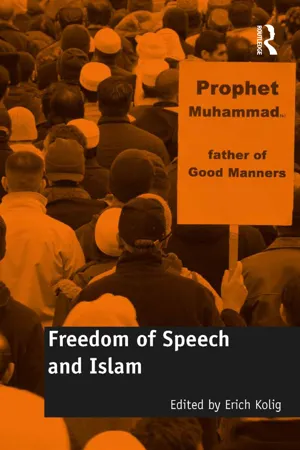
Freedom of Speech and Islam
About this book
Freedom of speech and expression is considered in the West a high public good and an important social value, underpinned by legislative and ethical norms. Its importance is not shared to the same extent by conservative and devout Muslims, who read Islamic doctrines in ways seemingly incompatible with Western notions of freedom of speech. Since the Salman Rushdie affair in the 1980s there has been growing recognition in the West that its cherished value of free speech and associated freedoms relating to arts, the press and media, literature, academia, critical satire etc. episodically clash with conservative Islamic values that limit this freedom for the sake of holding religious issues sacrosanct. Recent controversies - such as the Danish cartoons, the Charlie Hebdo affair, Quran burnings, and the internet film 'The Innocence of Muslims' which have stirred violent reactions in the Muslim world - have made the West aware of the fact that Muslims' religious sensitivities have to be taken into account in exercising traditional Western freedoms of speech. Featuring experts across a spectrum of fields within Islamic studies, Freedom of Speech and Islam considers Islamic concepts of blasphemy, apostasy and heresy and their applicability in the modern world.
Information
Chapter 1
Introduction: This Book, Its Mission and Its Essays
I disagree strongly with what you say, but I will defend to the death your right to say it.
(Voltaire 1694–1778)
And the (faithful) slaves of the Most Gracious (Allah) are those who walk on the earth in humility and sedateness, and when the foolish address them (with bad words) they reply back with mild words of gentleness.
(Quran 25/63, translation in the official Saudi version, The Noble Qur’an in the English Language, Madinah, n.d.)
Voltaire’s bon mot, having been recycled thousands of times in many diverse contexts and for various purposes, still sums up one of the arguably greatest public goods the West has produced and through its Enlightenment modernity elevated to a supremely important principle in its social discourse. Legal and political ideas as much as modern liberal democracy have been inspired by it, handing liberties to individual persons unprecedented in recorded history. Incompletely though as it may be applied in many Western nations, and hemmed in by limiting legislation intended to be protective of other aspects of human interaction, it stands as a beacon in the globalising enterprise. But in this respect it runs into new difficulties with other cultural and ideological systems that place value emphases differently. The fact that the West is ranking free speech and associated freedoms very highly has also had the effect of throwing a negative limelight on the absence of both freedom of speech and the ideological value placed on it, in other societies. In return these societies view this freedom in the West with suspicion and disgust.
Ethical and legal issues surrounding the value of the freedom of speech and expression, in the West considered one of its most precious of public goods, in very recent years have come to pose a source of trouble and a most pressing problem to address. In the modern globalised world, some ultra-conservative and radical expressions of Islam (and harsh interpretations of sharia) have powerfully and controversially raised awareness in the West that this is a liberty that, when it comes to Islamic issues, can cause problems. It seems it cannot, or should not, be exercised to its full extent, at least not as it is traditionally understood in the West.1 Largely secularised Western society extends this freedom to criticising and even mocking religion – potentially all religions, but especially and routinely Christianity as well as Islam, have become fair game. It becomes evident, however, that in the interest of global harmony caution is to be mandated.
In an ideologically charged arena the Western notion of personal freedom episodically collides powerfully and sometimes fatally with the conservative Islamic conceptions of blasphemy, heresy and apostasy – regardless of the triviality such clashes and their causes may have from a Western viewpoint. The globalising mission based on Western Enlightenment rationality appears to have to be bent to orthodox (or conservative) Islamic values for the sake of peaceful relationships. Yet, among Muslim political and ideological leadership the realisation sets in that religious privilege to set social boundaries and to punish transgression (in accordance with traditional religious values) is diminishing in the modern world.
Free speech is a general, ubiquitous political, philosophical, legal and ideological issue, but in relation to Islam in the West it has become a more focussed and specific matter in recent years. It resurrected concerns about blasphemy thought to have been overcome in secularised modern Western society. It started with the Rushdie affair (in the late 1980s) and since then its simmering topicality is episodically punctuated by even more tragic events: the Theo van Gogh murder; the endless ructions around the Danish cartoons; the firebombing of the Charlie Hebdo office in Paris; irreverent treatment of the Quran; the bitter dispute around the internet film The Innocence of Muslims. There are recurrent death threats against individuals necessitating police protection, violent demonstrations, book burnings and many other incidents. Equally disturbing is the fact that through increasing globalisation of the news media more and more reports on the bloody suppression of this freedom in the so-called Islamic world spread in the West. This demonstrates very clearly that the globalisation in ethical and legal matters in the Western sense is far from complete; or, phrased differently, that the global ideological hegemony of the Euro-American West is far less powerful than often claimed by both its proponents and its detractors.
Islamicly imprinted cultures impose constraints on the free expression of thought and belief, some interpretations of Islam proffered by radical Muslim thinkers even iconicising such limitations, so as to hold religious faith sacrosanct and above human entitlement to reject, dissent, criticise and mock. Even open and honest discussion may be subject to harsh retribution. The strict reduction and limitation of the right to free speech and the condemnation of ‘irresponsible’ levity with which to address religious issues have become cultural markers setting fundamentalist expressions of Islam apart. Not only Muslim ‘free-thinkers’ and dissenting theologians are in peril – being perceived a heretic can also have awful consequences. Adherents to local minority sects as much as apostates, reformers and others deviating from the locally or nationally prevalent ideological course have to fear for their lives in so-called Muslim-majority countries and collectively often are politically disadvantaged. Even within the borders of the West Muslim reformers and detractors have to fight against stigmatisation and attempts to silence them. In both Sunni and Shi’a Islam fundamentalisation has elevated the unholy trinity of blasphemy, heresy and apostasy to central and mutually interwoven importance that begins to impinge even on the West and its sense of free speech.
Most Islamic schools and formal scholarly opinion on the subject take so-called religious insult very seriously, although not all consider it a crime worthy of the death penalty. Radical forms of Islamic scholasticism certainly wish to pursue very harshly what they consider sacrilege. Apostasy and heresy are equally condemned as crimes against God and his ‘gift to humanity’. Intolerant interpretations of sharia demand the severest retribution in absolute denial of the right to freely choose belief and express it. When seen from the outside what appears to be a widespread tendency among Muslimhood is to show little tolerance for phenomena that fall outside the regionally or locally accepted norms of religious belief. The life of individuals considered blasphemers, heretics or apostates is made precarious. Suffering rejection by large parts of their society, such persons’ demonstrated ‘deviance’ may even be treated as a formal, punishable crime by tribal authorities or the state’s judicial apparatus.
Much publicity is given to the demands by radical Muslims to punish so-called blasphemers, heretics and apostates with death, befitting, as they believe, the magnitude of the offence. Not all Muslims though agree with the view that such allegedly insulting incidents – several of which have made headlines in the Western media in recent years – constitute capital crimes. Voices clamouring for deadly revenge may attract the most attention, but their claims to represent true Islam are challenged by others, quite different ones which make the same claim of authenticity. Quranic and Sunna (tradition) tendencies that seemingly demand harsh retribution for insulting God and his Prophet can be counter-balanced with milder scriptural expressions such as the one quoted above. Many forms of Sufism and other more liberal interpretations of Islamic dogma reject the extreme theological positions the regimes of Saudi Arabia, Iran, Pakistan and some other countries (or non-governmental organisations dishing out their own version of justice) enforce with their judicial systems – and which through Islam’s recent fundamentalisation have widely infused other Muslimmajority countries and regions (such as northern Nigeria, parts of Somalia and (temporarily) Afghanistan and Mali). Also, the Muslim diaspora in the West has not remained untouched by this development.
Abdurrahman Wahid, former Indonesian president and Islamic scholar of note, formulated an enlightened, ‘globalised’ notion of Islamic piety which regards the conventionally attributed importance of blasphemy as absurd. He argues that ascribing to God the pettiness that He could be seriously offended by anything people – the denizens of a tiny speck in the infinite vastness of the universe – do, and thereby handing to devout Muslims the duty to punish ‘transgression’, is a self-aggrandisement that in itself is tantamount to blasphemy.2 It anthropomorphises and belittles God, reducing Him to the limited comprehension of truth man is capable of – and therefore has to be rejected.3 This is possibly the strongest indictment of the overzealous, intolerant, hateful reactions some Muslims manifest towards perceived religious insults from the West, or towards so-called dissidents among their own ranks. In reconciling humanity’s position in the universe with modern knowledge, it redefines conventional religious views on dissidents’ turpitude and relegates the religiocentric understanding of the traditional Islamic cosmology to the intellectual flat-earth category. It is theocentrism with a modern twist.
It is well to remember that the right to free speech is not absolute, not even in the West. Even the most liberal and liberty-conscious of jurisprudential systems in Western nations hedge the freedom of speech and expression in with some restrictions. Most conspicuously in Western judicial thinking, libel, slander, obscenity and incitement to commit crime are categorically excluded from this freedom. Nebulous rights to be verbally aggressive and offensive run up against boundaries set by law and other regulations which divide the generic concept of personal freedom from public order offences. Locutionary powers of aggressive, xenophobic, insulting, misoxenous provenance have to be dammed in for the sake of social harmony. Conversely, religious freedom is also not unlimited. Despite human rights and other guarantees, religion has to be exercised under the auspices of domestic laws and conventions. (In the West, for instance, this curtails the reach of sharia enormously.)4
A complaint of Muslims, not infrequently heard, is that the West’s legal situation is manifestly unfair: Islam can be insulted with impunity, they claim, while denying the Holocaust, for instance, is forbidden in several European countries. Of course it must be remembered that such restrictions primarily are not meant to exercise controls over history writing or seek to protect Judaism, but are to prevent the resurrection of unwelcome political ideologies which in the past have brought untold misery over the world. Muslims also forget that several strictures have been imposed in Europe on critics of Islam under the aegis of laws protecting religion or religious communities from defamation. Some non-Muslim critics of Islam, having stepped over an opaque line of legality, have been subjected to arraignments before courts and suffered convictions (usually fines or bans). Such relevant laws, being aimed at minority protection, seek to prevent slander or purport the preservation of social harmony, and may not be aligned with notions of sharia rules about blasphemy or meant to protect Islamic ‘exceptionalism’. But they may have been successful in protecting against religious slurs in general. However, when in mid October 2012 an American federal judge rejected to force YouTube to withdraw the anti-Islamic internet video The Innocence of Muslims that had triggered violent protests across the Muslim world, it seemed like another proof of the Western judicial system’s unfairness. President Obama had previously even declared himself powerless to intervene by reference to the First Amendment. The internet of course has introduced a whole new dimension into the issue of free speech, making controls practically very difficult as well as politically and ethically odious. Again, Muslims saw the judicial system’s inability to intervene as evidence that the West prefers to ignore their sensitivities. This leads them to suspect that this is just another expression of the West’s Islamophobia. And while insulting other religions and cultures is seen by the West’s opinion-shapers as violating if not actual laws then ‘political correctness’ and rules of international courtesy, Islamic beliefs, from the Muslims’ angle, appear to come under no such protective regime of voluntary self-censorship.
Considering the individual’s unfettered freedom – which is an ideal of course unattainable in any form of ordered society – also touches on principles of collective academic, artistic and news media freedoms, and also has to take account of attendant social responsibilities. Another aspect of this freedom is that relating to religion, which immediately invites a counter-question. Is the right of someone to use this freedom to offer insult to the religious feelings of others more important than the right not to be insulted or have one’s sacred beliefs criticised, ridiculed or – almost equally sacrilegious – attacked by ‘illicit’ reform attempts? There is a close relationship between laws to preserve that freedom of free speech yet respect the right of others not to have their person or their sacred beliefs mocked and cruelly insulted. Muslims’ religious sensitivities are vitally affected by this problem and by the manner in which conflicts are being handled through legislative and judicial processes. Many questions hinge on this; for instance, is respecting someone’s religious sensitivity tantamount to preserving the inviolability of a person’s integrity, which usually and in various forms is protected under Western judicial systems?5 Universalised human rights can certainly be interpreted this way. Critics on the other hand maintain that anti-vilification laws are anti-blasphemy laws in disguise.6 As blasphemy has effectively been ‘decriminalised’, religious protectionism, they say, seems to be returning by the back door. Can an abstract entity such as culture or religion have the same rights under the law as a natural person? In other words, can religions be defamed in quite the same way as a person? While in the USA the First Amendment grants greater freedom to the expression of personal views, the European Convention on Human Rights uses the code of protection of a person’s dignity to ban anti-religious slurs and blasphemy. In the opinion of some, the right not to be offended protects a person from insults, but not a religion per se – but it can be, and has been, instrumentalised by the Court of Human Rights to do the latter. Some European countries, however, do have specific domestic legislation that protects religious communities (and therefore religion in abstracto by implication) from defamation. Because of the complexity of the legislative situation whenever a case is brought before the courts, its outcome is never a foregone conclusion. On another level, it seems paradoxical that American society, where religion plays a greater role in the social discourse than in Europe, protects free expression to profane and blaspheme to a greater extent than the much more secularised European society where in the public space religion is almost invisible.7
Much less controversial is the utility to have state secrets preserved by preventing public debate and general comment, and ...
Table of contents
- Cover Page
- Title Page
- Copyright Page
- Contents
- Prefatory Remarks and Acknowledgements
- List of Contributors
- Foreword
- 1 Introduction: This Book, Its Mission and Its Essays
- 2 Why Is Freedom of Speech a Problem for So Many Muslims?
- 3 Balancing Freedom of Speech and the Rights of Muslim Minority Groups in the Australian Context
- 4 Muslim Sensitivities and the West
- 5 The Rushdie Affair: Cultures at Cross Purposes
- 6 Being an Unbeliever and the Power of Fatwa in Iran
- 7 Free Speech: Creating the ‘Us and Them’ Debate
- 8 The Instrumental Accusation of Islamophobia and Heresy as a Strategy of Curtailing the Freedom of Speech
- 9 Parameters of Teaching Islam ‘Freely’
- Bibliography
- Index
Trusted by 375,005 students
Access to over 1.5 million titles for a fair monthly price.
Study more efficiently using our study tools.
Frequently asked questions
Yes, you can cancel anytime from the Subscription tab in your account settings on the Perlego website. Your subscription will stay active until the end of your current billing period. Learn how to cancel your subscription
No, books cannot be downloaded as external files, such as PDFs, for use outside of Perlego. However, you can download books within the Perlego app for offline reading on mobile or tablet. Learn how to download books offline
Perlego offers two plans: Essential and Complete
- Essential is ideal for learners and professionals who enjoy exploring a wide range of subjects. Access the Essential Library with 800,000+ trusted titles and best-sellers across business, personal growth, and the humanities. Includes unlimited reading time and Standard Read Aloud voice.
- Complete: Perfect for advanced learners and researchers needing full, unrestricted access. Unlock 1.5M+ books across hundreds of subjects, including academic and specialized titles. The Complete Plan also includes advanced features like Premium Read Aloud and Research Assistant.
We are an online textbook subscription service, where you can get access to an entire online library for less than the price of a single book per month. With over 1.5 million books across 990+ topics, we’ve got you covered! Learn about our mission
Look out for the read-aloud symbol on your next book to see if you can listen to it. The read-aloud tool reads text aloud for you, highlighting the text as it is being read. You can pause it, speed it up and slow it down. Learn more about Read Aloud
Yes! You can use the Perlego app on both iOS and Android devices to read anytime, anywhere — even offline. Perfect for commutes or when you’re on the go.
Please note we cannot support devices running on iOS 13 and Android 7 or earlier. Learn more about using the app
Please note we cannot support devices running on iOS 13 and Android 7 or earlier. Learn more about using the app
Yes, you can access Freedom of Speech and Islam by Erich Kolig in PDF and/or ePUB format, as well as other popular books in Social Sciences & Middle Eastern History. We have over 1.5 million books available in our catalogue for you to explore.