eBook - ePub
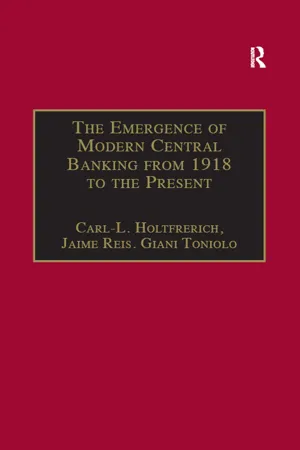
The Emergence of Modern Central Banking from 1918 to the Present
- 408 pages
- English
- ePUB (mobile friendly)
- Available on iOS & Android
eBook - ePub
The Emergence of Modern Central Banking from 1918 to the Present
About this book
The twentieth century has seen the rise of modern central banking. At its close, it is also witnessing the first steps in the decline of the role of some of the most famous of these institutions. In this volume, some of the world's best known specialists examine the process whereby central banks emerged and asserted themselves within the economic and political spheres of their respective countries. Although the theory and the political economy that presided over their creation did not show great divergence across borders, a considerable institutional variety was nevertheless the result. Among the many factors responsible for this diversity, attention is drawn here not only to the idiosyncrasies of domestic financial systems and to the occurrence of political shocks with major monetary repercussions, such as wars, but also to the peculiarities of each economy and of the political and social climate reigning at the time when central banks were created or formalized. The twelve essays cover European, Asian and American experiences and many of them use a comparative approach.
PART I
The Origins of Central Banking
CHAPTER ONE
Bank of England Autonomy: A Retrospective
Introduction
A critical function of history is to provide a long-term perspective for current preoccupations, to come up with historical yardsticks against which to measure recent experience. Past economic experience provides one of the essential ingredients needed for a proper assessment of current economic theory and policy. The recent tercentenary of the Bank of England (which first opened for business in July 1694) – as with the 150th anniversary of the Bank of Portugal – has offered one of those traditional occasions for retrospective contemplation on the role of a key agency responsible for the direction of a country’s economic policy: the central bank.
The Bank of England’s three hundred years have involved many aspects of British financial development but the following four issues have been at the core of its evolution as a central bank:
1. Prudential control of, and responsibility for, money market institutions;
2. Exchange rate policy and international financial cooperation;
3. Monetary control and the maintenance of price stability;
4. Bank/government relations.
This paper concentrates on just one issue, that of Bank/government relations, though, in fact, all are inextricably linked. We are particularly concerned to provide an historical perspective on current moves to establish greater central bank autonomy in the UK. In the next section we make some general introductory remarks about central bank autonomy and the Bank of England’s historical experience. The following two sections then deal with the post-war period, treating separately the decades of the 1950s and 1960s which were dominated by Keynesian thinking on macroeconomic management, and the period since the 1970s in which greater weight was given to the role of monetary policy in subduing inflationary pressures. As will become clear, in both these post-war periods the extent of Bank of England autonomy was for the greatest part very muted, though for different reasons. Certainly, postwar experience represents a marked decline in the extent of independence exercised in previous periods. Two further sections explore the reasons for this earlier autonomy and explain the reasons for its decline between the wars. The concluding section briefly outlines the latest changes to Bank of England responsibilities and reiterates the lessons from history: that central bank autonomy has worked in Britain only when non-discretionary rules have bound the central bank’s behaviour, and only when politicians have supported both the rules and the Bank’s behaviour within them. Up until very recent times, such political backing has been fairly nominal and in an historical context the degree of autonomy exercised by the Bank of England – at least until mid-1997 – has been limited. Inevitably, though, the effects of the changes implemented in the late 1990s are still too recent to allow for a proper assessment.
Central bank autonomy
Over the very long sweep of Bank of England history, the degree of autonomy exercised by Threadneedle Street has been much less in the twentieth century than in the nineteenth. This autonomy was at its greatest prior to 1914. It began to crumble in the inter-war period and was swept aside in the war and post-war era of demand management. It continued suppressed under the monetary uncertainties of the 1970s and the monetarist experiments of the 1980s. Revival of official interest in British central bank autonomy is thus very recent, dating only from the late 1980s.
There is now a broad consensus on two propositions: (1) that low (or zero) and predictable rates of inflation are beneficial; and (2) that over the long term there is no clear trade-off between the rate of inflation and real growth. Therefore, the cost of attaining a low inflation rate over the long term is not severe. In turn, convergence of British views about the desirability of greater independence for the central bank, as a means of attaining lower inflation, arises out of the failure of earlier policy and institutional regimes to achieve the economic goals of low inflation without high unemployment. Another factor has been the apparent success of those few countries overseas which since the war have had constitutionally more independent central banks.1 In other countries, the extent of central bank autonomy has tended to be positively correlated to lower and less variable rates of inflation, without any noticeable effects (for good or ill) on real macro-economic performance. The most important comparators are West Germany, Switzerland, Japan and the USA – though many doubts have been raised about the true autonomy of the Federal Reserve at different times, not least by Milton Friedman (Friedman, 1962) and, of course, the other countries are all exceptional in a number of important respects and very few would point to their central banks’ autonomy as the most crucial element in their economic success. Nevertheless, once the possibility of greater autonomy for the Bank of England became an issue, the existence of alternative models overseas was directly relevant.
Another important factor has been the UK’s position in Europe. European monetary union was established on 1 January 1999, with the creation of the ‘European Central Bank [which] will formulate a unified monetary policy which independent national central banks will implement’ (Read, 1996: 131). Thus, legislative independence must be established for individual central banks as a precondition for joining EMU. The current UK government is intending to join the single currency though not at the first opportunity and, therefore, establishing greater independence for the Bank of England is part of the necessary preparations.
However, in the broader historical context, it has been the breakdown of previous policy regimes and the loss of faith – if not in particular theoretical paradigms, then in the capability of the politico-institutional framework to operate according to theoretical principles – that has provided the impetus for establishing greater central bank autonomy. This paper takes a closer look at the previous regimes, in order to show how they suppressed central bank autonomy and how their passing has led to the possibility of greater independence for the Bank of England.
Bank autonomy and demand management, 1950s and 1960s
The extent of Bank autonomy reached a new low during the period of the so-called ‘Keynesian consensus’, from the late 1940s to the 1970s. The long-term trend towards greater subordination of the Bank to the state which had become apparent between the wars, was greatly reinforced by wartime experience and this culminated in 1946 with the passing of the Nationalisation Act. In terms of distance between Bank and state, the Act retained some compromises.2 It did take the Bank into public ownership and passed to the Crown (in practice, the Prime Minister) the power of appointing the Governor, Deputy-Governor and other directors. The term of office for the Governor was set at five years (with eligibility for re-appointment which, in fact, became the norm) but, though appointed by the government, the Governor cannot be removed in mid-term. The Bank did not become a department of state but remained a separate institution under the management of the Governor and Deputy-Governor, with the assistance of the Court of Directors. It thus retained a fair degree of independence over day-to-day institutional affairs, and indeed over the day-to-day implementation of policy, but not over policy itself. In fact, even before the war (when the Bank was still in private ownership) it had become the practice that no change in bank rate would be implemented before the Chancellor of the Exchequer had been fully consulted (and, by implication, approved the change).
More important than the legislative change in the Bank’s status was the fact that from the late 1940s, the prevailing ethos of British macroeconomic policy negated the requirement for an independent central bank. Successive governments (from both major political parties) embraced an explicit responsibility for managing the economy and this included the conduct of monetary policy. The new macro-economic priorities were the maintenance of high levels of employment and high rates of growth. Price stability was subordinated to these greater goals. However, it was not merely that the new orthodoxy subordinated Bank policy to Treasury policy – that it did – but it went further in necessitating the active participation of the Bank in the management of aggregate demand. At the centre of this new approach was the use of discretionary judgement by those advising policy makers. It is instructive to quote from Richard Sayers, then the leading authority on the Bank (and, with Cairncross, the major presence on the influential Radcliffe Committee which reported on the ‘Working of the Monetary System’ in 1959). His views show clearly how concepts of central bank autonomy had shifted in the brave new world of pro-active economic management. He welcomed the Bank’s ready participation in discretionary demand management, but went much further by arguing that discretion was at the heart of the definition of central banking:3
The essence of central banking is discretionary control of the monetary system … working to rule is the antithesis of central banking. A central bank is necessary only when the community decides that a discretionary element is desirable. The central banker is the man who exercises discretion, not the machine that works according to rule. [p. 1] … [W]e must have central bankers to exercise a discretionary influence upon the monetary situation. And it follows that there is no code of eternal rules for them to follow. They have to adapt their ways to the shape of the community’s constantly changing financial habits. By comparative study we may, of course, hope to find some generalisations about the behaviour of central banks, and the experience of some may offer guarded guidance to others; but we are doomed to disappointment if we look for rules applicable to all times and all places. We have central banks for the very reason that there are no such rules (Sayers, 1957: 1–7).
Given this prevailing view of economic policy and of the part played by government agencies, it is hardly surprising that Bank autonomy all but evaporated. Monetary policy was too important to be left to any agent which was not subject to democratic sanction.
The strong element of policy discretion and the wide acceptance of a political responsibility for monetary matters remained, despite the British government’s adherence to the fixed exchange rate regime which had been negotiated at Bretton Woods as part of the international postwar settlement. The Bretton Woods system was not the same animal as the old gold standard, nor did it operate in the same environment. The Bretton Woods conference of 1944 was a response to the disruption and dislocation to international trade and growth resulting from the hostilities of the 1930s and the Second World War. The aim of the conference was to foster international trade and, consequently, growth through stable exchange rates. Each participating country’s currency was fixed in terms of gold, but without the requirement for convertibility (only the US$ had convertibility at US$35 per ounce). Moreover, an essential feature was the assumption of the continuation of active intervention by the authorities in foreign exchange markets.
The disruption to domestic economies occasioned by the Second World War resulted not only in loss of international trade and changing patterns of demand, but also a requirement for greater governmental involvement and direction in the use of resources in order to support the war effort. Moreover, this experience of wartime direction of the economy followed a long period in which there was a dwindling of confidence in previously accepted beliefs in the efficacy of the workings of the market economy and of economic agents. This was a period which embraced the inflation of the early 1920s and the heavy unemployment of the 1930s. The post-war years saw, therefore, the emergence of a consensus in favour of a more active governmental role in managing the economy. Eventually, this led to an acceptance of the importance of demand management; of the subordination of price control to the macroeconomic objective of full employment; and of a view of the Bank of England as part of the machinery of state for the implementation of macroeconomic policy. Hence, the loss of central bank autonomy culminating in the Nationalisation Act of 1946.
This is not to say that during the 1950s and 1960s the Bank showed no glimpses of independence. The Bank of England Act of 1946, in fact, left some little room for independent action. It was short on essential detail. Thus, ‘…beyond the enactment of powers of direction, nothing in the legislation indicated … what the division of responsibility was to be between the Bank and the Treasury…’ (Cairncross, 1988: 50). Under the legislation the Governor could be ‘directed’ by the Treasury to take action and the Bank’s ‘requests’ to the commercial banks could be made binding by the Treasury, but the Governor had to be consulted in all cases and the Treasury itself had no power to instruct the commercial banks directly. Moreover, in practice the power of direction has never been exercised against the Bank.
The precise balance of power between Bank and Treasury depended upon particular circumstances and on the perceived success of the Bank’s interventions. Lack of success has always been more likely to invite outside interference. For the immediate post-war decades, the events of the mid-1950s can be seen as something of a turning point, for they illustrate both the exercise of independence at that time and its clear limitations.
During the life of the immediate post-war Labour administration, domestic monetary policy was not considered central to overall economic policy, but with the election of the Conservatives in 1951 a more active interest rate policy was introduced and the government, for the most part, was prepared to allow Cobbold (Governor, 1949–61) a free hand. However, things started to go wrong in 1955 (Kynaston, 1995: 48–9). In April the government had introduced an expansionary budget and was expecting the Bank to hold back inflationary pressures through the implementation of a credit squeeze on the banks. The Bank, however, was reluctant to impose quantitative restrictions on the clearing banks. By early summer, the frictions were clear, yet Cobbold not only refused government requests to tighten the squeeze (arguing that the banks would be unable to bear it) but also insisted on the sanctity of current practice whereby the Treasury could only communicate with the commercial banks through the mediation of the Bank of England. In the spring of 1956 the Governor resisted the Prime Minister’s suggestion of imposing liquidity ratio requirements on the clearing banks and pointed to the need to cut back government expenditure (Kynaston, 1995: 49). There was a similar clash eighteen months later, between the Governor and Chancellor Thorneycroft. The latter wanted quantitative restrictions on bank lending and modest increases in interest rates, but the Governor reminded the government that the 1946 Act had vested the Bank with the power to ‘direct’ the commercial banks and he sided with the banks in preferring higher interest rates and no quantitative restrictions. On this occasion, the Treasury conceded and the bank rate was raised to seven per cent in September 1957, despite government views.
But while the Bank may have won this battle, it was losing the war. Within the context of the long history of Bank autonomy, such displays of independence were marginal. The truth is that, in this period the scope for independent action was severely restricted (Fforde, 1992: ch. 10). Demand management encompassed all macro-economic policy and Bank action was not allowed to stray very far. The policy ethos that prevailed from the late 1940s until (at least) the early 1970s subordinated Bank activity to that of the government, to the policy preoccupations of the political party in power.
In the case of the mid-1950s, confusion over policy responsibilities was one factor in the appointment of the Radcliffe Committee. The subsequent Report, published in 1959, strongly affirmed the subordination of the Bank – and of monetary policy – to the Treasury and to the overall aims of discretionary management. ‘Monetary policy … cannot … pursue its own independent objectives. It is part of a country’s economic policy as a whole and must be planned as such … We are … dissociating ourselves from a view … that the central bank should be assured complete independence from political influence’ (Radcliffe, 1959: 273). The Wilson Committee, some two decades later. took a similar view (Wilson, 1980: para. 1278).
Indeed the outcome of the problems of the mid-1950s was a belittling of the Bank’s autonomy in monetary matters, with the Bank powerless to prevent Conservative pre-election booms or the sharp inflationary expansion of 1971/73 (‘Barber boom’), and it was unable to persuade the new Labour government of 1964 to adopt a policy of public sector retrenchment, despite a confrontation between Prime Minister and Governor (Wilson, 1971: 34–8).
To...
Table of contents
- Cover
- Half Title
- Title Page
- Copyright Page
- Table of Contents
- List of Figures
- List of Tables
- Acknowledgements
- Introduction
- Part I The Origins of Central Banking
- Part II National Experiences with Central Banking
- Part III International Institutions and Central Banking
- Part IV The Emergence of Modern Central Banking from 1918 to the Present
- Index
Trusted by 375,005 students
Access to over 1.5 million titles for a fair monthly price.
Study more efficiently using our study tools.
Frequently asked questions
Yes, you can cancel anytime from the Subscription tab in your account settings on the Perlego website. Your subscription will stay active until the end of your current billing period. Learn how to cancel your subscription
No, books cannot be downloaded as external files, such as PDFs, for use outside of Perlego. However, you can download books within the Perlego app for offline reading on mobile or tablet. Learn how to download books offline
Perlego offers two plans: Essential and Complete
- Essential is ideal for learners and professionals who enjoy exploring a wide range of subjects. Access the Essential Library with 800,000+ trusted titles and best-sellers across business, personal growth, and the humanities. Includes unlimited reading time and Standard Read Aloud voice.
- Complete: Perfect for advanced learners and researchers needing full, unrestricted access. Unlock 1.5M+ books across hundreds of subjects, including academic and specialized titles. The Complete Plan also includes advanced features like Premium Read Aloud and Research Assistant.
We are an online textbook subscription service, where you can get access to an entire online library for less than the price of a single book per month. With over 1.5 million books across 990+ topics, we’ve got you covered! Learn about our mission
Look out for the read-aloud symbol on your next book to see if you can listen to it. The read-aloud tool reads text aloud for you, highlighting the text as it is being read. You can pause it, speed it up and slow it down. Learn more about Read Aloud
Yes! You can use the Perlego app on both iOS and Android devices to read anytime, anywhere — even offline. Perfect for commutes or when you’re on the go.
Please note we cannot support devices running on iOS 13 and Android 7 or earlier. Learn more about using the app
Please note we cannot support devices running on iOS 13 and Android 7 or earlier. Learn more about using the app
Yes, you can access The Emergence of Modern Central Banking from 1918 to the Present by Carl-L. Holtfrerich,Jaime Reis in PDF and/or ePUB format, as well as other popular books in History & World History. We have over 1.5 million books available in our catalogue for you to explore.