eBook - ePub
Conservative Politics in National and Imperial Crisis
Letters from Britain to the Viceroy of India 1926-31
- 446 pages
- English
- ePUB (mobile friendly)
- Available on iOS & Android
eBook - ePub
Conservative Politics in National and Imperial Crisis
Letters from Britain to the Viceroy of India 1926-31
About this book
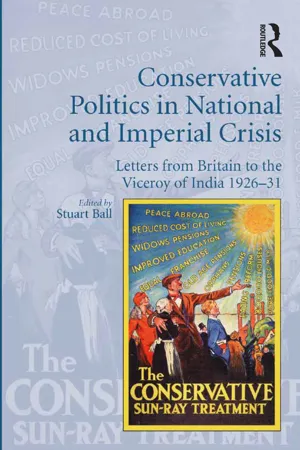
Whilst serving in the prestigious post of Viceroy of India between 1926 and 1931, Lord Irwin (later the Earl of Halifax) was kept informed about political events in Britain by frequent and lengthy letters from Cabinet Ministers, senior Conservative MPs and other prominent figures, such as the editor of The Times. Covering events from the General Strike of May 1926 to Irwin's negotiation of a pact with Gandhi in March 1931, these private and previously unpublished letters mix analysis and gossip. They offer a frank account from within the highest political circles of the Baldwin government of 1924-29 and the serious crisis in the Conservative Party which followed in 1929-31. There is also much commentary on major figures such as Stanley Baldwin, Neville Chamberlain, Winston Churchill and Ramsay MacDonald. Of great depth and richness, and emanating from experienced and shrewd political insiders, this collection is an essential historical source for British history between the two world wars.
Chapter 1
1926:
The General Strike and the Coal Dispute
Hoare1 to Irwin,2 29 April 1926 (C152/17/1/22a)
As to general politics we have had a week of big events, the Budget on Monday and the coal negotiations3 ever since. As to the coal negotiations you will know the result by the time that this letter arrives and anything that I can say today will, therefore, probably appear to be foolish. I have always thought myself that both sides were so much compromised by their past that there was bound to be a stoppage. As things have developed during the last two days, the situation has looked more hopeful, but I still think that unless the Government imposes a settlement upon the owners and men neither side will be strong enough to agree. I am not at present convinced as to whether or not it would be a good thing to have this Government intervention, particularly if it deals with questions outside the Coal Commission’s report.4 As to the feeling in the Government, you can judge quite accurately from your own experience the attitude of our various colleagues. I think, however, that it is safe to say Stanley,5 upon whom the brunt of the negotiations has fallen the whole way through, will get us to accept any action that he may strongly press.
The Budget has been completely over-shadowed by the coal business. Perhaps it is not a bad thing, as whilst it is a very ingenious affair, it is not the kind of Budget to excite much enthusiasm. Winston’s6 speech was subdued, but on the whole successful. Indeed, he has been speaking very well in the House, particularly on the Second and Third Readings of the Economy Bill, where he had very difficult country to defend. I do not think that he will have much trouble with the Budget in the House, and I believe that it is getting into people’s heads that unless you scrap things that really matter, it is almost impossible to get expenditure below about £800 millions. Walter7 is having a good deal of trouble with his agricultural committee in the House of Commons and tells me that he will have even more trouble with his constituents at Newmarket over the betting tax. Your other Department8 is also in heavy weather, as Eustace9 seems to have equally annoyed the spenders and the economists. The teachers have left us over circular 137110 and the economists are furious at the rise in the Education votes. So far as my Department is concerned I have had a fairly quiet time since the Estimates, though, as you know, a good deal of sniping constantly goes on from the two other Departments and I get weary of the wrangling to which it gives rise.11 F.E.12 seems to be better, but strikes me as being very remote from current politics.
I am afraid that you will say that this gossip is all more or less obvious. Anyhow it will show you that things have not changed very much since you left.
Inskip13 to Irwin, 9 May 1926 (C152/17/1/28)
We are in the thick of it,14 but the patient is going on as well as can be expected, though the crisis is not likely to come for a few days yet. Up to the last moment everyone outside the circle of negotiators expected a settlement to be made. On Saturday, the 1st May, the House of Commons golf enthusiasts were playing Ranelagh15 and Stanley Jackson16 who was playing was fairly confident. However that is all past history now. I don’t know where the blame really rests. The Spectator which comes out in a typed form moans about the Government’s blunder in giving any importance to the refusal of the printers in the Daily Mail office to produce the paper. I think I would back the Prime Minister’s judgment on that point, but at first I was rather sorry he had mentioned that as part of the reason for stopping negotiations. The threat of a general strike was quite big enough, especially as active steps were being taken and had been taken since the night of the 28th April to make the strike as effective as possible. At the moment the general position of Trade Unions as it is likely to be after the strike is the most discussed topic. I think the Prime Minister has made up his mind to have a general overhaul of the Trade Union law. The 1906 Act17 has really broken down. Simon18 made a much advertised speech on Thursday night in which he expressed the view that the whole strike was illegal and outside the protection of the Trade Disputes Act which contemplated a strike by orderly methods in direct furtherance of a trade dispute. I doubt Simon’s accuracy. The Act clearly contemplates breaches of contract by the members of the Trade Union which is given immunity. Banbury19 has of course introduced a Bill into the Lords to repeal the Trade Disputes Act of 1906. I think the Prime Minister’s mind is moving along the line of granting a Trade Union immunity, provided a strike is ordered only after the expiry of contracts and after compliance with all the rules of the Union which shall include a compulsory ballot of members. Rose,20 the Labour Member for Aberdeen, who of course has always been rather a heretic in his own tabernacle, says the Trade Unions are behaving like the Chinaman who revenges himself on his enemy by committing suicide on his enemy’s doorstep. There is a good a deal of truth in it. Bevin21 and Bromley22 and Thomas23 have been altering the rules of their Unions to dispense with a ballot, because they realised the cumbrousness of the regular machinery of the Trade Union, but I am not at all sure that Thomas, at any rate, did not assent to this course, because he thought Trade Unionism which has been losing membership steadily all through the winter must do or die as a political weapon and he hoped it would die. Thomas has cut a poor figure this week. On Wednesday night the Prime Minister and Steel-Maitland24 convicted him of an almost impudent falsehood. Thomas in the absence of the Prime Minister in an irrelevant debate which the Speaker25 allowed on the Emergency Regulations said that when negotiations were summarily ended, he had at that moment signed on behalf of the Trade Union Council – who were fully armed with authority – a formula proposed and written out by the Prime Minister. When the facts were stated later on Wednesday night by the Prime Minister and Steel-Maitland, it was proved from the shorthand notes that no formula had been put into writing by the Prime Minister and Thomas had merely gone out to the miners to ask them how far they would go in giving an assurance as to the acceptance of the Report. It was curious to watch Thomas wriggling under the Prime Minister’s polite description of his statement as a lie. I don’t know what your opinion of Thomas is. I always thought him a twister and double-faced, though, when he was looking the right way, quite capable of genuine enthusiasm for the Empire, and of a sound appreciation of the merits of a particular policy. He has lost his character with this House at any rate. MacDonald26 is almost pathetic. He wrings his hands and says he withdraws not a word of his former declarations as to the duty of the Government to carry on the life of the nation and to fight any attempt to strangle it, and yet he stands by Bevin and his lot, who are organising the general strike.
The Prime Minister has been splendid, and has made a great impression of solidity. His declarations are taken at their face value, and I think the strike is going to be broken as much by the really great impression which the Prime Minister has made on the Labour leaders as by the steadiness with which the country has organised the essential services. Jix27 has hardly proved the strong silent man which he would like to be. I am very fond of Jix for his unaffected good spirits and self-confidence, but somehow in these circumstances, without at all losing his head, he has failed to realise that we are in a state of war. In the most ingenuous fashion he offers assurances to the Opposition as to what be will do and won’t do under the new powers given to him by the Emergency Regulations. Winston is enjoying himself in editing the British Gazette.28 His budget of 820 million no longer interests him very much. I don’t say he is wrong in his instinct for the dominant issue of the moment, but he is entertaining in his absorption in ‘publicity’.
I find myself with very little to do. Before the strike there was plenty for the Attorney29 and me, and I daresay there will be afterwards, but at the moment I am almost idle. The Courts are more or less suspended and the House of Commons Committees are difficult to get together. The A[ttorney-]G[eneral] and his Electrical Bill are hung up, as all the experts are working in Power Stations, where the staff has struck and it seemed ungracious to go on without them. … Rufus30 had a wonderful reception at the Pilgrims dinner last month. He and F.E. (who proposed his health) spoke very well but very long – an hour and 50 minutes.
This is a dull letter, but the occasion is a little depressing. Here we are at the bottom of the hill again and a more difficult period in front of us just at a time when we ought to be feeling the summer increase of employment. The 44th Psalm, 1st Psalm for the 9th day, seemed extraordinarily apt this morning – ‘we are a byeword among the nations’.
Lane-Fox31 to Irwin, 11 May 1926 (C152/17/1/31)
As you will have seen we are in the middle of a General Strike, and fortunately the experience is not half as terrible as it seemed beforehand. The Government organisation of supplies has been brilliantly successful. Philip Cunliffe-Lister32 and Mike Thomson33 have done wonderfully; the general public has remained marvellously calm, and though there have been a few local riots – buses stoned and stopped, transport generally held up, and a good deal of inconvenience – everybody has been wonderfully patient and good-humoured, and the great mass of working people have behaved quite admirably. I really feel that it has been worth while having a General Strike to really appreciate what the British nation is.
The negotiations which finally broke down were at the last moment, as so often happens, rather confused and unsatisfactory. After the event it is easy to be wise, but I myself think that the Prime Minister made a mistake in not at once breaking off negotiations when the Trades Union Council declared for a General Strike.
He had been trying for some time to get the miners to say that they would accept the Coal Commission’s report, as it affected them, in involving some reduction of wages – in consideration of the Government and the owners doing the same. The miners replied quite flatly – ‘No, we must see what the reorganisation proposals of the Commission mean before we agree to any reduction of wages’; in other words, they expected the subsidy to be continued for an indefinite period until by getting the pits grouped and combinations formed to keep up the selling price of coal, &c., conditions might have altered. This meant probably some three years, and was clearly impossible.
The Trades Union Council then came into the negotiations, and the Prime Minister, thinking they would be a less wooden body to deal with than the miners alone, accepted them as the principal negotiators and fell into the hands of Jimmy Thomas, who from that moment dominated everything.
The Trades Union Council could not get the miners to agree to accept any reduction and knew it, but would not admit it. We know that at the very last, while they were pretending to us that there was a real chance of getting a concession from the miners, Herbert Smith34 was telling his people that he had not the least intention of giving way.
The Trades Union Council were pressing the Government to agree to a fortnight’s suspension of notices, so that negotiations might continue. The Government agreed to pay the necessary subsidy for this, if the negotiations seemed likely to be genuine, and demanded as an earnest of that, that the miners, without being tied to any particular figure, should agree to the principle of some reduction being necessary in some districts. Finally the Prime Minster took two of his Cabinet colleagues, Birkenhead and Steel Maitland, and so persuaded the Trades Union Council to reduce their party to three also and they haggled and talked in secret without shorthand notes three aside (with no reference to Gowers35 or me, by the way), got thoroughly tied up in ‘formulas’, and finally left Thomas in a position to give a most misleading account of what had happened which he took full advantage of.
The Cabinet got restless, and on Sunday, May 2nd, after the miners were out on Saturday, but before the General Strike began on the Tuesday, May 3rd, they apparently drew up a sort of ultimatum to the Trades Union Council, saying that, in view of the threat of a General Strike, they must have an immediate answer whether the miners meant business or not, or terminate the negotiations. Unfortunately instead of presenting this to the Trades Union Council the Prime Minister decided to have another try with his little Committee of three. The hours of Sunday evening slipped by, the Cabinet and others of us were all waiting while the six, reinforced only by Steel-Maitland’s chief official and not by Gowers, haggled on, and finally the Prime Minister emerged, not preparing to hand the ultimatum, but having been persuaded to agree to another vague formula which had been sent to the miners through the Trades Union Council to see if they would agree. It was getting late; emergency arrangements had to be made; the Cabinet headed by Winston were furious; Birkenhead and Winston nearly came to blows, and they all clamoured to be kept waiting no longer. The three pleaded that they could not deliver an ultimatum, while the reply to their formula was still being waited for. Then came the news that the first shot had been fired. The Daily Mail printers had struck; others were coming out prematurely; the first reply to the Strike Orders was showing itself, for the printers were among those called out. The Cabinet, which was in a state of great excitement and confusion, all said – ‘Well, here is a good get out’, and the Prime Minister agreed; the ultimatum was sent and the negotiations terminated. And Thomas was left to say that while a very promising formula was being discussed and a settlement was actually in the making, the Government had broken off negotiations!
I have tried to give a broad outline; there are many details that would make the story too long. But on Tuesday there were no trains, no printers, no buses or transport, all lorries getting food out of the docks and depots were liable to be held up, and for the moment a very serious situation existed.
Now by a well-organised system of food convoys, guarded by police and soldiers, masses of food has been extracted from the docks,...
Table of contents
- Cover Page
- Title Page
- Copyright Page
- Contents
- Terms and Abbreviations
- Preface and Acknowledgements
- Introduction
- 1 1926: The General Strike and the Coal Dispute
- 2 1927: The Trade Disputes Act and the Prayer Book Controversy
- 3 1928: The De-Rating Scheme and the Liberal Revival
- 4 1929: The General Election and the Irwin Declaration
- 5 1930: The Conservative Party Crisis and the Round Table Conference
- 6 1931: The Survival of Baldwin and the Irwin-Gandhi Pact
- Index
Trusted by 375,005 students
Access to over 1.5 million titles for a fair monthly price.
Study more efficiently using our study tools.
Frequently asked questions
Yes, you can cancel anytime from the Subscription tab in your account settings on the Perlego website. Your subscription will stay active until the end of your current billing period. Learn how to cancel your subscription
No, books cannot be downloaded as external files, such as PDFs, for use outside of Perlego. However, you can download books within the Perlego app for offline reading on mobile or tablet. Learn how to download books offline
Perlego offers two plans: Essential and Complete
- Essential is ideal for learners and professionals who enjoy exploring a wide range of subjects. Access the Essential Library with 800,000+ trusted titles and best-sellers across business, personal growth, and the humanities. Includes unlimited reading time and Standard Read Aloud voice.
- Complete: Perfect for advanced learners and researchers needing full, unrestricted access. Unlock 1.5M+ books across hundreds of subjects, including academic and specialized titles. The Complete Plan also includes advanced features like Premium Read Aloud and Research Assistant.
We are an online textbook subscription service, where you can get access to an entire online library for less than the price of a single book per month. With over 1.5 million books across 990+ topics, we’ve got you covered! Learn about our mission
Look out for the read-aloud symbol on your next book to see if you can listen to it. The read-aloud tool reads text aloud for you, highlighting the text as it is being read. You can pause it, speed it up and slow it down. Learn more about Read Aloud
Yes! You can use the Perlego app on both iOS and Android devices to read anytime, anywhere — even offline. Perfect for commutes or when you’re on the go.
Please note we cannot support devices running on iOS 13 and Android 7 or earlier. Learn more about using the app
Please note we cannot support devices running on iOS 13 and Android 7 or earlier. Learn more about using the app
Yes, you can access Conservative Politics in National and Imperial Crisis by Stuart Ball in PDF and/or ePUB format, as well as other popular books in History & 20th Century History. We have over 1.5 million books available in our catalogue for you to explore.