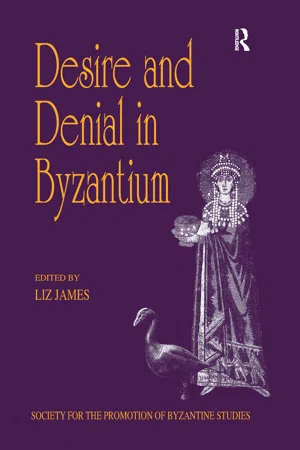
The papers in this volume derive from the 31st Spring Symposium of Byzantine Studies held for the Promotion of Byzantine Studies at the University of Sussex, Brighton, in March 1997. Desire, sex, love and the erotic are not terms usually associated with Byzantium and Byzantine Studies, unlike celibacy, virginity and asceticism, which more readily spring to mind. In order to examine whether the balance between these two extremes needed redressing, desire and denial was adopted as the theme for this symposium. The papers in this volume, by a group of international scholars, explore the many different aspects of Byzantine perceptions towards their own humanity and the frailties of that humanity. Using evidence from archaeology, art history and literary texts, ranging from sermons to legal documents, these chapters reveal writings about love, both secular and religious; images of sexuality and sensuality; the law; and Byzantine attitudes to bodies and the senses. What the symposium illustrated is that the question of desires in the Byzantine world is significant, and that such desires can offer insights into Byzantine conceptions of their own world.
Trusted by 375,005 students
Access to over 1.5 million titles for a fair monthly price.
My brief is love-letters, and this paper will be concerned, by nature of the subject, with pothos rather than with porneia,1 and, by nature of my own interests, with the middle rather than the early Byzantine period. It will concentrate on what went on in the mind, or at least on the page, rather than the body, with what people felt and wrote rather than what they did or were, and with dyads rather than individuals. We shall see that if ‘letters mingle soules’, their potential is not always exploited or appreciated,2 and that what constituted pothos in the period packs some surprises. I shall not deal with the issue of spiritual love in asceticism. There are three sections: fiction, damned lies, and statistics.
Fiction
If we look in the only theoretical literature on the Byzantine letter which has come down to us, the late antique Typoi epistolikoi attributed to Demetrios and the Epistolimaioi charakteres attributed to Proklos or Libanios, we have to search for help with love-letters. Demetrios does not list a type at all, and in Proklos-Libanios we find that the erotike type (no. 40) is that through which we offer erotic speeches (logoi) to our beloveds (feminine). Two examples are given in the Charakteres, the first a simple declaration of love which hardly makes use of the epistolarity of the Byzantine letter:
By the Gods, I love, I love your seemly and your lovely shape, and I am not ashamed to love it for there is no shame in loving what is seemly. Even if anyone were to blame me for being utterly in love, he would on the other hand praise me for desiring her who [or the shape which] is good.3
It is fairly cool, and were it not for the
we would have been very unsure that it was addressing the beloved at all; it is very much more concerned with the lover than the beloved. But we are instantly in the familiar Greek area of honour and shame in which sexual concerns are enveloped.4 The second, found in five manuscripts, is longer and perhaps more interesting:
... My dearest... soul, as I display the scorching erotic disposition (towards you) which is in me, I feel more pride than shame. For I really love you, I love your angelic state, I love your prudent and most sweet gaze, I love your quiet voice which more sweetly than honey pours from your holy lips, and I prefer to throw myself upon your sacred footprints than to luxuriate in imperial apartments.5
Love again raises the spectre of shame, and the eye contact is virtuous but the sweetness of eyes, voice and step focus on what makes the beloved loveable. Yet the repetition, the insistence,
of the first example (no. 40) is repeated here also. Neither of these prescriptions envisages a developing relationship, or the instrurnentality of a letter in the progress of a passion. What we might categorize as ‘before’, ‘during’ and ‘after’ letters – the letter of seduction (the staple of the eighteenth-century epistolary novel), letters written during brief separations in the course of a relationship, and the letters of abandonment and recrimination, the Heroides type6 – are each only one facet of the discourse of desire. If we wish to see this interplay between letters and loving (or lusting) relationships, we need to look to fiction, to the fictional letter-collections of late antiquity or to the revived fictional narratives of the twelfth century.
Two major fictional letter-collections have survived, fifty letters in the two books of Aristainetos dating from the early sixth century, and the eighty-five letters of Theophylact Simocatta.7 Both appear to be revival phenomena like the vogue for epigrams and for classicizing historiography, and both have yet to find a sympathetic interpreter, who will look at them in the context of sixth-century erotic epigrams and of contemporary rhetorical practice, and who will also read them against the major fictional collections of the second sophistic, Alkiphron’s letters from fishermen, farmers, parasites and hetairai and Philostratos’s Epistolai erotikai.8 Like these texts, the Byzantine examples are addressed to different persons, some historical, some mythological, some imaginary, women and boys, from men and women. They conjure up a landscape of easy promiscuous sex, of quickly sated passion, of agonistic wooing and world-weary advice, a whole social setting for the interplay of pleasure and longing, cynical, casual, gossipy and concerned. Unlike the ‘real’ Byzantine letter, they open windows into the populous community of their imagined life rather than portray what Barthes has called the language of an extreme solitude.9 Though each letter is complete in itself, it depicts a full cast of characters and is set at a particular moment; it casts back and forward in time as the situation demands. Unlike the ‘real’ Byzantine letter, which concentrates on the relationship between writer and recipient, third persons litter the landscape, urban or rural. The simple declaration of love of Libanios-Proklos is found seldom, sometimes tucked away at the end of a book.10
But even if these fictional letters are read in relation to the earlier collections, it seems unlikely that we shall be able to gain as much from this comparison as of late has been achieved in another genre by the reading of the four twelfth-century novels with the five ancient ones.11 The production and the reception of fictional letters in the new piety of the sixth century conjures up incongruous images of bishops and lawyers flicking through this classicizing pornography12 before setting off to preach a sermon or try a case of adultery. Yet stranger incongruities existed even earlier: both Brent Shaw and Patricia Cox Miller have commented lately onthe habitual pornographic flavour of Jerome’s discourses, ‘a rhetorical mixture of erotics and outright pornography of which Jerome, a saint, was particularly capable’, and in particular on the ‘steamy memory’ of the erotic dream-content of letter 22 to Eustochium.13 What, we wonder, are the implications for Jerome’s conception of his relationship with her? Occasionally in late antiquity, these two worlds, of a classicizing and bucolic erotic playground and of the popular passion for ascesis now well established in the empire, converge, uncomfortably. In the letters of Procopios of Gaza,14 there is almost a sense that this erotic playground might sometimes gain a toehold on real life. Procopios’s letters are firmly in the tradition of the Byzantine letter, of the real letter, of real problems of communication, of the topoi of presence and absence which make Byzantinists feel at home and are so far from the knowing sophistication of the parasites and prostitutes of the fictional collections. Yet with some correspondents he flirts with the rhetorical and fictional models we have been looking at, and we gain a sense of danger – and emotion.15
After this however, we search in vain for this erotic discourse in the Byzantine letter, despite the obvious advantages of the literary form: its monoaxial and dyadic nature, its concentration on emotion, its compressed charge and its illusory intimacy, and the exploitation Byzantine letter-writers made of this quality.16 This looks like denial indeed. The closest we come to the concentration on love in the fictional letters of the sixth and seventh centuries is in the fictional revival of the eleventh and twelfth centuries.17 In three of these works, letters of love play a part. Digenes Akrites may have been ‘a man’s man who lived on the frontier, never met an intellectual, and devoted his life to sex and violence’.18 But in the Lay of the Emir, in Escorial as well as Grottaferrata, letters are prominent, mostnotably expressing the love of mother for son. In Book I the mother of the kore writes (12 lines) to her sons urging them to seek out their sister, and in the next book they reply (6 lines); after the wedding the emir’s mother also writes to the emir (full of mourning, accusation and blame, 46 lines). But there are also letters between the lovers: on the emir’s journey to visit his mother in Syria, ‘every day he sent letters to his love’.19 The example given is a speedy one-liner (don’t weep, I beg you, rather pray), a rather feeble effort compared with the dutiful effusions of maternal epistolary exchange: a reflection...
Table of contents
Cover Page
Title Page
Copyright Page
Table of Contents
Acknowledgements
List of abbreviations
List of plates
Preface
Section I Love Letters?
1. Margaret Mullett From Byzantium, with love
2. Mary B. Cunningham Shutting the gates of the soul’: spiritual treatises on resisting the passions
Section II Do as your Father tells you
3. Kathy L. Gaca The sexual and social dangers of Pornai in the Septuagint Greek stratum of patristic Christian Greek thought
4. Aideen Hartney Manly women and womanly men: the subintro-ductae and John Chrysostom
5. Joseph A. Munitiz Anastasios of Sinai’s teaching on body and soul
6. Dirk Krausmiiller Divine sex: Patriarch Methodios’s concept of virginity
7. Peter Hatlie The city a desert: Theodore of Stoudios on porneia
Section III Problems with Bodies
8. Bernard Stolte Desires denied: marriage, adultery and divorce in early Byzantine law
9. Antony Eastmond Body vs. column: the cults of St Symeon Stylites
10. Béatrice Caseau Christian bodies: the senses and early Byzantine Christianity
11. Charles Barber Writing on the body: memory, desire, and the holy in iconoclasm
Section IV Fine Manly Bodies
12. Kathryn M. Ringrose Passing the test of sanctity: denial of sexuality and involuntary castration
13. Dion C. Smythe In denial: same-sex desire in Byzantium*
14. Shaun Tougher Michael III and Basil the Macedonian: just good friends?
Section V Byzantine Erotica
15. Marc Lauxtermann Ninth-century classicism and the erotic muse
16. John Hanson Erotic imagery on Byzantine ivory caskets
17. Barbara Zeitler Ostentatio genitalium: displays of nudity in Byzantium
Section VI Conclusion
18. Averil Cameron Desire in Byzantium – the Ought and the Is
Index
Frequently asked questions
Yes, you can cancel anytime from the Subscription tab in your account settings on the Perlego website. Your subscription will stay active until the end of your current billing period. Learn how to cancel your subscription
No, books cannot be downloaded as external files, such as PDFs, for use outside of Perlego. However, you can download books within the Perlego app for offline reading on mobile or tablet. Learn how to download books offline
Perlego offers two plans: Essential and Complete
Essential is ideal for learners and professionals who enjoy exploring a wide range of subjects. Access the Essential Library with 800,000+ trusted titles and best-sellers across business, personal growth, and the humanities. Includes unlimited reading time and Standard Read Aloud voice.
Complete: Perfect for advanced learners and researchers needing full, unrestricted access. Unlock 1.5M+ books across hundreds of subjects, including academic and specialized titles. The Complete Plan also includes advanced features like Premium Read Aloud and Research Assistant.
Both plans are available with monthly, semester, or annual billing cycles.
We are an online textbook subscription service, where you can get access to an entire online library for less than the price of a single book per month. With over 1.5 million books across 990+ topics, we’ve got you covered! Learn about our mission
Look out for the read-aloud symbol on your next book to see if you can listen to it. The read-aloud tool reads text aloud for you, highlighting the text as it is being read. You can pause it, speed it up and slow it down. Learn more about Read Aloud
Yes! You can use the Perlego app on both iOS and Android devices to read anytime, anywhere — even offline. Perfect for commutes or when you’re on the go. Please note we cannot support devices running on iOS 13 and Android 7 or earlier. Learn more about using the app
Yes, you can access Desire and Denial in Byzantium by Liz James in PDF and/or ePUB format, as well as other popular books in History & World History. We have over 1.5 million books available in our catalogue for you to explore.