eBook - ePub
Welfare and Religion in 21st Century Europe
Volume 2: Gendered, Religious and Social Change
- 212 pages
- English
- ePUB (mobile friendly)
- Available on iOS & Android
eBook - ePub
Welfare and Religion in 21st Century Europe
Volume 2: Gendered, Religious and Social Change
About this book
Historically, European churches have played a large part in the provision of welfare. Responsibility, however, has gradually shifted to the state - a shift that forms an integral part of the process of secularization and one that has been readily accepted by European populations. But what happens when the state itself begins to recede - a process that is occurring in most, if not all, European societies for a wide variety of reasons? The implications for welfare are considerable, not least for the role of the churches which begin to resume the responsibilities previously shed but in new and different ways. This book looks at the connections between religion and welfare in Europe, exploring in detail eight European societies - Finland, Norway, Sweden, England, Germany, France, Italy and Greece. The different theological traditions, different church-state relationships and different welfare regimes are all examined. The analysis is based on first hand empirical research which considers not only the changing situation on the ground, but attitudes towards this within a range of different constituencies - the churches, local government and the general public. Particular attention is paid to the significance of gender in both the process of change and in attitudes towards this. Welfare and Religion in 21st Century Europe: Volume 1 represents comparative research at its best and highlights key policy implications for the future. A companion book, Welfare and Religion in 21st Century Europe: Volume 2 explores thematically the changing nature of religion and welfare and the new relationships that are emerging between the religious and the secular, and between church and state in the 21st century.
Information
Chapter 1
The WREP Project: Building Bridges
Anders Bäckström, Grace Davie, Ninna Edgardh and Per Pettersson
This book, together with its partner volume (Bäckström and Davie 2010), is concerned with the project known as Welfare and Religion in a European Perspective - or WREP for short. The goal of the project is easily summarized: it is to discover exactly what happens on an everyday basis in the fields of welfare and religion in Europe in the first decade of the twenty-first century, and to ask what our findings can tell us about the changing nature of European societies.
WREP was designed to build bridges - between different research fields (notably welfare and religion) and between different disciplines (the social sciences, gender studies and theology), bearing in mind that research fields and disciplines are overlapping categories at least to some extent. Very fruitful syntheses have emerged from these collaborations. This introduction is designed however to build a bridge in a different sense: its primary aim is to ‘connect’ the first and second volumes of Welfare and Religion in a European Perspective. In so doing it works on a ‘need to know’ basis. In other words it introduces sufficient contextual material for this book to make sense as a free-standing volume. The reader who wishes to know more should refer to Volume 1, where the genesis and development of WREP are set out in detail and where both the rationale and the methodology of the project are described in full.1
The chapter starts by reviewing the case studies that lie at the heart of the WREP project. This is followed by a short section that underlines the increasingly apparent links between Europe’s major theological traditions and the different welfare regimes that have been identified in different parts of the continent. In this, two distinct bodies of literature (those relating to welfare and to religion) are brought together in innovative ways. A third section introduces the thematic analyses that form the core of Volume 2. What insights emerge if the extensive data produced by WREP are examined from the perspectives of sociology, gender and theology? The final section is in two parts. It looks first at the common themes that emerge from the preceding chapters; it then introduces the developed theoretical analysis that will form the conclusion to the project as a whole.
1 See also the final section of this chapter where the organizational elements of WREP are summarized.
Eight Case Studies in Eight Medium-sized Towns
The core of WREP lies in a detailed examination of the social economy of a single locality in eight European countries: Sweden, Norway, Finland, Germany, England, France, Italy and Greece. Our intention has been to map the place of both welfare and religion in the town in question; to note the similarities and differences across Europe regarding the responses of the state (in its local forms), the churches, and a range of voluntary organizations to the current situation; and to ask what this information can tell us about the changing nature of European societies, which are clearly facing similar issues. Our questions included the following. How do these various actors respond to the pressures that they face, and what resources do they have at their disposal? To what extent do these resources depend on the fact that the modern welfare state has developed differently in different parts of Europe - developments which leave distinctive ‘spaces’ not only for the churches to contribute, but for their role to adjust as circumstances require? And how, finally, might this situation evolve?
The case studies themselves are described in detail in the partner volume; so also are the reasons for choosing these particular examples and the various methodologies employed to understand them better. Here they are simply summarized, as a backdrop to the thematic analyses that follow.2 The precise location of each town can be seen in Figure 1.1. In terms of timing, it is important to note that the detailed fieldwork took place between 2004 and 2005 - in what follows the contextual information has been updated where appropriate, but not the data themselves.
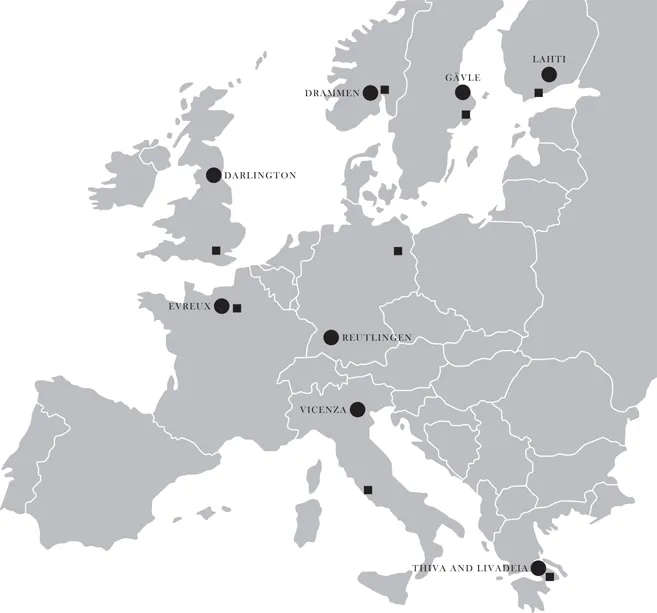
Figure 1.1 Map of case study locations
The Swedish case was located in Gävle, a town situated near the east coast of Sweden, and approximately 180 km north of Stockholm. Since the 1950s this former industrial town has gradually metamorphosed to become part of the new service economy. As in Sweden generally, Gävle is a place where the labour movement and the Social Democrats have dominated politically. Also typical is the numerical dominance of the Church of Sweden, to which about 75 per cent of the population belong and pay an annual fee (about one per cent of their income).3 Currently 92,000 people live in the municipality of Gävle, including 10 per cent from outside Sweden (mostly refugees from the Middle East and Africa); three quarters of the population reside in the urban area. The WREP enquiry concentrated on the latter and drew on a variety of sources, including a close analysis of documents concerning the welfare situation and the role of the church within this and a series of interviews with both employed and elected representatives from the public authorities and the Church of Sweden. Group interviews were also carried out with representatives from the population as a whole. Broadly speaking, these methods were repeated in every case, bearing in mind that the available documentation varied very considerably from place to place - the reasons for these differences are worth pondering.4
2 Reference should also be made to the very detailed working papers of the WREP project (Edgardh Beckman 2004; Yeung et al. 2006a; 2006b). Much of the data cited in the following chapters comes from these papers.
3 At the time of the fieldwork, this figure was noticeably higher (80 per cent) - a reduction in membership that is repeating itself all over Sweden.
The Norwegian enquiry was carried out in Drammen, a town of about 57,000 inhabitants some 40 km south of Oslo. Drammen is an old port, closely connected to a range of industrial and commercial activities in the southeastern part of Norway. The town, however, has undergone significant structural change in the last 20 to 30 years to become primarily a regional service centre. Traditionally, the Social Democrats have had a majority in the town but this is also changing. Drammen is noteworthy in that it hosts a wide variety of religious (both Christian and non-Christian) and philosophical communities. The Church of Norway, however, is by far the largest of these, comprising 77 per cent of the population. Also present are Muslims, Buddhists, Hindus, Sikhs and Jehovah’s Witnesses. Unsurprisingly, Muslims comprise the largest religious group outside the Church of Norway, which reflects the significant immigration of ethnic minorities into Drammen. Among the Christian denominations outside the Church of Norway, the Norwegian Pentecostal movement is the largest. The presence of Muslims and Pentecostals in Drammen corresponds more or less to the relative strength of the two groups at national level. It is important to note that the local parishes and the voluntary organizations of the Church of Norway have a long tradition of engaging in social work.
4 Unsurprisingly, the further south that you go in Europe, the sparser the documentation becomes. There is also a close relationship with finance: wealthier churches have more resources available for this kind of work.
The Finnish case study took place in Lahti, a town with circa 98,000 inhabitants and located 100 km north of Helsinki, with a history dating back to the fifteenth century. In recent years, Lahti has undergone rapid and troublesome economic change. Currently the main source of employment lies in service provision, and the majority of the municipality’s employees are social and health care workers (53.9 per cent). At the time of the fieldwork, the local council was dominated by Social Democrats together with the National Coalition Party, a typical collaboration in towns of this size. Lahti is also representative of Finland with respect to socio-demographic variables and in the fact that 84 per cent of the population belongs to the Evangelical Lutheran Church. The parishes have a long tradition of engaging in social work, in cooperation with the municipality and other organizations. And as in the rest of Finland, the church has assumed an increasingly active role as the town has faced economic challenges. Lahti contains examples of all the major issues represented in this project: structural change, difficult economic adjustments, pressures from outside as well as within and a desire to find new (and affordable) ways of organizing the welfare sector.
The German case is one of the most striking in WREP given the distinctive and highly significant role of church-related organizations (both Catholic and Protestant) in the welfare systems of Germany. About 60 per cent of welfare is provided in this way, financed by a variety of insurance schemes. This situation was very apparent in Reutlingen, a town with 110,000 inhabitants. From the early sixteenth century, Reutlingen was a bastion of the Reformation and a strongly Protestant identity still persists. After the Second World War, however, the town became more and more mixed from a denominational point of view. Currently, the Protestants remain the largest religious group with 42.8 per cent of Reutlingen’s citizens belonging to the Evangelical-Lutheran church compared with 23.9 per cent who are Catholic. Over and above these two groups, public statistics also reveal the so-called ‘others’ (33.3 per cent). This highly varied category comprises other Christians (such as the Orthodox or members of the free churches), Muslims, Jews, Buddhists and Hindus, but also people who do not belong to any religion at all. Interestingly the last named are the most numerous among ‘the others’ in Reutlingen (Stadt Reutlingen 2005). Immigrants make up approximately 10 per cent of the population and are mainly of Turkish or Greek origin. It is also important to note the presence of ethnic Germans who have returned from the former Soviet Union.
The town is situated in the industrial region known as the ‘Mittlerer Neckar’ (in Baden-Württemberg) which is currently dominated by the car industry. Following crisis and decline in the textile industry the biggest employer in Reutlingen today is Robert Bosch GmbH (a hi-tech firm). In the field of higher education Reutlingen offers a recently founded college for economic studies; conversely a college for teachers was closed in the mid 1980s. Independent welfare organizations in Reutlingen are represented by (among others) a large diaconal institution which employs about 2,500 people, who work as carers for the elderly and disabled and in education. The current re-organization of the local welfare model into smaller units is also significant. Increasingly public welfare authorities, independent organizations and commercial firms compete to provide services within these units. On the one hand this change encourages greater co-operation, but on the other it increases the economic regulation of social work and health care. It has also undermined the monopoly of the diaconal institutions in certain areas.
The English case is very different - here the presence of volunteers rather than paid employees is at its most developed. It was carried out in Darlington in the northeast of England. Once a manufacturing town, Darlington has undergone significant change during the late twentieth century. In 2004 the town had a population of about 98,000 and 80 per cent of jobs were in the service sector. The relatively deprived northeast is traditionally a Labour stronghold and this is also true of Darlington, though the presence of Labour, Conservative and Liberal Democrat representatives on the local council witnessed to the mixed social make-up of the town. As in most of our cases, Darlington mirrored the nationally relevant issues that derive from the shift from an industrially-based to a service-oriented society - these include an ageing population, unemployment and inequalities in health and wealth. There are examples of real social need in the area. Quaker families played a major role in the social history of Darlington, but a Church of England presence has also been significant. Our enquiries revealed that the local parishes are involved in both independent and cooperative initiatives in the areas of social welfare and community development; the role of the church in education is particularly important in the English case.
The French enquiry took place in the town of Evreux, which lies 100 km northwest of Paris, and has approximately 100,000 inhabitants. This formerly provincial city is gradually being incorporated into the suburbs of Paris; the city has, however, considerable significance in France both politically and religiously. In 2002, after more than 20 years of Communist government, the city elected as député Jean-Louis Debré - a prominent, and at times controversial, member of the political right, and from 2002 to 2007 the President of the French National Assembly. In 1995, Monsignor Gaillot (the Catholic Bishop of Evreux) was sharply criticized by the Vatican, and eventually removed from his post, for (amongst other things) his views on contraception and the ordination of women. His condemnation raised unexpectedly strong reactions throughout France. The Evreux case study reflects on the influence of this episode on Catholic activities at local level. That said, Catholic organizations have been present for a long time in this city. Very largely, they concentrate their efforts on those who are deemed marginal in French society: on prisoners, on long-stay patients in hospital (notably in psychiatry and geriatric medicine) and on the new immigrant populations (especially the sans-papiers). The presence of Islam is of particular significance in France, as it is in Evreux itself - most Muslims in the town live in the district known as La Madeleine.
The Italian case study was conducted in Vicenza, a city in the Veneto famous for its outstanding Palladian buildings. Today it is a medium size town of 110,000 inhabitants, typical of the urban northeast of Italy, a region which is experiencing rapid socio-econ...
Table of contents
- Cover
- Half Title
- Series Page
- Title Page
- Copyright Page
- Table of Contents
- List of Figures and Table
- Preface
- 1 The WREP Project: Building Bridges
- 2 Majority Churches as Agents of European Welfare: A Sociological Approach
- 3 A Gendered Perspective on Welfare and Religion in Europe
- 4 Thinking Theologically about Welfare and Religion
- 5 Welfare and Religion in Europe: Themes, Theories and Tensions
- Appendix: The WREP Team
- Bibliography
- Index
Trusted by 375,005 students
Access to over 1.5 million titles for a fair monthly price.
Study more efficiently using our study tools.
Frequently asked questions
Yes, you can cancel anytime from the Subscription tab in your account settings on the Perlego website. Your subscription will stay active until the end of your current billing period. Learn how to cancel your subscription
No, books cannot be downloaded as external files, such as PDFs, for use outside of Perlego. However, you can download books within the Perlego app for offline reading on mobile or tablet. Learn how to download books offline
Perlego offers two plans: Essential and Complete
- Essential is ideal for learners and professionals who enjoy exploring a wide range of subjects. Access the Essential Library with 800,000+ trusted titles and best-sellers across business, personal growth, and the humanities. Includes unlimited reading time and Standard Read Aloud voice.
- Complete: Perfect for advanced learners and researchers needing full, unrestricted access. Unlock 1.5M+ books across hundreds of subjects, including academic and specialized titles. The Complete Plan also includes advanced features like Premium Read Aloud and Research Assistant.
We are an online textbook subscription service, where you can get access to an entire online library for less than the price of a single book per month. With over 1.5 million books across 990+ topics, we’ve got you covered! Learn about our mission
Look out for the read-aloud symbol on your next book to see if you can listen to it. The read-aloud tool reads text aloud for you, highlighting the text as it is being read. You can pause it, speed it up and slow it down. Learn more about Read Aloud
Yes! You can use the Perlego app on both iOS and Android devices to read anytime, anywhere — even offline. Perfect for commutes or when you’re on the go.
Please note we cannot support devices running on iOS 13 and Android 7 or earlier. Learn more about using the app
Please note we cannot support devices running on iOS 13 and Android 7 or earlier. Learn more about using the app
Yes, you can access Welfare and Religion in 21st Century Europe by Anders Bäckström,Grace Davie,Ninna Edgardh,Per Pettersson in PDF and/or ePUB format, as well as other popular books in Theology & Religion & Christian Canon & Ecclesiastical Law. We have over 1.5 million books available in our catalogue for you to explore.