Structure your workload with this comprehensive guide to the role and responsibilities of library technicians!More than basic instructions on how to do library classification, this classic work is a how-to handbook covering all aspects of a library technician's job. Cataloging and Classification for Library Technicians, Second Edition, gives step-by-step instructions for all aspects of cataloging and classification of library materials (book and non-book), emphasizing copy cataloging but also discussing original cataloging. Because much has changed in the library field since the first edition of this valuable resource was published in 1995, each chapter has been revised and updated, and an entire new chapter has been added to discuss computer cataloging in the MARC format and cataloging of Internet materials. Cataloging and Classification for Library Technicians, Second Edition, interprets and explains cataloging rules and how they should be applied. Kao describes library organization and personnel patterns to illustrate the relationship between library technicians and other library staff. Library technicians will find many helpful features in Cataloging and Classification for Library Technicians, Second Edition, including:
definitions of relevant terminology
review questions to focus learning
a list of suggested readings
routines and responsibilities of library technicians
issues and trends in library cataloging and classification
detailed tables and figures to enable easier learning
many convenient Web addresses for up-to-date information
Cataloging and Classification for Library Technicians, Second Edition, is an ideal text to use in programs for library technical assistants and a handy reference for practicing library technicians.
So, you want to be a library technician? Or, more precisely, you want to be a cataloging assistant, or, perhaps, you want to learn more about cataloging? Before studying the essential details of cataloging and classification, a general background is necessary. To have an overall understanding of the operation of a library, information must be acquired regarding the whole library organization and its separate library functions. It is important to know how cataloging and classification fit into the infrastructure. Before we get to the main topics of cataloging and classification, we need to understand the hierarchy of library personnel. We need to explore questions such as, What is a library technician, or a library technical assistant? What kinds of jobs does a library technician perform? What is the relationship between the library technician and other library staff?
Terminology
acquisitions: The process of planning, selecting, ordering, and receiving materials in a library.
automation: Computerization of library functions, such as checking books out by computer, ordering materials from vendors or publishers through connected databases, using the online public access catalog, and using online or CD-ROM databases to retrieve information.
cataloging: The process of organizing library materials and making them accessible to library users. Cataloging work is divided into three parts: descriptive cataloging, subject heading, and classification.
circulation: Also called access service, this library function mainly consists of checking in and checking out materials, shelving, shelf reading, and maintenance of shelves. Circulation duties also include the maintenance of databases, such as building a users’ database on the computer.
classification: The number or a combination of letters and numbers assigned to a work indicating its subject. The purpose is to have materials of the same subject stand side by side on the shelves for easy browsing.
interlibrary loan: When users request materials not owned by one library, the library borrows them from another library on behalf of the users. The requested materials may be mailed, delivered, faxed, or electronically transmitted to the borrowing library. Many libraries offer free interlibrary loan service; others charge a fee.
library technician: A member of the library staff who is in the middle level of the personnel hierarchy, who supervises clerical and student workers, and who is supervised by librarians.The library technician is also called the library technical assistant, abbreviated as LTA, or para-professional, or library support staff. Though there is no national requirement for this classification, the library technician customarily has an associate degree or certificate in the field of Library Technology.
public services: Sometimes called reader’s services, these are duties performed in the library’s public area that require some contact between library staff and users. Reference services and programming for children are public services. Circulation used to be considered public service, but because it now involves the maintenance of databases, it may be grouped with Technical Services.
reference: A function in which library staff answer inquiries of the users. Reference personnel instruct users on the use of library materials and facilities and assist them in finding needed materials or information.
reserve: Reserve has two meanings. (1) It refers to materials kept in closed stacks, allowing more users to access such materials for a shorter period of time. (2) It refers to materials kept behind the circulation desk that may be checked out only by the requester.
technical services: Services performed behind the scenes in the library for the convenience of the library users. These activities include, but are not limited to, selecting and ordering materials, cataloging and processing materials, and maintaining the databases.
The Organization of the Library
First, let us explore how libraries are organized. Just as every person is an individual, so every library is organized individually. However, one general pattern emerges as a model. Traditionally, all library functions are placed under two sections: technical services and public services. Technical services usually include all the behind-the-scenes work, such as acquisitions, cataloging, processing, binding, and book repair. Public services, also called reader’s services, usually embrace reference, circulation, reserve, and interlibrary loan. As mentioned earlier, each library is organized a little differently, so interlibrary loan might be categorized by some libraries under technical services. Also, with the increasing use of online catalogs, more libraries are classifying circulation under technical services as well. The line between technical and public services is becoming less defined, and many libraries have abolished the division, grouping together personnel who perform related functions. For example, the duties of library personnel who specialize in fine arts may include selecting and acquiring materials in that subject area, cataloging and processing them, as well as answering related reference questions from the users. Some libraries have merged the cataloging department with acquisitions and serials, along with computer technology, into a department of automation and bibliographic control. Always keep in mind that overlapping functions occur in some areas, depending on the organizational culture and policies of individual libraries. There is no right or wrong way of organizing libraries functions.
The organizational chart shown in Figure 1.1 illustrates the division of functions for most libraries. As seen in the chart, the function of cataloging and classification falls under the technical services division of library operation. Some libraries may call this function bibliographic control.
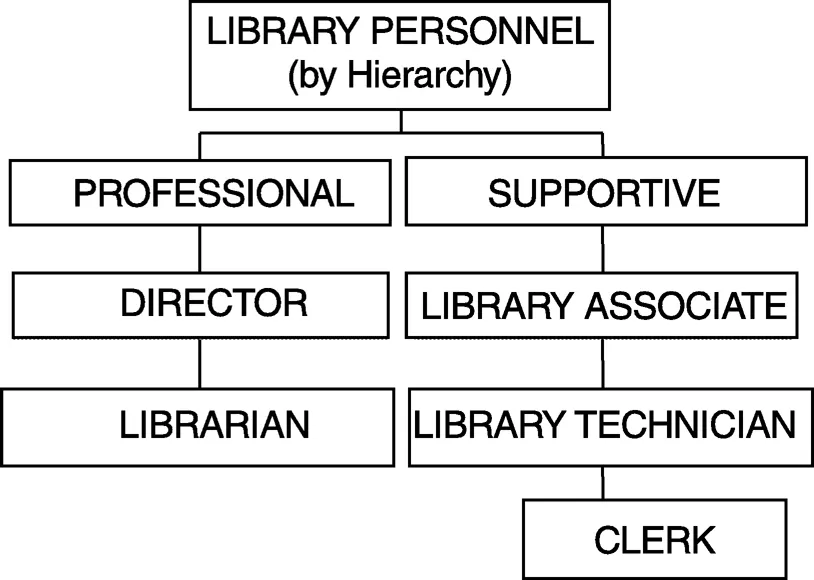
The American Library Association, in its 1976 statement Library Education and Personnel Utilization, defines the categories of library personnel and their qualifications. Until now, this was the only official guideline in existence. This document separates library personnel into two categories: professional and supportive. The professional librarian requires a master’s degree in Library Science (MLS). The supportive category includes the library associate, the library technician, and the clerks. The minimum requirement for library associate is a bachelor’s degree, and for library technician, two years of college-level study, or an associate degree, or a one-year certificate. Clerks are not required to have a college education but do need to have clerical skills and in-service training. The chart shown in Figure 1.2 is a convenient way to demonstrate the library personnel hierarchy.
This chart reflects the official guidelines; actual classification may vary from library to library. In many small libraries, for example, the staff classification is purposely vague and there may be only two categories: professional and nonprofessional. Some very small libraries do not even make that distinction, and as a result, everyone who works there is a “librarian.” The only nationally recognized requirement is that the librarian have a master’s degree in Library Science. Not only is there no universal standard requirement for the next level of library personnel, but there is also no universal agreement on the title for these dedicated, important library staff. For this book, the title library technician is chosen. Other publications may use different acceptable titles, such as library technical assistant (LTA), library support staff, paraprofessional, or library assistant. Used less frequently and generally considered inappropriate, other titles that have appeared in the literature include nonprofessional, subprofessional, library aide, and paralibrarian. Today, the overall consensus sets the qualification for library technician as a bachelor’s degree or an associate degree or certificate, or education and training gained from a Library Technology Program in a four-year or community college. This issue is being discussed extensively in the library world, and there are indications that, in the near future, either an associate degree or a certificate will be necessary to qualify one as a bona fide library technician.
Cataloging and the Library Technician
Before we talk about what types of jobs library technicians perform in the area of cataloging, let us examine what cataloging is and why it is the most important function in the total library operation.
Cataloging is the process of organizing library materials and making them accessible to library users. The challenge the cataloger faces is accommodating the many diverse approaches people use in retrieving library materials. A good cataloger makes it possible for users to find materials easily, whatever approach is applied. Good cataloging practices make library operation more efficient. The most wonderful collection is useless if the materials are not easily accessible to library users. Cataloging is also called bibliographic control, and understanding the why and how of bibliographic control is not only vital to staff working in the cataloging department, it is important to all library personnel. Reference and public service staff are more likely to perform their duties effectively if they have some background knowledge in cataloging and classification. This includes understanding how the collections are arranged for use and how to assist users in finding needed information in an accurate and timely fashion. Special training is necessary to ensure that library staff acquire knowledge and skills on the theories and procedures of the cataloging and classification process. Continuing education involving new developments and trends in the field, including rule changes and revisions, must be available.
To facilitate the cataloging process, guides and codes are designed, reviewed, and redesigned by library organizations. The official guides and codes, in turn, are adopted by libraries to ensure uniformity from library to library. In a time when people move from place to place and use different libraries at different times, consistency is essential. Even for the users of small libraries, confusion is minimized when officially adopted standards are practiced. In the sense of shared catalogs and personal computer connections, automation allows access to many different libraries simultaneously; more reason for uniformity in cataloging and classification rules. Knowledge of cataloging rules and codes, along with a general background in cataloging, encourages all library staff to understand how the collection is organized and to identify quickly and easily the materials contained within the local collection or from other remoteaccess libraries.
In the area of cataloging, the library technician’s job has changed in the past decade chiefly because of automation and budget restraints. Many tasks done in the past by librarians are now routinely performed by library technicians. A modern-day library technician accomplishes almost every task in the cataloging department, usually working at a computer terminal connected to nationwide or area databases. The library technician’s job is to retrieve bibliographic information from print sources or computer databases to match the locally acquired materials, and to input local collections into the database. Traditional cataloging support tasks such as typing, duplicating cards, and filing are gradually being eliminated because of automation. Nowadays, library technicians need to possess more sophisticated skills. ...
Table of contents
Cover
Half Title
Title Page
Copyright Page
Dedication Page
About The Author
Table of Contents
Preface
Preface to the Second Edition
Chapter 1. Introduction
Chapter 2. Library Catalogs
Chapter 3. Tools Used for Cataloging
Chapter 4. Descriptive Cataloging
Chapter 5. Subject Headings
Chapter 6. Classification
Chapter 7. Copy Cataloging
Chapter 8. Cataloging on Computers
Chapter 9. The Cataloging Department
Chapter 10. Issues and Trends
Suggested Readings
Index
Trusted by 375,005 students
Access to over 1.5 million titles for a fair monthly price.
Study more efficiently using our study tools.
Frequently asked questions
Yes, you can cancel anytime from the Subscription tab in your account settings on the Perlego website. Your subscription will stay active until the end of your current billing period. Learn how to cancel your subscription
No, books cannot be downloaded as external files, such as PDFs, for use outside of Perlego. However, you can download books within the Perlego app for offline reading on mobile or tablet. Learn how to download books offline
Perlego offers two plans: Essential and Complete
Essential is ideal for learners and professionals who enjoy exploring a wide range of subjects. Access the Essential Library with 800,000+ trusted titles and best-sellers across business, personal growth, and the humanities. Includes unlimited reading time and Standard Read Aloud voice.
Complete: Perfect for advanced learners and researchers needing full, unrestricted access. Unlock 1.5M+ books across hundreds of subjects, including academic and specialized titles. The Complete Plan also includes advanced features like Premium Read Aloud and Research Assistant.
Both plans are available with monthly, semester, or annual billing cycles.
We are an online textbook subscription service, where you can get access to an entire online library for less than the price of a single book per month. With over 1.5 million books across 990+ topics, we’ve got you covered! Learn about our mission
Look out for the read-aloud symbol on your next book to see if you can listen to it. The read-aloud tool reads text aloud for you, highlighting the text as it is being read. You can pause it, speed it up and slow it down. Learn more about Read Aloud
Yes! You can use the Perlego app on both iOS and Android devices to read anytime, anywhere — even offline. Perfect for commutes or when you’re on the go. Please note we cannot support devices running on iOS 13 and Android 7 or earlier. Learn more about using the app
Yes, you can access Cataloging and Classification for Library Technicians, Second Edition by Ruth C Carter,Mary L Kao in PDF and/or ePUB format, as well as other popular books in Business & Management. We have over 1.5 million books available in our catalogue for you to explore.