- 448 pages
- English
- ePUB (mobile friendly)
- Available on iOS & Android
eBook - ePub
Glycopeptide Antibiotics
About this book
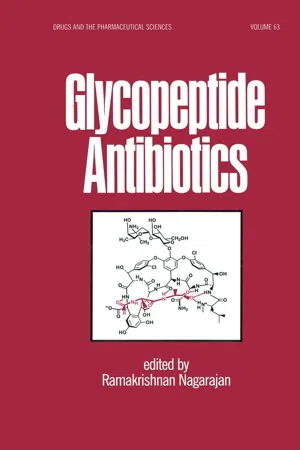
This work describes all known assays used to discover new glycopeptide antibiotics. It discusses practical techniques for screening, isolating and analyzing glycopeptide antibiotics, correlating structure-activity relationships with the mode of action. Every relevant chemical aspect of the carbohydrate components of glycopeptide antibodies is examined.
Information
1
Glycopeptides
Classification, Occurrence, and Discovery
Lilly Research Laboratories, Eli Lilly and Company, Indianapolis, Indiana
I. Introduction
A. Historical Aspect
Vancomycin was first discovered at Eli Lilly and Company in a natural products screening program in the early 1950s directed at new antibiotic-producing microorganisms (1). This antibiotic, active primarily against Gram-positive bacteria, was produced by a new species of actinomycete isolated from an Indonesian soil; subsequently, two other vancomycin-producing strains were isolated from samples of Indian soil (2). The culture, originally designated Streptomyces orientalis, was later renamed Nocardia orientalis based on the tendency of the vegetative hyphae to break into small, squarish units often referred to as “fragments” (3). With the advent of chemotaxonomic techniques that include the analysis of cell wall amino acids and sugars, whole-cell sugars, fatty acids (including mycolic acids), mena-quinones, and phospholipids, this nocardioform, which lacks mycolic acids, was eventually reclassified as Amycolatopsis orientalis (4).
The discovery of vancomycin was followed a year later by the isolation of ristocetin (5). These two antibiotics were recognized as belonging to a chemical class of antibiotics called glycopeptides, but their complete structures were not determined until some years later. The glycopeptides are complex molecules, characterized by a multiring peptide core containing six peptide linkages, an unusual triphenyl ether moiety, and sugars attached at various sites. Over 30 antibiotics designated as belonging to the glycopeptide class have been reported. As is expected with microbial secondary metabolites, most of these antibiotics have first been isolated as families of closely related factors.
B. Medical and Agricultural Uses
Even though a number of glycopeptides have been discovered since the 1950s, vancomycin was the only member of this class introduced for clinical use until the recent approval of teicoplanin. Vancomycin is effective at low concentrations against the majority of Gram-positive bacteria, but toxicity problems encountered in the early years of its application precluded its widespread use despite its selective action against bacterial cell wall synthesis. The introduction of semisynthetic penicillins, later followed by cephalosporins and lincomycin, overshadowed vancomycin. In the past 10 years, however, as the result of the emergence of multiple-resistant and methicillin-resistant staphylococcal (MRS) infections (6), vancomycin has become the drug of choice as well as the drug of last resort. Vancomycin is a valuable antibiotic for the treatment of endocarditis and MRS infections and is the first line of treatment for pseudomembranous colitis.
Teicoplanin has been introduced in Germany, Italy, and France and is under investigation for clinical use in several other countries, including the United States (7). Like vancomycin, it is particularly effective in the treatment of severe infections caused by antibiotic-resistant, Gram-positive bacteria.
Ristocetin appeared to be a promising antibacterial agent for use in human medicine, but it was withdrawn following a high incidence of thrombocytopenia (8). Further investigation of its hemostatic effects indicated that ristocetin causesplatelet aggregation by interacting with a plasma factor missing from patients with one form of von Willebrand s disease. This property has been exploited, and ristocetin is used in the differential diagnosis of this disorder.
Several glycopeptide antibiotics have shown growth-promoting activity in farm animals;...
Table of contents
- Cover
- Half Title
- Series Page
- Title Page
- Copyright Page
- Dedication
- Preface
- Table of Contents
- Contributors
- Original Half Title
- 1. Glycopeptides: Classification, Occurrence, and Discovery
- 2. Separation Methodology
- 3. Approaches to the Synthesis of the Vancomycin Aglycones
- 4. Chemistry of Carbohydrate Components
- 5. Structure-Activity Relationships of Vancomycin Antibiotics
- 6. Resistance and Mode of Action
- 7. Analytical Quantitation and Characterization
- 8. Teicoplanin
- 9. Vancomycin: A Clinical Overview
- Epilogue
- Index
Trusted by 375,005 students
Access to over 1.5 million titles for a fair monthly price.
Study more efficiently using our study tools.
Frequently asked questions
Yes, you can cancel anytime from the Subscription tab in your account settings on the Perlego website. Your subscription will stay active until the end of your current billing period. Learn how to cancel your subscription
No, books cannot be downloaded as external files, such as PDFs, for use outside of Perlego. However, you can download books within the Perlego app for offline reading on mobile or tablet. Learn how to download books offline
Perlego offers two plans: Essential and Complete
- Essential is ideal for learners and professionals who enjoy exploring a wide range of subjects. Access the Essential Library with 800,000+ trusted titles and best-sellers across business, personal growth, and the humanities. Includes unlimited reading time and Standard Read Aloud voice.
- Complete: Perfect for advanced learners and researchers needing full, unrestricted access. Unlock 1.5M+ books across hundreds of subjects, including academic and specialized titles. The Complete Plan also includes advanced features like Premium Read Aloud and Research Assistant.
We are an online textbook subscription service, where you can get access to an entire online library for less than the price of a single book per month. With over 1.5 million books across 990+ topics, we’ve got you covered! Learn about our mission
Look out for the read-aloud symbol on your next book to see if you can listen to it. The read-aloud tool reads text aloud for you, highlighting the text as it is being read. You can pause it, speed it up and slow it down. Learn more about Read Aloud
Yes! You can use the Perlego app on both iOS and Android devices to read anytime, anywhere — even offline. Perfect for commutes or when you’re on the go.
Please note we cannot support devices running on iOS 13 and Android 7 or earlier. Learn more about using the app
Please note we cannot support devices running on iOS 13 and Android 7 or earlier. Learn more about using the app
Yes, you can access Glycopeptide Antibiotics by Ramakris Nagarajan in PDF and/or ePUB format, as well as other popular books in Medicine & Biochemistry in Medicine. We have over 1.5 million books available in our catalogue for you to explore.