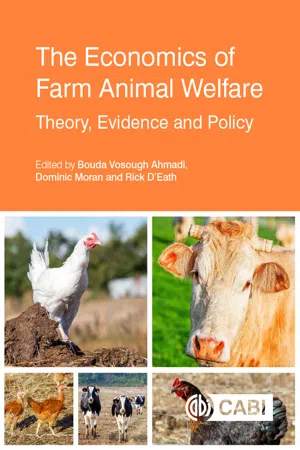
This landmark new text charts the latest developments in economic research relevant to farm animal welfare. A range of global experts and key opinion leaders outline the challenges in achieving sustainable livestock production while improving farm profit, climate change and animal welfare, and make policy-relevant recommendations for the future. This is a theoretical yet practical book that examines: - the origins of farm animal welfare, cross-disciplinary interactions and the future of the field;- consumer demand and changing preferences as animal welfare rises up the social agenda;- the impact political organisations such as the EU and WTO have on animal welfare.An important resource for policy makers and animal welfare scientists, economists and clinicians, this book provides a thought-provoking yet evidence-based review for all those interested in quantifying and improving farm animal welfare.
eBook - ePub
Economics of Farm Animal Welfare, The
Theory, Evidence and Policy
- 208 pages
- English
- ePUB (mobile friendly)
- Available on iOS & Android
eBook - ePub
Economics of Farm Animal Welfare, The
Theory, Evidence and Policy
About this book
Information
Topic
MedicineSubtopic
Veterinary Medicine1 Farm Animal Welfare: Origins, and Interplay with Economics and Policy
1Animal Behaviour and Welfare, Animal and Veterinary Sciences, Scotland’s Rural College (SRUC)
1The Roslin Institute, University of Edinburgh
*Corresponding author: [email protected]
Summary
In this chapter we look at the origins of animal welfare as a societal concern and the interplay between the concept of animal welfare, economics and policy. We firstly propose adjustments to the ‘standard view’ of the development of animal welfare concerns (which we refer to as the Harrison-Brambell-FAWC (HBF) sequence). For example, we suggest that the role of science in setting animal welfare policy is a more complex process than is sometimes acknowledged. We discuss the application of economics to animal welfare including the analysis of the costs of animal welfare improvements to more recent work on trade-offs relating to animal welfare across the supply chain. Considering this range of uses of economics relating to animal welfare, we identify that the question of how to value animal welfare in economic terms remains unresolved. Lastly, we suggest that the period 1965–2008 may come to be regarded as a ‘golden era’ for the translation of animal welfare concerns into positive socio-political actions. We discuss a raft of issues which appear to have diminished the position of animal welfare in the policy ‘pecking order’. However, societal concern over animal welfare will mean that government and others will need to be cautious of breaching ‘red lines’. On a more positive note, the public profile that animal welfare enjoys will continue to provide the opportunity for policy and business innovations to improve animals’ lives.
1.1 Introduction
We consider the origins of animal welfare as a societal concern and the interplay between the concepts of animal welfare, economics and policy. Much of the material will be drawn from Europe and particularly the UK. While this may limit relevance to other geo-political areas, the UK and Europe have, arguably, the richest experience and history of animal welfare, and are therefore most suited to exploring why animal welfare concerns have arisen and how they influence, and are influenced by, wider society.
1.2 The Origins of Animal Welfare: The Standard View
The standard view for the origin of animal welfare is that it originated in the mid-1960s in the UK, directly following the publication of Ruth Harrison’s book Animal Machines (Harrison, 1964). The book illustrated that animal farming had moved significantly away from the public’s perception of a ‘rural idyll’ to what thereafter became known as ‘factory farming’. It gave rise, almost immediately, to misgivings among members of the British public about conditions in intensive farm animal production. It is rather remarkable that the book had such an immediate and profound effect, perhaps because of the public sensitivity to animal issues and perhaps because the 1960s had already seen increasing public alarm over other issues such as environmental pollution (Carson, 1962). One of the most significant and long-lasting impacts of Harrison’s book was the forming, by the UK government, of the Brambell Committee, whose purpose it was to investigate and report on welfare conditions in British livestock farming. In 1965, the Committee issued its Report of the Technical Committee to Enquire into the Welfare of Animals Kept under Intensive Livestock Husbandry Systems (Brambell, 1965).
The Brambell Report is often seen as another seminal point in the development of animal welfare because it introduced a broader idea of what animal welfare should encompass. Whereas previous anti-cruelty legislation had focused on preventing what was seen as pointless or, as it was said, ‘wanton’ suffering without human benefits, this new development involved protecting animals against the adverse consequences of human activities even if the activities made food production more efficient. For example, although keeping sows confined using chains or crates, or housing slaughter pigs at very high stocking densities, could be seen as integral to the most efficient production of pork, these methods were still criticized for denying animals the fulfilment of their needs. The Brambell Report understood animals’ needs as something which, if they were not met, would cause suffering. Thus the report insisted on a new and wider understanding of suffering, which went beyond persistent and significant pain to include the frustration of ‘behavioural urges’ in the form of discomfort, stress and, by inference, other negative mental states. This understanding of suffering made it possible, for example, to criticize the confinement of sows, not on the basis that confinement causes pain but rather because confinement prevents animals from engaging in behaviours that they are highly motivated to perform. Using these ideas, the Brambell Report formulated the general requirements that farm animals should be free to ‘stand up, lie down, turn around, groom themselves and stretch their limbs’ (Brambell, 1965, p. 13).
The report also recommended the creation of a Farm Animal Welfare Advisory Committee (FAWAC), which was formed in 1967, to be superseded by the Farm Animal Welfare Council (FAWC) in 1979. It was FAWC which distilled the so-called Five Freedoms from the Brambell Report, formalizing these in a press release shortly afterwards (FAWC, 1979). Despite potential criticisms (e.g. McCulloch, 2013) and proposed alternatives (e.g. Mellor, 2016), the Five Freedoms have become the most widely used animal welfare framework globally (e.g. OIE, 2019), taking forward the broadening of animal welfare beyond prevention of cruelty. This includes the much-discussed freedom to ‘express normal patterns of behaviour’ (e.g. Bracke and Hopster, 2006; see below).
Many of the socio-political activities relating to animal welfare can be seen to follow from the ‘Harrison-Brambell-FAWC’ (HBF) sequence. In the UK, for example, Defra (2006) put the idea of animal needs into a legislative framework (House of Commons, 2006). The needs, as expressed in the act, for: a suitable environment (place to live); a suitable diet; to exhibit normal behaviour patterns; and to be: housed with, or apart from, other animals (if applicable); and protected from pain, injury, suffering and disease, are strongly influenced by the Five Freedoms.
Science had an important role in these developments. The Brambell Committee was clearly influenced by the emerging fields of animal behaviour and neuroscience. For example, in a footnote on page 10, the report states that the Committee was impressed by recent comments by Lord Brain (a neurologist) that he saw ‘no reason for conceding mind to my fellow men and denying it to animals’. The committee also included W.H. Thorpe (then Director of the Animal Behaviour Department at the University of Cambridge) as an animal behaviour expert. Thorpe wrote an Appendix to the report entitled ‘The Assessment of Pain and Distress in Animals’, in which he developed the argument that animals are capable of suffering based on their physiology and behaviour, including those ‘expressive movements’ which are associated with deprivation and suffering. Dawkins (2016) argued that Thorpe set out an agenda for the future study of animal welfare that included the study of animals’ subjective feelings.
In fact, much of the research that was to help fulfil Thorpe’s agenda was not directly related to animal welfare but came about through developments in mainstream science. Most notable was the so-called ‘cognitive revolution’, which led to consciousness and awareness being widely accepted as suitable for scientific study across a range of disciplines and areas (e.g. Sperry, 1993). One consequence of this was for studies of animal behaviour to begin to explore animal cognition and awareness, refreshing the debate over animal mentality (e.g. Griffin, 2013). Thorpe’s agenda was, however, also served by the more bespoke scientific area that we now refer to as animal welfare science. Animal welfare science is a loose amalgam of scientific disciplines ranging from the natural to the social sciences and including philosophy that since the late 1960s has focused specifically on addressing animal welfare issues (Lawrence, 2008a). The subject matter of animal welfare science followed closely Thorpe’s agenda, particularly when scientists such as David Wood-Gush began to develop scientific approaches to study the ‘animal’s perspective’, including studies of animal emotions such as ‘frustration’ (Duncan and Wood-Gush, 1971) and ‘fear’ (Hughes and Black, 1974). This early phase culminated in the publication of Marian Dawkins’s seminal book Animal Suffering: The Science of Animal Welfare (Dawkins, 1980), in which she argued for animal preferences to be applied as a method for objectively assessing animals’ motivational priorities and, by inference, their experiences.
Animal welfare science has continued to build on these early years through other innovative approaches to the study of the animals’ experience (see Lawrence, 2016 for further details). For example, the development of judgement bias tests by Mike Mendl, Liz Paul and others is based on human psychology studies suggesting that underlying emotional states affect cognitive processing, for example with more depressed or anxious people judging ambiguous stimuli more negatively (e.g. Mathews and Mackintosh, 1998). The first application of ‘cognitive bias’ (as it is often referred to) tested rats for their response to ambiguous stimuli following exposure to different housing (Harding et al., 2004) and has been followed by many studies applying cognitive bias across a range of species and contexts. Cognitive bias testing is supported by a theoretical framework aimed at understanding and interpreting research on animal emotions (e.g. Mendl et al., 2010).
Another example of innovation in animal welfare science that builds on the HBF sequence is the development of qualitative behavioural assessment (QBA) by Françoise Wemelsfelder and colleagues, which directly fulfils Thorpe’s aim to scientifically assess those ‘expressive movements’ which are associated with animal welfare. QBA arose from Wemelsfelder’s position (part philosophical and part biological) that it can be legitimate to study animal behaviour from a qualitative perspective, and indeed that it may be essential to do so, in order to capture the subjective aspects relating to mental state that are of concern in animal welfare (Wemelsfelder, 2012). The result of this thinking led to the development of an approach to the recording of animal behaviour that focuses on the expressive quality of the behaviour as opposed to the quantitative descriptions of behaviour that are normally used in behavioural data collection (e.g. Wemelsfelder et al., 2001). Similar to cognitive bias, testing QBA is now widely used in animal welfare science across a range of species from farm animals (e.g. Rutherford et al., 2012) to elephants (Carlstead et al., 2013).
In summary the standard view sees the publishing of Animal Machines as the essential primer to a sequence of events that was to define the development of animal welfare as a concept, as a public concern and as an area for scientific study.
1.3 Adjustments and Additions to the Standard View
In this section we want to suggest additions or adjustments to the standard view of animal welfare, partly to bring the standard view of animal welfare up to date with new evidence and also to better align the past development of animal welfare with the present.
1.3.1 The long view
So far we have described the HBF sequence as marking the transition from an era where animal welfare was seen, effectively, as the equivalent of animal cruelty to one where animal welfare took on a broader range of issues and concerns (e.g. Woods, 2012). However, this is possibly to downplay gradual changes in attitudes to animal mentality that had been happening since at least the 18th century (Lawrence, 2008b). For example, the Scottish philosopher David Hume wrote, in 1742, that ‘animals undoubtedly feel … tho in a more imperfect manner than men’ (Hume, 1987, revised edition). Perhaps the most famous early advocate of animals’ moral status was Jeremy Bentham who wrote that ‘the question is not, can they reason nor can they talk but can they suffer’ (Bentham, 1789).
Radford (2001) suggests that early philosophers such as Hume and Bentham were influenced by emerging scientific evidence of the biological similarities between human and non-human animals, which called into question the anthropocentric view that dominated at the time. Thus, for at least 200 years, the idea that animals are sentient with some capacity to experience or feel has been evolving in philosophical circles, although how much more widely these views were to be found in society is harder to judge. It does seem plausible that this early belief in animal sentience was at least partly responsible for the first early steps to protect animals in law. As described by Radford (2001), the passing of the earliest animal protection legislation in the form of Martin’s Act (1822) coincided with the writings of Bentham and others and the beginnings of a changing attitude towards animals’ moral status.
1.3.2 Lack of clarity over what animal welfare is about
As we have seen, the standard view suggests that Animal Machines was responsible for the idea of animal welfare becoming more than a simple prevention of cruel acts. Woods (2012) has explored the historical evidence for this and presents a more nuanced analysis with some conclusions that resonate to the present day. For example:
Although she [Harrison] is often retrospectively credited with being the first to articulate the concept of welfare, it should be noted that she was not the only critic of intensive farming, and that her book did not actually use the term ‘welfare’. Rather, she expressed her concerns in the existing vocabulary of cruelty and suffering, while attempting simultaneously to redefine them. (Woods, 2012, p. 17)
Woods (2012, p. 18) debates why the UK government ministry responsible (MAFF) at the time used the term ‘welfare’ in the full title for the Brambell Report given that the term had...
Table of contents
- Cover
- Half-title Page
- Title Page
- Copyright
- Contents
- Foreword
- Preface
- Acknowledgements
- Contributors
- 1 Farm Animal Welfare: Origins, and Interplay with Economics and Policy
- 2 Farm Animal Welfare: Do Free Markets Fail to Provide It?
- 3 Consumer Demand for Animal Welfare Products
- 4 People’s Preferences in Relation to Animal Welfare
- 5 Animal Welfare and Farm Economics: An Analysis of Costs and Benefits
- 6 Poultry Breeding for Sustainability and Welfare
- 7 EU Regulations and the Current Position of Animal Welfare
- 8 Animal Welfare Measures and the WTO Post-EC – Seal Products Case: A Renewed Debate and Research Agenda
- 9 Farm Animal Welfare: The Future
- Index
- Backcover
Trusted by 375,005 students
Access to over 1.5 million titles for a fair monthly price.
Study more efficiently using our study tools.
Frequently asked questions
Yes, you can cancel anytime from the Subscription tab in your account settings on the Perlego website. Your subscription will stay active until the end of your current billing period. Learn how to cancel your subscription
No, books cannot be downloaded as external files, such as PDFs, for use outside of Perlego. However, you can download books within the Perlego app for offline reading on mobile or tablet. Learn how to download books offline
Perlego offers two plans: Essential and Complete
- Essential is ideal for learners and professionals who enjoy exploring a wide range of subjects. Access the Essential Library with 800,000+ trusted titles and best-sellers across business, personal growth, and the humanities. Includes unlimited reading time and Standard Read Aloud voice.
- Complete: Perfect for advanced learners and researchers needing full, unrestricted access. Unlock 1.5M+ books across hundreds of subjects, including academic and specialized titles. The Complete Plan also includes advanced features like Premium Read Aloud and Research Assistant.
We are an online textbook subscription service, where you can get access to an entire online library for less than the price of a single book per month. With over 1.5 million books across 990+ topics, we’ve got you covered! Learn about our mission
Look out for the read-aloud symbol on your next book to see if you can listen to it. The read-aloud tool reads text aloud for you, highlighting the text as it is being read. You can pause it, speed it up and slow it down. Learn more about Read Aloud
Yes! You can use the Perlego app on both iOS and Android devices to read anytime, anywhere — even offline. Perfect for commutes or when you’re on the go.
Please note we cannot support devices running on iOS 13 and Android 7 or earlier. Learn more about using the app
Please note we cannot support devices running on iOS 13 and Android 7 or earlier. Learn more about using the app
Yes, you can access Economics of Farm Animal Welfare, The by Bouda Vosough Ahmadi, Dominic Moran, Richard B D'Eath, Bouda Vosough Ahmadi,Dominic Moran,Richard B D'Eath in PDF and/or ePUB format, as well as other popular books in Medicine & Veterinary Medicine. We have over 1.5 million books available in our catalogue for you to explore.