
- 132 pages
- English
- ePUB (mobile friendly)
- Available on iOS & Android
eBook - ePub
Divers and Diving
About this book
"Divers and Diving" is a vintage book on diving, looking in detail at its history and developments in equipment, technique, and purpose. With detailed descriptions of every aspect of diving as well as interesting accounts of notable historical dives and salvage operations, this volume constitutes a must-have for those with an interest in the history and evolution of diving. Contents include: "Diving in Olden Days", "What Water Pressure Means", "The Invention of the Diving Suit", "Down Goes the Diver", "Divers at Work", 'The Dangers of Diving", "The All-Metal Diving Dress", "The Diving Bell", "How Ships are Salved", "Salving Ships Upside Down", "Raising an American Submarine", "The Treasure of the Laurentic", etc. Many vintage books such as this are increasingly scarce and expensive. It is with this in mind that we are republishing this volume now in an affordable, modern, high-quality edition complete with a specially-commissioned new introduction.
Information
Print ISBN
9781528702669
Subtopic
Sport & Exercise ScienceCHAPTER III
THE INVENTION OF THE DIVING SUIT
A land-breeze shook the shrouds,
And she was overset;
Down went the Royal George,
With all her crew complete.
THIS is a verse from the well-known poem in which William Cowper tells of the loss of the Royal George, a wooden three-decked battleship, at Spithead in the year 1782.
It was not true, however, that this disaster, which caused the loss of about 900 lives, was due to a land-breeze “shaking her shrouds.” What really happened was that the ship had been heeled over (“careened” is the word sailors use) to allow repairs to be made in an underwater pipe in the hull of the ship. The careening was so carelessly done that the ship went over too far; the water poured in through the open port-holes, and she filled and sank.
For many years afterwards great efforts were made to raise the Royal George or at least to recover guns and other valuable things that had sunk with her. All efforts failed until, in the year 1834, divers were sent down with a diving dress invented some years earlier by Augustus Siebe—one of the most famous men in the history of diving, and founder of the firm of Siebe, Gorman and Company, Limited.
Siebe’s “Open” Diving Dress
Siebe’s first diving dress was simply a metal helmet and an airtight jacket. From the helmet ran a pipe which led to an air pump worked by men on the diving boat. As the diver was lowered into the water the pumped-in air allowed him to breathe and also balanced the pressure of the water. The air pressure inside the dress had, in fact, to be kept a little higher than the water pressure outside, so as to keep the water out of the dress. Since some of the air bubbled out under the lower edge of the dress, the diver had a steady stream of fresh air to breathe.
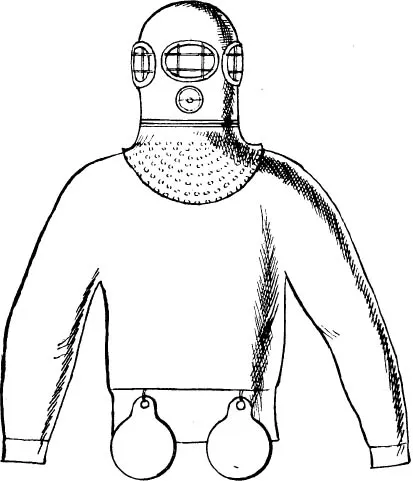
FIG. 7. SIEBE’S “OPEN” DIVING DRESS
By courtesy of Siebe, Gorman & Co. Ltd.
This dress worked quite well so long as the diver kept more or less upright. If he leaned too far over, or if he fell down, the air escaped out of the dress and water rushed in, drowning him if he were not at once hauled to the surface. In spite of this drawback divers using the dress brought up many guns and other things from the wreck of the Royal George. They were able to stay below for over an hour at a time.
Siebe’s “Closed” Diving Dress
It was in fact Siebe’s invention that made salvage work on the Royal George possible. Not content with this triumph, the inventor set to work improving the dress. As the fault lay in the dress being open, so that water could get into it, he tried a closed dress—a complete one-piece suit making, with the helmet, the “balloon” mentioned at the close of the last chapter.
The step from an open to a closed diving dress may seem to us a very short and simple one. Most inventions, however, look quite simple after they have been discovered. The open diving dress had been in use for eighteen years before Siebe, in 1837, made the change to the closed dress and proved it a success. These long years, however, were well spent. Siebe’s closed dress was a success at the start and is still used. Except for a number of changes in small matters, the dress that divers use to-day is the same as that invented by Siebe one hundred years ago.
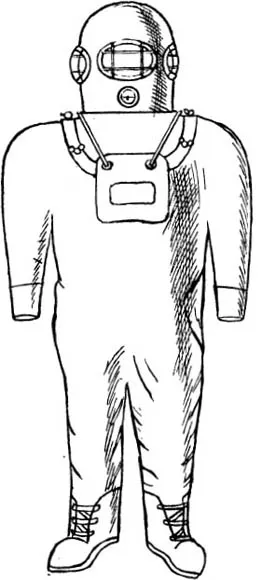
FIG. 8. SIEBE’S FIRST “CLOSED” DIVING DRESS
By courtesy of Siebe, Gorman & Co. Ltd.
Although it was called a closed dress, it was not quite closed. It was watertight but not airtight. In the helmet Siebe fitted a valve, or tap, which let air out but let nothing in. By letting air out it served to keep up a flow of fresh air from the pumps to the diver. Again, the diver could adjust the tap, so that he could blow out his dress or ease off the air pressure as he pleased, in order to balance the water pressure.
Siebe, then, gave the diver a dress in which he could breathe comfortably, in which he could move about freely, and in which he could lie down or crawl without danger. His name in the diving world is as much honoured as the name of James Watt in the world of steam, or Michael Faraday in the world of electricity.
“Bends”
As might be expected, the invention of the closed dress made divers try to go deeper than ever they had tried to go before. But when they did so, they found that deep diving had a special, indeed a terrible, danger of its own. Deep divers felt no ill effects as they went down. They were all right, too, as they worked for a while many fathoms down, even though they were breathing compressed air. But when they came up they were seized with severe pains in the joints. Sometimes their limbs were paralysed, and in more than one case the unfortunate diver died.
Different names were given to this dreaded illness after diving. It was called “divers’ palsy” and also “caisson disease,” since the men worked under compressed air in the caissons or chambers used when building bridges or driving tunnels. The name most used, however, was “bends,” given because the sufferer’s limbs twist in his agony.
The first step towards finding out how to escape this danger was to discover the cause. As the risk of “bends” was absent in shallow-water diving and became greater and greater with the depth of the dive and the pressure of the air in the diver’s dress, it seemed clear that the trouble was due to the pressure of the air the diver breathed. So the scientists set to work to find out just what happens in our bodies when we breathe air which is much more dense than the air we usually breathe.
Air is a mixture of oxygen, nitrogen and carbon dioxide, with tiny amounts of argon, helium, neon and xenon. Oxygen and nitrogen make up all but a very small part of the mixture, and it is only the oxygen that works in keeping us alive. When we “breathe in,” the oxygen of the air that enters our lungs is caught up by the little red bodies—“red corpuscles,” as they are called—which swarm in our blood and give it its red colour. The heart pumps the blood to all parts of the body, and the oxygen carried by these wonderful red corpuscles repairs the waste that is going on all the time in all these parts. It makes, with the carbon in our bodies, carbon dioxide which is carried back by the blood and got rid of when we “breathe out.”
In all this coming and going, the nitrogen does nothing. True, it is needed to weaken the oxygen which, by itself, would be far too strong for our bodies, but though we breathe it in and breathe it out, and though some of it soaks into our blood, it does not change in any way or do any work. So chemists call nitrogen an “inert” (lifeless) gas.
Yet it is this inert gas that is the cause of all the mischief in the matter of divers’ “bends.”
The amount of nitrogen that can soak into our blood depends on the pressure of the air we breathe. The deeper a diver goes the more nitrogen his blood can hold, and if he stays deep down for some time his blood will get “charged” with nitrogen much as a bottle of soda water is charged with gas.
Our bodies have no quick way of getting rid of this nitrogen as they have of shifting oxygen or carbon dioxide. If a diver with his blood well charged with nitrogen comes to the surface quickly, the effect is the same as when the cork is taken out of a soda-water bottle—that is to say, the nitrogen forms bubbles in his blood.
Here, then, is how “bends” are caused. Now we turn to the question of how the trouble can be cured or, rather, prevented.
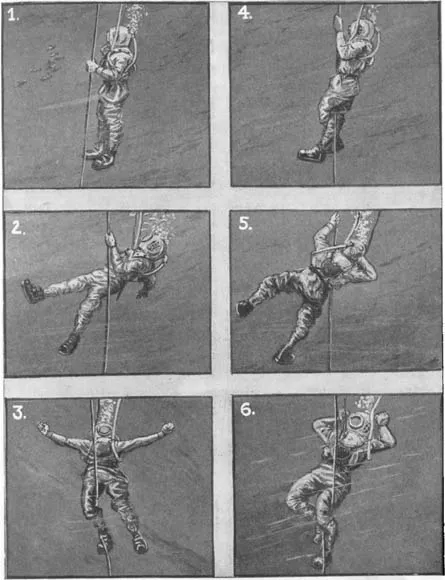
FIG. 9. DIVER ON HIS SHOT ROPE DOING EXERCISES TO GET THE NITROGEN OUT OF HIS BLOOD
By courtesy of Siebe, Gorman & Co. Ltd.
We cannot keep nitrogen from soaking into the diver’s blood while he is breathing compressed air. We can, however, prevent the bubbles forming afterwards. In the case of the soda-water bottle it sometimes happens that when the cork is drawn the water is found to be “flat”; there is no pop and there are no bubbles. This means that there has been a leak somewhere and that the gas with which the water was charged under pressure has slowly and quietly oozed away.
The same sort of thing can be done with the diver. If, instead of being hauled up from a deep dive to the surface right away, he is hauled up part of the way (where, of course, the pressure is lower than it was farther down) and kept there for a time, some of the nitrogen will ooze out of his blood quite harmlessly. He can then be hauled up a little farther and, after another pause for more oozing, up another step, and so in safety to the surface.
“Haldane’s Tables”
This step-by-step method was not the first to be tried. For many years the practice was to haul the diver up very slowly and quite steadily, but the step-by-step method, which was tried later, turned out to be much better.
In the year 1906 the British Admiralty formed a Deep Diving Committee to go into the whole question, and a member of that Committee, the late Professor J. S. Haldane of Oxford University, made many experiments on both animals and men to find out the best way. He also worked out exactly how high each step should be, and how long the pauses at each step, according to the depth at which the diver had been working and the time he had been below. The figures he got out are known to all divers as “Haldane’s Tables,” and they were so excellent that “bends” are now a thing of the past.
Since these tables were first drawn up the Admiralty and Siebe, Gorman and Company have collaborated in many experiments in deep diving, with the result that the tables have been extended and altered, and 300 feet has now become the routine depth for deep diving in the Navy.
Science thus swept away a terrible danger that haunted the diver. It has since improved the diver’s lot by making the business of getting rid of the nitrogen much quicker and more pleasant than it was at first.
It was very wearisome for the diver to dangle in deep water, with nothing to do but to keep moving his arms and legs so as to help the nitrogen in his blood to get away. If he had been working in deep water he might have to spend an hour and more on the way up, perhaps in bitterly cold water.
What is the D.S.D.C.?
All that has been changed by an invention known in the British Navy as the “D.S.D.C.” These letters, like the D.S.D.C. itself, save a great deal of time; they stand for “Davis Submerged Decompression Chamber,” invented by Sir Robert Davis, of Siebe, Gorman and Company, Ltd. This is a steel barrel with room in it for two men and with a door at the bottom large enough for a man to get in. When in service the chamber is lowered, with a man inside, to a certain depth with the bottom door open, air being pumped in to keep the water out. Up comes the diver and climbs a short ladder in through the door. After his hel...
Table of contents
- Cover
- Half title
- Copyright
- Title
- Contents
- List of Illustrations
- Introduction
- I. Diving in Olden Days
- II. What Water Pressure Means
- III. The Invention of the Diving Suit
- IV. Down Goes the Diver
- V. Divers at Work
- VI. The Dangers of Diving
- VII. The All-Metal Diving Dress
- VIII. The Diving Bell
- IX. How Ships are Salved
- X. Salving the “Gladiator”
- XI. Salving Ships Upside Down
- XII. Raising an American Submarine
- XIII. The Treasure of the “Laurentic”
- XIV. The “Egypt’s” Treasure and the “Observation Chamber”
- XV. Tales of Sunken Treasure
- XVI. An “Everyday” Salvage Job
Trusted by 375,005 students
Access to over 1.5 million titles for a fair monthly price.
Study more efficiently using our study tools.
Frequently asked questions
Yes, you can cancel anytime from the Subscription tab in your account settings on the Perlego website. Your subscription will stay active until the end of your current billing period. Learn how to cancel your subscription
No, books cannot be downloaded as external files, such as PDFs, for use outside of Perlego. However, you can download books within the Perlego app for offline reading on mobile or tablet. Learn how to download books offline
Perlego offers two plans: Essential and Complete
- Essential is ideal for learners and professionals who enjoy exploring a wide range of subjects. Access the Essential Library with 800,000+ trusted titles and best-sellers across business, personal growth, and the humanities. Includes unlimited reading time and Standard Read Aloud voice.
- Complete: Perfect for advanced learners and researchers needing full, unrestricted access. Unlock 1.5M+ books across hundreds of subjects, including academic and specialized titles. The Complete Plan also includes advanced features like Premium Read Aloud and Research Assistant.
We are an online textbook subscription service, where you can get access to an entire online library for less than the price of a single book per month. With over 1.5 million books across 990+ topics, we’ve got you covered! Learn about our mission
Look out for the read-aloud symbol on your next book to see if you can listen to it. The read-aloud tool reads text aloud for you, highlighting the text as it is being read. You can pause it, speed it up and slow it down. Learn more about Read Aloud
Yes! You can use the Perlego app on both iOS and Android devices to read anytime, anywhere — even offline. Perfect for commutes or when you’re on the go.
Please note we cannot support devices running on iOS 13 and Android 7 or earlier. Learn more about using the app
Please note we cannot support devices running on iOS 13 and Android 7 or earlier. Learn more about using the app
Yes, you can access Divers and Diving by Adam Gowans Whyte in PDF and/or ePUB format. We have over 1.5 million books available in our catalogue for you to explore.