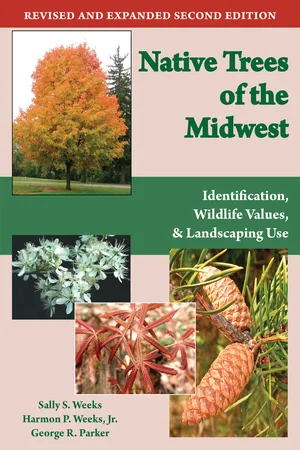
eBook - ePub
Native Trees of the Midwest
Identification, Wildlife Value, and Landscaping Use
- 357 pages
- English
- ePUB (mobile friendly)
- Available on iOS & Android
eBook - ePub
Native Trees of the Midwest
Identification, Wildlife Value, and Landscaping Use
About this book
Native Trees of the Midwest is a definitive guide to identifying trees in Indiana and surrounding states, written by three leading forestry experts. Descriptive text explains how to identify every species in any season and color photographs show all important characteristics. Not only does the book allow the user to identify trees and learn of their ecological and distributional attributes, but it also presents an evaluation of each species relative to its potential ornamental value for those interested in landscaping. Since tree species have diverse values to wildlife, an evaluation of wildlife uses is presented with a degree of detail available nowhere else. The revised and expanded second edition contains a chapter on introduced species that have become naturalized and invasive throughout the region. All accounts have been reviewed and modifications made when necessary to reflect changes in taxonomy, status, or wildlife uses. Keys have been modified to incorporate introduced species.
Information
Subtopic
BotanyOpposite, Simple
Maples
Genus: Acer
The maples are represented by 14 species in the United States. Sugar (A. saccharum) and black maples (A. nigrum) have great commercial value because of their hard, strong, close-grained wood, which is used in making furniture, flooring, and cabinets. Bird’s-eye maple is a patterned wood (usually from sugar maple) that is much sought after for veneer. Along with their importance as lumber producers, sugar and black maples are commonly tapped in late winter for valuable sap to make maple syrup. The terms hard and soft maple are commonly used, and refer to the hard wood of the sugar and black maples versus the softer wood of the silver (A. saccharinum) and red maples (A. rubrum).
Maples are extensively used as ornamentals and are easily purchased through nurseries. Unfortunately, those most readily available are the soft-wooded silver maple and various Asian and European species.
From a wildlife perspective, maples are relatively important, but soft maples and hard maples have somewhat different values and uses. Leaves and twigs are generally preferred browse by white-tailed deer, moose, porcupine, and rabbits, but the soft maples are less preferred than the hard maples, and porcupines do not use red maple at all. Flower buds of maples are eaten to some degree by tree squirrels and ruffed grouse, and seeds are used by a variety of rodents, as well as by songbirds, ruffed grouse, and wild turkey. Availability of Acer seeds to wildlife is prolonged because our soft maples fruit in early spring and hard maples in mid- to late summer. Tree squirrels gnaw bark and drink sap of hard maples in the spring but rarely touch soft maples. Because maples are ubiquitous and common, they are used for nesting by songbirds, raptors, and tree squirrels, but are probably less preferred than trees of several other genera. Soft maples tend to form cavities and provide nesting opportunities for both primary and secondary cavity users.
Maples are easily recognized by their 3-to-5-lobed leaves (except for boxelder), and by their paired, winged seeds (samaras), which whorl like helicopter blades when they ripen and fly to the ground.

The paired, winged fruit of the boxelder.

Opposite branching on the boxelder.

The dense, spreading open-grown form of the sugar maple.

The fall color of the sugar maple.
black maple
Acer nigrum Michaux f.
Family: Aceraceae
Quick ID: opposite branching; dark green, 5-lobed leaves that droop on each side; usually has a leaf-like bract at base of leaf; buds nearly black, hairy, pointed
Black maple occurs throughout most of Indiana but is much less common than sugar maple, which it closely resembles. Black maple prefers moister sites.
Form and Size: Mature trees average 80 feet in height. Open-grown trees have oval, very dense crowns and short trunks. They are long-lived, often reaching 400 years of age.
Habitat: Black maple prefers moist sites along streams and river bottoms and is more common on calcareous soils. It is more often found at the base of a slope, while sugar maple will be found on the slope. It is extremely shade-tolerant. Hybridization between sugar and black maples occurs.
Wildlife Uses: Black maple is very similar to sugar maple in its wildlife value. Leaves and twigs are browsed by white-tailed deer in all seasons, and the seeds, which are produced in late summer, are used by rodents, wild turkey, ruffed grouse, and various songbirds. The bark is frequently used by porcupines in the northern reaches of its range, and elsewhere red and gray squirrels often strip bark from saplings and limbs of larger trees in the spring in order to eat the sweet inner bark and drink the sap flowing from the injuries.
Landscaping Value: Hardy to Zone 3, black maple is hard to beat because of its spectacular fall colors of yellow, orange, and red. It provides dense shade, is easy to transplant, and is resistant to atmospheric pollution. However, it is sensitive to drought and salt. A horticultural selection, ‘Green Column,’ has an upright, narrow form.
Similar Species Distinctions:
—Sugar maple (A. saccharum) leaves do not droop on the sides. It does not have the bract at the base of the leaf petiole. Sugar maple twigs are uniformly brown compared to the mottled coloration of the black maple twig. Hairs on the buds, leaves, and fruit of black maple are not always present and not a reliable identification tool. Hybrids can have bud and twig characteristics of both species. Bark differences between sugar and black are subtle. Both species have highly variable bark patterns, but black tends to have deeper furrows than sugar maple.
—The “soft” maples—red, silver, and boxelder—have rounded buds.


Black maple leaves are dark green and 5-lobed. The sides always droop as if the tree needs watering. They are commonly somewhat hairy. There is usually a tiny bract at the base of the leaf blade.

The bright yellow, dangling flowers appear in April and May, depending on latitude. A tree can have both perfect and staminate flowers.

Black maple produces 1½-inch-long winged seeds that are paired. They ripen in the fall and spin like helicopter blades when they sail to the ground. There may be hairs on the outside covering of the seed.

Black maple buds are fairly sharply pointed with overlapping blackish scales. The scales are often slightly hairy. Twigs are stout with mottled gray, tan, and black colorations.

Mature black maple bark is tan-gray with irregular vertical ridges that often curl along one side.
striped maple
Acer pensylvanicum Linneaus
Family: Aceraceae
Quick ID: opposite branching; leaves 3-lobed with serrate margins; buds red, elongate, stalked, with 2 keeled scales; twigs greenish or reddish, developing obvious white stripes after first year; bark greenish brown with obvious white stripes
Striped maple is a small tree or large shrub that prefers cooler climates. It is common in the Northeast, but has a very restricted...
Table of contents
- Cover
- Title
- Copyright
- Contents
- Preface to the Second Edition
- Preface to the First Edition
- Introduction
- Illustrated Glossary
- Conifers
- Hardwoods
- Introduced Species
- Keys
- Introduced Species
- Plant Hardiness Zone Map
- Bibliography
- Index
- About the Authors
Trusted by 375,005 students
Access to over 1.5 million titles for a fair monthly price.
Study more efficiently using our study tools.
Frequently asked questions
Yes, you can cancel anytime from the Subscription tab in your account settings on the Perlego website. Your subscription will stay active until the end of your current billing period. Learn how to cancel your subscription
No, books cannot be downloaded as external files, such as PDFs, for use outside of Perlego. However, you can download books within the Perlego app for offline reading on mobile or tablet. Learn how to download books offline
Perlego offers two plans: Essential and Complete
- Essential is ideal for learners and professionals who enjoy exploring a wide range of subjects. Access the Essential Library with 800,000+ trusted titles and best-sellers across business, personal growth, and the humanities. Includes unlimited reading time and Standard Read Aloud voice.
- Complete: Perfect for advanced learners and researchers needing full, unrestricted access. Unlock 1.5M+ books across hundreds of subjects, including academic and specialized titles. The Complete Plan also includes advanced features like Premium Read Aloud and Research Assistant.
We are an online textbook subscription service, where you can get access to an entire online library for less than the price of a single book per month. With over 1.5 million books across 990+ topics, we’ve got you covered! Learn about our mission
Look out for the read-aloud symbol on your next book to see if you can listen to it. The read-aloud tool reads text aloud for you, highlighting the text as it is being read. You can pause it, speed it up and slow it down. Learn more about Read Aloud
Yes! You can use the Perlego app on both iOS and Android devices to read anytime, anywhere — even offline. Perfect for commutes or when you’re on the go.
Please note we cannot support devices running on iOS 13 and Android 7 or earlier. Learn more about using the app
Please note we cannot support devices running on iOS 13 and Android 7 or earlier. Learn more about using the app
Yes, you can access Native Trees of the Midwest by Sally S. Weeks,Harmon P. Weeks Jr.,George R. Parker in PDF and/or ePUB format, as well as other popular books in Technology & Engineering & Botany. We have over 1.5 million books available in our catalogue for you to explore.