Bringing together a wealth of knowledge, the Handbook of Environmental Management, Second Edition, gives a comprehensive overview of environmental problems, their sources, their assessment, and their solutions. Through in-depth entries, and a topical table of contents, readers will quickly find answers to questions about pollution and management issues. This six-volume set is a reimagining of the award-winning Encyclopedia of Environmental Management, published in 2013, and features insights from more than 500 contributors, all experts in their fields.
The experience, evidence, methods, and models used in studying environmental management is presented here in six stand-alone volumes, arranged along the major environmental systems.
Features of the new edition:
The first handbook that demonstrates the key processes and provisions for enhancing environmental management.
Addresses new and cutting -edge topics on ecosystem services, resilience, sustainability, food-energy-water nexus, socio-ecological systems and more.
Provides an excellent basic knowledge on environmental systems, explains how these systems function and offers strategies on how to best manage them.
Includes the most important problems and solutions facing environmental management today.
In this second volume, Managing Air Quality and Energy Systems, the reader is introduced to the general concepts and processes of the atmosphere, with its related systems. This volume explains how these systems function and provides strategies on how to best manage them. It serves as an excellent resource for finding basic knowledge on the atmosphere, and includes important problems and solutions that environmental managers face today. This book practically demonstrates the key processes, methods, and models used in studying environmental management.
V ENT: Environmental Management Using Environmental Technologies
21 Air Pollution: Monitoring
Waldemar Wardencki
Introduction
Objectives of Air Monitoring
History of Air Pollution Legislation
Air Quality Standards
Air Quality Index
Regulated Air Pollutants
Main Sources of Air Pollutants
Characteristics of Criteria Air Pollutants
Air Quality Monitoring
Design of Monitoring Networks for Air Pollution
Types of Information Obtained from Air Monitoring
General Requirements of the Instruments Used in Monitoring
Classification of the Instruments Used for the Detection and Monitoring of Air Pollutants
General Characteristics of the Methods and Analytical Instruments for Air Monitoring
Chemiluminescence for NO EN 14211
Ultraviolet Fluorescence for SO2 EN 14212
Non-Dispersive Infrared for CO EN 14626
Ultraviolet Photometry for O3 EN 14625
Online Gas Chromatography for Benzene EN 14662-Part 3
Other Monitoring Approaches
Biomonitoring Using Plants
GIS in Air Quality Monitoring
Remote Monitoring Techniques
Monitoring of Flue and Exhaust Gas Emissions
Systems for Continuous Monitoring of Stack Gases
Conclusions
References
Introduction
Concern about air quality is not new. The first reports of air pollution problems appear to have been made by writers in ancient Rome who were aware of its adverse effects on human health. Air pollution and its consequences had originally been considered to be relatively local phenomena associated with urban and industrial centers. Complaints were recorded in the 13th century when coal was first used in London. Now, it has become apparent that pollutants may be transported long distances in the air, causing adverse effects in environments far removed from the source emission. Scientific research, conducted over 200 years, has evidently shown that polluted air has a negative influence on health and, in some cases, may lead to death. The World Health Organization (WHO) appraises that air pollution causes approximately 2 million premature deaths worldwide per year. The levels of pollutants, which have a negative influence on life, are nowadays well defined. Because current thresholds set by national or global air quality guideline values are frequently exceeded, further reductions of emissions are necessary.
The first essential step in controlling and mitigating air pollution is to quantify the emissions of air pollutants. Most countries entail controlling a range of key pollutants at their point of discharge. The most important tool in environmental protection is monitoring. Environmental monitoring is the general term for systematic observations of what is going on in the environment. In the broadest context, environmental monitoring is defined as a system of measurements, evaluations, and forecasts of environmental states, and the collecting, processing, and spreading of information on the environment.
Air pollution and its control are a global issue demanding international cooperation. Monitoring of air pollution is a very important source of data. However, measurement of air pollutant concentrations, in comparison to monitoring of other elements of the environment, is the most difficult. This is related to the dynamics of the atmosphere, making it the main route of pollutant transport between the remaining environmental compartments. Unlike the case of water and soil pollution, environmental pollution is not geographically restricted, as a result of which large human populations can be exposed to it. Another problem is low concentration of air pollutants and their interaction with other gases.
This entry reviews the issues in the field of air pollution monitoring. At the beginning, the general objectives of air monitoring, ambient air quality standards for so-called criteria pollutants, and their sources are presented. In the next part, both analytical methods and instruments for monitoring of ambient air and stack gases are briefly presented. Additionally, other approaches applied in air pollution monitoring, such as biomonitoring, geographical information system (GIS), or remote monitoring, are also briefly characterized.
Objectives of Air Monitoring
Collecting information on the presence and concentration of pollutants in the environment, both naturally occurring or from anthropogenic sources, may be achieved by measurements of such substances or phenomenon of interest. For realistic assessment, temporal and spatial variations of concentrations in the particular environmental compartment, repeated measurements rather than single ones, are made.
The general aim of monitoring is to provide information about the actual levels of harmful or potentially harmful pollutants to indicate areas in which the quality of air does not fulfill proper standards. The main objectives of air monitoring are as follows:
To measure pollutant mixing ratios and their interactions, patterns, and fate in the environment.
To carry out ecotoxicological studies and assessment of the effects of pollution on man and the environment, to identify possible cause-and-effect relationship between pollutant concentration and health effects.
To assess emission sources and the need for legislative controls on emissions of pollutants and to ensure compliance with emission standards.
To activate emergency procedures in areas prone to acute pollution episodes.
To obtain a historical record of air quality to provide a database for future use.
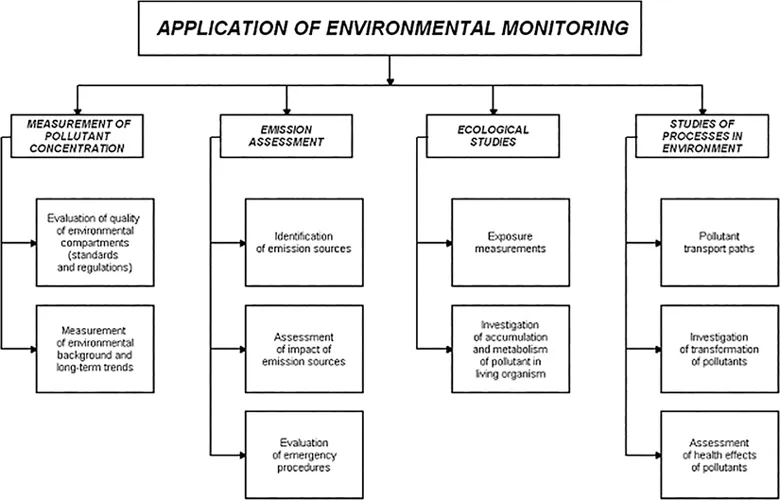
The area of applications of air monitoring data is presented in Figure 1.
FIGURE 1 The detailed goals of activities in air monitoring.
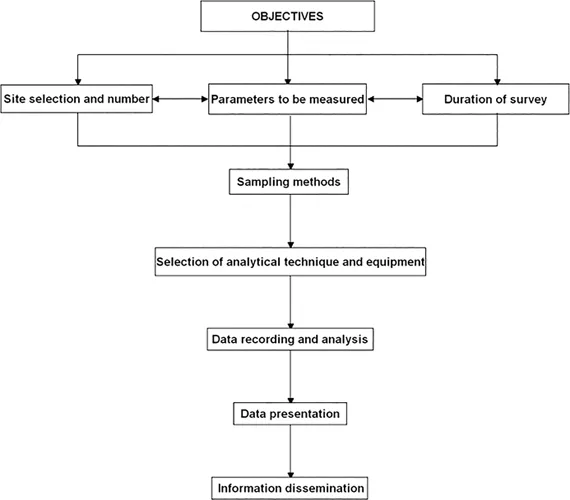
When the objectives of monitoring are clearly defined, several decisions should be made to generate suitable data for the intended use. Decisions on what to monitor, when and where to monitor, and how to monitor are usually undertaken at the beginning. More difficult are next decisions, e.g., establishing the number and location of sampling sites, the duration of the survey, and the time resolution of sampling. All the steps in the design of a monitoring program are presented in Figure 2.
FIGURE 2 Steps in the design of a monitoring program.
History of Air Pollution Legislation
A growing concern over the influence of different air pollutants on human health was the main driving force to develop and implement air quality criteria and standards. Impetus was given to the development of air quality standards in 1958 when it was realized that photochemical problems could not be resolved without control of motor vehicle emission.
Air Quality Standards
Efforts to regulate air quality by law were discussed and undertaken in the 1960s. One of the first p...
Table of contents
Cover
Half Title
Series Page
Title Page
Copyright Page
Table of Contents
Preface
Editors
Contributors
Section I APC: Anthropogenic Chemicals and Activities
Section II COV: Comparative Overviews of Important Topics for Environmental Management
Section III CSS: Case Studies of Environmental Management
Section IV DIA: Diagnostic Tools: Monitoring, Ecological Modeling, Ecological Indicators, and Ecological Services
Section V ENT: Environmental Management Using Environmental Technologies
Section VI PRO: Basic Environmental Processes
Index
Trusted by 375,005 students
Access to over 1.5 million titles for a fair monthly price.
Study more efficiently using our study tools.
Frequently asked questions
Yes, you can cancel anytime from the Subscription tab in your account settings on the Perlego website. Your subscription will stay active until the end of your current billing period. Learn how to cancel your subscription
No, books cannot be downloaded as external files, such as PDFs, for use outside of Perlego. However, you can download books within the Perlego app for offline reading on mobile or tablet. Learn how to download books offline
Perlego offers two plans: Essential and Complete
Essential is ideal for learners and professionals who enjoy exploring a wide range of subjects. Access the Essential Library with 800,000+ trusted titles and best-sellers across business, personal growth, and the humanities. Includes unlimited reading time and Standard Read Aloud voice.
Complete: Perfect for advanced learners and researchers needing full, unrestricted access. Unlock 1.5M+ books across hundreds of subjects, including academic and specialized titles. The Complete Plan also includes advanced features like Premium Read Aloud and Research Assistant.
Both plans are available with monthly, semester, or annual billing cycles.
We are an online textbook subscription service, where you can get access to an entire online library for less than the price of a single book per month. With over 1.5 million books across 990+ topics, we’ve got you covered! Learn about our mission
Look out for the read-aloud symbol on your next book to see if you can listen to it. The read-aloud tool reads text aloud for you, highlighting the text as it is being read. You can pause it, speed it up and slow it down. Learn more about Read Aloud
Yes! You can use the Perlego app on both iOS and Android devices to read anytime, anywhere — even offline. Perfect for commutes or when you’re on the go. Please note we cannot support devices running on iOS 13 and Android 7 or earlier. Learn more about using the app
Yes, you can access Managing Air Quality and Energy Systems by Brian D. Fath, Brian D. Fath,Sven Erik Jorgensen in PDF and/or ePUB format, as well as other popular books in Technology & Engineering & Environmental Law. We have over 1.5 million books available in our catalogue for you to explore.