Managing Water Resources and Hydrological Systems
eBook - ePub

Managing Water Resources and Hydrological Systems

  1. 762 pages
  2. English
  3. ePUB (mobile friendly)
  4. Available on iOS & Android
eBook - ePub

Managing Water Resources and Hydrological Systems

About this book

Bringing together a wealth of knowledge, Environmental Management Handbook, Second Edition, gives a comprehensive overview of environmental problems, their sources, their assessment, and their solutions. Through in-depth entries and a topical table of contents, readers will quickly find answers to questions about environmental problems and their corresponding management issues. This six-volume set is a reimagining of the award-winning Encyclopedia of Environmental Management, published in 2013, and features insights from more than 400 contributors, all experts in their field.

The experience, evidence, methods, and models used in studying environmental management are presented here in six stand-alone volumes, arranged along the major environmental systems.

Features

  • The first handbook that demonstrates the key processes and provisions for enhancing environmental management
  • Addresses new and cutting-edge topics on ecosystem services, resilience, sustainability, food–energy–water nexus, socio-ecological systems, and more
  • Provides an excellent basic knowledge on environmental systems, explains how these systems function, and offers strategies on how to best manage them
  • Includes the most important problems and solutions facing environmental management today

In this fourth volume, Managing Water Resources and Hydrological Systems, the reader is introduced to the general concepts and processes of the hydrosphere with its water resources and hydrological systems. This volume serves as an excellent resource for finding basic knowledge on the hydrosphere systems and includes important problems and solutions that environmental managers face today. This book practically demonstrates the key processes, methods, and models used in studying environmental management.
Trusted by 375,005 students

Access to over 1 million titles for a fair monthly price.

Study more efficiently using our study tools.

Information

Publisher
CRC Press
Year
2020
eBook ISBN
9781000081947

II
COV: Comparative Overviews of Important Topics for Environmental Management

11
Rain Water: Harvesting

K.F. Andrew Lo
Introduction
Advantages of Rainwater Harvesting
Types of Rainwater Harvesting Systems
Simple Rooftop Collection Systems
Large Systems for Educational Institutions, Stadiums, Airports, and Other Facilities
Rooftop Collection Systems for High-Rise Buildings in Urbanized Areas
Land Surface Catchments
Collection of Stormwater in Urbanized Catchment
Design and Maintenance of Rainwater Harvesting Systems
Catchment Surface
Conveyance Systems
Storage Tanks
Conclusion
References

Introduction

Among the various alternative technologies to augment water resources, rainwater harvesting is a simple, decentralized solution and imposes insignificant impact on the environment. It is an important water source in many areas with significant rainfall but lacking any kind of conventional, centralized supply system. It is also a good option in areas where good-quality fresh surface water or groundwater is lacking. Rainwater harvesting systems have been used since ancient times and evidence of roof catchment systems dates back to early Roman times. In the Negev Desert in Israel, in Libya and Egypt, in Mexico, and in the Andes Range in South America as well as in the Arizona Desert in North America, stone dams and tanks were built to divert and store rainwater for irrigation purposes.

Advantages of Rainwater Harvesting

Rainwater harvesting systems can provide water at, or near, the point where water is needed or used. The systems can be both owner-operated and utility-operated, and owner-managed and utility-managed. Rainwater collected using existing structures (rooftops, parking lots, playgrounds, parks, ponds, and flood plains) has few negative environmental impacts compared with other water resources development technologies.[1] Rainwater is relatively clean and the quality is usually acceptable for many purposes with little or even no treatment. The physical and chemical properties of rainwater are usually superior to sources of groundwater that may have been subject to contamination.
Other advantages of rainwater harvesting include the following:
  1. Rainwater harvesting can coexist with, and provide a good supplement to, other water sources and utility systems, thus relieving pressure on other water sources.
  2. Rainwater harvesting provides a water supply buffer for use in times of emergency or breakdown of public water supply systems, particularly during natural disasters.
  3. Rainwater harvesting can reduce storm drainage load and flooding in cities.
  4. The owners who operate and manage the rainwater catchment system are more willing to exercise water conservation.
  5. Rainwater harvesting technologies are flexible and can be built to meet almost any requirements.

Types of Rainwater Harvesting Systems

Collection systems can vary from simple households to large catchment systems. The categorization of rainwater harvesting systems depends on factors such as the size and nature of the catchment areas and whether the systems are in urban or rural settings.[2]

Simple Rooftop Collection Systems

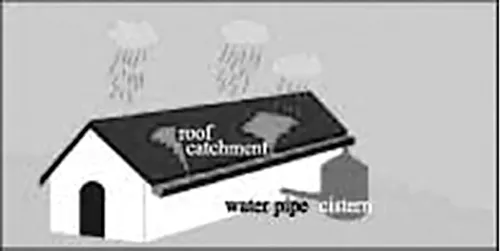
The main components of a simple rooftop collection system are the cistern itself, the piping that leads to the cistern, and the appurtenances within the cistern (Figure 1). The materials and the degree of sophistication of the whole system largely depend on the initial capital investment. Some cost-effective systems involve cisterns made with ferrocement. In some cases, the harvested rainwater may be filtered or disinfected.
Image
FIGURE 1 A simple roof catchment system (illustrated by Chia-Ming Lin).

Large Systems for Educational Institutions, Stadiums, Airports, and Other Facilities

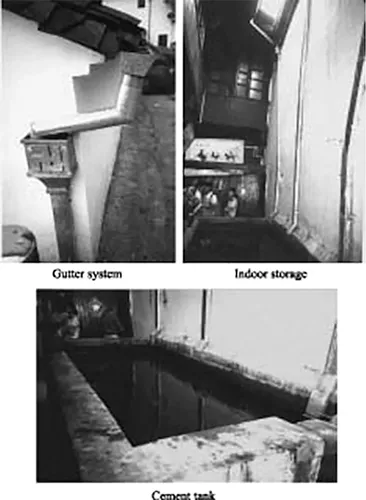
When the systems are larger, the overall system can become more complicated (e.g., rainwater collection from roofs and grounds of institutions, storage in underground reservoirs, and treatment and use for non-potable applications) (Figure 2).
Image
FIGURE 2 An indoor storage system in a monastery in China (photographed by K. F. Andrew Lo).

Rooftop Collection Systems for High-Rise Buildings in Urbanized Areas

In high-rise buildings, roofs can be designed for catchment purposes and the collected roof water can be kept in separate cisterns on the roofs for non-potable uses.

Land Surface Catchments

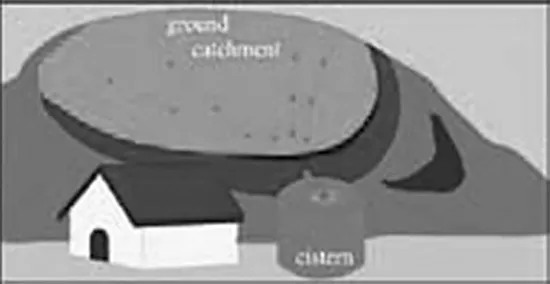
Ground catchment techniques (Figure 3) provide more opportunity for collecting water from a larger surface area. By retaining small creek and stream flows in small storage surfaces or underground reservoirs, can meet water demands during dry periods. However, there is a possibility of high seepage loss to the ground. The marginal quality of the water collected is suitable for use mainly in agriculture.
Image
FIGURE 3 A land catchment system (illustrated by Chia-Ming Lin).

Collection of Stormwater in Urbanized Catchment

The surface runoff collected in stormwater ponds/reservoirs from urban areas is subject to a wide variety of contaminants. Keeping these catchments clean is of primary importance; hence the cost of water pollution control can be considerable.

Design and Maintenance of Rainwater Harvesting Systems

Typically, a rainwater harvesting system consists of three basic elements: the collection system, the conveyance system, and the storage system.

Catchment Surface

The effective catchment area and the material used in constructing the catchment surface influence collection efficiency and water quality. Materials commonly used for roof catchment are corrugated aluminum and galvanized iron, concrete, fiberglass shingles, tiles, and slates. Mud is used primarily in rural areas. Bamboo roofs are least suitable because of possible health hazards. The catchment surface materials must be non-toxic and must not contain substances that impair water quality. Roofs with metallic paint or other coatings are not recommended because they may impart tastes or color to the collected water. Catchment surfaces and collection devices should be cleaned regularly to remove dust, leaves, and bird droppings to minimize bacterial contamination and to maintain the quality of collected water. Roofs should also be free from overhanging trees because birds and animals in the trees may defecate on the roofs.
When land surfaces are used as catchment areas, various techniques are available to increase runoff capacity: 1) clearing or altering vegetation cover; 2) increasing the land slope with artificial ground cover; and 3) reducing soil permeability by soil compaction. Specially constructed ground surfaces (concrete, paving stones, or some kind of liner) or paved runways can also be used to collect and convey rainwater to storage tanks or reservoirs. Care is required to avoid land surface damage and contamination by people and animals. If required, these surfaces should be fenced to prevent people and animal entry. Large cracks in the paved catchment because of soil movement, earthquakes, or prolonged exposure should be repaired immediately. Maintenance, typically consisting of the removal of dirt, leaves, and other accumulated materials, should take place annually before the start of the major rainfall season.

Conveyance Systems

Conveyance systems are required to transfer the rainwater collected on catchment surfaces to storage tanks. This is usually accomplished by making connections to one or more downpipes connected to collection devices. The pipes used for conveying rainwater, wherever possible, should be made of plastic, polyvinyl chloride (PVC), or other inert substance because the pH of rainwater can be acidic and may cause corrosion and mobilization of metals in metal pipes.
When it first starts to rain, dirt and debris from catchment surfaces and collection devices will be washed into the conveyance systems. Relatively clean water will only be available sometime later in the storm. The first part of each rainfall should be diverted from the storage tank. There are several possible options for selectively collecting clean water for the storage tanks. The common method is a sediment trap, which prevents debris entry into the tank. Installing a first-flush (or foul-flush) device is also useful to divert the initial batch of rainwater away from the tank.[3]
Rainwater pipes must be permanently marked in such a way that there is no risk of confusing them with drinking water pipes. Gutters and downpipes need to be periodically inspected and carefully cleaned. A good tim...

Table of contents

  1. Cover
  2. Half Title
  3. Series Page
  4. Title Page
  5. Copyright Page
  6. Table of Contents
  7. Preface
  8. Editors
  9. Contributors
  10. Section I APC: Anthropogenic Chemicals and Activities
  11. Section II COV: Comparative Overviews of Important Topics for Environmental Management
  12. Section III CSS: Case Studies of Environmental Management
  13. Section IV DIA: Diagnostic Tools: Monitoring, Ecological Modeling, Ecological Indicators, and Ecological Services
  14. Section V ELE: Focuses on the Use of Legislation or Policy to Address Environmental Problems
  15. Section VI ENT: Environmental Management Using Environmental Technologies
  16. Section VII NEC: Natural Elements and Chemicals Found in Nature
  17. Section VIII PRO: Basic Environmental Processes
  18. Index

Frequently asked questions

Yes, you can cancel anytime from the Subscription tab in your account settings on the Perlego website. Your subscription will stay active until the end of your current billing period. Learn how to cancel your subscription
No, books cannot be downloaded as external files, such as PDFs, for use outside of Perlego. However, you can download books within the Perlego app for offline reading on mobile or tablet. Learn how to download books offline
Perlego offers two plans: Essential and Complete
  • Essential is ideal for learners and professionals who enjoy exploring a wide range of subjects. Access the Essential Library with 800,000+ trusted titles and best-sellers across business, personal growth, and the humanities. Includes unlimited reading time and Standard Read Aloud voice.
  • Complete: Perfect for advanced learners and researchers needing full, unrestricted access. Unlock 1.4M+ books across hundreds of subjects, including academic and specialized titles. The Complete Plan also includes advanced features like Premium Read Aloud and Research Assistant.
Both plans are available with monthly, semester, or annual billing cycles.
We are an online textbook subscription service, where you can get access to an entire online library for less than the price of a single book per month. With over 1 million books across 990+ topics, we’ve got you covered! Learn about our mission
Look out for the read-aloud symbol on your next book to see if you can listen to it. The read-aloud tool reads text aloud for you, highlighting the text as it is being read. You can pause it, speed it up and slow it down. Learn more about Read Aloud
Yes! You can use the Perlego app on both iOS and Android devices to read anytime, anywhere — even offline. Perfect for commutes or when you’re on the go.
Please note we cannot support devices running on iOS 13 and Android 7 or earlier. Learn more about using the app
Yes, you can access Managing Water Resources and Hydrological Systems by Brian D. Fath, Sven Erik Jorgensen, Brian D. Fath,Sven Erik Jorgensen, Brian D. Fath in PDF and/or ePUB format, as well as other popular books in Physical Sciences & Environmental Law. We have over one million books available in our catalogue for you to explore.