Winner of the 2015 Educational Publishing Awards Australia - Scholarly Resource
Most people of European background are not aware that they see the world through the lens of the Western tradition, but for Indigenous people, it can seem like a foreign language.
Indigenous ways of thinking and working are grounded in many thousands of years of oral tradition, and continue among Australian Aboriginal and Torres Strait Island people today. Lorraine Muller shows that understanding traditional holistic approaches to social and emotional wellbeing is essential for practitioners working with Indigenous clients across the human services. She explores core principles of traditional Indigenous knowledge in Australia, including relatedness, Country, circular learning, stories, and spirituality. She then shows how these principles represent a theory for Indigenous practice.
A Theory for Indigenous Australian Health and Human Service Work offers a deep insight into Indigenous Australian ways of working with people, in the context of a decolonisation framework. It is an invaluable resource for both Indigenous and non-Indigenous practitioners and researchers in health, social work, community work, education and related fields.
'In today's global environment, where Indigenous Peoples continue to fight for self-determination, Muller's work is an exemplary model of Indigenous self- determination. It is bound to be a foundational model of Indigenous practice in field of health and well-being.' - Michael Hart, Canada Research Chair in Indigenous Knowledges and Social Work, University of Manitoba
'Lorraine Muller's work covers some centrally important issues for those that work with Aboriginal and Torres Strait Islander people, and who want to understand indigenous knowledge frameworks.' - Dr Mark Wenitong, Apunipima Cape York Health Council
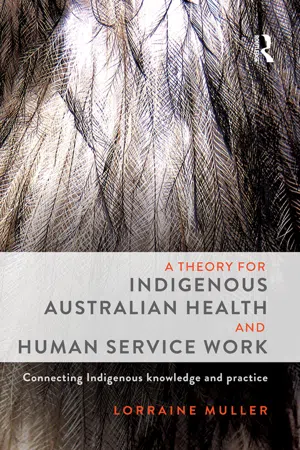
eBook - ePub
A Theory for Indigenous Australian Health and Human Service Work
Connecting Indigenous knowledge and practice
- 272 pages
- English
- ePUB (mobile friendly)
- Available on iOS & Android
eBook - ePub
A Theory for Indigenous Australian Health and Human Service Work
Connecting Indigenous knowledge and practice
About this book
Information
Chapter 1
THE POWER OF STORY
I always knew that I was a little bit different, not black enough to be black, and not white enough to be white—I am not quite white.
Indigenous writers and speakers normally introduce themselves by saying what Country and peoples they come from because this is the basis of their identity. Like many others, I am not able to introduce myself and my connection to Country. My connection to Country and kin was denied due to the colonisers’ policies and I mourn the loss of connection. In spite of the social engineering policies to ‘breed out the colour’ that denied me that right, it was clear to me that I had a way of looking at the world that did not fit within the conventional social script.
I was born on Kalkadoon Country (in North Western Queensland), raised in Zenadh Kes (the Torres Strait) and live on Girramay Country (Cardwell, North Queensland). It was not until my late 30s, when I finally got to university, that I realised how different I was from the mainstream. I was a mother of four, with the youngest close to finishing high school. Having worked as a coordinator in the Aboriginal Tutorial Assistance Scheme’s homework program, working with mostly non-Indigenous teachers and Indigenous parents and children, I had thought that I was reasonably literate in the mainstream discourse. My experiences with mainstream education systems, while my children were at school, should have alerted me to some of the difficulties I was to face in my own studies. To give an example of this different world view, during preparations at the local primary school for NAIDOC celebrations (a week of celebration of Aboriginal and Torres Strait Islander cultures named after the National Aboriginal and Islander Day Observance Committee), the principal could not see a disparity when he expected Elders to share their cultural knowledge on a voluntary basis, including providing their own transport, while he was being well paid for passing on his settler culture.
It was a shock when I began studying in the social sciences and I was confronted with a world view and cultural truths that clashed with my understanding of the world. Acceptance of the legitimacy of the colonialist interpretation of history and reality challenged me. I reject the use of ‘we’ to mean ‘white/dominant class’. I struggled, and continue to struggle, to understand how a concept such as patriarchy is understood to be a ‘truth’ to be challenged by feminist theory, when I know it as a pestilent concept that was introduced with occupation. Theories and practice models in the social sciences appeared to me to be distorted by foreign cultural assumptions and values.
While I was negotiating my way through this alien landscape of knowledge, I found Indigenous Australian writers reflected my understanding of knowledge and truths. I questioned the reliance on Western theory in tertiary education. The Aboriginal and Torres Strait Islander Women’s Task Force on Violence Report, chaired by Boni Robertson, became my inspiration and my most treasured textbook, for it contained a historical and theoretical base that I could relate to (Robertson, 2000). Indigenous writers discussed theories of relatedness and acceptance of our spirituality that resonated within me (Atkinson, 2002; Martin, 2003; Robertson, 2000).
While this realisation has been a personal pilgrimage for me, these studies have raised my consciousness of the void in literature on theories that relate to the context, values, history and spirituality of Indigenous social-health and welfare practice. Rather than feeling confident in my knowledge after successfully completing mainstream studies, graduating in social science and social work with honours degrees, I remained unfulfilled—something was missing. I knew there is a way of working not represented in the mainstream curriculum: knowledge that has been subjugated.
It was during the latter part of my undergraduate studies that this research project found me. It has been recognised that Indigenous Australians have a different way of working, as documented in Murri Way! (‘Murri’ refers to Aboriginal and Torres Strait Islander Queenslanders; it can sometimes be taken as an offensive term); however, this different way of working was often relegated to that of the ‘other’ in welfare texts (Lynn, Thorpe, Miles, Cutts, Ford & Butcher, 1998). The topic became obvious following discussions in 2003 with my fellow social-work students, Robyn and Paul, about the difficulties of trying to negotiate the relevance of theories and practices that were centred on values and a world view that were foreign. It was clear to us that there is a metatheory informing practice of Indigenous people in the helping professions. Our discussions revealed that we knew many students who, if our theory and praxis were available, would be more likely to relate to and succeed at tertiary studies.
Tokenism and racism are evident in many forms in modern Australia, particularly in the helping professions, and addressing these issues was a major impetus for my research. The majority of people who shared their knowledge with me discussed incidents where their knowledge had been sought and then disregarded or ridiculed. To be the ‘token blackfella’ is an occupational issue that causes real stress to workers. Although tokenism and racism are not the focus of my research, they were themes that arose in almost all of my conversations, and it is hoped that by documenting our knowledge these issues can be challenged.
Conversations with people working in the Indigenous social-health services confirmed for me that the absence of formal and accessible Indigenous theory within the education sector was an enormous barrier to participation. ‘Social health’ is a term I use that takes its place alongside, and at times incorporates, the terms ‘mental health’ and ‘physical health’, to form the holistic notion of ‘social and emotional wellbeing’ (Purdie, Dudgeon & Walker, 2010, p. xxvi). I use the term ‘social health’ as it reflects a holistic model of practice that incorporates the many disciplines where the social, emotional (including spiritual) and physical health of our people is central to practice.
My goal in my research was to identify what is unique about Indigenous Australian social-health theory and practice. This book is an example of Indigenous social-health theory in action. Honouring our ways of working, this book has a circular structure. Starting with foundational knowledge, I return in later chapters to points raised in the earlier chapters, positioning the reader with the necessary knowledge to take deeper learning at each encounter. Rather than just me writing about it, readers get a chance to experience this circular way of learning.
Respecting that a person can only speak for themselves, unless explicit permission is given, I break with Western academic protocols and weave my own story into my work.
As an Indigenous Australian woman I am acutely aware that this task brings with it enormous responsibility. My personal integrity will be scrutinised and I will be held accountable for the validity of the project. Although I am the researcher in this project, my own knowledge, thinking and interaction with the learning process are indelibly part of the research, for this is insider research (Tuhiwai-Smith, 1999). Through the pilgrimage of this research, I have been fortunate to learn from many people who shared their wisdom and knowledge so generously. It has also been a challenging journey. At times, the horrific stories of violence affected me deeply and had it not been for the wisdom shared with me, I would have had great difficulty in continuing this task. Until I began this research, I had not been aware that it is normal to feel another’s pain, let alone known the best ways in which to accept and work with it. Therefore, I also weave my personal story into this work by sharing some of my thought process and experiences.
At the beginning of the formal research journey, I was given explicit guidance from an Elder, directing me to make use of Indigenous learning processes of observation, reflection and clarification. I was instructed to observe what was happening and reflect on how it related to my existing knowledge, even if I was not fully aware of what knowledge I was seeking, or how and where it fitted at the time. I was to observe people in practice, allowing what I was seeing to meld with what I knew, thereby deriving greater understanding. Time and deep reflection was often required to understand how and where each piece fitted with my existing knowledge. This process was repeated throughout the research process in what I experienced as a rhythmic layering and integration of new knowledge with my existing knowledge.
In what others might see as similar to auto-ethnography, it became obvious to me in the very early stages that I was also a research participant. Because I am an Indigenous social-health professional, it was not possible for me to extricate myself out of the research process; as well as being the researcher I was also part of the research focus. Sandy Grande describes her similar experiences with the complexity of insider Indigenous research in this way:
Instead (of Geertz’s participant/observer) the gaze is always shifting inward, outward, and throughout the spaces-in-between, with the idea itself holding ground as the independent variable. As I engage this process, I survey viewpoints on the genealogy of ideas, their representation and potential power to speak across boundaries, borders, and margins, and filter the gathered data through an Indigenous perspective. When I say ‘Indigenous perspective’, what I mean is my perspective as an Indigenous scholar. And when I say ‘my perspective’, I mean from a consciousness shaped not only by my own experiences but also those of my peoples and ancestors. (2008, p. 233)
As Grande explains, far from me being a blank canvas, the values, experiences, knowledge and culture within myself cannot be segregated, and had to be incorporated into the research. Integrating my personal understandings of my learning provided a liberating and ethical approach to sharing knowledge in this project.
Sharing knowledge with others during the research process and transcribing interviews helped me reflect on my own practices and to understand how deeply embedded these are, such as the use of examples to set the context and provide guidance in interviewing. Rather than researcher, I conceptualised myself as ‘learner’, and research participants as ‘sharers of knowledge’.
Positioning myself as one of the research contributors is irrevocable as protocol dictates that one can only speak for themselves unless there is explicit permission otherwise (Martin, 2008). By incorporating myself into the research I can speak on my observations, my experiences of receiving learning, and my interpretations of these. Where explicit permission is given, I can relate another’s wisdom, teachings or stories. Sharing collective knowledge, which is the aim of this project, requires collective approval: consensus.
As I explain in detail later, this project had an ‘expert panel’ to guide me and assist in achieving consensus on what is appropriate to be shared. My personal understanding of what are ‘open findings’ are those things which are openly observable or currently documented, and are separate from what I think of as the ‘conditional findings’. ‘Conditional findings’ reflect the collective knowledge of people who have shared in this research and are reliant on the approval of the expert panel before being put into the open arena. Both the open and conditional findings are subject to the approval of the expert panel; and when necessary I was able to source guidance, clarification and wisdom from its members.
Reflecting on the knowledge and experiences I have received in the course of researching and documenting Indigenous Australian Social-Health Theory, I am now more confident in my knowledge of Indigenous ways of working. I feel complete, for although not yet represented in the mainstream curriculum, this project provides knowledge that will no longer be easily ignored.
JOURNEY OF REDISCOVERY AND RECOVERY
Paperbark Tree
Oodgeroo Noonuccal, 1993
In the new Dreamtime there lived a woman,
an Aborigine,
who longed for her lost tribe,
and for the stories that had belonged to her people;
for she could remember only the happenings
of her own Dreamtime
But the old Dreamtime
had stolen the stories and hidden them. The woman knew
that she must search for the old stories and through them
she might find her tribe again
Biami told her to go to the paperbark trees
and ask them to give her some of their bark …
Then Biami told the woman
to return to the dead fire of her tribe,
collect all the charred sticks,
and place these too, in her bag
and to do this
each time she came upon the dead fire of any lost tribe
She travelled far and wide over the earth,
and each time she came upon the dead fire of a lost tribe,
she would gather the charred sticks,
and when at last her bag was filled with them,
she went to the secret dreaming-places of the old tribes.
Here she rested and again called to Biami,
and asked him to help her remember the old stories,
so that through them she might find her tribe
Biami loved this woman
and he put into her mind a new way
in which she might find those stories and her tribe.
The woman sat down and drew from her bag
the charred pieces of stick she had taken from the dead fires,
and placed the paperbark flat upon the ground.
She drew the sticks across the paperbark,
and saw that they make marks on its surface
So she...
Oodgeroo Noonuccal, 1993
In the new Dreamtime there lived a woman,
an Aborigine,
who longed for her lost tribe,
and for the stories that had belonged to her people;
for she could remember only the happenings
of her own Dreamtime
But the old Dreamtime
had stolen the stories and hidden them. The woman knew
that she must search for the old stories and through them
she might find her tribe again
Biami told her to go to the paperbark trees
and ask them to give her some of their bark …
Then Biami told the woman
to return to the dead fire of her tribe,
collect all the charred sticks,
and place these too, in her bag
and to do this
each time she came upon the dead fire of any lost tribe
She travelled far and wide over the earth,
and each time she came upon the dead fire of a lost tribe,
she would gather the charred sticks,
and when at last her bag was filled with them,
she went to the secret dreaming-places of the old tribes.
Here she rested and again called to Biami,
and asked him to help her remember the old stories,
so that through them she might find her tribe
Biami loved this woman
and he put into her mind a new way
in which she might find those stories and her tribe.
The woman sat down and drew from her bag
the charred pieces of stick she had taken from the dead fires,
and placed the paperbark flat upon the ground.
She drew the sticks across the paperbark,
and saw that they make marks on its surface
So she...
Table of contents
- Cover
- Half Title
- Title Page
- Copyright Page
- Contents
- Foreword
- Acknowledgements
- 1 The power of story
- 2 Story of colonisation
- 3 Decolonisation
- 4 Aboriginal knowledge
- 5 Grounding the research
- 6 Responsibility of knowledge
- 7 Racism
- 8 Spirituality
- 9 Indigenous Australian Social-Health Theory
- 10 Healing and Forgiveness
- 11 Holding knowledge
- References
- Index
Trusted by 375,005 students
Access to over 1.5 million titles for a fair monthly price.
Study more efficiently using our study tools.
Frequently asked questions
Yes, you can cancel anytime from the Subscription tab in your account settings on the Perlego website. Your subscription will stay active until the end of your current billing period. Learn how to cancel your subscription
No, books cannot be downloaded as external files, such as PDFs, for use outside of Perlego. However, you can download books within the Perlego app for offline reading on mobile or tablet. Learn how to download books offline
Perlego offers two plans: Essential and Complete
- Essential is ideal for learners and professionals who enjoy exploring a wide range of subjects. Access the Essential Library with 800,000+ trusted titles and best-sellers across business, personal growth, and the humanities. Includes unlimited reading time and Standard Read Aloud voice.
- Complete: Perfect for advanced learners and researchers needing full, unrestricted access. Unlock 1.5M+ books across hundreds of subjects, including academic and specialized titles. The Complete Plan also includes advanced features like Premium Read Aloud and Research Assistant.
We are an online textbook subscription service, where you can get access to an entire online library for less than the price of a single book per month. With over 1.5 million books across 990+ topics, we’ve got you covered! Learn about our mission
Look out for the read-aloud symbol on your next book to see if you can listen to it. The read-aloud tool reads text aloud for you, highlighting the text as it is being read. You can pause it, speed it up and slow it down. Learn more about Read Aloud
Yes! You can use the Perlego app on both iOS and Android devices to read anytime, anywhere — even offline. Perfect for commutes or when you’re on the go.
Please note we cannot support devices running on iOS 13 and Android 7 or earlier. Learn more about using the app
Please note we cannot support devices running on iOS 13 and Android 7 or earlier. Learn more about using the app
Yes, you can access A Theory for Indigenous Australian Health and Human Service Work by Lorraine Muller in PDF and/or ePUB format, as well as other popular books in Social Sciences & Social Science Research & Methodology. We have over 1.5 million books available in our catalogue for you to explore.