'Seldom has a senior public servant been so candid. As a key policymaker, Meredith Edwards takes us inside the process to reveal how we get the policies the affect so much of our lives.' - Paul Kelly, International Editor, The Australian
'This innovative and important volume, unique in the policy literature, provides ideas and case studies of interest to everyone who cares about the quality of Australian public policy. It will be an indispensable guide to past choices, and its lessons should help shape future Australian social policy decisions.' - Dr Glyn Davis, co-author of The Australian Policy Handbook
How are social policies conceived, developed and put into practice?
Based on four case studies of social policy reforms in which the author was a major player (the Child Support Scheme, AUSTUDY, the Higher Education Contribution scheme (HECS) and long-term employment policies presented as 'Working Nation') Social Policy, Public Policy provides insights into what is often otherwise seen as a 'black box' on how policy advice occurs. Meredith Edwards' personal experience, revealed in extracts from her journal, provides a picture of what social policy participants actually do, something on which too little has been written.
Questions addressed in the book include: How was the policy problem identified and articulated and by whom? What were the key ingredients in policy analysis? When did consultation occur and in what form? How was the policy decision arrived at? What were the events between decision and implementation? And what evaluation processes occurred?
Social Policy, Public Policy is essential reading for all students of public policy and policy advisers.
eBook - ePub
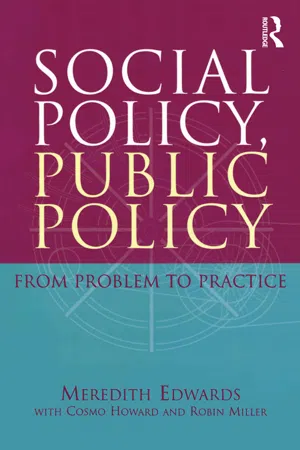
Social Policy, Public Policy
From problem to practice
- 232 pages
- English
- ePUB (mobile friendly)
- Available on iOS & Android
eBook - ePub
About this book
Information
Chapter One
Introducing policy processes
This is a book about government policy processes: it examines the way government ministers and public servants, as well as experts such as academics and others in the community, work together to develop policy from its conception through to its practice.
Ministers are the ultimate policy-makers but government officials can help them immeasurably, not only by advising on policy but also by being aware of the capacity of the policy development process to contribute to the policy objectives of their political masters. Even in the midst of political chaos, there is a part that public servants can play by being conscious of the value of being as rigorous as possible in how they do their work, individually and with others.
Recently the Australian public sector has seen major changes, particularly increased activity in contracting the private sector to take on business previously undertaken within government agencies. Core functions of government have been under serious review. One core function remaining, however, is policy advice and development. In the environment of the ‘contracting state’, there are, I hope, some insights in this book not only for public servants and political advisers, but also for those in the private and community sectors who deal with government.
A recent impetus for this book was the publication, in late 1999 (a second edition appeared in 2000), of a most useful ‘how-to’ book by Peter Bridgman and Glyn Davis, Australian Policy Handbook. It offers a possible path through the complexities of decision-making and a practical guide to stages in the policy process. The purpose of this book is to provide some concrete examples, through case studies, to accompany Bridgman and Davis’s generalisations, and in this way to be a complementary textbook. It is not the purpose of this book to develop a new theoretical structure on how policy is or should be developed, although it is hoped that the case studies provided may assist scholars in further refining their models of the policy process. Bailey’s observation about the interaction of scholars’ works and practitioners’ experience is relevant here:
The information that practitioners own is needed by scholars to develop and test theories, which can then be applied by practitioners to improve the practice of public administration and by scholars both in further theory development and for the teaching of public managers. (1994: 190)
While the four cases presented in Chapters 2–5 arise out of Australian Commonwealth experience, and under a Labor government, their lessons, on reflection, are just as relevant for other levels of government as well as for governments of various persuasions, both here and overseas.
GOOD POLICY PROCESSES: A POLICY DEVELOPMENT FRAMEWORK
The purpose of putting effort into good policy development processes is to ensure that as far as possible, good outcomes emerge. Michael Keating has argued that ‘a good policy process is a vital underpinning of good policy development. Of course, good process does not necessarily guarantee a good policy outcome, but the risks of bad process leading to a bad outcome are very much higher’ (1996: 63).
There is no universal answer to the much-debated question of what is good policy or a good policy outcome—what is meant by ‘good’ is inherently subjective. But one expected response is that good policy is policy that achieves its objectives as set by the decision-makers. This could be a single minister or a group of ministers, such as Cabinet. If the objectives are not clear, obviously it is hard to judge the achievements of a policy process. It could also be argued that good policy can be expected to be durable and sustainable—so long, of course, as external circumstances do not overtake the original objectives of the policy, which does happen. Support from a wide range of players for the values and objectives that lie behind a policy would be expected. Without that support, policy can be undermined in its implementation or in other ways by lobbyists and others, and hence have little chance of being sustainable.
It is a key premise of this book, therefore, that good policy processes are necessary in most instances to ensure good outcomes in terms of achieving objectives, although they may not be sufficient on their own.
At a more basic level, a good policy development process will be rigorous and will broadly follow an organising framework (such as the rigour found in processes followed by the Commonwealth Government around regulation development [ORR 1998] and also by the Ralph Review [1998]). Several broad policy frameworks have appeared in public administration literature over the last 50 years, with refinements along the way (e.g. May and Wildavsky 1978; Hogwood and Gunn 1984; Davis et al. 1993; Edwards 1993; Hawke 1993; Howlett and Ramesh 1995; Colebatch 1998). Much of that literature debates the relevance of what has become known as the ‘rational model’—a scientific approach to finding a solution to a problem (but see the well-known essay by Lindblom [1959]). In the literature the alternative to ‘rational’ is not ‘irrational’ but ‘incremental’, a process by which decisions are made by building on current policies ‘step-by-step and by small degrees’ (Lindblom 1959: 81). (For further discussion, see Bridgman and Davis 2000: 64).
Policy environments are full of complexities, usually involving a diverse range of players coming from different perspectives and spawning a host of unexpected events. It is therefore very unlikely that circumstances would permit anything approaching classical rationality in the decision-making process. It is not proposed to enter the somewhat sterile debate about whether or not the policy processes described in this book were ‘rational’ or not. Rather, the starting point for this book is that despite the complexities of the real world, a systematic approach to policy development can deliver significant benefits of order and process in addressing policy problems (see also Bridgman and Davis 2000: 48). An analogy here is the reliance of an organisation on strategic planning processes to improve performance, despite the lack of control of the organisation over the external environment.
THE POLICY FRAMEWORK
In the context of policy development, a rigorous approach is commonly referred to as the ‘policy cycle’ model (Bridgman and Davis 2000), or as I prefer to call it, a ‘policy development framework’.
The framework I have found most useful in practice, especially when chairing government interdepartmental committees (IDCs), and which I have used with students of public policy in an attempt to encourage good practice, contains stages similar to those in Bridgman and Davis (Edwards 1993). What follows is that framework with slight modification to fit in with the wording used by Bridgman and Davis.
A modified Bridgman and Davis framework for policy development
- Identify issues
- – problem defined
- – problem articulated
- Policy analysis
- – collect relevant data and information
- – clarify objectives and resolve key questions
- – develop options and proposals
- Undertake consultation
- Move towards decisions
- Implement
- Evaluate
Each case study is organised around the above approach. Regardless of the names given to the various stages in the cycle or framework, the purpose is to gain the benefit of breaking up the policy process into clear steps in order to manage the complexities of developing policy in a systematic and rigorous manner. As Howlett and Ramesh put it:
The advantage of employing the cycle model is that it facilitates the understanding of the public policy process by breaking it into subprocesses, each of which can be investigated alone or in terms of its relationship to the other stages of the cycle. This allows study of individual cases, a comparative study of a series of cases, or study of one or many stages of one or several cases. The model’s greatest virtue, however, is its empirical orientation which enables analysis of a wide range of different factors at work at the various stages. (1995: 198)
THE POLICY STAGES EXPLAINED
Identifying the issues is the initial stage when an issue demands government attention and where the nature of the problem is clarified and articulated. The empirical evidence is that commonly the policy process is initiated from within government (Howlett and Ramesh 1995: 105; Hall et al. 1986). A key question to address early on, therefore, in the context of the case studies to follow, is how the problem got on the agenda and how it was articulated. Until there is broad acceptance of the nature of the policy problem, it is difficult to move on. This point is put well by Parsons:
We may all agree what an issue is but disagree as to what exactly the problem is, and therefore what policy should be pursued. If we see people sleeping on the streets as a problem of vagrancy, then the policy response may be framed in terms of law enforcement and policing. (Hill 1997: 115, quoting Parsons 1995: 87)
Senior ministers can be heavily involved in articulating the problem and ensuring that there is broad enough acceptance of the issue to move towards its resolution. Here lobby groups and the media can play a significant part in putting the problem on the agenda and informing the public about it. And senior bureaucrats will try to influence the policy agendas of their ministers according to their own priorities. If they are politically astute, they will take into account how crowded and competing those agendas are.
The policy analysis stage follows. Policy analysis can be quite complex. It is useful in my experience to divide the analysis into the three elements identified above:
- collecting relevant data and undertaking relevant research
- clarifying objectives if needed, and identifying areas of disagreement as key questions requiring guidance from policy-makers on direction before moving on to
- developing options and proposals for reform.
Some questions addressed in discussing this stage of the policy framework include: Where did the data and research come from and what was its significance in affecting the identification of the problem, the issues and the options? How did key players interact and how were areas of disagreement identified? When and how were they resolved? At what stage were options developed and by whom and in what forums? Were criteria used to assess the options, and if so, what were they? What can be understood about bureaucratic politics from these events?
The next identified stage in policy analysis is consultation. Consultation can be formal or informal, and continuous or episodic. It can therefore occur at any, perhaps all stages in developing policy. What happened in each case? When did formal consultation occur in the cycle and why? How was it undertaken and how was that decision made? To what extent did consultation lead to policy refinement and affect policy decisions? In other words, policy debates that take place outside government often lead to political sensitivity on certain proposals and hence action (Dalton et al. 1996). While consultation should and usually does take place throughout the policy development process, and good judgment is required on what type of consultation is needed, formal consultation seems most appropriate when some key issues and/or options are on the table and before final decisions are made.
This book illustrates what Bridgman and Davis call the ‘consultation diamond’: earlier and later stages in policy development tend to be kept within the public sector; it is in the middle stage that there is greater public participation ‘as assumptions are tested … [and t]he foundations are laid f...
Table of contents
- Cover
- Half Title
- Title Page
- Copyright Page
- Contents
- Preface
- Acknowledgements
- Glossary
- Abbreviations
- 1 Introducing policy processes
- 2 Income support for young people: The search for a single allowance
- 3 From child maintenance to child support: An unlikely policy reform
- 4 Paying for a university education: HECS and not fees
- 5 Long-term unemployment policy: From Green Paper to Working Nation
- Concluding observations
- Bibliography
- Index
Trusted by 375,005 students
Access to over 1.5 million titles for a fair monthly price.
Study more efficiently using our study tools.
Frequently asked questions
Yes, you can cancel anytime from the Subscription tab in your account settings on the Perlego website. Your subscription will stay active until the end of your current billing period. Learn how to cancel your subscription
No, books cannot be downloaded as external files, such as PDFs, for use outside of Perlego. However, you can download books within the Perlego app for offline reading on mobile or tablet. Learn how to download books offline
Perlego offers two plans: Essential and Complete
- Essential is ideal for learners and professionals who enjoy exploring a wide range of subjects. Access the Essential Library with 800,000+ trusted titles and best-sellers across business, personal growth, and the humanities. Includes unlimited reading time and Standard Read Aloud voice.
- Complete: Perfect for advanced learners and researchers needing full, unrestricted access. Unlock 1.5M+ books across hundreds of subjects, including academic and specialized titles. The Complete Plan also includes advanced features like Premium Read Aloud and Research Assistant.
We are an online textbook subscription service, where you can get access to an entire online library for less than the price of a single book per month. With over 1.5 million books across 990+ topics, we’ve got you covered! Learn about our mission
Look out for the read-aloud symbol on your next book to see if you can listen to it. The read-aloud tool reads text aloud for you, highlighting the text as it is being read. You can pause it, speed it up and slow it down. Learn more about Read Aloud
Yes! You can use the Perlego app on both iOS and Android devices to read anytime, anywhere — even offline. Perfect for commutes or when you’re on the go.
Please note we cannot support devices running on iOS 13 and Android 7 or earlier. Learn more about using the app
Please note we cannot support devices running on iOS 13 and Android 7 or earlier. Learn more about using the app
Yes, you can access Social Policy, Public Policy by Meredith Edwards,Cosmo Howard,Robin Miller in PDF and/or ePUB format, as well as other popular books in Politics & International Relations & Health Care Delivery. We have over 1.5 million books available in our catalogue for you to explore.