Southern Theory presents the case for a radical re-thinking of social science and its relationships to knowledge, power and democracy on a world scale.
Mainstream social science pictures the world as understood by the educated and affluent in Europe and North America. From Weber and Keynes to Friedman and Foucault, theorists from the global North dominate the imagination of social scientists, and the reading lists of students, all over the world. For most of modern history, the majority world has served social science only as a data mine.
Yet the global South does produce knowledge and understanding of society. Through vivid accounts of critics and theorists, Raewyn Connell shows how social theory from the world periphery has power and relevance for understanding our changing world from al-Afghani at the dawn of modern social science, to Raul Prebisch in industrialising Latin America, Ali Shariati in revolutionary Iran, Paulin Hountondji in post-colonial Benin, Veena Das and Ashis Nandy in contemporary India, and many others.
With clarity and verve, Southern Theory introduces readers to texts, ideas and debates that have emerged from Australia's Indigenous people, from Africa, Latin America, south and south-west Asia. It deals with modernisation, gender, race, class, cultural domination, neoliberalism, violence, trade, religion, identity, land, and the structure of knowledge itself.
Southern Theory shows how this tremendous resource has been disregarded by mainstream social science. It explores the challenges of doing theory in the periphery, and considers the role Southern perspectives should have in a globally connected system of knowledge. Southern Theory draws on sociology, anthropology, history, psychology, economics, philosophy and cultural studies, with wide-ranging implications for social science in the 21st century.
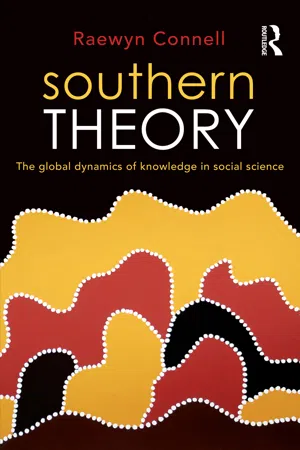
- 288 pages
- English
- ePUB (mobile friendly)
- Available on iOS & Android
eBook - ePub
About this book
Information
PART I
Northern theory
1
Empire and the creation of a social science
If savage man has come out of an animal state (Homo descended from Pithecanthropus), if barbaric man has come from savage man, if half-civilized man has come from barbaric man, if civilized man has come from half-civilized man, if enlightened man has come from early civilized man, then there has in the long run always been progress in spite of the forms of degeneracy and all the rhythms to which this series of phenomena has been subjected.
—Lester F. Ward (1903)
An equally familiar fact is that the women, occupying a servile position, do all the unskilled labour and bear the burdens; with which may be joined the fact that not unfrequently during war they carry the supplies, as in Asia among the Bhils and Khonds, as in Polynesia among the New Caledonians and Sandwich Islanders, as in America among the Comanches, Mundrucus, Patagonians …
—Herbert Spencer (1879)
Origin stories
Open any introductory sociology textbook and you will probably find, in the first few pages, a discussion of founding fathers focused on Marx, Durkheim and Weber. The first chapter may also cite Comte, Spencer, Tönnies and Simmel, and perhaps a few others. In the view normally presented to students, these men created sociology in response to dramatic changes in European society: the Industrial Revolution, class conflict, secularisation, alienation and the modern state. This curriculum is backed by histories such as Alan Swingewood’s (2000) Short History of Sociological Thought. This well-regarded British text presents a two-part narrative of ‘Foundations: Classical Sociology’ (centring on Durkheim, Weber and Marx), and ‘Modern Sociology’, tied together by the belief that ‘Marx, Weber and Durkheim have remained at the core of modern sociology’ (2000: x). Sociologists take this account of their origins seriously. Twenty years ago, a star-studded review of Social Theory Today began with a ringing declaration of ‘the centrality of the classics’ (Alexander 1987). In the new century, commentary on classical texts remains a significant genre of theoretical writing (Baehr 2002).
The idea of classical theory embodies a canon, in the sense of literary theory: a privileged set of texts, whose interpretation and reinterpretation defines a field (Seidman 1994). This particular canon embeds an internalist doctrine of sociology’s history as a social science. The story consists of a foundational moment arising from the internal transformation of European society; classic discipline-defining texts written by a small group of brilliant authors; and a direct line of descent from them to us.
But sociologists in the classical period itself did not have this origin story. When Franklin Giddings (1896), the first professor of sociology at Columbia University, published The Principles of Sociology, he named as the founding father—Adam Smith. Victor Branford (1904), expounding ‘the founders of sociology’ to a meeting in London, named as the central figure—Condorcet.
Turn-of-the-century sociology had no list of classic texts in the modern sense. Writers expounding the new science would commonly refer to Comte as the inventor of the term, to Darwin as the key figure in the theory of evolution, and then to any of a wide range of figures in the landscape of evolutionary speculation. Witness the account of the discipline in the second edition of Dynamic Sociology (1897) by Lester Ward, later the founding president of the American Sociological Society. At the time of the first edition in 1883, Ward observed, the term ‘sociology’ had not been in popular use. However, in the intervening decade a series of brilliant scientific contributions had established sociology as a popular concept. There were now research journals, university courses, societies; and sociology ‘bids fair to become the leading science of the twentieth century, as biology has been that of the nineteenth’. Ward listed 37 notable contributors to the new science. The list included Durkheim and Tönnies, but not Marx or Weber.
The list of notables became a common feature in the textbooks of sociology that multiplied in the United States from the 1890s, Giddings’ Principles being one of the first. (Ward had included Giddings in his list, and Giddings politely included Ward in his.) The famous ‘Green Bible’ of the Chicago School, Park and Burgess’s (1924) Introduction to the Science of Sociology, listed 23 ‘representative works in systematic sociology’. Simmel and Durkheim were among them, but not Marx, Weber or Pareto. Only one work by Weber was mentioned in this thousand-page volume, and then only in the notes.
As late as the 1920s, then, there was no sense that certain texts were discipline-defining classics demanding special study. Rather, there was a sense of a broad, almost impersonal advance of scientific knowledge, the notables being simply leading members of the pioneering crew. Sociologists accepted the view, articulated early in the history of the discipline by Charles Letourneau (1881: vi), who was to hold the first chair of sociology in the world, that: ‘The commencement of any science, however simple, is always a collective work. It requires the constant labour of many patient workmen …’
We therefore have strong reasons to doubt the conventional picture of the creation of sociology. This is not just to question the influence of certain individuals. We must examine the history of sociology as a collective product—the shared concerns, assumptions and practices making up the discipline at various times, and the shape given that history by the changing social forces that constructed the new science.
Global difference and empire
Sociology as a teaching discipline and a public discourse was constructed during the final two decades of the nineteenth century and the first decade of the twentieth in the great cities and university towns of France, the United States, Britain, Germany and, a little later, Russia. The internalist foundation story interprets these places as the site of a process of modernisation, or capitalist industrialisation, with sociology seen as an attempt to interpret what was emerging here. ‘It was above all a science of the new industrial society’ (Bottomore 1987: 7).
The main difficulty with this view is that it does not square with the most relevant evidence—what sociologists at the time were writing. Most general textbooks of sociology, up to World War I, did not have a great deal to say about the modernisation of the society in which the authors lived. Giddings’ Readings in Descriptive and Historical Sociology (1906), typical in this respect, ranged from polyandry in Ceylon via matrilineal survivals among the Tartars to the mining camps of California. It was so little focused on modernity that it took as its reading on ‘sovereignty’ a medieval rendering of the legend of King Arthur.
What is in college textbooks need not correspond to the research focus of sociology, but on this too we have abundant evidence. Between 1898 and 1913, Émile Durkheim and his hard-working collaborators produced twelve issues of L’année sociologique, an extraordinarily detailed international survey of each year’s publications in, or relevant to, sociology. In these twelve issues, nearly 2400 reviews were published. (I have counted only the reviews in large type, whatever their length, not the brief notices in small type in the early issues, nor the listings of titles without reviews.) The reviews concerning Western/Northern Europe and modern North America increase with time: they average 24 per cent of all reviews in the first six issues, 28 per cent in the next five issues, and 32 per cent in the bumper issue of the year before the war.
Modern industrial society was certainly included: the journal published reviews about the American worker, the European middle class, technology in German industries, books by the Webbs and by Sombart, Booth on London poverty, even a work by Ramsay MacDonald, later Labour prime minister of Britain. But works focused on the recent or contemporary societies of Europe and North America made up only a fraction of the content of L’année sociologique: about 28 per cent of all reviews. Even fewer were focused on ‘the new industrial society’, since the reviews on Europe included treatises on peasant folk-tales, witchcraft in Scotland, crime in Asturias and the measurements of skulls.
Twice as many of the reviews concerned ancient and medieval societies, colonial or remote societies, or global surveys of human history. Studies of holy war in ancient Israel, Malay magic, Buddhist India, technical points of Roman law, medieval vengeance, Aboriginal kinship in central Australia and the legal systems of primitive societies were more characteristic of sociology as seen in L’année sociologique than studies of new technology or bureaucracy.
The enormous spectrum of human history that the sociologists took as their domain was organised by a central idea: difference between the civilisation of the metropole and other cultures whose main feature was their primitiveness. I will call this the idea of global difference. Presented in many different forms, this contrast pervades the sociology of the late nineteenth and early twentieth centuries.
The idea of global difference was often conveyed by a discussion of ‘origins’. In this genre of writing, sociologists would posit an original state of society, then speculate on the process of evolution that must have led from then to now. The bulk of the three volumes of Herbert Spencer’s Principles of Sociology, first issued in the 1870s, told such a story for every type of institution that Spencer could think of: domestic institutions, political institutions, ecclesiastical institutions, and so on. Spencer acted as if the proof of social evolution were not complete without an evolutionary narrative, from origins to the contemporary form, for each and every case.
The formula of development from a primitive origin to an advanced form was widespread in Victorian thought (Burrow 1966). Sociologists simply applied a logic that their audience would find familiar. The same architecture is found in works as well known as Durkheim’s Division of Labour in Society (1893) and as obscure as Fairbanks’ Introduction to Sociology (1896).
In none of these works was the idea of an origin taken as a concrete historical question. It could have been, because historians’ knowledge of early societies was growing dramatically in these decades. Troy, Mycenae and Knossos were excavated by Schliemann and Evans. Flinders Petrie systematised the archaeology of Egypt, and the first evidence of Sumerian culture was uncovered at Lagash and Nippur (Stiebing 1993). But sociologists were not interested in where and when a particular originating event occurred, nor were they concerned about when the major changes actually happened. Time functioned in sociological thought mainly as a sign of global difference.
Durkheim did not have to find a precise time in the past for ‘segmentary societies’; they existed in his own day. Durkheim used the example of the Kabyle of Algeria as well as the ancient Hebrews, and made no conceptual distinction between the two. He knew about the Hebrews because the ancient texts were in his library. How did he know about Kabylia? Because the French had conquered Algeria earlier in the century, and at the time Durkheim wrote, French colonists were evicting the local population from the best land (Bennoune 1988). Given the recent history of conquest, peasant rebellion and debate over colonisation, no French intellectual could fail to know something about the Kabyle. Indeed, the social life of France’s North African subjects was being documented in great detail by a series of private and official enquiries (Burke 1980).
Algeria was not an isolated case. In the dozen years before Division of Labour was published, the armies of the French republic had moved out from Algeria to conquer Tunisia; had fought a war in Indo-China, conquered Annam and Tonkin (modern Vietnam) and seized control of Laos and Cambodia; and had established a protectorate over Madagascar. Under the Berlin Treaty of 1885, French trading posts in Central and Western Africa became the basis of a whole new empire. While Durkheim was writing and publishing the Division of Labor and the Rules of Sociological Method (1895), French colonial armies were engaged in a spectacular series of campaigns against the Muslim regimes of inland North and West Africa which produced vast conquests from the Atlantic almost to the Nile.
All this was part of a larger process. The British empire, also a maritime empire with a pre-industrial history, similarly gained a new dynamism and grew to a vast size in the nineteenth century (Cain and Hopkins 1993). The thirteen-colony United States became one of the most dynamic imperial powers of the nineteenth century, with about 80 years of overland conquest and settlement (the ‘westward expansion’), followed by a shorter period of overseas conquest. The Tsarist overland conquests, begun in earlier centuries, were extended to North-east and Central Asia. In the later part of the nineteenth century, they were consolidated by Russian settlement. Prussia’s expansion as an imperial power began with conquest within Europe—in the process, setting up a relationship between dominant and conquered races in the East which became the subject of young Max Weber’s (1894) first sociological research. German overseas colonies in Africa and the Pacific followed the formation of the Reich in 1871. By the time the system of rival empires reached its crisis in the Great War of 1914–18, the expansion of Western power to a global scale had reached its climax.
In this light, the making of sociology takes on a new significance. The places where the discipline was created were the urban and cultural centres of the major imperial powers at the high tide of modern imperialism. They were the ‘metropole’, in the useful French term, to the larger colonial world. The intellectuals who created sociology were very much aware of this.
Since Kiernan’s (1969) remarkable survey The Lords of Human Kind, historians have begun to grasp the immense impact that the global expansion of North Atlantic power had on popular culture (MacDonald 1994) and intellectual life (Said 1993) in the metropole, as well as in the colonies. It would be astonishing if the new science of society had escaped the impact of the greatest social change in the world at the time. In fact, the relationship was intimate. Sociology was formed within the culture of imperialism, and embodied an intellectual response to the colonised world. This fact is crucial in understanding the content and method of sociology, as well as the discipline’s wider cultural significance.
The content and method of sociology
As remarked by the civilised Arthur Todd (the first, and perhaps still the only, professor of sociology to introduce Japanese cherry-blossom paintings into a discussion of social theory): ‘From Comte onward sociologists have pretty generally agreed that the only justification for a Science of Society is its contributions to a workable theory of progress’ (Todd 1918: vii). John Stuart Mill, the sharpest mind among all whose idea of social science was shaped by Comte, had cautioned against equating historical change with improvement (Mill 1843: 596). Few of the sociologists took heed. Spencer’s first attempt at social theory, in Social Statics (1850), made moral improvement the touch stone of analysis of ‘the social state’. Discovering and expounding laws of progress was the core of what sociology meant for the next two generations.
In Auguste Comte’s writings, the idea mostly had to do with the ancient–medieval–modern sequence in Europe. Critics in the later nineteenth century rejected the arbitrariness of Comte’s system and demanded an empirical base for the concept of progress.
This was the common ground between Spence...
Table of contents
- Cover
- Half Title
- Title Page
- Copyright Page
- Contents
- Introduction
- Acknowledgments
- Part I: Northern theory
- Part II: Looking south
- Part III: Southern theory
- Part IV: Antipodean reflections
- References
- Index
Trusted by 375,005 students
Access to over 1.5 million titles for a fair monthly price.
Study more efficiently using our study tools.
Frequently asked questions
Yes, you can cancel anytime from the Subscription tab in your account settings on the Perlego website. Your subscription will stay active until the end of your current billing period. Learn how to cancel your subscription
No, books cannot be downloaded as external files, such as PDFs, for use outside of Perlego. However, you can download books within the Perlego app for offline reading on mobile or tablet. Learn how to download books offline
Perlego offers two plans: Essential and Complete
- Essential is ideal for learners and professionals who enjoy exploring a wide range of subjects. Access the Essential Library with 800,000+ trusted titles and best-sellers across business, personal growth, and the humanities. Includes unlimited reading time and Standard Read Aloud voice.
- Complete: Perfect for advanced learners and researchers needing full, unrestricted access. Unlock 1.5M+ books across hundreds of subjects, including academic and specialized titles. The Complete Plan also includes advanced features like Premium Read Aloud and Research Assistant.
We are an online textbook subscription service, where you can get access to an entire online library for less than the price of a single book per month. With over 1.5 million books across 990+ topics, we’ve got you covered! Learn about our mission
Look out for the read-aloud symbol on your next book to see if you can listen to it. The read-aloud tool reads text aloud for you, highlighting the text as it is being read. You can pause it, speed it up and slow it down. Learn more about Read Aloud
Yes! You can use the Perlego app on both iOS and Android devices to read anytime, anywhere — even offline. Perfect for commutes or when you’re on the go.
Please note we cannot support devices running on iOS 13 and Android 7 or earlier. Learn more about using the app
Please note we cannot support devices running on iOS 13 and Android 7 or earlier. Learn more about using the app
Yes, you can access Southern Theory by Raewyn Connell in PDF and/or ePUB format, as well as other popular books in Social Sciences & Teaching Social Science. We have over 1.5 million books available in our catalogue for you to explore.