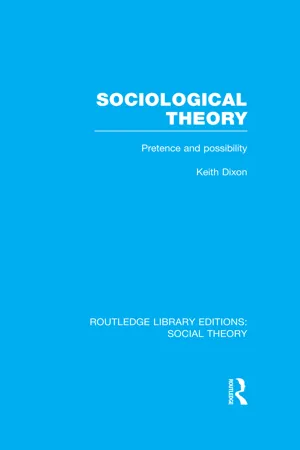
Most professional sociologists claim that sociology is, or ought to be, a theoretical science. Keith Dixon argues here that this claim is formulated in such a way that a proper evaluation of its status is extremely difficult, and that the contingent objections to the possibility of sociological theorizing are sufficiently strong for such activity to be labelled as pretence. He believes that pretence to the theoretical is a hindrance to the development of sociology proper. It devalues significant empirical work by giving status to research findings only in so far as they relate to often arbitrarily conceived 'theoretical' concerns; it leads to a systematic neglect of the historical dimension in the explanation of human behaviour; and it sets up ideals of explanation whose pursuit leads to sterility, frustration and even intellectual corruption. Keith Dixon emphasizes, however, that in attacking the contingent possibility of theory, he does not mean to devalue empirical expertise, analytic skill or the exercise of disciplined speculative intelligence. The argument of his book is that intelligence can only flourish when released from the constraints of attempting to justify the unjustifiable.
- 140 pages
- English
- ePUB (mobile friendly)
- Available on iOS & Android
eBook - ePub
About this book
Information
chapter 1
Ordinary language and theoretical explanations
ORDINARY LANGUAGE EXPLANATIONS
The description and explanation of human behaviour is not the prerogative solely of social scientists. Each of us is already equipped with a set or sets of concepts which enable us to make sense, more or less successfully, of our own behaviour and the behaviour of others. Explanations of human behaviour are given typically by referring to the motives, intentions and dispositions of people and to the reasons they have, or are alleged to have for their behaviour. Arguments frequently centre around the evaluation of the behaviour of others either in an attempt to elicit the meaning of actions or in making moral judgments about them. We ask questions about the significance of remarks, gestures and movements—attempting to see other people’s behaviour and our own in terms of some consistent pattern which enables us to typify individuals and to simplify our relationships with them. In morally evaluating the acts of others we are interested in the question of whether they acted freely or under some kind of physical or psychological constraint. The states of affairs which people actively bring about are distinguished from things which happen to them and associated with, or parasitic upon this distinction are such notions as responsibility, culpability, justification and excuse.
In our accounts of human behaviour, explanation, description and evaluation interpenetrate such that apparently simple observations of a man’s conduct become enmeshed within a complex of norms and values. To describe a man as cruel, for example, is to evaluate his behaviour and if it can be established that he acted under substantial constraint then our original description of his behaviour is significantly altered.
Typically, in our ordinary explanations of human behaviour, we form judgments against a background of ‘acceptable’ or accepted assumptions. It is assumed that deviations from certain norms of behaviour require special explanation. In Britain one does not require to explain why one drives on the left-hand side of the road; whereas leading a beribboned crab down the Strand might conceivably raise a few eyebrows. Furthermore, the mere act of labelling a man as deviant in some defined respects inclines us to see his behaviour under the description of that which requires special categories of explanation: a lie of a friend, for example, forces us to consider both the reasons for the lie and the motives of our friend; the lie of a ‘confidence trickster’ is already partially ‘explained’ through the attachment of that label.
Where the motives of others are intelligible to us in the sense of meeting our expectations, we tend to eschew the use of the words motive, intention and reason—for enquiries into motivation appear redundant in such circumstances. We typically query a man’s motives when we suspect that the reasons he gives for his behaviour are not the real reasons.1 Nevertheless, the fact that in ordinary usage we tend to restrict the use of the words motive, intention and the like to deviant, suspect or puzzling aspects of behaviour does not entail the presumption that ‘motive’ cannot operate as an explanatory term in a wide range of ‘normal’ human behaviour for in such cases a person’s motives are well undestood but left implicit in giving an account of his behaviour.
Such explanatory or descriptive categories as motive, reason, disposition or proneness, intention, voluntariness, involuntariness, constraint and cause are, of course, used normally to answer very specific enquiries about a man’s behaviour within a well-understood context. As J. O. Urmson points out,2 when puzzled by a man’s behaviour, we tend to ask general questions like: ‘What led him to do that?’, ‘What was his reason for doing that ?’, ‘What possessed him to do that?’, rather than to ask for explanations couched in 'causal’ terms. But even in the use of such terms as ‘possessed’, ‘led’, ‘his reason’ and the like, there exist pre-formulated favoured types of explanation. To ask the question about a man, ‘What possessed him to resign his job?’, is to imply that his stated reasons were, in some sense, unsatisfactory or that no good reasons for his actions were apparent to the enquirer. An answer to such a question might in fact involve a rejection of the original formulation of the question, i.e. ‘nothing “possessed” him to resign; he was unhappy and had managed to get something better.’
The usefulness of our everyday accounts of human behaviour depends upon what we are prepared to accept as explanation. At perhaps the ‘lowest’ level we might be prepared to accept dispositional accounts of a person’s behaviour, e.g. ‘Why was he so rude to me?’; ‘Oh, don’t mind him, he’s always aggressive’. In this example, an ‘explanation’ is desired merely to reassure one party to a conversation that he has said nothing specific to offend. If the relationship specified is transitory or unimportant then this explanation would normally suffice. Should a deeper relationship be presupposed one might expect a corresponding interest at a deeper level in explaining the behaviour of a friend who is prone to aggressiveness. A psychiatrist or close friend, for example, might wish to examine a very wide range of possible explanations for a man’s habitual aggressiveness which would take into account, either as complementary or exclusive, varieties of explanations—the man’s motives and reasons, and other psychological or social constraints which appeared to be impelling him towards this form of behaviour.
Now such ‘everyday’ explanations of human behaviour, although sociologically interesting in that their analysis may reveal a fascinating complex of ‘background expectancies’ relevant to our judgment of others, are in an important sense non-theoretical. That is, the generalities implicit in everyday explanations of behaviour do not necessarily cohere within some system of explanation. Rather, there is a closer analogy with proverbial or gnomic wisdom which offers a series of tenuously related aphorisms as a guide to explanation and judgment.
One does not refer to a set of ‘covering laws’ which hold for a particular range of human behaviour in explaining, say, the lie of a friend. Nor does one typically formulate general hypotheses which are put to the test of falsification. One refers doubts about the behaviour of a friend not to a set of axioms, nor to some variation of an S-R model of behaviour but to the minutiae of the situation. The questions are, rather: how am I to interpret this particular action in this set of circumstances; does the response of others to one’s own actions fit into a pattern consistent with already-formulated expectations; is the behaviour serious or the product of a mere mood of frivolity or cynicism? And so on.
In such situations, of course, I have available to me a number of possible interpretations of the given behaviour based upon my past experience and the recorded or unrecorded experience of others. I may have encountered similar situations before, read about them in novels or had them recited to me by friends. But only in the loosest possible of senses can I be said to be theorising about the matter in hand. What I am interested in is the explanation of a specific response set in a particular context, and it would be a very foolish thing to generalise from a manifold of particular personal experiences (except perhaps in a tentatively inductive sense relevant to the necessity to make an immediate practical decision). Indeed we define the socially obtuse as those who are inclined to make too facile an extrapolation of their own limited insights.
The difficulty about relating sociological explanation to common sense or even historical accounts of behaviour is the widespread disagreement amongst professional sociologists as to the nature of their discipline. I want to direct my arguments, however, to a broad spectrum of practitioners who would agree that, at the very least, sociology is a generalising science of human behaviour—however the terms ‘generalising’ and ‘science’ are to be defined. But in order to avoid the kind of primitive, subjective generalities already implicit in folk-lore, sociology needs an inter-subjectively defined basis upon which generalisations can be properly secured. This ‘basis’ is notoriously difficult to locate. In empirically testing, for example, the proposition that ‘too many cooks spoil the broth’ it is perhaps not sufficient to confine oneself to ‘cooks’, ‘broth’ and the interpretation of ‘ego and alters’ response to ‘tasting-situations’. Nor is a simple stochastic proposition correlating the number of cooks with the quantity of spoiled broth sufficient. For broth-making is merely one activity of man—an activity which is differently conceived, interpreted, enacted and justified in different circumstances. One man’s broth is another man’s poison.
What is required then, it has been argued, as the preliminary to any generalising science whatsoever is some concept, or set of concepts, which gives anchorage to widely different forms of behaviour. Distinctively theoretical explanation needs, it is alleged, to relate to data which are unambiguous and which can be consistently defined. One has to treat data as having some common basis such that one can move from the interpretation of one specific action or event to another via a complex chain of theoretical reasoning. In our everyday usage, we take for granted existing categories of classification and explanation simply because we tend to use them on a specific, even an ad hoc, basis to meet the contingencies of practical living. But in aiming at a theoretical explanation of behaviour one cannot be content with the ad hoc. The notion of a systematic understanding of behaviour must begin, it has been suggested, with an ordering or an analysis of ‘the given’ in its most fundamental aspect.3
THE CONSTRUCTION OF A DATA-LANGUAGE: BEHAVIOURISM
One possible way of locating a data-base is to attempt to construct a language which embodies only the unambiguously given elements in human behaviour. A data-language is defined as ‘that language which is used to describe the evidence adduced in support of a theory’.4 The requirements of such a language are strict. It must be ‘neutral’ with respect to existing theories, new theories and to the value judgments of any (social) scientist; it must refer only to precise and measurable observations. Attempts to construct data-languages have had a chequered history but I want to concentrate upon the version of this positivist doctrine which has been especially influential in the social sciences—namely behaviourism.
Anyone embarking upon however limited a discussion of behaviourism faces the problem that for some sociologists the very label conjures up the notion of redundant stimulus–response models which by ignoring the dimension of the subjective meaning attached to behaviour by ‘actors’ systematically distort the explanations of human behaviour; whilst for others the label ‘behavioural’ is a defining characteristic of the discipline which marks it off from ‘speculative’, ‘intuitive’ or ‘empathetic’ accounts of the way men behave.
One can, however, make a simple distinction between a ‘behavioural science’ and ‘behaviourism’ as a methodology. In its widest connotation the word ‘behavioural’ simply marks off overt behaviour either from processes which occur in the central nervous system or more generally from the notion of inner states. A ‘behavioural scientist’ as such makes no explicit or implicit recommendations or judgments as to the relationship or lack of relationship between what goes on in the organism and what is manifested publicly. Behaviourism strictly interpreted is a very different kettle of fish.
Central to traditional accounts of behaviourism is the belief that concepts of mind, purpose and subjective meaning are capable either of being reduced to a set of observation statements or of being dismissed as wraith-like entities and hence without counterparts in the 'real’ world. The relegation of subjective factors to a methodologically irrelevant ‘black-box’ confirms for the ‘philosophical behaviourist’ their dubious existential status. Thus the description of the world in terms of a neutral, uninterpreted language of observation-statements is a complete description. Speculation on what lies ‘behind’ overt behaviour (except neurophysiological and internal chemical states of the physical organism) is beside the point. Such speculations are ‘metaphysical reifications’ or theoretical constructs which not only go beyond the evidence but cannot attach to it. This most general form of behaviourism has been distinguished however from the ‘more careful methodological’ formulation of behaviourism in the current psychological literature. As I. E. Farber notes:5 ‘To the best of my knowledge no one these days denies the existence of mental events.’ Watson did so on occasions but Farber condemns this view as ‘silly’. For Farber, ‘mental events exist and in a commonsense way we know what we mean when we refer to them’ but it is unnecessary, he argues, to appeal to such events in a ‘thorough-going account of behaviour’. Indeed mental events may be analysed simply in terms of ‘behavioural, physiological and environmental items’.
Ernest Nagel6 also argues that much of the criticism of behaviourism is directed towards a caricature of that approach. He claims that the behaviourist can recognise the existence of ‘directly experienced’ and ‘private’ psychic states but argues that these states are ‘adjectival or adverbial’ of bodies having certain types of organisation rather than ‘entities’ inhabitating those bodies. However we are meant to interpret this metaphorical account of the mental, Nagel makes it quite clear that ‘psychic states’ are in his view always accompanied by ‘certain overt and publicly observable behaviours of that body’. Such overt behaviours constitute, according to him, ‘a sufficient basis for grounding conclusions about the entire range of human experience’. He writes: ‘a behaviourist can maintain without inconsistency that there are indeed such things as private psychic states and also that the controlled study of overt behaviour is nevertheless the only sound procedure for achieving reliable knowledge concerning individual and social action . . .’ It is difficult to see what difference the ‘concessions’ made by both Farber and Nagel concerning the existence of mental events make to the traditional version of beha...
Table of contents
- Cover
- Half Title
- Title Page
- Copyright Page
- Original Title Page
- Original Copyright Page
- Table of Content
- Prefer
- Acknowledgements
- 1 Ordinary language and theoretical explanations
- 2 Matching the physical science paradigm
- 3 Causal explanation and rational action
- 4 An alternative conceptualisation: voluntaristic action theory
- 5 Bringing history back in: laws and the explanation of human action
- Notes
- Index
Trusted by 375,005 students
Access to over 1.5 million titles for a fair monthly price.
Study more efficiently using our study tools.
Frequently asked questions
Yes, you can cancel anytime from the Subscription tab in your account settings on the Perlego website. Your subscription will stay active until the end of your current billing period. Learn how to cancel your subscription
No, books cannot be downloaded as external files, such as PDFs, for use outside of Perlego. However, you can download books within the Perlego app for offline reading on mobile or tablet. Learn how to download books offline
Perlego offers two plans: Essential and Complete
- Essential is ideal for learners and professionals who enjoy exploring a wide range of subjects. Access the Essential Library with 800,000+ trusted titles and best-sellers across business, personal growth, and the humanities. Includes unlimited reading time and Standard Read Aloud voice.
- Complete: Perfect for advanced learners and researchers needing full, unrestricted access. Unlock 1.5M+ books across hundreds of subjects, including academic and specialized titles. The Complete Plan also includes advanced features like Premium Read Aloud and Research Assistant.
We are an online textbook subscription service, where you can get access to an entire online library for less than the price of a single book per month. With over 1.5 million books across 990+ topics, we’ve got you covered! Learn about our mission
Look out for the read-aloud symbol on your next book to see if you can listen to it. The read-aloud tool reads text aloud for you, highlighting the text as it is being read. You can pause it, speed it up and slow it down. Learn more about Read Aloud
Yes! You can use the Perlego app on both iOS and Android devices to read anytime, anywhere — even offline. Perfect for commutes or when you’re on the go.
Please note we cannot support devices running on iOS 13 and Android 7 or earlier. Learn more about using the app
Please note we cannot support devices running on iOS 13 and Android 7 or earlier. Learn more about using the app
Yes, you can access Sociological Theory (RLE Social Theory) by Keith Dixon in PDF and/or ePUB format, as well as other popular books in Philosophy & Philosophy History & Theory. We have over 1.5 million books available in our catalogue for you to explore.