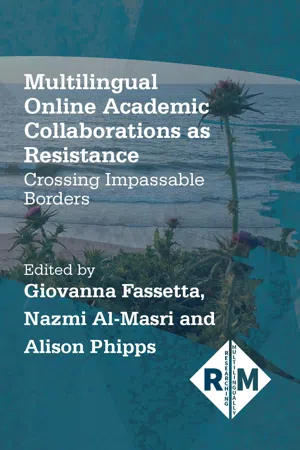
This book details online academic collaborations between universities in Europe, the USA and Palestine. The chapters recount the challenges and successes of online collaborations which promote academic connections and conversations with the Gaza Strip, despite a continuing blockade imposed on Gaza since 2007, and forge relationships between individuals, institutions and cultures. The chapters examine, from different perspectives, what happens when languages and the internet facilitate encounters, and the fundamental importance this has as a form of defiance and of resistance to the physical confinement experienced by Palestinian academics, students and the general population of Gaza. They highlight the limitations of multilingual and intercultural encounters when they are deprived of the sensory proximity of face-to-face situations and what is lost in the translation of languages, practices and experiences from the 'real' to the 'virtual' world. This book is open access under aCC BY NC ND licence.
eBook - ePub
Multilingual Online Academic Collaborations as Resistance
Crossing Impassable Borders
- 200 pages
- English
- ePUB (mobile friendly)
- Available on iOS & Android
eBook - ePub
Multilingual Online Academic Collaborations as Resistance
Crossing Impassable Borders
About this book
Information
Topic
EducationSubtopic
Entreprise ApplicationsPart 1
English as an Additional Language and Online Technologies
1Engineers Operating Multilingually: Reflections on Four Years of Glasgow-Gaza Pre-sessional English Telecollaboration
Bill Guariento
The Siege of Gaza, and the isolation, war damage and shortages that it has engendered, have brought about many compensatory strengths within Gazan society in general, and its higher education sector in particular. The collaboration outlined in this chapter has been built on two very specifically Siege-related attributes found among students and staff at a Gazan university: expertise in online platforms that can help overcome the isolation, and a keen interest in exploring potential engineering responses to the destruction and the shortages that have resulted. Each of these have in turn been built on the Palestine-specific characteristic of ‘sumud’, which can be translated as ‘[…] personal and collective resilience and steadfastness’ (Marie et al., 2018: 20); working on our pre-sessional English language course in far-away Scotland, we have had many opportunities to appreciate (and to benefit from) this unwillingness to bow down in the face of immense challenges, the ‘stubbornness’ that the editors note in their Introduction. This opening chapter outlines the stages of a successful online collaboration between students on science, engineering and technology (SET) Master’s courses at the Islamic University of Gaza (IUG), and pre-sessional international students hoping to embark on SET-related Master’s courses at the University of Glasgow – the English for Academic Studies Telecollaboration (EAST) Project. It also looks at one, less successful, attempt to broaden this endeavour to embrace biomedical science (Biomed) students at each institution, and draws some conclusions from this relative failure. The chapter offers an overview of the four years of the collaboration to date, examining how the overall project was structured and funded, the organizational, financial and technological challenges that were overcome, the lessons that have been learned, the challenges that remain, and the benefits to both institutions that have resulted. It also reflects on the political economy of the collaborative work, and its relationship to ideologies of global mobility and immobilization.
The Initial Rationale for Setting Up an Online International Link-up
The UK is the second most popular destination in the world for overseas study, with 458,000 international students in 2017/18 (Universities UK, 2019). The University of Glasgow, like all UK universities, has seen a growth in the number of international students; in the academic year 2016/2017 (the most recent year for which statistics are available at the time of writing), slightly over 5000 of the 28,600 students at the university were from outside the UK/European Union (EU). But a better idea of the significance of this group can be gained from the fees they are charged. Many of the students reported on in this chapter were studying for an MSc in electronics and electrical engineering; taking this as an example, while home and EU students will pay £8000 per year, those from overseas will be paying over £21,000 to access the very same course (University of Glasgow website, 2018). Overseas students clearly have an economic significance for the institutions that host them that goes well beyond their numbers, but they often lack the language needed for entry to their chosen postgraduate courses. Many students opt to take a secure English language test (such as IELTS), whereas others instead choose to attend a pre-sessional summer course at their university, a bridge to matriculation that provides (beyond the key language skills) the added value of acculturation, taking ‘culture’ both in the most generally accepted sense, but also to signify learning about the workings of a UK university, i.e. the ‘culture of academia’.
In the larger universities, there is often a subject-specific element to the tuition that is provided. However, these summer pre-sessional courses are held at a time when faculty tend to take holiday, and are delivered by English language teachers who are recruited just for the summer months and who, as a rule, lack subject-specific knowledge. The dearth of meaningful engagement with content that results can in part be overcome via published courses (and a really extensive range of subject-specific textbooks has emerged), but there remain many UK university courses that target niche areas of SET, or interdisciplinary degrees (crossovers, for instance, between engineering and management studies, or engineering and accountancy) that have yet to benefit from a course book. An even more fundamental problem with the provision of appropriate content, however, is the fact that these are by definition disciplines that evolve very quickly indeed, and published materials can be considered dated within a few short years or, as in the case of electronics and electrical engineering or information and communications technology, much faster.
Teaching materials must also be paid for, and this can be quite expensive for institutions. One response to this is to produce materials in house, but the production of a well-researched and attractively presented in-house course will also incur significant costs for a university; even a five-week course will necessitate many weeks of staff time, depending upon the experience of more established staff members who tend to be at the higher end of the pay scales. Moreover, as with the course books, every year these materials will need to be revisited and, if necessary, updated or replaced.
At the University of Glasgow’s English for Academic Study (EAS) unit, we felt that these top-down solutions were unwieldy, resistant to change and costly. At the same time, as trained teachers of English, we had our own opinions as to how effective learning could best be fostered, and how the university’s graduate attributes definition of the effective communicator – i.e. one ‘able to articulate complex ideas with respect to the needs and abilities of diverse audiences’ and ‘to communicate clearly and confidently, and listen and negotiate effectively with others’ (University of Glasgow Graduate Attributes Matrix) – could best be met. We were aiming to create a much more authentic course than could be provided by a textbook or through in-house materials, one whose emphasis ‘should primarily be on meaning and communication and which replicates communication in the real world’ (Guariento & Morley, 2001: 350).
In particular, we knew the classroom value of the ‘information gap’, a central tenet of the communicative language teaching methodology that has driven developments in English language instruction over the past three decades. An information gap occurs when your interlocutor possesses information that you require in order to complete a task, which in turn leads to an authentic reason for speaking (or writing) in order to overcome the gap. We wondered whether a cross-border response building on students’ personal content-interests could be fashioned, and whether a methodology channelling the motivational power of the information gap might be achievable online. To enable this, we needed access to an overseas partner.
Genesis and Basic Design of the Project
There is a history of fruitful collaboration between the University of Glasgow’s School of Education and the IUG, dating back to 2007. In 2015 staff from English for academic studies within the School of Modern Languages and Cultures in Glasgow (from now on, for the sake of simplicity, just ‘Glasgow’) approached the Vice-Dean for Internationalization at the IUG (from now on, ‘Gaza’) with a view to engaging their students as partners on the project work element of the culminating five weeks of Glasgow’s pre-sessional SET course.
We started with a simple premise. One (or sometimes two) Gazan students would form a ‘team’ with two (in some cases three) Glasgow-based pre-sessional students, providing a range of engineering-related challenges facing those living in the Gaza Strip. The Glasgow-based students would choose a project title from this list, one which they considered relevant to their coming studies, and gather information, working towards a 1500-word written project and a presentation, each for submission in the final week. The written project would be researched jointly by the Glasgow-based students, then written up individually. The Gazan students, having provided the initial Gaza-specific engineering problem to be analysed, would subsequently provide content feedback on their Glasgow-based partners’ responses over the five weeks of the EAST Project, via Facebook, email, Skype and WhatsApp, analysing in particular whether these responses were feasible, given the geography and the massive resource constraints under which Gazan engineers must operate.
Worth emphasizing at this point is the multilingual nature of these teams. As many as 60% of pre-sessional students in Glasgow speak Mandarin as their mother tongue, while maybe 20% are Arabic speakers, as a rule from Saudi Arabia, and the Glasgow-based groups were formed with the aim of maximizing the mix of L1 speakers. Due to the prevalence of students from China, some uniformly Chinese groupings were unavoidable, but in all cases, the resulting interactions obliged all participants to use English as a lingua franca (ELF); any temptation to use L1 intra-group (Glasgow-Glasgow) would usually exclude a team member, and any similar temptation to use L1 inter-group (Glasgow-Gaza) would invariably exclude a member of any given team. This was a fundamental strength of EAST as it came to develop, and has been key to its longevity.
Partners? Running a Project with an Inherent Power Imbalance
An important element of the role played by the Gazan students was the need to provide content feedback alone, without any suggestion of help in actually writing the written project, and this raised an important ethical issue from the outset. Lorente (2010), writing about the Philippines, outlines government policy aimed at preparing prospective migrants for the remittance-gathering overseas employment which is so key to overall Philippines GDP and (controversially) choosing to categorize the language needs of each according to their professions/skills. Was it acceptable to similarly limit the role and expectations of the Gazan participants? Were we fashioning, via these limitations, something akin to what Lorente terms ‘scripts of servitude’? The importance of fostering creativity and im...
Table of contents
- Cover-Page
- Half-Title
- Series
- Title
- Copyright
- Contents
- Contributors
- Prologue. Collaborating under Siege: A WhatsApp Tale
- Introduction: Can You ‘Here’ Me? Editors’ Reflections on Online Collaborations between the Gaza Strip and the Global North
- Part 1: English as an Additional Language and Online Technologies
- Part 2: Finding Motivation for Language Learning in a Situation of Forced Immobility
- Part 3: Palestine and the Arabic Language
- Part 4: Making Connections
- Afterword. ‘I am Here’: Savouring the ‘Selfie Moments’
- Index
Trusted by 375,005 students
Access to over 1.5 million titles for a fair monthly price.
Study more efficiently using our study tools.
Frequently asked questions
Yes, you can cancel anytime from the Subscription tab in your account settings on the Perlego website. Your subscription will stay active until the end of your current billing period. Learn how to cancel your subscription
No, books cannot be downloaded as external files, such as PDFs, for use outside of Perlego. However, you can download books within the Perlego app for offline reading on mobile or tablet. Learn how to download books offline
Perlego offers two plans: Essential and Complete
- Essential is ideal for learners and professionals who enjoy exploring a wide range of subjects. Access the Essential Library with 800,000+ trusted titles and best-sellers across business, personal growth, and the humanities. Includes unlimited reading time and Standard Read Aloud voice.
- Complete: Perfect for advanced learners and researchers needing full, unrestricted access. Unlock 1.5M+ books across hundreds of subjects, including academic and specialized titles. The Complete Plan also includes advanced features like Premium Read Aloud and Research Assistant.
We are an online textbook subscription service, where you can get access to an entire online library for less than the price of a single book per month. With over 1.5 million books across 990+ topics, we’ve got you covered! Learn about our mission
Look out for the read-aloud symbol on your next book to see if you can listen to it. The read-aloud tool reads text aloud for you, highlighting the text as it is being read. You can pause it, speed it up and slow it down. Learn more about Read Aloud
Yes! You can use the Perlego app on both iOS and Android devices to read anytime, anywhere — even offline. Perfect for commutes or when you’re on the go.
Please note we cannot support devices running on iOS 13 and Android 7 or earlier. Learn more about using the app
Please note we cannot support devices running on iOS 13 and Android 7 or earlier. Learn more about using the app
Yes, you can access Multilingual Online Academic Collaborations as Resistance by Giovanna Fassetta,Nazmi Al-Masri,Alison Phipps,Dr. Alison Phipps in PDF and/or ePUB format, as well as other popular books in Education & Entreprise Applications. We have over 1.5 million books available in our catalogue for you to explore.