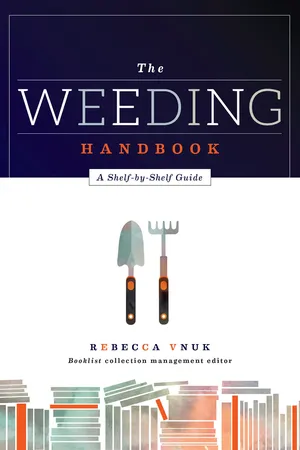
- 216 pages
- English
- ePUB (mobile friendly)
- Available on iOS & Android
eBook - ePub
Information
CHAPTER 1
The Basics
LET’S START AT THE BEGINNING: Why is it important that libraries weed?
• To free up shelf space
In most libraries, the shelves should ideally be 75 to 85 percent full. This makes the items much easier to browse, makes it easier to shelve, and, in general, makes the collection look better. But it’s not only looks that matter—it also saves the patron time and frustration. When outdated materials are removed, then newer, more frequently used materials become clearly visible on the shelves. Who wants to search through a dozen outdated or ragged books to find the one they are really looking for?
• Collection development best practices
How better to get a good handle on what you already own and what areas you need to beef up than to weed on a regular basis? It can be invaluable to look at and touch every book in your collection. Weeding increases knowledge of the collection as a whole. The selector can see firsthand what materials are damaged, need updating, or need to be replaced, and also get a sense for what is used (and more importantly when it comes to weeding, what isn’t used) by the patrons.
• To purge outdated materials
Particularly in nonfiction and in reference, there is a real need to have timely information on your shelves. Remember that your library is not a museum—there is simply not enough space (nor is it a library’s mission) to be a warehouse of unused books. It’s also very important to remember that reference material has an expiration date!
Crowded shelves and worn-out books are distasteful, especially to busy patrons. Just as a bookstore will clearance out titles that do not sell to make room for the constant arrival of new books to keep an eye on profits, a library must consider if removing titles that do not circulate may maintain or even increase its budget allocation. How does that work? The budget is often set in relation to the value and esteem in which the community holds the library, which in turn depends to a large degree on circulation figures.
The idea that we are the chosen keepers of the sacred books is at odds with the fact that weeding actually goes to the very core of the librarian’s professional responsibility to offer patrons the very best information possible. To those librarians who feel that weeding goes against what we have been called to do; our duty to protect books and information: I would remind them of the last two of S. R. Ranganathan’s Five Laws of Library Science: Save the time of the reader and The library is a growing organism.
Ideally, weeding is an ongoing process. Many libraries try to follow a weeding schedule that allows for an easy, continual flow to the weeding process. Weeding throughout the year reduces the number of materials withdrawn at one time and keeps your community happy—because the shelves look fresh, and patrons will not see a large number of books leaving the building at one given time. If you haven’t made an effort to weed continually—or even if you have—oftentimes a weeding project may be needed. Specifically, you know you need a “deep weed” when shelf space becomes impossible to navigate or patrons complain about the condition of materials or a lack of current information.
Weeding Responsibility
One thing you may or may not choose to designate in a collection development plan is who is actually responsible for weeding the collection. Because few libraries, especially smaller ones, have a dedicated collection development librarian, your collection development plan should spell out the personnel in each department who are responsible for weeding. The best way to handle this is to let those who select materials also be responsible for deselecting them. These staff members should have the expertise and experience with their collection areas, and therefore would be able to make good decisions. Personal and detailed knowledge of the collection can be indispensable when weeding. In addition, first-hand knowledge about the community and the tastes of local users comes in handy. If one person handles all of the materials buying (as is common in smaller libraries), then a committee or group should be formed to cover weeding. Team weeding lessens the burden, and provides for a balanced view of the collection. Final decisions should rest with department managers (or the library director). This should be clearly stated in the collection development plan.
Where to Begin?
You’ll see this again in chapter 12: Have a solid collection development plan in place. This not only gives you backup by highlighting your reasons for weeding and your timeline, but also gives your staff instruction. On page 16, I offer a basic, easily adaptable sample to kickstart the weeding and retention section of a collection development plan.
There are a number of ways to handle the question of when to weed. Many libraries rely on automated computer reports to identify low-circulating items. It’s easy enough to have those items pulled, reviewed, and decided upon. Some libraries specify (by policy or when space necessitates) that a certain percentage of the collection must be evaluated on an annual basis. There are less formal ways of accomplishing weeding tasks as well, such as having librarian selectors periodically check their areas or have shelvers alert them to overcrowded areas that need weeding. I feel very strongly that all libraries can benefit from having a published schedule for weeding.
A wonderful example of a weeding schedule comes from King County Library System in Washington. KCLS uses the following schedule as a guideline for weeding collections, aimed at a review of the entire collection each year (reprinted with permission).
| January | 000–099 |
| January | Fiction A-B |
| January | Youth Graphic Novels |
| February | 100–199 |
| February | Fiction C-D-E |
| February | J Series |
| March | 200–299 |
| March | Fiction F-G |
| March | World Language |
| April | 300–399 |
| April | Fiction H-I-J |
| April | E/J Folk and Fairy Tales |
| May | 400–499 |
| May | Fiction K-L |
| May | DVDs |
| June | Fiction M |
| June | Large Print |
| June | CD Music |
| July | 500–599 |
| July | Fiction N-O-P |
| July | ABE/ESL |
| August | 600–699 |
| August | Fiction Q-R |
| August | Reference |
| September | 700–799 |
| September | Fiction S |
| September | Audiobooks (including read-alongs) |
| October | 800–899 |
| October | Fiction T-U-V |
| October | E Readers |
| November | 900–999 |
| November | Fiction W |
| November | Teen Classics |
| December | Fiction X-Y-Z |
| December | Biographies |
| December | E Board Books |
All major integrated library system (ILS) software has the ability to generate circulation reports. You may be able to run them yourself, or you may have to request them from your vendor, but the records exist—use them! Reports available from your cataloging system are invaluable for weeding. You can sort them by all kinds of criteria, including last checkout date, age of item, and number of checkouts. The numbers will, of course, vary depending on the size and type of library and the intent of your collection, but chapters 2 through 9 offer some general advice. Reports can give you a great overall picture of your collection, even outside of the numbers specific to each item. For example, a report can show you the average circulation rate of items at a particular call number. This will let you know whether you need to take a closer look at the section, or if you need to purchase more in that area, for example.
Pre-Weeding Steps
• Identify Stakeholders: Library administrators need to support and endorse the weeding process. Librarians need to be prepared to weed. Support staff, such as shelvers or IT personnel, may be called upon to create lists and check for circulation of weeded materials not on the lists. Catalogers and other technical services staff will need to assist with updating holdings and the discard process.
• Shelf Read: This will ensure that the area to be...
Table of contents
- Title Page
- Copyright Page
- Contents
- Acknowledgments
- Introduction
- Chapter 1. The Basics
- Chapter 2. Shelf by Shelf: 000, 100, 200
- Chapter 3. Shelf by Shelf: 300s
- Chapter 4. Shelf by Shelf: 400s and 500s
- Chapter 5. Shelf by Shelf: 600s
- Chapter 6. Shelf by Shelf: 700s
- Chapter 7. Shelf by Shelf: 800s and Fiction
- Chapter 8. Shelf by Shelf: 900s and Biography
- Chapter 9. Other Areas of the Collection
- Chapter 10. Special Considerations for Youth Collections
- Chapter 11. Weeding Gone Wrong
- Chapter 12. The Importance of a Collection Development Plan
- Appendix. Annotated Sample Collection Development Plans
- Suggested Reading
- Index
Trusted by 375,005 students
Access to over 1.5 million titles for a fair monthly price.
Study more efficiently using our study tools.
Frequently asked questions
Yes, you can cancel anytime from the Subscription tab in your account settings on the Perlego website. Your subscription will stay active until the end of your current billing period. Learn how to cancel your subscription
No, books cannot be downloaded as external files, such as PDFs, for use outside of Perlego. However, you can download books within the Perlego app for offline reading on mobile or tablet. Learn how to download books offline
Perlego offers two plans: Essential and Complete
- Essential is ideal for learners and professionals who enjoy exploring a wide range of subjects. Access the Essential Library with 800,000+ trusted titles and best-sellers across business, personal growth, and the humanities. Includes unlimited reading time and Standard Read Aloud voice.
- Complete: Perfect for advanced learners and researchers needing full, unrestricted access. Unlock 1.5M+ books across hundreds of subjects, including academic and specialized titles. The Complete Plan also includes advanced features like Premium Read Aloud and Research Assistant.
We are an online textbook subscription service, where you can get access to an entire online library for less than the price of a single book per month. With over 1.5 million books across 990+ topics, we’ve got you covered! Learn about our mission
Look out for the read-aloud symbol on your next book to see if you can listen to it. The read-aloud tool reads text aloud for you, highlighting the text as it is being read. You can pause it, speed it up and slow it down. Learn more about Read Aloud
Yes! You can use the Perlego app on both iOS and Android devices to read anytime, anywhere — even offline. Perfect for commutes or when you’re on the go.
Please note we cannot support devices running on iOS 13 and Android 7 or earlier. Learn more about using the app
Please note we cannot support devices running on iOS 13 and Android 7 or earlier. Learn more about using the app
Yes, you can access The Weeding Handbook by Rebecca Vnuk in PDF and/or ePUB format, as well as other popular books in Languages & Linguistics & Library & Information Science. We have over 1.5 million books available in our catalogue for you to explore.