eBook - ePub
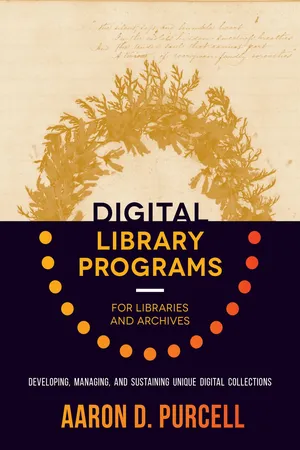
Digital Library Programs for Libraries and Archives
Developing, Managing, and Sustaining Unique Digital Collections
- 256 pages
- English
- ePUB (mobile friendly)
- Available on iOS & Android
eBook - ePub
Digital Library Programs for Libraries and Archives
Developing, Managing, and Sustaining Unique Digital Collections
Information
PART I
The Theory and Reality of Digital Libraries
1
Growth of Digital Libraries
For centuries, libraries represented a physical space where users could access a comprehensive collection of information. The idea of a universal library, where all knowledge is stored and available to anyone, is a cornerstone idea of librarianship. With the advent of digital technology and the Internet, many librarians imagined creating a perfect and complete digital library, one that contains all of the information and knowledge in existence, which can be easily searched, retrieved, and consulted. The theory of digital libraries is that all of the needed components magically fit together easily and quickly, and suddenly there is a powerful tool that allows anyone to access the information he or she is looking for. In reality, however, building and maintaining a digital library is a complex process full of challenges and variables according to what resources and collections are available.
The shift from a print to a digital culture is perhaps the most significant and dramatic change over the past 50 years. The book, or codex, will never disappear as a medium to convey knowledge, but digital forms of communication cannot be ignored. Responding to change is a necessity for librarians and archivists. Even though many outside of the profession think of libraries and archives as static places, they are dynamic places. The point of these repositories is to actively record, document, and preserve available information for the users of today and tomorrow. Planning for future information needs is tricky, especially with fast technological changes. For example, in the 1990s, many libraries invested heavily in CD-ROM databases and indexes as well as computer workstations to operate the software, but within just a few years, a majority of those electronic resources became available online and made the CD-ROMs and equipment obsolete.
The progression of electronic resources from single-use workstations to online subscription databases is just one example of how technology has changed the work of information professionals. Even more dramatic, in just over a single generation, most libraries have transformed from places to find books into information centers with access to online content maintained elsewhere. The growth of the Internet as an avenue to information is largely responsible for the rapid changes in libraries and librarianship. Many libraries and archives have created digital libraries and online collections for public use. The concept of greater access to information has guided many digitization efforts, especially in academic libraries.
There is a lengthy history of librarians and archivists responding to technological changes and the needs of their researchers, but those developments did not happen in a vacuum. The emergence of digital libraries occurred over many decades and because of contributions from several fields. This chapter provides a brief overview of the development of the concept of a digital or electronic library. It discusses how different professions approach the building of digital libraries, the challenge of changing technology, and the importance of original and archival materials in today’s digital project planning. The context of how digital libraries evolved into their current form helps librarians and archivists understand how to structure their digital collections and digital library programs.
Brief History of Digital Libraries
The development of digital libraries and the transformation of libraries occurred quickly, but the concept of having large amounts of information collected in electronic form took several decades to mature. Following World War II, researchers, scientists, scholars, and librarians put forward different ideas about how to manage information. Many books, articles, and presentations on the concept of an electronic-based library followed, with a handful having the greatest influence on the development of digital libraries in the early 1990s.
There is a tradition of writers and scholars predicting the future of libraries. Often these works influenced how libraries planned for new directions. Writers such as Edward Bellamy and H. G. Wells predicted that the libraries of the future would provide users with quick access to information. As the amount of information grew, they believed that technology would make it possible to store that content in different and smaller formats that could be easily retrieved.1 By the early 1940s, libraries faced this issue of growing print collections, shrinking shelf space, and massive cataloging backlogs.
Fremont Rider, head librarian at Wesleyan University, offered solutions to the flood of library information in his book The Scholar and the Future of the Research Library (1944). He asserted that growing print collections in research libraries could be managed through simple approaches such as collaborative interlibrary loan programs, a faster more streamlined approach to cataloging, and collection weeding. In the decades that followed, nearly every library used these approaches to manage their print collections. The majority of Rider’s book focused on a type of technology that offered the potential to shrink the physical size of printed collections. Rider believed that the microcard offered libraries the ability to store millions of books in reasonably sized cabinets. Library users would be able to access the collection by using a simple microcard reader. The microcard approach to collection management gained some popularity in the decades that followed, but that technology was eclipsed by the ability to store and retrieve electronic library resources using computers.2
At the same time that Rider delivered a librarian’s view of the future, a government scientist and engineer presented a different way of managing the explosion of information after World War II. In 1945, Vannevar Bush’s article “As We May Think” appeared in Atlantic Monthly. Like many scientists from the war years, Bush believed that research should be used to improve society and not for destructive purposes. His visionary essay described and predicted many types of technological advances in communication, photography, and the storage of information. Similar to Rider, Bush embraced the idea of microforms as a way to store large amounts of library information in a small space, but he recognized that such an approach did not improve access to the materials. Bush acknowledged that only a handful of people “nibbled” at the great information resources found in research libraries.3
Vannevar Bush had a vision. He believed that in the coming decades it would be technologically possible to build a logic machine that stored, searched, and retrieved data. The device, which he called a memex, would link data by association and not through traditional indexing. Bush postulated that library and information resources such as books, periodicals, newspapers, photographs, and even correspondence would be purchased on microfilm and loaded into the memex by a photographic process. Then the person adding the information would type on a keyboard various codes to describe and contextualize the materials. Further, Bush explained that the memex would allow an individual to store and easily access his or her “books, records, and communications.” His concept of accessing data through a mesh of associative trails mirrors the structure of the World Wide Web, and the device itself sounds like a personal computer with an attached scanner ready for a digitization project. Bush predicted that such a machine would revolutionize the way that people shared information and result in significant scientific discoveries, better public health, and greater efficiency in society. Many of his predictions took several decades’ worth of technological advances to become possible, but the idea of associating and connecting information forms the basis of digital libraries and image galleries of fancy cats.4
The next significant work on electronic storage and retrieval systems for use by libraries came in 1965 with the publication of Libraries of the Future. The book, written by J. C. R. Licklider, an MIT computer science professor and early leader of the Defense Advanced Research Projects Agency (DARPA) within the Department of Defense, carried forward the ideas of Vannevar Bush. Licklider predicted that by 2000 libraries would be much different than they were in the mid-1960s largely because of the use of technology to harness and better organize the explosion of information. He believed that with electronic methods library information would become more accessible, organized both broadly and deeply, available to multiple users, and connected to other networks of information. Instead of relying on traditional library cataloging rules for books on shelves, the organization of the information would be based on associations with other materials instead of physical location. The book emphasized the importance of the users of libraries and how to best meet their information needs.5
In Libraries of the Future, Licklider made bold predictions about libraries that included a vision of digital libraries. He discussed topics such as creating electronic data, selection of materials, data entry, interdisciplinary research, faster processors, cheaper memory, multiple input workstations, descriptor-based retrieval systems, a stylus, automated card catalogs, and natural language searching. In his book and other publications, Licklider made clear that digital computers would change not only libraries but also society. His research focused on the interaction between humans and computers, and in the early 1960s, Licklider outlined an “intergalactic computer network.” His idea later became the first large-scale computer network, ARPANET (Advanced Research Projects Agency Network), which was the forerunner of the Internet.6
As government engineers created the first networks, technology companies built faster processors and more powerful computers with newly developed integrated circuits, known as computer chips. In the 1970s, the decreasing costs of equipment made it possible for companies to develop personal computers for the general public and not just large institutions or the government. It took several years for personal computers to gain popularity, but in the mid-1970s, a group of computer hobbyists took advantage of the availability of new low-cost technology. Many of these technology enthusiasts became multimillionaires as developers of software programs, computer equipment designers, and creators of operating systems.7
The next significant pioneering work on digital technology came from the underground. Ted Nelson’s Computer Lib/Dream Machines (1974) brought together the threads of individual computer use and the potential to connect information through computer networks. Technically, these were two separate books bound together to show the interconnected nature of the topics, but more importantly, the publication served as an informal way of understanding computer use and the creative potential of the computer. While a graduate student studying computers, Nelson developed the concept of hypertext, which is linked electronic information that can be displayed at multiple levels. He expanded the idea into a larger computer network of linked information that he called Project Xanadu. In Computer Lib/Dream Machines, Nelson described the potential of linked information through computer networks and challenged readers to keep that power in the hands of individuals and not large companies or the government.8
During the 1980s, a number of technological changes set the stage for the development of the first digital library projects a decade later. First, personal computers became more common because of their affordability. Greater familiarity with computers led to increased computer literacy. Second, libraries transitioned from index card catalogs to electronic library catalog systems. The ability to search for books and other materials at computer terminals, and later from home computers, changed the way that people used libraries. Finally, greater demand for computer networks for non–defense research purposes resulted in the expansion of ARPANET and management of the network by the National Science Foundation (NSF).9
In the 1990s, a growing national computer network once reserved for use by the military, government, or academics became accessible to the public. Anyone with a personal computer could dial in to the Internet and have access to the World Wide Web. The Web consisted of hyperlinked documents, known as webpages, accessible through a web browser, a type of software that facilitated searching and retrieval of electronic content. By the mid-1990s, commercial users overwhelmed the Internet and fueled an explosion of online commerce. In the next decade, Web 2.0 transformed static webpages into more robust and complex entities. The Web became much more interactive, with new tools to communicate and add multimedia content to webpages.10
Libraries and archives have responded to the technological advances of the past twenty-five years in a variety of ways. Following the conversion of paper-based card catalogs to electronic catalogs, libraries placed their catalogs online, built webpages, and moved many of their services to a virtual environment. The ability to combine catalogs from different institutions resulted in shared databases and resources. A number of larger academic and government libraries embarked on projects to digitize rare or out-of-copyright printed materials. The strength of these early digital projects was the ability to search difficult-to-find texts from multiple institutions.
Online access to scholarly content has challenged the traditional publishing model. In the 1990s, scholars began a movement toward open-access online publishing of scholarly materials. Their early work involved the development of local online repositories, where scholars could deposit their research findings and preprints. A majority of these projects came from the academic environment, as libraries partnered with campus departments such as computer science and information technology to develop the software and architecture for these first institutional repositories. As these open-access databases of scholarly information grew on many campuses, leaders of the movement established uniform standards for these repositories. This effort became known as the Open Archives Initiative (OAI), which is designed to provide efficient access to and dissemination of scholarly content.11
At the same time, journal editors contracted with online publishers to make their publications available through electronic means. Many of these publishers provide access to the content to subscribers only, but more recently, there is a trend among online publishers to allow free access to older content and backfiles. One of the first large-scale online journal publishing projects, JSTOR (Journal Storage), employed this hybrid model of access. JSTOR emerged as a pilot project at the University of Michigan and became a nonprofit organization in 1995. Today, JSTOR ...
Table of contents
- Cover
- Title Page
- Copyright Page
- Dedication
- Contents
- Figures
- Preface
- Acknowledgments
- Introduction
- Part I. The Theory and Reality of Digital Libraries
- Part II. Building Digital Library Programs: A Step-By-Step Process
- Part III. Digital Library Planning Exercises
- Bibliography
- Index
Trusted by 375,005 students
Access to over 1.5 million titles for a fair monthly price.
Study more efficiently using our study tools.
Frequently asked questions
Yes, you can cancel anytime from the Subscription tab in your account settings on the Perlego website. Your subscription will stay active until the end of your current billing period. Learn how to cancel your subscription
No, books cannot be downloaded as external files, such as PDFs, for use outside of Perlego. However, you can download books within the Perlego app for offline reading on mobile or tablet. Learn how to download books offline
Perlego offers two plans: Essential and Complete
- Essential is ideal for learners and professionals who enjoy exploring a wide range of subjects. Access the Essential Library with 800,000+ trusted titles and best-sellers across business, personal growth, and the humanities. Includes unlimited reading time and Standard Read Aloud voice.
- Complete: Perfect for advanced learners and researchers needing full, unrestricted access. Unlock 1.5M+ books across hundreds of subjects, including academic and specialized titles. The Complete Plan also includes advanced features like Premium Read Aloud and Research Assistant.
We are an online textbook subscription service, where you can get access to an entire online library for less than the price of a single book per month. With over 1.5 million books across 990+ topics, we’ve got you covered! Learn about our mission
Look out for the read-aloud symbol on your next book to see if you can listen to it. The read-aloud tool reads text aloud for you, highlighting the text as it is being read. You can pause it, speed it up and slow it down. Learn more about Read Aloud
Yes! You can use the Perlego app on both iOS and Android devices to read anytime, anywhere — even offline. Perfect for commutes or when you’re on the go.
Please note we cannot support devices running on iOS 13 and Android 7 or earlier. Learn more about using the app
Please note we cannot support devices running on iOS 13 and Android 7 or earlier. Learn more about using the app
Yes, you can access Digital Library Programs for Libraries and Archives by Aaron D. Purcell in PDF and/or ePUB format, as well as other popular books in Languages & Linguistics & Library & Information Science. We have over 1.5 million books available in our catalogue for you to explore.