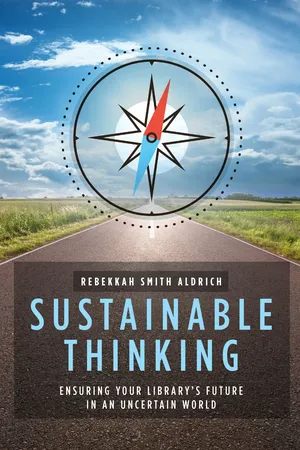
eBook - ePub
Sustainable Thinking
Ensuring Your Library's Future in an Uncertain World
- 216 pages
- English
- ePUB (mobile friendly)
- Available on iOS & Android
eBook - ePub
Information
PART I
SITUATION REPORT
1
DISRUPTION
INSIDE, OUTSIDE, AND ALL AROUND
Well-meant newspaper headlines love to question the vitality and viability of libraries, noting popular opinions that libraries have gone the way of the dinosaur. Reporters and writers across the world, sympathetic to the plight of an institution they view much like their own profession, note the danger of extinction. I’ve read so many of these articles in the past five years I’ve lost count.
Dozens upon dozens of newspaper articles, magazine stories, and online news source features follow this same formula: bet you thought libraries were a thing of the past → but wait, there’s more to the eye → [insert latest technology or unexpected program] → cute, right? Rarely does a writer miss the opportunity to speak to her own nostalgia about libraries, the printed word, and the quiet solitude of the libraries of her youth. The librarian who changed the writer’s life by putting the right book in her hands at the right moment. The fondness that writers and reporters have for libraries is undeniable. The charm, the promise, the hope that libraries have always embodied is still there, everyone!
We are often viewed as passive, awaiting your attention, here to help if you need us. Our bread and butter is storytime and free, high-speed access to the Internet; everything else seems to be cast as the flavor of the month.
Use of libraries, overall, is down. Spin, spin, spin, but the data don’t lie. Fewer people are coming through the doors of our libraries. Fewer people borrow items, the same people visit our websites, and we struggle to get people to interact with our electronic resources, save e-books. “That’s not the story at my library!” I’ll often hear. “People love our library!” “Why, I had fifty kids at this program or the other.” That’s nice. In fact, that’s great! I’m so glad to hear it. However, a trend is a trend for a reason—it means that more often than not, use of libraries is down, overall, nationwide.
The Pew Research Center data are invaluable to libraries if you’re willing to assess all the data, not just the stuff that makes us look good. The center’s 2013 report, The New Library Patron, has one of the best headlines about libraries in decades: “91% of Americans think libraries are important.” Boom! That’s amazing, fantastic, and pretty hard to top. However, read a bit farther and you’ll see a startling statistic: 30 percent admit—perhaps sheepishly—that they don’t quite understand what libraries do anymore.1 We look different. We’re “more than books.”
The fact that 30 percent (21 percent of whom earlier answered that they think we are important) are confused about what we do should set off warning bells, like when a hurricane is reclassified to the next highest category. This is our honeymoon period and has been for the past decade. We’ve tried to tackle it as a messaging issue: okay, we’ve got a public relations problem—let’s fix that; let’s learn to talk about ourselves in new ways that will resonate and turn this confusion around.
Valiant efforts are undertaken, regularly, to find new ways to talk about libraries, to find that perfect phrase that’s going to turn things around. Yet in 2016, in a new report from Pew, released in April, right at the start of National Library Week thank-you-very-much, came the statistical headline we’ve all secretly known was coming: “Use of Public Libraries Drifts Down,” and no, e-use does not make up the difference.2 You can read the report for yourself.
Now, you can continue to be in denial (not my library!), talk about how it’s not about the numbers (it’s all about outcomes!), and, honestly, that’s the truth. It should be about the outcomes, about the lives changed, but the numbers are the numbers, and they are used for us and against us in critical moments tied to our funding.
If we are going to be relevant, remain trusted, and be able to truly ride the story line about outcomes to success at the polls and in the hearts and minds of those we serve, we’ve got a lot of work to do.
A new campaign slogan isn’t going to fix this. A new innovative program isn’t going to fix this. A cool new application of tech isn’t going to fix this. This is big and needs a true, long-haul thinking strategy to address.
The mixed messaging out there about who libraries are and what we do causes confusion among our community members, even our stakeholders. We are many different things to many different people, which means there is a lack of cohesion behind the messaging of why we matter.
Libraries transform. Libraries change lives. Libraries matter. All popular phrases used nationally that say, basically, nothing to someone who isn’t a native library user or parent.
We’re slipping when we should be shining. There are dozens of beacons out there, libraries “doing it right,” who are hardwired into their communities, truly working hand-in-hand with their neighbors to create a better world through library services, but not enough of them. Not enough to stem the tide of uncertainty about the future of libraries. Not enough to turn the tide in Plainfield, Illinois, when an antitax Super PAC turned its sights on the library’s building referendum and squashed it. Not enough to quell the inevitable questions we field from family members and friends about the future of libraries.
But we know, we library leaders, we library advocates. We know that libraries do matter. We do change lives. But we also know that we’re often spread too thin, that the impact we’re having should be bigger, more obvious. Our institutions, designed for a world that existed decades ago, are struggling in this age of amplified disruption.
We have limped along for a long time, but our honeymoon is over. Outside forces are afoot, directly and indirectly shaping the future of libraries and our communities.
The Americans for Prosperity (AFP) Political Action Committee, a well-known Super PAC underwritten by the Koch brothers, promulgates the Tea Party flavor of the antitax faction: any tax is a bad tax. The Koch brothers, two of the richest men on Earth, together worth roughly $43 billion, have sunk funding into AFP that makes this Super PAC a force to be reckoned with. They have helped a fringe movement become mainstream, and in 2016 set their sights on Plainfield, Illinois.
The Plainfield Public Library worked for years to understand what the community needed from it. Through focus groups, surveys, and public town meetings, librarians identified the need for a new library facility. The library followed a textbook path to build consensus about the new facility and worked hard to present an opportunity to the community that would be affordable and help community members reach their goals for library services in their town.
AFP swooped in after the campaign to pass a referendum to fund the new building got started. The Super PAC funded robocalls to all residents, underwrote signs and ads, and ran a textbook misinformation campaign. The library’s $6,000 campaign committee budget could not compete. The referendum was crushed at the polls. The library tried again the next year, lowering the amount requested, but the damage was done. The referendum lost again, by a lot.
Today’s civil wars can be won with money if a community is not cohesive. A library that is operating with the old handbook is going to limp into the future, its fate uncertain. What is swirling around outside our professional lives is getting weirder and scarier. To weather what is already happening, and what is coming, we need a loyal base of supporters—not just users—in our communities that “get” what their library is all about and why that matters in modern society.
The first worksheet of the book, “By the Numbers,” can give you a bird’s-eye view of how a few people can influence the fate of a community. Voter apathy in local elections and unpredictable voter turnout at the polls can leave a library scrambling to gather enough votes to win. Libraries cut it too close for comfort in more cases than not. Understanding these numbers is critical to being more strategic in the future about who knows about us, who understands us, and who benefits from our services. These are actually three distinct groups, all with the power to sway the financial future of the library.
A new slogan, shiny new tech, and pop-up libraries alone are not going to turn the tide. We need to be strategic, and that’s what this book is all about. Being strategic about the future of libraries to the point at which we are sewn so tightly into the fabric of the lives of the communities we serve that it would be unthinkable to underfund, defund, or vote against our libraries.
NOTES
1. Kathryn Zickuhr, Lee Rainie, Kristen Purcell, and Maeve Duggan, “How Americans Value Public Libraries in Their Communities,” Pew Internet and American Life Project (December 11, 2013), http://libraries.pewinternet.org/2013/12/11/libraries-in-communities/.
2. “Use of Libraries Drifts Down, While Use of Library Websites Levels Off,” Pew Research Center: Internet and Technology (April 6, 2016), www.pewinternet.org/2016/04/07/libraries-and-learning/pi_2016-04-07_learning-and-libraries_0-02/.
BY THE NUMBERS
Hypothetically, if your library went for a vote this year for a building referendum, how many votes would it take to win? (To find the answer, call your board of elections or school district and ask how many people normally come out to vote in the general election or the school budget process in your legally chartered service area.)
How many library cardholders do you have?
How many of your library cardholders have actively used your library in the past twelve months?
How many donors do you have?
How many of your active cardholders and donors are currently registered to vote?
Is there a gap between the number of likely supporters of your referendum (users and donors who are registered to vote) and the number of votes you would need to win (50 percent + 1 of the number of voters who come out in a similar election)?
2
BEYOND OUR WALLS
Is time long, or is it wide?
—LAURIE ANDERSON, ARTIST
It is easy to have blinders on. It is easy to focus on immediate issues of concern, such as the price of e-books, the challenges of managing new staff who are from a different generation than yours, the difficulties associated with being managed by someone from a different generation than yours, or the fact that the air conditioning on the second floor of the library doesn’t ever seem to work right. It is hard to keep our eyes on what is going on around us, outside the library, and to synthesize the implications of changes in our world for our library and community.
But that is part of the work: situational awareness.
In the military, officers will ask their soldiers for a “sitrep,” a report on the current situation in a particular area. Officers then collate the data from various areas to course correct their plans to ensure that they have the latest intel to base decisions on. To provide a sitrep, soldiers have to be constantly vigilant, and to maintain that vigilance, they cultivate a high level of situational awareness.
Situational awareness is the ability to identify, process and comprehend the critical elements of information about what is happening with regards to the mission. More simply...
Table of contents
- Cover
- Title Page
- Copyright Page
- Dedication
- Contents
- Acknowledgments
- Introduction
- Part I: Situation Report
- Part II: The Strategy
- Part III: The Tactics
- Part IV: Resources
- Index
Trusted by 375,005 students
Access to over 1.5 million titles for a fair monthly price.
Study more efficiently using our study tools.
Frequently asked questions
Yes, you can cancel anytime from the Subscription tab in your account settings on the Perlego website. Your subscription will stay active until the end of your current billing period. Learn how to cancel your subscription
No, books cannot be downloaded as external files, such as PDFs, for use outside of Perlego. However, you can download books within the Perlego app for offline reading on mobile or tablet. Learn how to download books offline
Perlego offers two plans: Essential and Complete
- Essential is ideal for learners and professionals who enjoy exploring a wide range of subjects. Access the Essential Library with 800,000+ trusted titles and best-sellers across business, personal growth, and the humanities. Includes unlimited reading time and Standard Read Aloud voice.
- Complete: Perfect for advanced learners and researchers needing full, unrestricted access. Unlock 1.5M+ books across hundreds of subjects, including academic and specialized titles. The Complete Plan also includes advanced features like Premium Read Aloud and Research Assistant.
We are an online textbook subscription service, where you can get access to an entire online library for less than the price of a single book per month. With over 1.5 million books across 990+ topics, we’ve got you covered! Learn about our mission
Look out for the read-aloud symbol on your next book to see if you can listen to it. The read-aloud tool reads text aloud for you, highlighting the text as it is being read. You can pause it, speed it up and slow it down. Learn more about Read Aloud
Yes! You can use the Perlego app on both iOS and Android devices to read anytime, anywhere — even offline. Perfect for commutes or when you’re on the go.
Please note we cannot support devices running on iOS 13 and Android 7 or earlier. Learn more about using the app
Please note we cannot support devices running on iOS 13 and Android 7 or earlier. Learn more about using the app
Yes, you can access Sustainable Thinking by Rebekkah Smith Aldrich in PDF and/or ePUB format, as well as other popular books in Languages & Linguistics & Library & Information Science. We have over 1.5 million books available in our catalogue for you to explore.