- a history of archives, including the roles of historical societies and local history collections in libraries;
- new sections on community archives, diversity, and inclusion;
- conducting a survey and starting an archival program;
- selection, appraisal, acquisition, accessioning, and deaccessioning;
- important points of copyright, privacy, and ethics;
- arrangement of archival collections, with a discussion of new theories;
- description, including DACS, EAD, and tools such as ArchivesSpace;
- access, reference, and outreach, with a look at how recent innovations in finding aids can help researchers;
- preservation, including guidance on how to handle rare books, maps, architectural records, and artifacts;
- digital records, addressing new and popular methods of storage and preservation of email, social media, image files, webpages, Word documents, spreadsheets, databases, and media files;
- disaster planning, security, and theft prevention;
- metrics, assessment, establishing employee procedures and policies, working with interns and volunteers, and other managerial duties;
- public relations and marketing, from social media and the Web to advocacy; and
- professional guidelines and codes, such as the newly developed SAA Statement of Core Values of Archivists.
- 320 pages
- English
- ePUB (mobile friendly)
- Available on iOS & Android
eBook - ePub
About this book
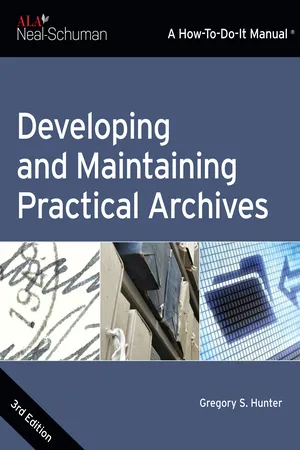
Since its original publication Hunter's manual has been "not only a rich and ready reference tool but also a practical resource for solving problems" (Catholic Library World), and no text has served as a better overview of the field of archives. Newly revised and updated to more thoroughly address our increasingly digital world, including integration of digital records and audiovisual records into each chapter, it remains the clearest and most comprehensive guide to the discipline. Former editor of American Archivist, the journal of the Society of American Archivists (SAA), Hunter covers such keystone topics as
Information
1
Introduction to Archives and Manuscripts
IN THIS CHAPTER
✓ Basic Definitions
✓ The Archival Mission
✓ Differences between Libraries and Archives
✓ A Brief History of Archives
✓ A Brief History of Manuscript Collecting
✓ Archives and Archivists Today
✓ Conclusion
✓ Notes
“I HAVE DROVE FORDS exclusively when I could get away with one,” wrote a satisfied customer to Henry Ford in 1934. “For sustained speed and freedom from trouble the Ford has got ever other car skinned . . .” The Ford Motor Company has received thousands of similar letters over the years. Why was this one preserved? Because a trained eye caught the play on words above and associated it with a famous (or infamous) author: “. . . even if my business hasn’t been strictly legal it don’t hurt anything to tell you what a fine car you got in the V8. Yours truly, Clyde Champion Barrow.” There is no record of whether or not Bonnie agreed with Clyde’s judgment.1
Archivists and manuscript curators are the ones whose eyes are trained to recognize such hidden value—to identify the primary sources necessary to tell the historical story.2 Archivists work in many settings: government agencies, colleges and universities, for-profit and not-for-profit corporations, religious communities and institutions, labor unions, and fraternal and community organizations. All of these institutions have one thing in common: they recognize the value of a historical perspective for daily operations and the importance of having a trained professional maintain the historical resources.3
Though the settings may vary, the mission of the archivist is the same: to identify, preserve, and make available records and papers of enduring value.4 This three-part mission directs archival activities outward, toward the communities we serve; just identifying and preserving records is not enough. Though the methods of serving patrons may change, archival outreach will not decrease in importance.5
Practical Archives is intended as a one-volume introduction to archives and manuscripts—a first step in the training of an archival eye. It will cover all aspects of the archivist’s work, combining theory with practice.6 As will become clear, archival management is as much an art as a science.
BASIC DEFINITIONS
Before proceeding further, it is necessary to define some basic terms. In the past, it was easier to understand the meaning of archives. There was a general sense that archives were items retained for a long period of time. The information age, however, has led to confusion. Archiving a word-processing document, for example, now means saving it on an external medium, perhaps for only a day or two. The distinction between long- and short-term retention has blurred.
As used in this book, archives has three possible meanings:
- materials: items created in the conduct of affairs and preserved because of their enduring value (also referred to as archival records)
- place: the building or part of a building where archival materials are located (also referred to as an archival repository)
- agency: the division within an organization responsible for maintaining records of enduring value (also referred to as an archival agency, archival institution, or archival program)7
Archives is a collective noun, correctly used in the plural, though one may see the singular form used by some repositories.
There are two main approaches to defining the materials in an archives. One approach is to use the word archives broadly to refer to items of enduring value created or received by individuals, families, or organizations (public or private). The second approach is to use the word archives narrowly only to refer to items created or received by organizations. Another term, manuscripts, is used for materials created or received by individuals or families.8 Figure 1.1 summarizes this second approach.
FIGURE 1.1
Distinctions between archives and manuscripts
| CATEGORY | ARCHIVES | MANUSCRIPTS |
|---|---|---|
| Source | Organization or institution | Individual or family |
| Specific terminology for holdings | Records | Papers |
| General terminology for holdings | Collections | Collections |
| Title of custodian | Archivist | Manuscript curator |
In this approach, the holdings of an archival repository are called records. An example would be the records of the Ford Motor Company. By contrast, the holdings of a manuscript repository are called papers—for example, the Papers of Thomas Jefferson or the Rockefeller Family Papers. It is correct, however, to refer to both records and papers as collections. Finally, the custodian of organizational records is called an archivist, while the custodian of personal papers is called a manuscript curator.
Almost all organizations have records of enduring value; many have a place for the storage of these records (the place may even be suitable for storage); fewer organizations, however, have a department or program to manage the records effectively. This book is intended for the information professional who is responsible for archival records and wants to do the correct thing for them but must do so on a limited budget and with modest staffing. It presents as much defensive archives as practical archives.
THE ARCHIVAL MISSION
Let’s look at the mission of the archivist in greater detail. It has three elements:
- • Identify records and papers of enduring value.
- • Preserve them.
- • Make them available to patrons.
Were you surprised that the definition of archives did not mention permanence? Why is enduring—rather than permanent—value the mark of archival records?
This subtle change of wording is relatively recent. Archivists know that most records will not last forever, despite our best intentions. Fragile physical media, atmospheric pollutants, and improper handling all take their toll. More important, the research value of the records may change over time, making them expendable for historical purposes. If we define archival records as having permanent value, we have bestowed sainthood on them—and have limited our ability to reconsider them at a later date. Records of enduring value are beatified—a state below sainthood. Archivists maintain future flexibility while still treating the records with reverential care.9
Archivists used to think of the elements of their mission in a linear fashion: from identification through preservation to reference and access (see figure 1.2). This reflects the order in which archival tasks usually are accomplished. Today, however, archivists increasingly are taking a cyclical view of their work, focusing more on the ultimate purpose (use of the collections) than on the progression of activities (see figure 1.3).10
FIGURE 1.2
Linear expression of the archival mission

FIGURE 1.3
Cyclical expression of the archival mission

A cyclical model of the archival mission also permits one to locate the various archival functions and to relate them to one another. As part of identifying records and papers of enduring value, archivists conduct surveys and appraise records. A survey is a systematic procedure used to locate items of possible archival value. Appraisal is the process of determining the value, and thus the disposition (retention or destruction), of records.11
The bridge between identifying records of enduring value and preserving them is represented by two archival functions: acquisition and accessioning. Acquisition covers such areas as donor relations and policies for collecting records and papers. Accessioning involves the actual transfer of records or papers to an archives or a manuscript repository along with the transfer of legal rights to the physical and intellectual property.
The mission of preserving historically valuable items encompasses three archival functions: arrangement, preservation, and security. Arrangement is the organization of archives or manuscripts in accordance with accepted professional principles.12 Preservation is both the protection of records from physical deterioration and damage and the restoration of previously damaged items.13 Security is the safeguarding of records from natural and human disasters.14
Description is the bridge between preserving records and making them available; it is the opportunity for the archivist to record what is known about the collection and its arrangement, in a way that will facilitate access by researchers. Description requires both clear and concise writing skills and a feel for the research questions archival patrons ask.
The third part of the archival mission, making records available, focuses on two archival functions: access and reference, and outreach and promotion. Access and reference involve more than just presenting a box of records to a researcher. Rather, archivists employ a number of policies and procedures to ensure that use of the records involves neither physical damage to the items nor violations of copyright and the right to privacy. Outreach and promotion make people aware of archival records and the valuable information they contain. To this end, archivists use traditional exhibits a...
Table of contents
- Cover
- Title Page
- Copyright Page
- Dedication
- Contents
- List of Figures
- Preface
- 1. Introduction to Archives and Manuscripts
- 2. Surveys: Identifying Records on All Media
- 3. Starting an Institutional or Community Archives
- 4. Selection and Appraisal
- 5. Acquisitions and Accessioning
- 6. Arrangement
- 7. Description
- 8. Preservation
- 9. Security and Disaster Planning
- 10. Access, Reference, Outreach, and Advocacy
- 11. Leadership and Management
- 12. The Archival Profession
- Bibliography
- Index
Trusted by 375,005 students
Access to over 1.5 million titles for a fair monthly price.
Study more efficiently using our study tools.
Frequently asked questions
Yes, you can cancel anytime from the Subscription tab in your account settings on the Perlego website. Your subscription will stay active until the end of your current billing period. Learn how to cancel your subscription
No, books cannot be downloaded as external files, such as PDFs, for use outside of Perlego. However, you can download books within the Perlego app for offline reading on mobile or tablet. Learn how to download books offline
Perlego offers two plans: Essential and Complete
- Essential is ideal for learners and professionals who enjoy exploring a wide range of subjects. Access the Essential Library with 800,000+ trusted titles and best-sellers across business, personal growth, and the humanities. Includes unlimited reading time and Standard Read Aloud voice.
- Complete: Perfect for advanced learners and researchers needing full, unrestricted access. Unlock 1.5M+ books across hundreds of subjects, including academic and specialized titles. The Complete Plan also includes advanced features like Premium Read Aloud and Research Assistant.
We are an online textbook subscription service, where you can get access to an entire online library for less than the price of a single book per month. With over 1.5 million books across 990+ topics, we’ve got you covered! Learn about our mission
Look out for the read-aloud symbol on your next book to see if you can listen to it. The read-aloud tool reads text aloud for you, highlighting the text as it is being read. You can pause it, speed it up and slow it down. Learn more about Read Aloud
Yes! You can use the Perlego app on both iOS and Android devices to read anytime, anywhere — even offline. Perfect for commutes or when you’re on the go.
Please note we cannot support devices running on iOS 13 and Android 7 or earlier. Learn more about using the app
Please note we cannot support devices running on iOS 13 and Android 7 or earlier. Learn more about using the app
Yes, you can access Developing and Maintaining Practical Archives by Gregory S. Hunter in PDF and/or ePUB format, as well as other popular books in Languages & Linguistics & Library & Information Science. We have over 1.5 million books available in our catalogue for you to explore.