- 28 pages
- English
- ePUB (mobile friendly)
- Available on iOS & Android
eBook - ePub
The Child's First Steps in Pianoforte Playing
About this book
First published in 1920, this book contains a fantastic guide to teaching piano playing for music teachers, written by Tobias Matthay. Tobias Augustus Matthay (1858 – 1945) was an English pianist, composer, and teacher. He was taught composition while at the Royal Academy of Music by Arthur Sullivan and Sir William Sterndale Bennett, and he was instructed in the piano by William Dorrell and Walter Macfarren. Contents include: "Method in its Good and Its Bad Sense", "Fad-Methods to be Avoided", "Method in its Helpful Sense", "Cramming v. Teaching", "Method v. Teaching Devices", "Example of Method in Teaching, Fore-am Rotation", "Repetition of Formulae Useless, Knowledge of Facts Essential", etc. This timeless handbook will be of considerable utility to piano teachers and students alike, and it would make for a worthy addition to allied collections. Other notable works by this author include: "The Act Of Touch In All Its Diversity" (1903), "The First Principles of Pianoforte Playing (1905)" and "Relaxation Studies" (1908). Many vintage books such as this are increasingly scarce and expensive. It is with this in mind that we are republishing this volume now in an affordable, modern, high-quality edition complete with a specially-commissioned new biography of the author.
Information
Subtopic
MusicaTHE
CHILD’S FIRST STEPS
IN
PIANOFORTE PLAYING
BY
Preamble: This little work is intended for the use of the Child, or Adult Beginner, and is quite complete in itself. It would be well, however, if the Teacher were familiar with the first and last chapters of the author’s “First Principles of Pianoforte Playing” (Longmans, Green & Co.); also, later on, with its Supplement, “Some Commentaries on Pianoforte Playing” while some of the additional teaching-material may be found in the “Relaxation Studies” (Bosworth & Co.), and “The Forearm Rotation Principle and its Mastery” (Joseph Williams and The Boston Music Co.). and “Musical Interpretation,” its laws and principles (Joseph Williams)†
Foreword: Before you begin to make Music on the Piano, you must already have learnt to feel the pulse of musical rhythm, and to hear the intervals of the musical scale.*
And now that you are ready to begin to make music with your own fingers on the keyboard, I will try to show you how to do this and how to understand the First Principles of Technique.
Before, however, you take the very first step in Tone-production, be sure to understand that you must never touch the Piano without always trying to make music. It is only too easy to sound notes without really making music at all. To make music we must make all the sounds mean something — just as it is of no use pretending to speak unless the sounds we make with our lips mean something, that is, unless they form reasoned phrases and sentences.
And how can we make a series of musical sounds “mean something”? We shall learn to do this if we try to see that there is no music without a reasoned rhythm, and that such rhythm implies always a definite Progression or Movement. We must learn, then, from the first, as Pianists, to feel that all the notes we play, or hear, are going somewhere, — are moving towards a climax; that they lead onwards towards a rhythmical goal, a Pulse (or beat), or some other more important musical landmark. We must learn to feel pulse itself and its divisions as being a Progression, and must learn at all times to fit the notes we play into such pulse-progressions or recurring Time-throbs. For instance:
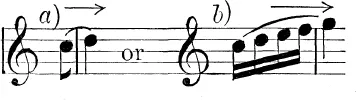
Ex. No. 1
And we must learn to see how such pulse-progressions lead us further and further on as they grow into little phrases, large phrases, sentences, and through bigger climaxes into a complete piece — a short Tune or a long Movement (Exercise No. 2).
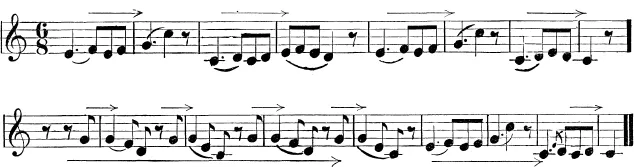
Ex. No. 2
We perceive Progression in Music (i.e., its Shape) through the ear, just as we perceive the shape of the progressions of the lines in drawing or writing through the eye. Presently, if you try to understand Music, you will find things there which are far more interesting even than its Shapes, for you will find that all real Music is meant to say something to you — that it is meant to express FEELING.
In short: Remember that every sound you make must be part of a musical Progression or shape, and, besides this, that there is always a mood to be expressed.*
But before you may touch the Piano, you still have to learn to understand Step I.
Step I: Your teacher will open the Piano, so that you can see its action or mechanism. Notice, when you move a key down, that its little hammer moves against its own set of strings, and then at once flies back. Notice how the strings continue sounding while the key is kept down, although the hammer remains away from the strings. From this you learn that you really make the sound just before and up to the beginning of it, for it is by moving the key down that you make the hammer hit the strings. Also you learn that you can do nothing to alter the sound once the key is down, since the hammer flies back as soon as you reach the sound in key-descent. But if you hold the key down (gently) the strings continue to sound (more and more faintly) until you let the key rise, when the sound at once stops. Notice that the sound stops, because a damper falls upon the strings when you allow the key to rise. This “damper” you had raised from the strings when you pressed the key down, and you kept it raised off the strings so long as you kept the key down.*
You have now learnt that you make the sound at the very beginning of it, as you move the key down, and that it is useless to squeeze the key upon the pad (or “bed”) beneath it for that purpose; and that to do this will only hinder you in your playing. Remember, the only way to make a sound is to make the key move; and you will find that the quicker you make the key move the louder is the sound.
You must now prove this to yourself by trying experiments with the keys. That is, move a key down repeatedly and try to make the movement each time quicker and quicker; and if you really succeed in making the key move down quicker and quicker, you will hear that the sound is each time louder and louder. Listen most carefully all the time. Next, try to move it down rather slower, and the sound will then be softer, and if you are careful you can move it slower and slower until you succeed in making it very soft.
You feel now what makes the difference between loud and soft. You also see how careful you must always be to try to make this movement of the key before it is too late to make it. For if you try too late to make the full speed of the key, you will only fix the key upon its bed before you have made the sound you meant to make. And, if the sounds are not just what you meant to make, the result cannot be music.
It comes to this: that you must always exactly time the moment you want each note to begin sounding; that is, you must be careful to see that you finish moving the key just at that very moment. Experiment again and again, and listen most carefully all the time, so that you may thoroughly understand these points, (a) so that you may apply the necessary force early enough during the descent of the key, and (b) so that you may learn accurately to time the beginning of each sound.
Step II: Now remember, unless each note sounds just the right loudness, your piece cannot possibly sound rightly, musically. Therefore the next step is that you must learn to tell how much muscular force will be required for each note; that is, the least possible amount of force that will make it sound rightly. Now, in trying your last experiments you will have noticed that it requires more force to move the key quickly than to move it slowly, although the loudest note requires far less force than you would at first expect — provided you apply the force early enough in key-descent. Notice again, but still more carefully this time, what happens when you put the key down slowly, and then quickly, and you will find that the key resists you more the quicker you try to move it — that is, it fee...
Table of contents
- Cover
- Title
- Copyright
- Tobias Matthay
- Contents
- The Child’s First Steps in Pianoforte Playing
- Appendix
Trusted by 375,005 students
Access to over 1.5 million titles for a fair monthly price.
Study more efficiently using our study tools.
Frequently asked questions
Yes, you can cancel anytime from the Subscription tab in your account settings on the Perlego website. Your subscription will stay active until the end of your current billing period. Learn how to cancel your subscription
No, books cannot be downloaded as external files, such as PDFs, for use outside of Perlego. However, you can download books within the Perlego app for offline reading on mobile or tablet. Learn how to download books offline
Perlego offers two plans: Essential and Complete
- Essential is ideal for learners and professionals who enjoy exploring a wide range of subjects. Access the Essential Library with 800,000+ trusted titles and best-sellers across business, personal growth, and the humanities. Includes unlimited reading time and Standard Read Aloud voice.
- Complete: Perfect for advanced learners and researchers needing full, unrestricted access. Unlock 1.5M+ books across hundreds of subjects, including academic and specialized titles. The Complete Plan also includes advanced features like Premium Read Aloud and Research Assistant.
We are an online textbook subscription service, where you can get access to an entire online library for less than the price of a single book per month. With over 1.5 million books across 990+ topics, we’ve got you covered! Learn about our mission
Look out for the read-aloud symbol on your next book to see if you can listen to it. The read-aloud tool reads text aloud for you, highlighting the text as it is being read. You can pause it, speed it up and slow it down. Learn more about Read Aloud
Yes! You can use the Perlego app on both iOS and Android devices to read anytime, anywhere — even offline. Perfect for commutes or when you’re on the go.
Please note we cannot support devices running on iOS 13 and Android 7 or earlier. Learn more about using the app
Please note we cannot support devices running on iOS 13 and Android 7 or earlier. Learn more about using the app
Yes, you can access The Child's First Steps in Pianoforte Playing by Tobias Matthay in PDF and/or ePUB format, as well as other popular books in Mezzi di comunicazione e arti performative & Musica. We have over 1.5 million books available in our catalogue for you to explore.