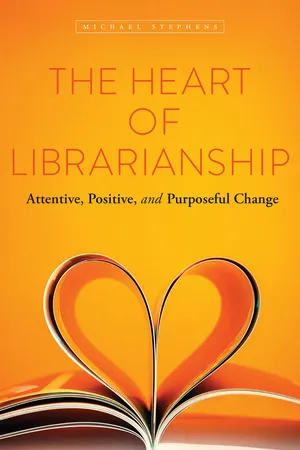
- 176 pages
- English
- ePUB (mobile friendly)
- Available on iOS & Android
eBook - ePub
Information
1
THE HYPERLINKED LIBRARIAN
Skills, Mind-Sets, and Ideas for Working in the Evolving Library
“THE WEB HAS changed everything.” A simple statement but so indicative of how the world has evolved with emerging mechanisms for global communication and collaboration. I’ve used this statement in slide decks and in my teaching. It has also become an integral part of an evolving model of library services focused on user-centric opportunities to engage and learn, capitalizing on the affordances of network-enabled technologies.
The hyperlinked library model is synthesized from data collected on emerging societal trends, socio-technological research reports from Pew Internet and American Life, OCLC, EDUCAUSE, and the writings of such authors as Henry Jenkins, David Weinberger, Clay Shirky, Douglas Thomas, John Seely Brown, and Seth Godin. My model for the “hyperlinked library” is born out of the ongoing evolution of libraries and library services. Weinberger’s chapter “The Hyperlinked Organization” in The Cluetrain Manifesto was a foundational resource for defining this model.1 I’ve been writing and presenting about it for a few years around the United States and abroad—expanding and augmenting as emerging ideas and technologies take libraries in unforeseen directions. The evolving library is not a new idea—we’ve been talking about it for years. “The Library is unlimited and cyclical” is just as powerful today as it was when Jorge Luis Borges wrote it in “The Library of Babel” in 1941.2
Hyperlinked library practice is based on the ideas, concepts, and trends of our socio-technological landscape. The hyperlinked librarian understands the following:
▪ The library is everywhere—it is not just the building or virtual spaces.
▪ Hyperlinking subverts existing organizational structures.
▪ Our institutions should be flatter and team-based.
▪ Seamless service should be available across all channels of interaction.
▪ We must reach all users, not just those who come through our doors.
▪ The most powerful information services to date are probably found in the palm of everyone’s hand.
▪ The path forward will always be an evolutionary one.
▪ Inevitably, there will always be some amount of chaos.
The hyperlinked librarian uses the following methods to inform practice:
▪ Gathering evidence of all kinds to make decisions
▪ Spotting trends that impact service and changing user behavior
▪ Integrating the new built on a foundation of core ethics and values
▪ Playfully approaching opportunities to create learning experiences and engaging information-based services
We can meet change with traditional methods or more chaotic methods, or somewhere in between. Regardless, future librarians need to understand that the current environment requires handling multifaceted issues simultaneously. One way of handling change graciously is through reflective practice. As we take time to contemplate our environment and circumstances, and the decisions we make, we will be more open to new ideas and poised to take action on those ideas.
As we seek to make change, we need to be careful and not let the status quo or the excuse of no time hold us back from progress. Putting this into practice requires consideration and reflection. The following essays explore these ideas for the skill sets and paradigms required for evolving library service. Although changing the status quo is difficult, our libraries must evolve to meet user preferences.
Above all, librarians entering the hyperlinked arena must be curious and creative.
NOTES
1. Rick Levine, Christopher Locke, Doc Searls, and David Weinberger, The Cluetrain Manifesto: The End of Business as Usual (New York: Basic Books, 2001).
2. Jorge Luis Borges, “The Library of Babel,” 1941, www.sjsu.edu/faculty/harris/DigLit_F10/Readings/Borges%20Babel.pdf.
HERETICAL THOUGHTS
DURING A PHONE conversation with a valued colleague who runs a university library, we discussed the process of hiring. My colleague described working hard to streamline staffing and budgets owing to a financial shortfall, while holding steady to a strategic plan anchored in creating useful information and collaboration spaces for the student body. I asked the question I always ask when I’m talking to someone who hires new librarians: “What non-traditional skills and competencies should a new librarian have?” His response? “I want risk-takers . . . innovators . . . creatives . . . I don’t want someone who’s afraid to make a move or make a decision without getting permission.” We chatted longer about skills that are becoming more important, usurping some of our long-standing curricular mainstays. Afterward, I continued to think about these skills and how they can be taught.
STRATEGIC THINKING AND PLANNING
As budgets fall and library use rises, LIS students need a solid foundation in project management and planning. I honestly can’t recall too much devoted to strategic, technology, or long-range planning in my own graduate work. I do remember watching reference books being wheeled into the classroom and explained one by one. That class time would have been better spent developing a mock plan for phasing out part of our print reference and the ins and outs of acquiring, leasing, and paying for online resources.
Programs drawn from schools of business and public administration would be a good fit for the soon-to-be-librarian. Our students need grounding in concepts like decision-making, advocacy, human resources, administration, and management of nonprofits. As staffing structures change, like in the example of my colleague, a newly hired librarian may be called upon to take over departments or projects.
How do we LIS educators—and others—create pragmatic projects to reinforce these important abilities? In my classes, the dreaded group project becomes a real-world example. Here’s an intriguing assignment for students: give a group a plan that was halted midstream, with directions to pick up the pieces and “make it work”—complete with roadblocks from administrators above and front-line staff below.
CREATIVITY AND INNOVATION
Thinking and planning are important but so is innovation and creativity. I’ve used Daniel Pink’s A Whole New Mind in my introduction to LIS classes to highlight the importance of right-brain thinking.1 Pink argues that the logically focused left brain, though necessary in professional work, has given way to the more artistic and conceptual right brain. Creative work is what remains after outsourcing and turning repetitive work over to computers.
Pink also stresses the importance of empathy and the power of story to transform products and services.2 Solutions to common problems can come when librarians tap into their creativity and inventiveness. For example, we could create and deliver library services built on human emotion that add to the ongoing story of a community, as they are doing at the DOK Library’s Agora in Delft, The Netherlands.3 Agora is a multimedia center where patrons can craft personal stories using provided space and software, and then broadcast those stories on one of many screens on a 33’ × 10’ video wall. The exhibits focus on a community-driven theme and change periodically. Clearly, this project was born out of creativity and interest in the library user.
Not all students are immediately ready to take this on. Some can only operate within the constraints of their own limited assumptions of what library work is. However, we can build greater creativity through our instruction practices. To conclude one semester, my introduction to LIS students walked a local labyrinth, as Pink describes, to engage the left brain and free the right to explore new ideas. “Think about your professional practice,” I said before the walk. “What can you do to encourage the heart of your library users?”
I caught up with one of the students from that class, Tara Wood, and asked her what she thought about it. “I think that it is just as easy for students to fall into a certain ‘comfort zone’ as it is for librarians. We get used to coming to class, listening to lectures, writing papers, etc., but these are not always the best methods for learning. At first, we all felt a little silly walking the labyrinth, but by the end we felt differently. . . . [I felt] a sense of clearing out the ‘junk’ in my mind and being able to focus.”
FOCUS ON THE HEART
As a teacher, I practice radical trust. I will never look over shoulders and scold a student for peeking at e-mail or the score of the big game, or practice scare tactics to make sure they do the assigned readings. They’re adults. In exploring the idea of fear as a mechanism for learning, Seth Godin writes in Linchpin that instead of “fear-based, test-based battlefields, [classrooms] could so easily be organized to encourage the heretical thought we so badly need.”4 As my colleague agreed, heretical thought may be the quality of choice for future employers.
Personally, I don’t want students to memorize facts. I never give exams and focus instead on writing and personal reflection about the practice of librarianship. I find the strongest student papers are usually those with a personal slant that tell a story as a means to show comprehension of course material. I want LIS students to understand what it means to be in the ultimate service profession. Being a good, innovative librarian means taking a humanistic stance toward policy, decision-making, and experimentation. It means focusing on the heart.
NOTES
1. Daniel H. Pink, A Whole New Mind: Why Right-Brainers Will Rule the Future (New York: Penguin, 2006).
2. Ibid.
3. Erik Boekesteijn, “What’s Your Story? Dutch Library DOK’s New Cutting-Edge Community Tech Projects,” Library Journal, September 1, 2010, http://lj.libraryjournal.com/2010/09/technology/whats-your-story-dutch-library-doks-new-cutting-edge-community-tech-projects/#_.
4. Seth Godin, Linchpin: Are You Indispensable? How to Drive Your Career and Create a Remarkable Future (New York: Portfolio, 2010), 44.
CAN WE HANDLE THE TRUTH?
IF YOU HAVEN’T read the 2010 Project Information Literacy Progress Report from Alison J. Head and Michael B. Eisenberg, you should.1 “Truth Be Told: H...
Table of contents
- Cover
- Title Page
- Copyright Page
- Contents
- Foreword, by Brian kenney
- Preface
- Acknowledgments
- 1. The Hyperlinked Librarian
- 2. Scanning the Horizon
- 3. Considerations for Prospective Librarians
- 4. Communities of Practice
- 5. A Curriculum for Librarianship
- 6. Infinite Learning
- Bibliography
- Index
Trusted by 375,005 students
Access to over 1.5 million titles for a fair monthly price.
Study more efficiently using our study tools.
Frequently asked questions
Yes, you can cancel anytime from the Subscription tab in your account settings on the Perlego website. Your subscription will stay active until the end of your current billing period. Learn how to cancel your subscription
No, books cannot be downloaded as external files, such as PDFs, for use outside of Perlego. However, you can download books within the Perlego app for offline reading on mobile or tablet. Learn how to download books offline
Perlego offers two plans: Essential and Complete
- Essential is ideal for learners and professionals who enjoy exploring a wide range of subjects. Access the Essential Library with 800,000+ trusted titles and best-sellers across business, personal growth, and the humanities. Includes unlimited reading time and Standard Read Aloud voice.
- Complete: Perfect for advanced learners and researchers needing full, unrestricted access. Unlock 1.5M+ books across hundreds of subjects, including academic and specialized titles. The Complete Plan also includes advanced features like Premium Read Aloud and Research Assistant.
We are an online textbook subscription service, where you can get access to an entire online library for less than the price of a single book per month. With over 1.5 million books across 990+ topics, we’ve got you covered! Learn about our mission
Look out for the read-aloud symbol on your next book to see if you can listen to it. The read-aloud tool reads text aloud for you, highlighting the text as it is being read. You can pause it, speed it up and slow it down. Learn more about Read Aloud
Yes! You can use the Perlego app on both iOS and Android devices to read anytime, anywhere — even offline. Perfect for commutes or when you’re on the go.
Please note we cannot support devices running on iOS 13 and Android 7 or earlier. Learn more about using the app
Please note we cannot support devices running on iOS 13 and Android 7 or earlier. Learn more about using the app
Yes, you can access The Heart of Librarianship by Michael Stephens in PDF and/or ePUB format, as well as other popular books in Languages & Linguistics & Library & Information Science. We have over 1.5 million books available in our catalogue for you to explore.