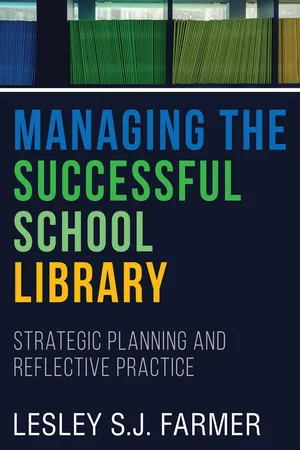
eBook - ePub
Managing the Successful School Library
Strategic Planning and Reflective Practice
- 264 pages
- English
- ePUB (mobile friendly)
- Available on iOS & Android
eBook - ePub
Managing the Successful School Library
Strategic Planning and Reflective Practice
Information
1
Introduction
If libraries had not already been invented, they would need to be created now. Why?
- • All people need information. Some information is required by everyone, but most information needs depend on interests, personal and professional situations, demographics, psychographics, income, literacy factors, culture, physical characteristics, and other variables.
- • Information must be accurate, relevant, and appropriate. This requires someone who can select it knowledgeably.
- • Access to information should be convenient. This depends on locale, transportation, income, personal attributes (e.g., language), and available forms of access.
- • People want to share information. At some point, people may want to share information in real time in mutual physical space. That space must be safe, dependable, and accessible.
- • People need help with their information tasks. Someone must know how to meet these needs.
- • For society to function, equitable access to information is needed. Some kind of legal, public entity must oversee information access. Therefore, some physical space needs to be established conveniently within the community with access to needed information, managed by a knowledgeable librarian.
This logical argument can be extended to school libraries in terms of convenience (just-in-time learning), safety, unique user focus, and instructional mission.
When asked, “What is the first thing that comes to mind when you think about a library?” people are most likely to say “books” or “resources” or perhaps “information.” In short, resources are the key aspect of school libraries. Many also think of the library as a place that houses these resources and enables people to use them. These two aspects do in fact represent the core idea of a library: to help people generate knowledge. The librarian facilitates this process through resource management and, to a degree, instruction or guidance.
Food for Thought
Suppose the school principal says one day: “You can find everything online. The classroom becomes the place for learning, and common areas are used for cross-curricular discussion. Teachers provide the guidance. And there’s always the public library to support students’ reading. In these tight financial times, we really can’t afford a school library, and certainly not a school librarian.”
The negative implication of such a mindset is the potential devaluation and extermination of school libraries. Generally, bookstores cannot replace libraries for two reasons: limited resources and cost. However, if information resources can be found for free online, in the convenience of a classroom or home, then a case could be made that the school library is not necessary. How would you counter this opinion?
Let’s say that you convince the principal that the library is needed. Maybe it’s mandated by the state education code. When you bring up the importance of managing the library, the principal says, “Well, there are several options: parent volunteers, an office clerk, the textbook lady, maybe teachers can take turns during their prep period.” How would you respond?
School librarians are quick to refute the first assertion—that school libraries are not necessary—on several counts. (The second issue will be discussed later.)
- • Not everything is available online. The vast majority of information exists in other formats: print, video, images, sound files. A collection of these alternative resources should be made available, and convenient to access. Public libraries serve the entire community, so their collections might not satisfy the academic needs of the entire school; nor are public libraries located close to every school.
- • Not everything online is free. For instance, access to periodicals is usually limited to one week (for newspapers) or another designated time frame, or only to sample articles that require the user to pay for each document every time it is accessed. Subscriptions to fee-based information are most effectively managed centrally.
- • Not everyone has equitable access to digital resources. A supervised site with Internet-connective hardware is required for all-day access. Even with computer carts, someone needs to manage the equipment fairly (i.e., sharing among classes) and equitably (i.e., ensuring access for all students, including those with disabilities). The public library provides free Internet access, but its location might not be convenient for students; furthermore, the rest of the community also vie for access to the same computers.
- • Not everyone is comfortable using digital resources, and some users may not know how to access them. School librarians are trained in this process, and know how to teach others.
- • Not everything online (or elsewhere) is relevant, developmentally appropriate, or of high quality. Resources need to be evaluated, and not everyone knows how to select critically and knowledgeably—or has the time. For that reason, some schools limit online access, and some teachers stick to textbooks and other sources that they already use rather than letting students explore other resources. School librarians, on the other hand, are trained in selecting materials, and because they know all about the curriculum and school community, they can be sure that materials support the school curriculum.
- • Copyright law must be followed. Interlibrary loan (which is strictly a library function) limits the number of items that can be borrowed. Even fair use has its limits; teachers, for instance, cannot use the same movie year after year without permission.
- • Classroom collections, although convenient for the teacher, are not cost-effective. Few classroom teachers can afford to buy rich collections that match each student’s needs and reading abilities, and teachers seldom exchange resources with each other. Resource inequities emerge because of budget constraints and teacher perspectives. A centralized library results in more cost-effective collections, less duplication of efforts and resources, more equitable access, and better management.
- • A school library is not confined to a physical space. Collections can be both digital and virtual, and should be selected and managed as carefully as physical collections. Furthermore, access to information is now just as important as ownership of material resources, and access to digital resources must be managed efficiently. School librarians create and follow management principles that encompass all aspects of resources, their organization, and effective use.
In short, school library programs serve as valuable, cost-effective learning centers. A good case can be made that strong school library programs are needed now more than ever because of the greater need for information and technological literacies, growing economic pressures, and increased diversity in the school community and the world at large.
A Few Definitions
In daily parlance, the term “library” usually refers to a physical place with resources, services, and professional staff. The California Education Code defines a school library as “a library that is established to support the curriculum-related research and instructional reading needs of pupils and teachers and provides the collections, related equipment, and instructional services of a staff for an elementary or secondary school” (EC 18810, Article 2). The code also stipulates that only a credentialed teacher librarian can provide library instruction. The law further requires that any library must have:
- 1. An explicit written mission statement and service objectives
- 2. A fixed location in California
- 3. Established hours of service
- 4. An organized collection of information and materials accessible for use by its primary clientele
- 5. Designated, on-site, paid staff for library services, one of which must have a master’s degree in library/information science or a California credentialed teacher librarian.
The federal government’s definition of a public library, according to the Institute of Education Statistics (2005), echoes California’s criteria:
A public library is an entity that is established under state enabling laws or regulations to serve a community, district, or region, and that provides at least the following:
- 1. An organized collection of printed or other library materials, or a combination thereof
- 2. Paid staff
- 3. An established schedule in which services of the staff are available to the public
- 4. The facilities necessary to support such a collection, staff, and schedule
- 5. Is supported in whole or in part with public funds.
The National Center for Education Statistics (1998, 13) defined library media centers as “an organized collection of printed and/or audiovisual and/or computer resources which [a] is administered as a unit, [b] is located in a designated place or places, and [c] makes resources and services available to students, teachers, and administrators. It is this definition, not the name, that is important; it could be called a library, media center, resource center, information center, instructional materials center, learning resource center, or some other name.”
The latter definition raises the issue of terminology. Besides the terms above, school libraries have been called instructional media centers, media centers, information centers, information commons, iCenters, learning labs, learning commons, digital libraries, and cybraries. For the purposes of this book, the term “school library” will be used. Although the term “information commons” is becoming more popular, it has a different connotation in higher education. The hope is that the school community will see how school librarians redefine school libraries in the digital age.
The term “school library (media) program” also needs to be defined. According to the American Association of School Librarian’s 1988 publication Information Power (AASL 1998, 1), the mission of the library media program “is to ensure that students and staff are effective users of ideas and information. This mission is accomplished through physical and intellectual access to materials, instruction, and collaboration.” Thus, the school library program includes the library’s resources and services, supported by qualified library staff. In public library settings, a library program is usually associated with an event, but in the school library arena a program is considered to be a full range of material and intellectual offerings that should be planned systematically to support the school’s mission. The emphasis is on action rather than on static conditions.
Library staff implement the school library program. The school librarian is considered as the program’s manager or administrator. It requires that the professional be credentialed by the state, and sometimes requires a master’s degree in library or information studies. Each state determines the basis for certification or licensure; the school librarian usually has to hold a teaching credential as well. As with the terms “library” and “library program,” several alternative terms for “school librarian” exist: teacher librarian, library teacher, (school) library media specialist, library media teacher, cybrarian, information navigator, information specialist, information professional, and even information scientist. The 2009 AASL mission statement operationalizes this position (it is called “school library media specialist”) in terms of that person’s function “[to] empower students to be critical thinkers, enthusiastic readers, skillful researchers, and ethical users of information” (8) through collaborative instructional design, access to materials, and educational leadership. Since issuing that statement, AASL reconfirmed “school librarian” as the preferred term, in the hope that these professionals will reconceptualize their position to reflect current practice.
The bottom line? School libraries and their programs, managed by school librarians, exist in terms of their mission: to serve their communities. Although one of the core criteria of a library is a fixed location, it does not stipulate that the location should be limited to a physical location. Rather, the core function of libraries is to provide information collections that their clientele can physically and digitally access. The central business of libraries is transmitting information that helps their clientele generate knowledge. The school library is distinguished from other libraries by its target population, its explicit instructional charge; and its existence within, and support of, its school system.
Managing School Library Programs
School library program management remains a core function of school librarians. Recently, management has gotten a bad rap, sometimes connoting staid, status quo supervision. However, lack of management is certainly considered a negative. If material and human resources are not well organized and supervised, then the school community will have a harder time using them. Another way to approach the concept of management is to think of it in terms of providing a value-added program that optimizes available resources to support the school’s mission.
Basically, the school librarian is responsible for planning, organizing, leading, implementing, controlling, and assessing the school library program. These activities are all managerial (Fayol 1916). The school librarian has to develop and maintain resources, oversee the physical facilities, handle finances, manage people, coordinate and monitor serv...
Table of contents
- Cover
- Title Page
- Copyright Page
- Contents
- Preface
- 1 Introduction
- 2 Ideal School Library Programs
- 3 The School Library’s Context
- 4 Starting with Yourself
- 5 Planning
- 6 Managing Resources
- 7 Managing Facilities
- 8 Managing Funding
- 9 Managing People
- 10 Managing Services
- 11 Managing Communication
- 12 From Manager to Leader
- Bibliography
- Index
Trusted by 375,005 students
Access to over 1.5 million titles for a fair monthly price.
Study more efficiently using our study tools.
Frequently asked questions
Yes, you can cancel anytime from the Subscription tab in your account settings on the Perlego website. Your subscription will stay active until the end of your current billing period. Learn how to cancel your subscription
No, books cannot be downloaded as external files, such as PDFs, for use outside of Perlego. However, you can download books within the Perlego app for offline reading on mobile or tablet. Learn how to download books offline
Perlego offers two plans: Essential and Complete
- Essential is ideal for learners and professionals who enjoy exploring a wide range of subjects. Access the Essential Library with 800,000+ trusted titles and best-sellers across business, personal growth, and the humanities. Includes unlimited reading time and Standard Read Aloud voice.
- Complete: Perfect for advanced learners and researchers needing full, unrestricted access. Unlock 1.5M+ books across hundreds of subjects, including academic and specialized titles. The Complete Plan also includes advanced features like Premium Read Aloud and Research Assistant.
We are an online textbook subscription service, where you can get access to an entire online library for less than the price of a single book per month. With over 1.5 million books across 990+ topics, we’ve got you covered! Learn about our mission
Look out for the read-aloud symbol on your next book to see if you can listen to it. The read-aloud tool reads text aloud for you, highlighting the text as it is being read. You can pause it, speed it up and slow it down. Learn more about Read Aloud
Yes! You can use the Perlego app on both iOS and Android devices to read anytime, anywhere — even offline. Perfect for commutes or when you’re on the go.
Please note we cannot support devices running on iOS 13 and Android 7 or earlier. Learn more about using the app
Please note we cannot support devices running on iOS 13 and Android 7 or earlier. Learn more about using the app
Yes, you can access Managing the Successful School Library by Lesley S. J. Farmer in PDF and/or ePUB format, as well as other popular books in Languages & Linguistics & Library & Information Science. We have over 1.5 million books available in our catalogue for you to explore.