This book, the first feminist ethnography of the violence in Northern Ireland, is an analysis of a political conflict through the lens of gender. The case in point is the working-class Catholic resistance to British rule in Northern Ireland. During the 1970s women in Catholic/nationalist districts of Belfast organized themselves into street committees and led popular forms of resistance against the policies of the government of Northern Ireland and, after its demise, against those of the British. In the abundant literature on the conflict, however, the political tactics of nationalist women have passed virtually unnoticed. Begoña Aretxaga argues here that these hitherto invisible practices were an integral part of the social dynamic of the conflict and had important implications for the broader organization of nationalist forms of resistance and gender relationships.
Combining interpretative anthropology and poststructuralist feminist theory, Aretxaga contributes not only to anthropology and feminist studies but also to research on ethnic and social conflict by showing the gendered constitution of political violence. She goes further than asserting that violence affects men and women differently by arguing that the manners in which violence is gendered are not fixed but constantly shifting, depending on the contingencies of history, social class, and ethnic identity. Thus any attempt at subverting gender inequality is necessarily colored by other dimensions of political experience.
eBook - ePub
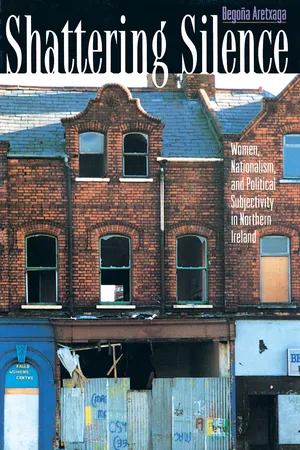
Shattering Silence
Women, Nationalism, and Political Subjectivity in Northern Ireland
- English
- ePUB (mobile friendly)
- Available on iOS & Android
eBook - ePub
Shattering Silence
Women, Nationalism, and Political Subjectivity in Northern Ireland
About this book
Information
Publisher
Princeton University PressYear
2020Print ISBN
9780691037547
9780691037554
eBook ISBN
9780691218267
Topic
Scienze socialiSubtopic
Antropologia* CHAPTER 1 *
Opening the Space of Interpretation
I READ the headlines of the New York Times on September 1, 1994, with joyful surprise: “IRA declares cease-fire seeing new opportunity to negotiate Irish peace.” The photograph in the front page of the newspaper depicted two girls happily waving little nationalist flags through the window of a passing car in West Belfast. For once the news was good. Not long after the IRA’s declaration, Protestant paramilitaries called a cease-fire, too. The war in Northern Ireland was apparently over. In the whirlwind of political statements and diplomatic activities that followed, Gerry Adams, president of Sinn Fein—the political wing of the IRA— swiftly changed from terrorist to emerging statesman in yet another demonstration of how fluid such categories can be. There were a lot of questions in my mind. I was writing this book about the politics of nationalist women during the violent conflict that followed the rise of the civil rights movement in Northern Ireland in 1968. Now the war seemed to have come to an end. What were these women thinking? What were they doing? How would they participate in the newly opened peace process? There was no mention of women in the multiple declarations and news reports about the peace. I telephoned Marie, a republican community activist I had come to know well during my fieldwork research in 1988-1989. She was full of news but also apprehensive. Contrary to my unqualified excitement Marie sounded skeptical: “There is no peace yet,” she said, “only deals being made by male politicians behind closed doors; it’s all very confusing.” Marie, a republican feminist, was critical of the fact that a decision so profoundly affecting the lives of everybody in Northern Ireland had been made so unilaterally, without consultation to different sectors of the communities. Her skepticism was shared by other republican feminists with whom I spoke in Belfast three months later. Not all republican women had the same opinion, of course; some were unconditionally supporting Sinn Fein policy. Nevertheless, there were enough critics to cause a stir among the ranks of the well-disciplined republican movement. At first I could not understand why these women were so critical. In the face of such a major breakthrough in the politics of Northern Ireland their concerns appeared petty. It seemed logical to me that in a context dominated by the secrecy of military organizations, a decision so politically delicate as a cease-fire would not have been openly discussed. And yet this was precisely the point. For republican feminists a lasting peace could only coalesce through an open process of discussion that involved all parts in the different communities. At stake for these women was not just the cessation of bombings and killings, but the future that they had envisioned through twenty-five years of struggle, a future that appeared in danger of being hijacked by the secret negotiations of a male leadership.
At a time of international complacency with the cease-fire in Northern Ireland, the critical attitude of republican feminists seem to run against the grain of the cherished stereotypes that so often have associated women with peace and men with war, as if these less than straightforward notions—peace and war—were a matter of hormone secretion. Despite the growing documentation of women’s involvement in guerrilla movements and wars of liberation, the popular perception of women as the “non-combatant many” (Elshtain 1987, 163) continues to be dominant. Indeed representations of the conflict in Northern Ireland have been saturated with images of violent men and victimized women.1 This simplistic genderized polarization is profoundly disrupted by the reality of the heterogeneous and contraposed political positions taken by women. Because these positions escape easy categorization, the politics of women further disturbs and complicates all major representational narratives of the conflict that have been organized around sets of demarcated binarisms like British/Irish, nationalist/loyalist, Catholic/Protestant. Precisely because of their anomalous and subversive character within established definitions of the political, the politics of nationalist women has been eclipsed in the accounts of Northern Ireland conflict. Women have been left out not because analysts have recognized their subversive potential but because, by not fitting existing discourses, they have not been recognized at all as socially relevant. If this is the case for nationalist women in general, then it is more so when it comes to republican women, whose political involvement often runs against the grain of the two major political fields in which it operates: nationalism and feminism. The critical attitude of republican women toward the peace process is both an example and a result of their specific, uneasy positioning within Northern Ireland’s politics.
Republican women like Marie do, of course, want peace. That is not the issue. The question for them is what exactly does peace mean. Defining peace, like defining war, means delineating the terms for a particular kind of society and a particular political structure. Peace and war are not so much two opposed states of being as they are multifaceted, ambiguous, mutually imbricated arenas of struggle. Peace does not necessarily entail the end of violent conflict; indeed, it can often heighten it, as recent developments in South Africa and Palestine, for example, illustrate.
When I visited Belfast in January 1995, republican feminists—some members of Sinn Fein, others not, most of them community activists— were worried and angered by the invisibility of women in the political process opened by the cease-fire. Their concern was shared by other women’s organizations that were organizing themselves to have an input in the process.2 To ensure that their voices would not be ignored in the new political conjuncture republican women had formed an organization Clar na mBan (Women’s Agenda) whose main goal was to formulate and advance a “women’s agenda for peace” that would be at once republican and feminist. With that purpose in mind, Clar na mBan held a conference in Belfast. More than 150 women from different community organizations gathered to discuss the peace process. The published report of the conference was an attempt to articulate the positions of republican feminists at a time when their voice was marginalized as much by republican discourse as by moderate mainstream feminism. The report declared at the outset the importance for women of “asserting our differences as well as our common ground.”3 The recognition and negotiation of difference was a salient theme of the conference. The other central issue was the implementation of democratic mechanisms that could ensure political participation of all social groups. This might seem a reasonable demand, but in a place marked by the scars of systematic ethnic and gender discrimination, the call for democracy as the sine qua non condition for peace was radical. The call was also a lucid reminder that political exclusion and violence are profoundly linked in the history of Ireland. Indeed, the inability to include Sinn Fein in all party talks— that is, to recognize republicans as subjects of political discourse in their own right—lead in February 1996 to the breakdown of the cease-fire and the crisis of the peace process.
Marginal as it might be within the intricate political landscape of Northern Ireland, the formation of Clar na mBan is important as an interpellation to historical narratives, nationalist or otherwise, that have excluded women from their records. I use interpellation here in its strict sense rather than in the sense Althusser uses it to describe the functioning of ideology. The Oxford English Dictionary defines the action of interpellation as “to appeal, to interrupt in speaking, to break in on or to disturb.” I see Clar na mBan, and the political practices that I describe in this book, as constituting precisely such irruptions in political discourse, disturbing presences that break the order of authorized historical narratives and in so doing raise questions about the nature of such order.
Clar na mBan is a preemptive move to the familiar dismissal of women: “the war is over; your services are no longer required.” By this deadly sentence Irish women, like so many others, were gradually forced back into the restrictive domesticity of postcolonial Ireland. It emerged thus as an affirmation of historical agency by nationalist women, at a moment when such agency ran the risk of being reified into oblivion, the way the inconvenient history of the “unmanageable revolutionaries” (Ward 1983) of preindependence Ireland was left to dust on the old shelves of archives, airing it now and then to pay lip service at the occasional commemoration. This is the irony of history: it is written not to be forgotten, and yet, once it is written it can be forgotten.
The breakdown of the cease-fire has again shifted women’s political perspectives in Northern Ireland. For republican nationalist women questions of historical agency are likely to be framed in yet another context. But just what kind of agency is it? Through what discourses and practices has it been constituted? What political subjectivities has it engendered? What social effects has it produced? To answer these questions I turn now to the field of war.
CONSTRUCTING GENDERED IDENTITIES
During the 1970s, women in the Catholic/nationalist districts of Belfast organized popular forms of resistance against the violence deployed by the Northern Ireland police and the British army in those areas of the city. Yet in the abundant social science literature on the conflict the political practices of nationalist women have either passed virtually unnoticed or been considered anecdotal to the real politics of the conflict.4 I intend to show that, far from being politically irrelevant, these “invisible” practices were crucial to the local configuration of the conflict with important effects on the organization of nationalist culture and the refiguration of women’s identities. Furthermore nationalist women’s political practices illuminate the complex mechanisms by which political processes in general and Irish nationalism in particular are en-gendered. Moreover, because they operate in the interstices of political life the politics of nationalist women offer a unique perspective from which to examine the possibilities and limits of social transformation.
Despite the general absence of research about Northern Ireland women, a number of articles, pamphlets, and a few books have emerged during the last fifteen years.5 Most of them have been written by local feminist activists. They reflect ongoing debates among Irish feminists and articulate the variety of political positions taken by feminist women (Devaney et al. 1989; Evason 1991; Loughran 1986; Ward 1983, 1987, 1991).6 Common to these pieces is the ineludible tension of difference within Irish feminism. The attempt to come to terms with the impossibility of a feminist practice based on a common identity as women was the object of an important feminist conference held in Belfast in 1983, a decade after second-wave feminism began its first steps in Northern Ireland. Coming to terms with difference was not an easy task. Its difficulty was reflected in the telling title of the published report of the conference, A Difficult, Dangerous Honesty: Ten Years of Feminism in Northern Ireland, edited by Margaret Ward. As in other parts of the world, the feminist movement in Northern Ireland had initially hoped to foster a unitary women’s identity that could transcend the polarized ethnic divide between Catholic and Protestants, nationalists and loyalists. The prison protests of the late 1970s made evident that feminism could not exist outside prevailing structures of power, which in Northern Ireland were inescapably defined by ethnicity and class (Loughran 1986). In 1989 a pamphlet significantly titled Unfinished Revolution (Devaney et al. 1989) went a step further, from the recognition to the articulation of political difference. The authors of this text—republican women, lesbians, Irish language activists—proposed new forms of feminism in which their voices, hitherto silenced by mainstream feminism, could be represented. The arguments filtering through these feminist writings provide an important window into the complexities, ambiguities, and instabilities that permeate the politics of identity in Northern Ireland. For all its ambiguity, the politics of identity have shaped the political experience of women, leading them to take different and often contraposed positions in the not less ambiguous arena of feminism. Women frequently refer to their different social experience to reinforce their diverse political positions. Nationalist women, for example, say that experiencing anti-Catholic violence taught them the meaning of second-class citizenship or that living under military occupation committed them to fight against the injustice of colonialism. Thus, nationalist women explicitly blend their lived experience into a political view of social relations, into what I call a political experience, the experience of an engagement to change the world in which they live from a particular social position. Yet the complex processes that have constituted such political experience—their contradictions, ambiguities, limits, and possibilities— have been seldom examined. Those processes are precisely my concern in this book.
Joan Scott (1991) has warned historians about the perils of taking experience as unproblematic evidence of social processes. The warning does also apply to anthropologists. Yet not only scholars, but also historical actors, may take experience for granted. The appeal to experience, to different experiences, is what legitimizes different feminist positions in Northern Ireland. When the experience of women from subordinate groups (nationalist women, lesbian women, working-class women, loyalist women) is what is obscured, denied, excluded from public discourse, to foreground experience might indeed be a necessary political act. Much of this book is therefore about the political experience of nationalist women, an experience that I and they acutely feel has been socially unrecognized, rendered invisible as much by the dominant discourse within feminism as by that of nationalism. In foregrounding experience, however, one runs the risk of leaving unquestioned the conditions that enable it, that make this particular political experience historically possible. How then can we write about experience in a way that foregrounds it yet does not take it for granted? While discourse theorists tend to focus on the linguistic construction of experience rather than on the meaning of lived experience, phenomenologically oriented scholars are often unconcerned with the political histories of its construction. It is as if attention to discourse would preclude attention to experience, and yet it seems to me that neither can exist without the other. For political agency—the capacity of people to become historical subjects deliberately intervening in the making and changing of their worlds—is the product of a movement that goes back and forth from discursive possibility to experience to change in the conditions of possibility. Political agency thus presupposes a degree of consciousness and intentionality as the Comaroffs (1991) have observed, but it is anchored in a cultural repository of largely unconscious discourses and images, modes of thinking and feeling. Whether we think of this cultural repository as the Foucaudian “episteme,” Bourdieu’s “habitus,” Gramsci’s “hegemony,” or the Lacanian “imaginary,” an account of political experience that seeks to elucidate the possibilities of social transformation cannot afford to ignore it. It cannot because, as Obeyesekere (1990) has argued, the transformation of culture entails the change of meanings and affects that are deeply rooted in the personal and social imaginary of particular people. For Drucilla Cornell we must pay attention to how this collective imaginary works because “part of the political struggle is to shift reality through shifting the meaning of our shared symbols. Politics is not just about power but also about the very basis of what can become ‘real’ and thus accessible to consciousness and change” (1993, 194). An account of political agency must go beyond, not beside, the narratives of political experience as told by specific individuals to inquire about the formation of political subjectivity. This means asking how political subjects come to be formed, and (to echo Clifford Geertz) not just formed in abstract, general ways but within systems of ethnic, gender, and sexual difference that are particularly configured within local places. Thus, in this book I am concerned with the political subjectivity of working-class nationalist women, the mechanisms through which it is constituted and transformed, and the effects that such subjectivity can produce on a political culture and on a gendered universe.
REPRESENTATIONS
Nationalist women’s political activism has been interpreted in the scant available literature as either an extension of a domestic role without broader transformative implications or as cooptation in a male-led war (Buckley and Lonergan 1984; Edgerton 1986; Fairweather et al. 1984; Shannon 1989). These works tend to portray women as victims of a violent conflict over which they have little control. This victimization of women is also a feature of popular fiction written about the North. When women are not represented as passive victims, as is the case with members of the IRA, they appear as viragos (Rolston 1989), out-of-place women who are “hovering in the marginal interstices of cultural life” (Elshtain 1987, 170). Northern Ireland women writers also tend to represent women as trapped victims. The Catholic women in Anne Devlin’s plays, for example, are pawns in men’s fights with each other. The female characters of contemporary Irish novels written by women on the subject of Northern Ireland are overwhelmed by impotence in the face of a meaningless violence (Weekes 1995). When women struggle to establish an independent existence within a male-dominated universe of violence, they are either defeated as in Jennifer Johnston’s Shadows on Our Skin (1978), or their defiance is composed of solitary and self-contained gestures, as in Mary Beckett’s stories A Belfast Woman (1980), where women are left to an aimless use of what James Scott has called “weapons of the weak” (1985).7 A notable exception to this pervasive representation of women is Nell McCafferty’s Peggy Deery (1981), the biography of an “ordinary” nationalist woman that depicts with sharpness, wit, and insight the complexity of women’s lives within the violent political context of the city of Derry.
By judging from these representations nationalist women seemingly have no choice and little agency. But then, what are we going to make of the women who walked the streets of their neighborhoods at night to prevent their menfolk from military detention, organized marches to protest arbitrary arrests, took arms against the state, defied the penal system by smearing their prison cells with feces and menstrual blood, clad themselves in blankets and traveled the world to break the silence on state violence, or argued to assert a distinctive feminist voice within male-dominated organizations? These women, their history, and their complex social practices challenge the assumption that women are the passive bystanders of a war between male factions. Nationalist women who have taken sides in the war become anomalies within representations of the conflict, co-opted into either defending male interests or acting like men, that is, being not quite women. This narrow representation of nationalist women assumes that women’s first interests reside in an unquestioned gender identity and ignores, as Coulter has noted, the links between women and their communities (1993, 54).
It is precisely the confining limits of representations of femininity that produce, for Drucilla Cornell, the experience of silencing for actual women. Thus, for her, feminism cannot be separated from the attempt to articulate “the experience of being pushed against the limit of meaning as an actual woman struggling with and against the restrictive femininity imposed by the gender hierarchy” (1993, 77). The story of the women who are protagonists in this book is a story of pushing against the limits of cultural meaning. Excluded from the discourses of war and from the discourse of feminism, marginal to the arena of dominant political practices, the actions of nationalist women emerge, however, as the locus of a political subjectivity that explodes the limits of gender and nationalist representations in Northern Ireland.
The limits of gender identity as the axi...
Table of contents
- Cover Page
- Title Page
- Copyright Page
- Dedication
- Contents
- Preface
- Chapter 1: Opening the Space of Interpretation
- Chapter 2: Catholic West Belfast: A Sense of Place
- Chapter 3: Gender Trouble and the Transformation of Consciousness
- Chapter 4: The Ritual Politics of Historical Legitimacy
- Chapter 5: The Gendered Politics of Suffering: Women of the RAC
- Chapter 6: The Power of Sexual Difference: Armagh Women
- Chapter 7: En-Gendering a Nation
- Afterword
- Notes
- References
- Index
Trusted by 375,005 students
Access to over 1.5 million titles for a fair monthly price.
Study more efficiently using our study tools.
Frequently asked questions
Yes, you can cancel anytime from the Subscription tab in your account settings on the Perlego website. Your subscription will stay active until the end of your current billing period. Learn how to cancel your subscription
No, books cannot be downloaded as external files, such as PDFs, for use outside of Perlego. However, you can download books within the Perlego app for offline reading on mobile or tablet. Learn how to download books offline
Perlego offers two plans: Essential and Complete
- Essential is ideal for learners and professionals who enjoy exploring a wide range of subjects. Access the Essential Library with 800,000+ trusted titles and best-sellers across business, personal growth, and the humanities. Includes unlimited reading time and Standard Read Aloud voice.
- Complete: Perfect for advanced learners and researchers needing full, unrestricted access. Unlock 1.5M+ books across hundreds of subjects, including academic and specialized titles. The Complete Plan also includes advanced features like Premium Read Aloud and Research Assistant.
We are an online textbook subscription service, where you can get access to an entire online library for less than the price of a single book per month. With over 1.5 million books across 990+ topics, we’ve got you covered! Learn about our mission
Look out for the read-aloud symbol on your next book to see if you can listen to it. The read-aloud tool reads text aloud for you, highlighting the text as it is being read. You can pause it, speed it up and slow it down. Learn more about Read Aloud
Yes! You can use the Perlego app on both iOS and Android devices to read anytime, anywhere — even offline. Perfect for commutes or when you’re on the go.
Please note we cannot support devices running on iOS 13 and Android 7 or earlier. Learn more about using the app
Please note we cannot support devices running on iOS 13 and Android 7 or earlier. Learn more about using the app
Yes, you can access Shattering Silence by Begoña Aretxaga in PDF and/or ePUB format, as well as other popular books in Scienze sociali & Antropologia. We have over 1.5 million books available in our catalogue for you to explore.