- English
- ePUB (mobile friendly)
- Available on iOS & Android
eBook - ePub
Meat Eaters
About this book
Primeval jungles, mountain ranges, and the cover of deep forests are not the only domains of meat-eating creatures. Carnivores also can be found stalking prey from the air, in ocean depths, and marshy swamps. Raptors, sharks, and crocodiles are among the most predominant non-mammalian meat-eaters that rely on hunting or scavenging for survival. This volume examines the various species in this select grouping, investigating the physical characteristics and traits that help these unique animals be successful predators.
Trusted by 375,005 students
Access to over 1 million titles for a fair monthly price.
Study more efficiently using our study tools.
Information
CHAPTER 1
RAPTORS: THE FALCONIFORMS
Falconiforms are swift, graceful birds known for their predatory skill as raptors. Included are eagles, condors, buzzards, kites, caracaras, ospreys, harriers, accipiters, vultures, secretary birds, falcons, hawks, and bateleurs.
Although seldom abundant, falconiforms are widespread, living in diverse habitats virtually worldwide. They are often large, conspicuous birds that attract attention from smaller birds. Falconiforms are all active during the day, though several fly at dawn and dusk. With few exceptions they feed on the flesh of other animals, taken alive or found dead. Some, especially those at high latitudes, migrate, but most do not.
The low population density of most species indicates that their economic importance is usually exaggerated. Some, especially large eagles, may prey upon animals kept by people, such as pets or livestock. More significantly, however, falconiforms feed upon various pests of human crops (e.g., hares, rodents, game birds, locusts) and eat otherwise noxious carrion. Because of their intelligence and hunting ability, some falcons and hawks are trained for the sport of falconry.
GENERAL FEATURES OF FALCONIFORMS
Falconiforms vary from tiny falconets (Microhierax), weighing 35 grams (1.2 ounces) or less, to huge vultures and eagles with weights of up to 14 kg (31 pounds)—the latter certainly being the most formidable of avian predators. Many species range from 0.4 to 2.0 kg (0.9 to 4.4 pounds) in weight. Females are normally 20 to 100 percent larger than males, especially among the bird-killing falcons and accipiters. In vultures, however, the male is normally 10 to 15 percent larger.
Falconiform wings, tail, and feet vary according to hunting methods, type of prey, and habitat. Carrion-eating vultures have broad, soaring wings and weak feet; speedy falcons have bullet-shaped bodies and long, pointed wings; maneuverable forest-living species—such as accipiters, some eagles, and forest falcons—have short, rounded wings and long, rounded or graduated tails.
The beak is always hooked and is used to tear flesh from prey held in the feet. It may be further modified for special types of food, such as snails and bone marrow. The feet, which are the primary means of killing prey, are exceptionally strong, equipped with long, curved talons, except in the vultures, which feed on carrion. Sight and hearing are highly developed, but the sense of smell is usually poor or absent.
Falconiforms are found from Arctic to equatorial latitudes, in habitats ranging from stark desert to tropical forest and coastal shores. They are most common and most varied in warm and relatively open country, though many, especially in South America, have adapted to forest life. They are never abundant except where gregarious species may roost or feed together. One pair of birds per 15 square km (6 square miles) or more is usual. Their numbers are not always dependent on the density of food animals, as raptor populations are sometimes limited by competition among themselves for territory in places where food is abundant.
NATURAL HISTORY
Falconiforms vary in their hunting practices and their flying skills. Some species soar in the air above or sit on perches awaiting their quarry, whereas others, such as the vultures, feed on the remains of kills made by other animals. Although most falconiforms rely on their flying ability to spot and capture prey, the secretary bird descends to the ground and uses its feet to stir up its next meal.
BEHAVIOUR
Falconiforms hunt by sight in daylight and normally roost on a perch, a tree branch, a rock ledge, or occasionally (in the case of harriers) on the ground in long grass. A few, including some falcons and sparrowhawks, are active at twilight; in fact, the bat hawk (Machaerhamphus alcinus) catches all its food in about half an hour at dusk. The only species actually recorded feeding at night are certain Indian vultures, which will feed on tiger kills on moonlit nights. Most raptors sleep all night, with head buried in the feathers of the back or hunched upon the shoulders.
Activity may begin soon after dawn with short “warming-up” flights, serious hunting beginning later. Some accipiters commence hunting at daybreak, when their avian prey is most active. Large, heavy species, however, do not usually start hunting or foraging until some time after dawn. Large vultures are unable to fly until updrafts are generated by thermal activity, but smaller species are able to fly soon after dawn. Certain specialized types with flapping flight, such as harriers, can fly easily at any time of the day. Bateleurs get on the wing early and fly most of the day, traveling perhaps 300 to 500 km (200 to 300 miles) on most days. However, very large species such as eagles and vultures probably fly for no more than four to six hours a day.
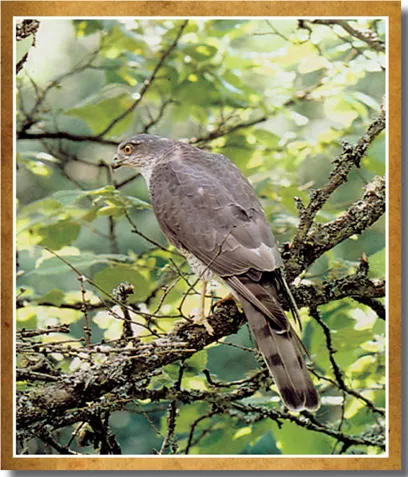
Eurasian sparrowhawk (Accipiter nisus). Stephen Dalton/EB Inc.
Before the day’s flight, a raptor usually preens, casts, and defecates. Castings are indigestible balls of fur, feathers, insect parts, etc., that are regurgitated. Preening is performed mainly with the bill, but falconiforms also scratch with their formidable talons. They frequently “rouse,” fluffing out and shaking all of their feathers.
Many falconiforms hunt daily, others every few days, feeding in the interim on the remains of their kills. In warm climates, hunting time may be only one to two hours; in temperate winters, when prey is scarce, it can occupy five to seven hours. When not hunting, falconiforms loaf on perches or soar, sometimes at great height. Vultures or eagles soaring very high are not hunting, especially when their crops are full. Killing frequency depends on appetite and the size of the animal killed. A kestrel consumes many grasshoppers per day, whereas a crowned eagle takes one mammal of almost 4 kg (9 pounds) every three to four days. The bird’s appetite and crop capacity permit ingestion of several days’ rations at a meal, and larger species can go without food for long periods without ill effect. With rare recorded exceptions, falconiforms will not hunt unless hungry and do not kill wantonly. Many species hunt from perches, flying from one to another. Others hunt on the wing, soaring or hovering at up to 100 metres (330 feet) above the ground or water.
One species, the secretary bird (Sagittarius serpentarius), is mainly terrestrial, and several others (chanting goshawks, honey buzzards, and the spotted eagle) walk about on the ground. The honey buzzard digs out wasps’ nests. The Egyptian vulture (Neophron percnopterus) hurls stones with its beak to break ostrich eggs.
Toward evening a falconiform may return to a regular roosting place or may settle for the night wherever it finds itself. Vultures often return nightly up to 100 miles to regular roosting cliffs or trees. In many less-active species, the roost is in the same general area as the nest. Members of a pair separated all day may rejoin at roosting time, and gregarious species (vultures, kites, and some others, such as the red-footed falcon) are at their most gregarious at roosting sites. Prior to settling into sleep, the bird usually preens again. Finally, when night comes, the raptor falls asleep on its perch and remains thus without moving until the following morning. If disturbed, however, it can fly quickly enough to save itself but will not travel any distance.
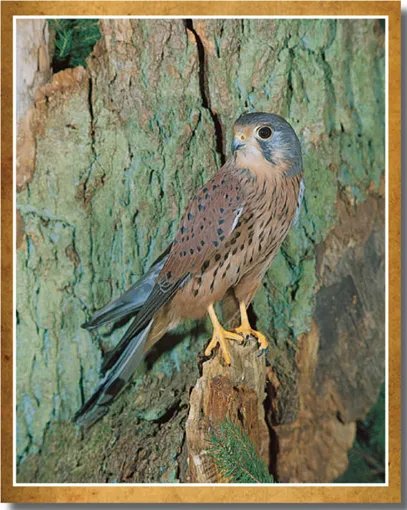
Male common kestrel (Falco tinnunculus). Werner Layer/Bruce Coleman Ltd.
BIRDS OF PREY
LOCOMOTION
All falconiforms fly well, some excellently. Few hunt on the ground, but all can walk or hop. With the exception of the secretary bird, flight is the most important method of locomotion. Modes of flight include flapping, gliding, soaring, or diving (stooping) and are used to locate and kill prey, move from perch to perch, or migrate. Adaptations for swift or slow flight, mainly associated with habitat or type of prey, are varied.
FLAPPING, SOARING, AND DIVING
All species can use flapping flight, but it is laboured in heavy species (vultures, condors). Most use it only to get under way or to move from perch to perch, thereafter gliding, hovering, or soaring. Harriers sustain flapping flight, interspersed with short glides, as they hunt small animals in open, grassy country. This also assists them in migrating across open water, a practice usually avoided by soaring species because of the lack of thermal updrafts. Accipiters accelerate in pursuit by rapid flapping flight, and many other species travel short distances by flapping alternated with gliding, especially when air currents are lacking.
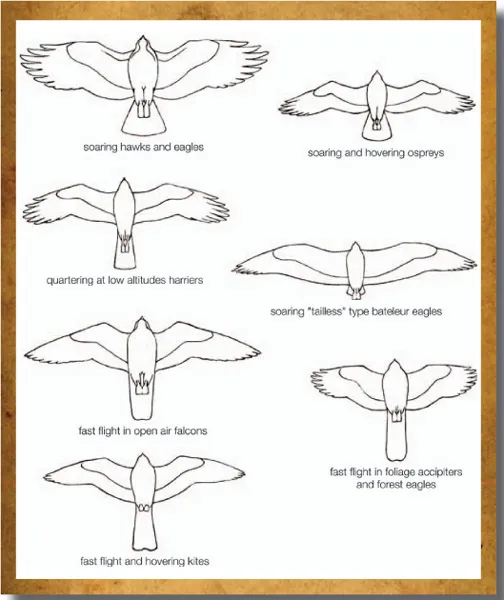
Modifications for specialized types of flight among falconiforms. Encyclopædia Britannica, Inc.
All the large species are adapted for soaring flight, and even accipiters, swift falcons, and the secretary bird can soar well. A typical soaring wing is rather long and moderately broad—i.e., of low aspect ratio. High-aspect-ratio wings (long and extremely narrow), found in seabirds, would presumably be inconvenient to falconiforms, which often require maneuverability in tight spaces. The wing usually has the outer four to six primary flight feathers more or less emarginated, forming slots at the spread wing tip that reduce turbulence. The slots also permit each feather to bend as an individual airfoil under a differential load, thereby increasing lift. Such a wing is typical of eagles, buzzards, vultures, and kites. In a few species (Indian black eagle, African harrier hawk), the primaries are long, soft, slightly emarginated, and flexible, probably associated with slow flight.
The ability to soar and circle in thermals is controlled by wing loading (the ratio of weight to wing area). The higher the wing loading, the larger the turning circle and the larger the thermal “bubble” required for soaring to gain height. Smaller species (e.g., the black kite), with low wing loadings, can utilize smaller thermals than can heavy vultures. Wing loading increases proportionately with weight as the cube of body size, while wing area increases as the square. The general rule is varied by specific adaptations. Some species (lammergeier, harriers) have much lower wing loadings than others of similar weight and have more buoyant, easy flight. In soaring flight, forward velocity is attained by gliding, with the aid of gravity; the bird mounts on rising air. Increasing the angle of glide increases speed until, in a vertical dive (falcons), speeds of 320 km (200 miles) per hour are attained. Some species (bateleur, lammergeier) are specialized for gliding, almost without wing flapping. Bateleurs glide at an airspeed of 55 to 85 km (34 to 53 miles) per hour for much of the day; they have long wings and very short tails, steering by sideways tilting, or canting. Lammergeiers glide rather slowly, assisted by long, diamond-shaped tails.
Falcons, especially bird killers such as the peregrine and lanner falcons, gyrfalcon, etc., have heavy, bullet-shaped bodies and long, pointed wings; their high wing loading provides high diving speed. They often attack in the air and in a dive can overtake species that would easily evade them in straight flapping flight. Few eagles are nearly as swift, but many combine distinguished soaring and gliding ability with swiftness and agility in attacks upon prey.
WALKING AND HOPPING
On the ground falconiforms progress by walking or hopping; in especially large vultures, hopping is elaborated into bounding threat displays. On a branch they move sideways by sidling or by walking “hand over hand” (e.g., vulturine fish eagle, harrier hawk). On the ground eagles walk slowly and deliberately. African harrier hawks and South American crane hawks have long, slim legs that can bend somewhat backward at the tarsal joint, permitting the attainment of peculiar positions and enabling the birds to probe cavities.
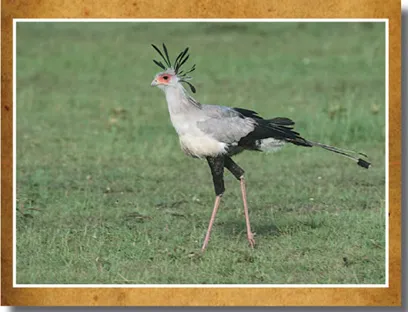
Secretary bird (Sagittarius serpentarius). © Stephen J. Krasemann/Peter Arnold, Inc.
The secretary bird (Sagittarius serpentarius) is the only primarily terrestrial species. It flies only to move from place to place or in display but nevertheless has been seen soaring at 4,000 metres (13,000 feet). It walks with a rapid, steady pace, head jerking to and fro, varying this regular progress with bouts of quick stamping steps to flush possible prey. It has short toes (like the gruiform bustards) and long, cranelike legs suited for rapid walking over long distances. It roosts in trees but descends to the ground to hunt soon after daybreak.
LIFE HISTORY
Large falconiforms are among the longest-lived birds, as shown both by records in captivity and by the slow breeding rates observed in the wild. Where not persecuted, populations of large falconiforms are remarkably stable. Breeding rates correlate with average life spans; i.e., longer-lived species breed slower than shorter-lived ones.
The falconiform life cycle consists of the four stages described below, each of which varies mainly according to size—the larger the bird, the longer the stage. Latitude also affects these periods, with longer fledging periods for equatorial species as compared with temperate species of similar size.
THE FLEDGING PERIOD
The fledging period (from hatching to first flight) varies from about three weeks in small accipiters to four months in large eagles and vultures and slightly longer still in condors. In this stage the downy nestling develops to adult size, during which time the bird may become up to 40 times heavier. The young must be fed at first, but before its first flight it learns to tear up prey brought by the parent...
Table of contents
- Cover Page
- Title Page
- Copyright Page
- Contents
- Introduction
- Chapter 1: Raptors: The Falconiforms
- Chapter 2: Selected Falconiforms
- Chapter 3: Raptors: The Owls
- Chapter 4: Types of Owls
- Chapter 5: Sharks and Rays
- Chapter 6: Sharks
- Chapter 7: Selected Groups of Sharks and Rays
- Chapter 8: Crocodiles
- Glossary
- Bibliography
- Index
Frequently asked questions
Yes, you can cancel anytime from the Subscription tab in your account settings on the Perlego website. Your subscription will stay active until the end of your current billing period. Learn how to cancel your subscription
No, books cannot be downloaded as external files, such as PDFs, for use outside of Perlego. However, you can download books within the Perlego app for offline reading on mobile or tablet. Learn how to download books offline
Perlego offers two plans: Essential and Complete
- Essential is ideal for learners and professionals who enjoy exploring a wide range of subjects. Access the Essential Library with 800,000+ trusted titles and best-sellers across business, personal growth, and the humanities. Includes unlimited reading time and Standard Read Aloud voice.
- Complete: Perfect for advanced learners and researchers needing full, unrestricted access. Unlock 1.4M+ books across hundreds of subjects, including academic and specialized titles. The Complete Plan also includes advanced features like Premium Read Aloud and Research Assistant.
We are an online textbook subscription service, where you can get access to an entire online library for less than the price of a single book per month. With over 1 million books across 990+ topics, we’ve got you covered! Learn about our mission
Look out for the read-aloud symbol on your next book to see if you can listen to it. The read-aloud tool reads text aloud for you, highlighting the text as it is being read. You can pause it, speed it up and slow it down. Learn more about Read Aloud
Yes! You can use the Perlego app on both iOS and Android devices to read anytime, anywhere — even offline. Perfect for commutes or when you’re on the go.
Please note we cannot support devices running on iOS 13 and Android 7 or earlier. Learn more about using the app
Please note we cannot support devices running on iOS 13 and Android 7 or earlier. Learn more about using the app
Yes, you can access Meat Eaters by Britannica Educational Publishing, John P Rafferty in PDF and/or ePUB format, as well as other popular books in Biological Sciences & Zoology. We have over one million books available in our catalogue for you to explore.