Notwithstanding its detractors, evolutionary science has anticipated modern genetic research and continued to illuminate mysteries about our past and our connectedness to the species around us. Detailing the evolutionary process and speciation as well as the continuing debates about evolution's inherent validity, this engrossing volume considers all aspects of this exciting field of study.
- English
- ePUB (mobile friendly)
- Available on iOS & Android
eBook - ePub
New Thinking About Evolution
About this book
Information
Subtopic
EvolutionIndex
Biological SciencesCHAPTER 1
UNDERSTANDING EVOLUTION
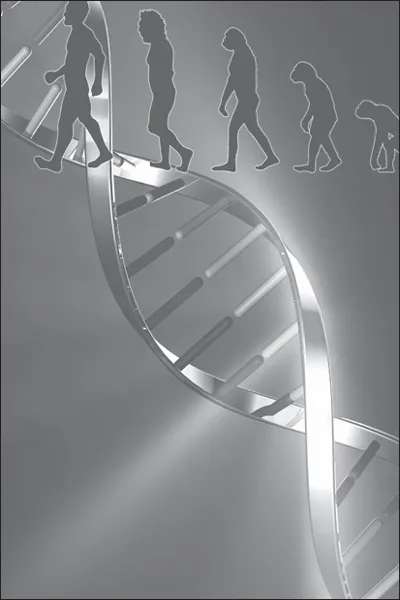
In biology the theory of evolution postulates that the various types of plants, animals, and other living things on Earth have their origin in other preexisting types and that the distinguishable differences are due to modifications in successive generations. The theory of evolution is one of the fundamental keystones of modern biological theory.
The diversity of the living world is staggering. More than 2 million existing species of organisms have been named and described; many more remain to be discovered—from 10 million to 30 million, according to some estimates. What is impressive is not just the numbers but also the incredible heterogeneity in size, shape, and way of life—from lowly bacteria, measuring less than a thousandth of a millimetre in diameter, to stately sequoias, rising 100 metres (300 feet) above the ground and weighing several thousand tons; from bacteria living in hot springs at temperatures near the boiling point of water to fungi and algae thriving on the ice masses of Antarctica and in saline pools at −23 °C (−9 °F); and from giant tube worms discovered living near hydrothermal vents on the dark ocean floor to spiders and larkspur plants existing on the slopes of Mount Everest more than 6,000 metres (19,700 feet) above sea level.
The virtually infinite variations on life are the fruit of the evolutionary process. All living creatures are related by descent from common ancestors. Humans and other mammals descend from shrewlike creatures that lived more than 150 million years ago; mammals, birds, reptiles, amphibians, and fishes share as ancestors aquatic worms that lived 600 million years ago; and all plants and animals derive from bacteria-like microorganisms that originated more than 3 billion years ago. Biological evolution is a process of descent with modification. Lineages of organisms change through generations; diversity arises because the lineages that descend from common ancestors diverge through time.
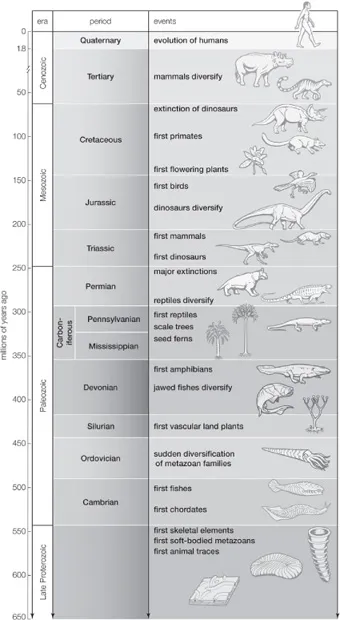
The geologic time scale from 650 million years ago to the present, showing major evolutionary events. Encyclopædia Britannica, Inc.
The 19th-century English naturalist Charles Darwin argued that organisms come about by evolution, and he provided a scientific explanation, essentially correct but incomplete, of how evolution occurs and why it is that organisms have features—such as wings, eyes, and kidneys—clearly structured to serve specific functions. Natural selection was the fundamental concept in his explanation. Natural selection occurs because individuals having more-useful traits, such as more-acute vision or swifter legs, survive better and produce more progeny than individuals with less-favourable traits. Genetics, a science born in the 20th century, reveals in detail how natural selection works and led to the development of the modern theory of evolution. Beginning in the 1960s, a related scientific discipline, molecular biology, enormously advanced knowledge of biological evolution and made it possible to investigate detailed problems that had seemed completely out of reach only a short time previously—for example, how similar the genes of humans and chimpanzees might be (they differ in about 1–2 percent of the units that make up the genes).
THE EVIDENCE FOR EVOLUTION
Darwin and other 19th-century biologists found compelling evidence for biological evolution in the comparative study of living organisms, in their geographic distribution, and in the fossil remains of extinct organisms. Since Darwin’s time, the evidence from these sources has become considerably stronger and more comprehensive, while biological disciplines that emerged more recently—genetics, biochemistry, physiology, ecology, animal behaviour (ethology), and especially molecular biology—have supplied powerful additional evidence and detailed confirmation. The amount of information about evolutionary history stored in the DNA and proteins of living things is virtually unlimited; scientists can reconstruct any detail of the evolutionary history of life by investing sufficient time and laboratory resources.
Evolutionists no longer are concerned with obtaining evidence to support the fact of evolution but rather are concerned with what sorts of knowledge can be obtained from different sources of evidence. The following sections identify the most productive of these sources and illustrate the types of information they have provided.
THE FOSSIL RECORD
Paleontologists have recovered and studied the fossil remains of many thousands of organisms that lived in the past. This fossil record shows that many kinds of extinct organisms were very different in form from any now living. It also shows successions of organisms through time, manifesting their transition from one form to another.
When an organism dies, it is usually destroyed by other forms of life and by weathering processes. On rare occasions some body parts—particularly hard ones such as shells, teeth, or bones—are preserved by being buried in mud or protected in some other way from predators and weather. Eventually, they may become petrified and preserved indefinitely with the rocks in which they are embedded. Methods such as radiometric dating—measuring the amounts of natural radioactive atoms that remain in certain minerals to determine the elapsed time since they were constituted—make it possible to estimate the time period when the rocks, and the fossils associated with them, were formed.
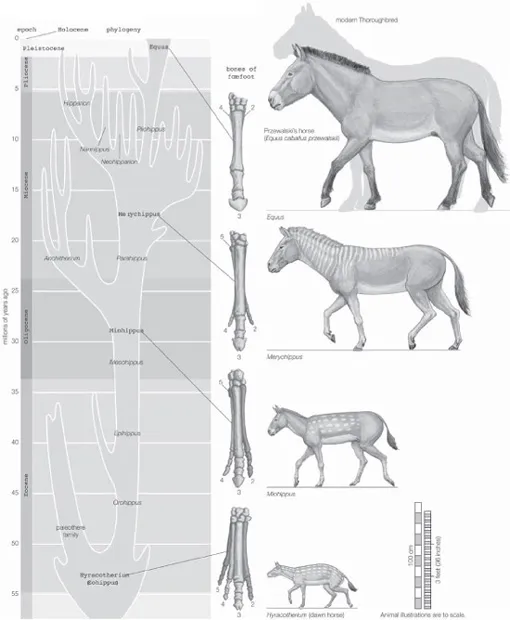
Evolution of the horse over the past 55 million years. The present-day Przewalski’s horse is believed to be the only remaining example of a wild horse—i.e., the last remaining modern horse to have evolved by natural selection. Numbered bones in the forefoot illustrations trace the gradual transition from a four-toed to a one-toed animal.
Encyclopædia Britannica, Inc.
Encyclopædia Britannica, Inc.
Radiometric dating indicates that Earth was formed about 4.5 billion years ago. The earliest fossils resemble microorganisms such as bacteria and cyanobacteria (blue-green algae); the oldest of these fossils appear in rocks 3.5 billion years old. The oldest known animal fossils, about 700 million years old, come from the so-called Ediacara fauna, small wormlike creatures with soft bodies. Numerous fossils belonging to many living phyla and exhibiting mineralized skeletons appear in rocks about 540 million years old. These organisms are different from organisms living now and from those living at intervening times. Some are so radically different that paleontologists have created new phyla in order to classify them. The first vertebrates, animals with backbones, appeared about 400 million years ago; the first mammals, less than 200 million years ago. The history of life recorded by fossils presents compelling evidence of evolution.
The fossil record is incomplete. Of the small proportion of organisms preserved as fossils, only a tiny fraction have been recovered and studied by paleontologists. In some cases the succession of forms over time has been reconstructed in detail. One example is the evolution of the horse. The horse can be traced to an animal the size of a dog having several toes on each foot and teeth appropriate for browsing; this animal, called the dawn horse (genus Hyracotherium), lived more than 50 million years ago. The most recent form, the modern horse (Equus), is much larger in size, is one-toed, and has teeth appropriate for grazing. The transitional forms are well preserved as fossils, as are many other kinds of extinct horses that evolved in different directions and left no living descendants.
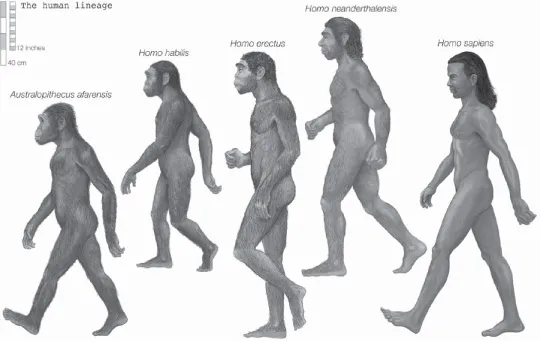
Five hominins—members of the human lineage after it separated at least seven million to six million years ago from lineages going to the apes—are depicted in an artist’s interpretations. All but Homo sapiens, the species that comprises modern humans, are extinct and have been reconstructed from fossil evidence. Encyclopædia Britannica, Inc.
Using recovered fossils, paleontologists have reconstructed examples of radical evolutionary transitions in form and function. For example, the lower jaw of reptiles contains several bones, but that of mammals only one. The other bones in the reptile jaw unmistakably evolved into bones now found in the mammalian ear. At first, such a transition would seem unlikely—it is hard to imagine what function such bones could have had during their intermediate stages. Yet paleontologists discovered two transitional forms of mammal-like reptiles, called therapsids, that had a double jaw joint (i.e., two hinge points side by side)—one joint consisting of the bones that persist in the mammalian jaw and the other composed of the quadrate and articular bones, which eventually became the hammer and anvil of the mammalian ear.
For skeptical contemporaries of Darwin, the “missing link”—the absence of any known transitional form between apes and humans—was a battle cry, as it remained for uninformed people afterward. Not one but many creatures intermediate between living apes and humans have since been found as fossils. The oldest known fossil hominins—i.e., primates belonging to the human lineage after it separated from lineages going to the apes—are 6 million to 7 million years old, come from Africa, and are known as Sahelanthropus and Orrorin (or Praeanthropus), which were predominantly bipedal when on the ground but which had very small brains. Ardipithecus lived about 4.4 million years ago, also in Africa. Numerous fossil remains from diverse African origins are known of Australopithecus, a hominin that appeared between 3 million and 4 million years ago. Australopithecus had an upright human stance but a cranial capacity of less than 500 cc (equivalent to a brain weight of about 500 grams), comparable to that of a gorilla or a chimpanzee and about one-third that of humans. Its head displayed a mixture of ape and human characteristics—a low forehead and a long, apelike face but with teeth proportioned like those of humans. Other early hominins partly contemporaneous with Australopithecus include Kenyanthropus and Paranthropus; both had comparatively small brains, although some species of Paranthropus had larger bodies. Paranthropus represents a side branch in the hominin lineage that became extinct. Along with increased cranial capacity, other human characteristics have been found in Homo habilis, which lived about 1.5 million to 2 million years ago in Africa and had a cranial capacity of more than 600 cc (brain weight of 600 grams), and in H. erectus, which lived between 0.5 million and more than 1.5 million years ago, apparently ranged widely over Africa, Asia, and Europe, and had a cranial capacity of 800 to 1,100 cc (brain weight of 800 to 1,100 grams). The brain sizes of H. ergaster, H. antecessor, and H. heidelbergensis were roughly that of the brain of H. erectus, some of which species were partly contemporaneous, though they lived in different regions of the Eastern Hemisphere.
STRUCTURAL SIMILARITIES
The skeletons of turtles, horses, humans, birds, and bats are strikingly similar, in spite of the different ways of life of these animals and the diversity of their environments. The correspondence, bone by bone, can easily be seen not only in the limbs but also in every other part of the body. From a purely practical point of view, it is incomprehensible that a turtle should swim, a horse run, a person write, and a bird or a bat fly with forelimb structures built of the same bones. An engineer could design better limbs in each case. But if it is accepted that all of these skeletons inherited their structures from a common ancestor and became modified only as they adapted to different ways of life, the similarity of their structures makes sense.
Comparative anatomy investigates the homologies, or inherited similarities, among organisms in bone structure and in other parts of the body. The correspondence of structures is typically very close among some organisms—the different varieties of songbirds, for instance—but becomes less so as the organisms being compared are less closely related in their evolutionary history. The similarities are less between mammals and birds than they are among mammals, and they are still less between mammals and fishes. Similarities in structure, therefore, not only manifest evolution but also help to reconstruct the phylogeny, or evolutionary history, of organisms.
Comparative anatomy also reveals why most organismic structures are not perfect. Like the forelimbs of turtles, horses, humans, birds, and bats, an organism’s body parts are less than perfectly adapted because they are modified from an inherited structure rather than designed from completely “raw” materials for a specific purpose. The imperfection of structures is evidence for evolution and against antievolutionist arguments that invoke intelligent design.
EMBRYONIC DEVELOPMENT AND VESTIGES
Darwin and his followers found support for evolution in the study of embryology, the science that investigates the development of organisms from fertilized egg to time of birth or hatching. Vertebrates, from fishes through lizards to humans, develop in ways that are remarkably similar during early stages, but they become more and more differentiated as the embryos approach maturity. The similarities persist longer between organisms that are more closely related (e.g., humans and monkeys) than between those less closely related (humans and sharks). Common developmental patterns reflect evolutionary kinship. Lizards and humans share a developmental pattern inherited from their remote common ancestor; the inherited pattern of each was modified only as the separate descendant lineages evolved in different directions. The common embryonic stages of the two creatures reflect the constraints imposed by this common inheritance, which prevents changes that have not been necessitated by their diverging environments and ways of life.
The embryos of humans and other nonaquatic vertebrates exhibit gill slits even though they never breathe through gills. These slits are found in the embryos of all vertebrates because they share as common ancestors the fish in which these structures first evolved. Human embryos also exhibit by the fourth week of development a well-defined tail, which reaches maximum length at six weeks. Similar embryonic tails are found in other mammals, such as dogs, horses, and monkeys; in humans, however, the tail eventually shortens, persisting only as a rudiment in the adult coccyx.
A close evolutionary relationship between organisms that appear drastically different as adults can sometimes be recognized by their embryonic homologies. Barnacles, for example, are sedentary crustaceans with little apparent likeness to such free-swimming crustaceans as lobsters, shrimps, or copepods. Yet barnacles pass through a free-swimming larval stage, the nauplius, which is unmistakably similar to that of other crustacean larvae.
Embryonic rudiments that never fully develop, such as the gill slits in humans, are common in all sorts of animals. Some, however, like the tail rudiment in humans, persist as adult vestiges, reflecting evolutionary ancestry. The most familiar rudimentary organ in humans is the vermiform appendix. This wormlike structure attaches to a short section of intestine called the cecum, which is located at the point where the large and small intestines join. The human vermiform appendix is a functionless vestige of a fully developed organ present in other mammals, such as the rabbit and other herbivores, where a large cecum and appendix store vegetable cellulose to enable its digestion with the help of bacteria. Vestiges are instances of imperfections—like the imperfections seen in anatomical structures—that argue against creation by design but are fully understandable as a result of evolution.
BIOGEOGRAPHY
Darwin also saw a confirmation of evolution in the geographic distribution of plants and animals, and later knowledge has reinforced his observations. For example, there are about 1,500 known species of Drosophila vinegar flies in the world; nearly one-third of them live in Hawaii and nowhere else, although the total area of the archipelago is less than one-twentieth the area of California or Germany. Also in Hawaii are more than 1,000 species of snails and other land mollusks that exist nowhere else. This unusual diversity is easily explained by evolution. The islands of Hawaii are extremely isolated and have had few colonizers—i.e, animals and plants that arrived there from elsewhere and established populations. Those species that did colonize the islands found many unoccupied ecological niches, local environments suited to sustaining them and lacking predators that would prevent them from multiplying. In response, these species rapidly diversified; this process of diversifying in order to fill ecological niches is called adaptive radiation.
Each of the world’s continents has its own distinctive collection of animals and plants. In Africa are rhinoceroses, hippopotamuses, lions, hyenas, giraffes, zebras, lemurs, monkeys with narrow noses and nonprehensile tails, chimpanzees, and gorillas. South America, which extends over much the same latitudes as Africa, has none of these animals; it instead has pumas, jaguars, tapir, llamas, raccoons, opossums, armadillos, and monkeys with broad noses and large prehensile tails.
These vagaries of biogeography are not due solely to the suitability of the different environments. There is no reason to believe that South American animals are not well suited to living in Africa or those of Africa to living in South America. The islands of Hawaii are no better suited than other Pacific islands for vinegar flies, nor are they less hospitable than other parts of the world for many absent organisms. In fact, although no large mammals are native to the Hawaiian islands, pigs and goats have multiplied there as wild animals since being introduced by humans. This absence of many species from a hospitable environment in which an extraordinary variety of other species flourish can be explained by the theory of evolution, which holds that species can exist and evolve only in geographic areas that were colonized by their ancestors.
MOLECULAR BIOLOGY
The field of molecular biology provides the most detailed and convincing evidence available for biological evolution. In its unveiling of the nature of DNA and the workings of organisms at the level of enzymes and other protein molecules, it has shown that these molecules hold information about an organism’s ancestry. This has made it possible to reconstruct evolutionary events that were previously unknown and to confirm and adjust the view of events already known. The precision with which these events can be reconstructed is one reason the evidence from molecular biology is so compelling. Another reason is that molec...
Table of contents
- Cover Page
- Title Page
- Copyright Page
- Contents
- Introduction
- Chapter 1: Understanding Evolution
- Chapter 2: The Process of Evolution
- Chapter 3: Species and Speciation
- Chapter 4: Reconstruction of Evolutionary History
- Chapter 5: Notable Evolutionary Thinkers
- Chapter 6: Related Evolutionary Concepts
- Glossary
- For Further Reading
- Index
Trusted by 375,005 students
Access to over 1.5 million titles for a fair monthly price.
Study more efficiently using our study tools.
Frequently asked questions
Yes, you can cancel anytime from the Subscription tab in your account settings on the Perlego website. Your subscription will stay active until the end of your current billing period. Learn how to cancel your subscription
No, books cannot be downloaded as external files, such as PDFs, for use outside of Perlego. However, you can download books within the Perlego app for offline reading on mobile or tablet. Learn how to download books offline
Perlego offers two plans: Essential and Complete
- Essential is ideal for learners and professionals who enjoy exploring a wide range of subjects. Access the Essential Library with 800,000+ trusted titles and best-sellers across business, personal growth, and the humanities. Includes unlimited reading time and Standard Read Aloud voice.
- Complete: Perfect for advanced learners and researchers needing full, unrestricted access. Unlock 1.5M+ books across hundreds of subjects, including academic and specialized titles. The Complete Plan also includes advanced features like Premium Read Aloud and Research Assistant.
We are an online textbook subscription service, where you can get access to an entire online library for less than the price of a single book per month. With over 1.5 million books across 990+ topics, we’ve got you covered! Learn about our mission
Look out for the read-aloud symbol on your next book to see if you can listen to it. The read-aloud tool reads text aloud for you, highlighting the text as it is being read. You can pause it, speed it up and slow it down. Learn more about Read Aloud
Yes! You can use the Perlego app on both iOS and Android devices to read anytime, anywhere — even offline. Perfect for commutes or when you’re on the go.
Please note we cannot support devices running on iOS 13 and Android 7 or earlier. Learn more about using the app
Please note we cannot support devices running on iOS 13 and Android 7 or earlier. Learn more about using the app
Yes, you can access New Thinking About Evolution by Britannica Educational Publishing, John P Rafferty in PDF and/or ePUB format, as well as other popular books in Biological Sciences & Evolution. We have over 1.5 million books available in our catalogue for you to explore.