Though smaller than most other Arab countries, the gulf states of Kuwait, Qatar, Bahrain, Oman, and the United Arab Emirates represent some of the most fascinating areas of the Middle East. A blend of traditional and modern, most of these states have become wealthy with oil money, which has allowed them to welcome foreign workers from diverse backgrounds, while retaining their Arab character. This absorbing volume surveys the organization, culture, and history of each of these states and their efforts to balance their ties with the Arab and international communities.
eBook - ePub
Persian Gulf States
Kuwait, Qatar, Bahrain, Oman, and the United Arab Emirates
- English
- ePUB (mobile friendly)
- Available on iOS & Android
eBook - ePub
Persian Gulf States
Kuwait, Qatar, Bahrain, Oman, and the United Arab Emirates
About this book
Information
Subtopic
Middle Eastern HistoryIndex
HistoryCHAPTER 1
BAHRAIN: THE LAND AND ITS PEOPLE
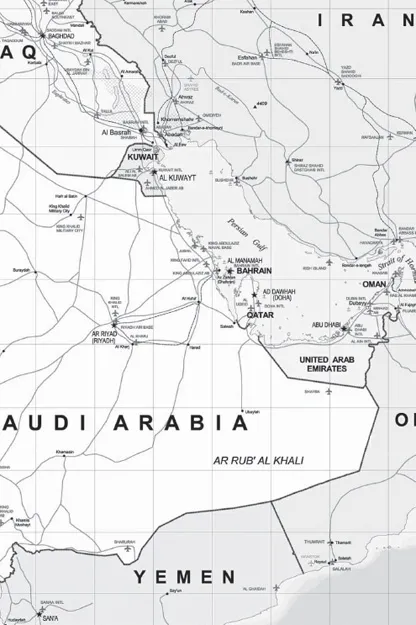
Bahrain’s total land area is slightly greater than that of Singapore. Saudi Arabia lies to the west across the Gulf of Bahrain, while the Qatar peninsula lies to the east. The King Fahd Causeway, 15 miles (24 km) long, links Bahrain to Saudi Arabia.
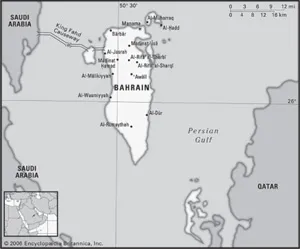
The state consists of two separate groups of islands, which together extend about 30 miles (50 km) from north to south and 10 miles (16 km) from east to west. The island of Bahrain accounts for seven-eighths of the country’s total land area and is surrounded by smaller islands. Two of these—Al-Muḥarraq and Sitrah, both to the northeast—are joined to Bahrain Island by causeways that have facilitated residential and industrial development. An oil port, Sitrah handles not only the entire petroleum production of Bahrain but is also an export centre for oil fields in northeastern Saudi Arabia. Other islands in the group are Nabī Ṣāliḥ, Al-Muḥammadiyyah (Umm al-Ṣabbān), Umm al-Na‘sān (linked by the King Fahd Causeway), and Jiddah. The second group consists of the Ḥawār Islands, which are situated near the coast of Qatar, about 12 miles (19 km) southeast of Bahrain Island; a dispute with Qatar over ownership of the islands was resolved in 2001, when the International Court of Justice awarded them to Bahrain. Small and rocky, they are inhabited by only a few fishermen and quarry workers, but they are believed to hold petroleum and natural gas reserves.
The majority of the population of Bahrain is Arab. Although most of the people are native-born Bahraini Arabs, there are also Arabs of Palestinian, Omani, and Saudi ancestry. Substantial foreign-born communities are also found in Bahrain; these residents hail from countries that include Iran, India, Pakistan, Britain, and the United States, and they account for more than one-third of the country’s total population.
RELIEF AND DRAINAGE
While the small islands in both groups are rocky and low-lying, rising only a few feet above sea level, the main island is more varied in appearance. Geologically, the island consists of gently folded layers of sedimentary rocks: limestones, sandstones, and marls (loose clay, sand, or silt) formed during the Cretaceous, Paleogene, and Neogene periods (i.e., from about 145 to 2.6 million years ago). The central region is rocky and barren, rising to 440 feet (134 metres) above sea level at Al-Dukhān Hill (Jabal Al-Dukhān), the country’s highest point. The southern and western lowlands consist of a bleak sandy plain with some salt marshes, while the northern and northwestern coasts afford a striking contrast, forming a narrow belt of date palms and vegetable gardens irrigated from prolific springs and wells that tap artesian water. The source of this water is precipitation on the western mountains of Saudi Arabia, which flows into deep underground aquifers. The abundance of fresh water has provided Bahrain with fertile land, from which it gained importance historically as a harbour and trading centre in the Persian Gulf. Economic developments and population growth have outstripped the available artesian water in the country, and some three-fifths of the water used now comes from seawater desalinization plants powered by natural gas.
CLIMATE
Summer in Bahrain is unpleasant, as high temperatures frequently coincide with high humidity. Midday temperatures from May to October exceed 90 °F (32 °C), often reaching the mid-90s F (mid-30s C) or higher; summer nights are sultry and humid. Winters are cooler and more pleasant, with mean temperatures from December to March dipping to the low 70s F (low 20s C). Precipitation is confined to the winter months and averages only 3 inches (75 mm) per year, but this may vary from almost nothing to double that amount. On average, precipitation occurs only about 10 days a year. Sunshine is abundant year-round. The predominant wind is the damp, northwesterly shamāl; the qaws, a hot, dry south wind, is less frequent and brings sand, dust, and low humidity.
PLANT AND ANIMAL LIFE
Some 200 different species of desert plants grow in the bare, arid portions of the archipelago, while the irrigated and cultivated areas of the islands support fruit trees, fodder crops, and vegetables. The variety of animals is limited by the desert conditions. Gazelle and hares are not yet extinct, and lizards and jerboas (desert rodents) are common; the mongoose—probably imported from India—is found in the irrigated areas. Birdlife is sparse except in spring and autumn, when many varieties of migratory birds rest temporarily in Bahrain while traveling to and from higher temperate latitudes.
ETHNIC GROUPS
Roughly two-thirds of the population is Arab, and most are native-born Bahrainis, but some are Palestinians, Omanis, or Saudis. Foreign-born inhabitants, comprising more than one-third of the population, are mostly from Iran, India, Pakistan, Britain, and the United States. About three-fifths of the labour force is foreign.
LANGUAGES
Arabic is the official language of Bahrain. English is widely used, however, and is a compulsory second language at all schools. Persian is also common, although it is spoken mostly in the home. A number of other languages are spoken among expatriates in Bahrain, including Urdu, Hindi, and Tagalog.
RELIGION
The population is more than four-fifths Muslim and includes both the Sunni and Shī‘ite sects, with the latter in the majority. The ruling family and many of the wealthier and more influential Bahrainis are Sunni, and this difference has been an underlying cause of local tension, particularly during and after the Iran-Iraq War (1980–88). Christians constitute about half of the remaining one-fifth of the population, with the rest consisting of Jews, Hindus, and Bahā’īs.
SETTLEMENT PATTERNS
The majority of the population now dwells in towns, but in the north and northwest of the main island, where irrigation has long been carried out using artesian water, there are numerous small villages and isolated dwellings where horticulture is the way of life. This area has an aspect of great fertility, which contrasts starkly with the bare desert appearance of much of the country. Villages consist, for the most part, of substantial flat-roofed houses built of stone or concrete. Some of the temporary settlements of fishermen and the poor are still constructed of barasti (branches of the date palm). There is little permanent settlement either in the southern half of Bahrain Island or on the smaller islands.
More than one-third of the population lives in the two principal cities, Manama and Al-Muḥarraq. Manama, with its Port Salmān, is the largest city and contains the main government offices, the business and financial district, many large hotels, Western-style shops, and a traditional Arab souk (market). It has a distinctly modern appearance as compared with Al-Muḥarraq, which is densely settled and has many narrow, winding streets. Other major settlements are ‘Awālī, near the centre of Bahrain Island, built largely for expatriate employees of the Bahrain Petroleum Company B.S.C. (Bapco); Madīnat ‘Īsā (Isa Town), a community established by the government in 1968; the sizable settlements of Al-Rifā‘ al-Shamālī (North Rifā‘), Al-Rifā‘ al-Sharqī (East Rifā‘), and Al-Rifā‘ al-Gharbī (West Rifā‘); and Madīnat Ḥamad, completed in 1984.
DEMOGRAPHIC TRENDS
Although the population of Bahrain has been steadily growing, it has done so by narrowing margins since the turn ...
Table of contents
- Cover Page
- Title Page
- Copyright Page
- Contents
- Introduction
- Chapter 1: Bahrain: The Land and Its People
- Chapter 2: The Bahraini Economy
- Chapter 3: Bahraini Government and Society
- Chapter 4: Bahraini Cultural Life
- Chapter 5: Bahrain: Past and Present
- Chapter 6: Kuwait: The Land and Its People
- Chapter 7: The Kuwaiti Economy
- Chapter 8: Kuwaiti Government and Society
- Chapter 9: Kuwaiti Cultural Life
- Chapter 10: Kuwait: Past and Present
- Chapter 11: Oman: The Land and Its People
- Chapter 12: The Omani Economy
- Chapter 13: Omani Government and Society
- Chapter 14: Omani Cultural Life
- Chapter 15: Oman: Past and Present
- Chapter 16: Qatar: The Land and Its People
- Chapter 17: The Qatari Economy
- Chapter 18: Qatari Government and Society
- Chapter 19: Qatari Cultural Life
- Chapter 20: Qatar: Past and Present
- Chapter 21: United Arab Emirates: The Land and Its People
- Chapter 22: The Emirati Economy
- Chapter 23: Emirati Government and Society
- Chapter 24: Emirati Cultural Life
- Chapter 25: The United Arab Emirates: Past and Present
- Glossary
- Bibliography
- Index
Trusted by 375,005 students
Access to over 1.5 million titles for a fair monthly price.
Study more efficiently using our study tools.
Frequently asked questions
Yes, you can cancel anytime from the Subscription tab in your account settings on the Perlego website. Your subscription will stay active until the end of your current billing period. Learn how to cancel your subscription
No, books cannot be downloaded as external files, such as PDFs, for use outside of Perlego. However, you can download books within the Perlego app for offline reading on mobile or tablet. Learn how to download books offline
Perlego offers two plans: Essential and Complete
- Essential is ideal for learners and professionals who enjoy exploring a wide range of subjects. Access the Essential Library with 800,000+ trusted titles and best-sellers across business, personal growth, and the humanities. Includes unlimited reading time and Standard Read Aloud voice.
- Complete: Perfect for advanced learners and researchers needing full, unrestricted access. Unlock 1.5M+ books across hundreds of subjects, including academic and specialized titles. The Complete Plan also includes advanced features like Premium Read Aloud and Research Assistant.
We are an online textbook subscription service, where you can get access to an entire online library for less than the price of a single book per month. With over 1.5 million books across 990+ topics, we’ve got you covered! Learn about our mission
Look out for the read-aloud symbol on your next book to see if you can listen to it. The read-aloud tool reads text aloud for you, highlighting the text as it is being read. You can pause it, speed it up and slow it down. Learn more about Read Aloud
Yes! You can use the Perlego app on both iOS and Android devices to read anytime, anywhere — even offline. Perfect for commutes or when you’re on the go.
Please note we cannot support devices running on iOS 13 and Android 7 or earlier. Learn more about using the app
Please note we cannot support devices running on iOS 13 and Android 7 or earlier. Learn more about using the app
Yes, you can access Persian Gulf States by Britannica Educational Publishing, Laura Etheredge in PDF and/or ePUB format, as well as other popular books in History & Middle Eastern History. We have over 1.5 million books available in our catalogue for you to explore.