By their very nature, inventions change the status quo. The innovations highlighted in this book have done so in a most dramatic, memorable, or effective fashion. Through engaging narrative and accompanying images, this volume gives readers a deeper appreciation for the inventions that have made their lives easier, more aesthetically pleasing, or otherwise better.
eBook - ePub
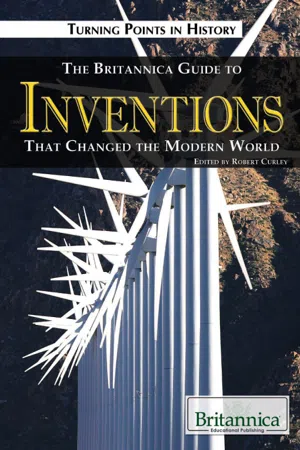
The Britannica Guide to Inventions That Changed the Modern World
- English
- ePUB (mobile friendly)
- Available on iOS & Android
eBook - ePub
The Britannica Guide to Inventions That Changed the Modern World
About this book
Trusted by 375,005 students
Access to over 1.5 million titles for a fair monthly price.
Study more efficiently using our study tools.
Information
Subtopic
World HistoryIndex
HistoryChapter 1:
Communication
In today’s interconnected world, communication—that is, the transmission of information for the purpose of creating understanding—can be seen as the product of a series of inventions and also as the basis of all further invention. Thanks to the invisible action of electrons working over the media of television, the telephone, and the Internet, our means of communication today have so extended our reach, broadened our vision, and expanded our knowledge that we are often said to live in the Age of Information. That age actually began thousands of years ago, with the first markings on clay tablets and sheets of papyrus.
CUNEIFORM
Cuneiform was the most widespread and historically significant writing system in the ancient Middle East, its active history comprising the last 3,000 years before the Common Era. The name cuneiform, a coinage from Latin and Middle French roots meaning “wedge-shaped,” has been the modern designation for the writing system since the early 18th century.
ORIGINS IN SUMERIA
The origins of cuneiform may be traced as far back as the end of the 4th millennium BCE. At that time the Sumerians, a people of unknown ethnic and linguistic affinities, inhabited southern Mesopotamia and the region west of the mouth of the Euphrates known as Chaldea. While it does not follow that they were the earliest inhabitants of the region or the true originators of their system of writing, it is to them that the first attested traces of cuneiform writing are conclusively assigned. The earliest written records in the Sumerian language are pictographic tablets from Uruk (Erech), evidently lists or ledgers of commodities identified by drawings of the objects and accompanied by numerals and personal names. Such word writing was able to express only the basic ideas of concrete objects. Numerical notions were easily rendered by the repetitional use of strokes or circles. However, the representation of proper names, for example, necessitated an early recourse to the rebus principle—i.e., the use of pictographic shapes to evoke in the reader’s mind an underlying sound form rather than the basic notion of the drawn object. This brought about a transition from pure word writing to a partial phonetic script. Thus, for example, the picture of a hand came to stand not only for Sumerian šu (“hand”) but also for the phonetic syllable šu in any required context. Sumerian words were largely monosyllabic, so the signs generally denoted syllables, and the resulting mixture is termed a word-syllabic script. The inventory of phonetic symbols henceforth enabled the Sumerians to denote grammatical elements by phonetic complements added to the word signs (logograms or ideograms). Because Sumerian had many identical sounding (homophonous) words, several logograms frequently yielded identical phonetic values and are distinguished in modern transliteration—(as, for example, ba, bá, bà, ba4). Because a logogram often represented several related notions with different names (e.g., “sun,” “day,” “bright”), it was capable of assuming more than one phonetic value. This feature is called polyphony.
During the 3rd millennium BCE the writing became successively more cursive, and the pictographs developed into conventionalized linear drawings. Due to the prevalent use of clay tablets as writing material (stone, metal, or wood also were employed occasionally), the linear strokes acquired a wedge-shaped appearance by being pressed into the soft clay with the slanted edge of a stylus. Curving lines disappeared from writing, and the normal order of signs was fixed as running from left to right, without any word-divider. This change from earlier columns running downward entailed turning the signs on one side.
AKKADIAN CUNEIFORM
Before these developments had been completed, the Sumerian writing system was adopted by the Akkadians, Semitic invaders who established themselves in Mesopotamia about the middle of the 3rd millennium BCE. In adapting the script to their wholly different language, the Akkadians retained the Sumerian logograms and combinations of logograms for more complex notions but pronounced them as the corresponding Akkadian words. They also kept the phonetic values but extended them far beyond the original Sumerian inventory of simple types (open or closed syllables like ba or ab). Many more complex syllabic values of Sumerian logograms (of the type kan, mul, bat) were transferred to the phonetic level, and polyphony became an increasingly serious complication in Akkadian cuneiform (e.g., the original pictograph for “sun” may be read phonetically as ud, tam, tú, par, laḫ, ḫiš). The Akkadian readings of the logograms added new complicated values. Thus the sign for “land” or “mountain range” (originally a picture of three mountain tops) has the phonetic value kur on the basis of Sumerian but also mat and šad from Akkadian mātu (“land”) and šadû (“mountain”). No effort was made until very late to alleviate the resulting confusion, and equivalent “graphies” like ta-am and tam continued to exist side by side throughout the long history of Akkadian cuneiform.
The earliest type of Semitic cuneiform in Mesopotamia is called the Old Akkadian, seen for example in the inscriptions of the ruler Sargon of Akkad (died c. 2279 BCE). Sumer, the southernmost part of the country, continued to be a loose agglomeration of independent city-states until it was united by Gudea of Lagash (died c. 2124 BCE) in a last brief manifestation of specifically Sumerian culture. The political hegemony then passed decisively to the Akkadians, and King Hammurabi of Babylon (died 1750 BCE) unified all of southern Mesopotamia. Babylonia thus became the great and influential centre of Mesopotamian culture. The Code of Hammurabi is written in Old Babylonian cuneiform, which developed throughout the shifting and less brilliant later eras of Babylonian history into Middle and New Babylonian types. Farther north in Mesopotamia the beginnings of Assur were humbler. Specifically Old Assyrian cuneiform is attested mostly in the records of Assyrian trading colonists in central Asia Minor (c. 1950 BCE; the so-called Cappadocian tablets) and Middle Assyrian in an extensive Law Code and other documents. The Neo-Assyrian period was the great era of Assyrian power, and the writing culminated in the extensive records from the library of Ashurbanipal at Nineveh (c. 650 BCE).
The expansion of cuneiform writing outside Mesopotamia began in the 3rd millennium, when the country of Elam in southwestern Iran was in contact with Mesopotamian culture and adopted the system of writing. The Elamite sideline of cuneiform continued far into the 1st millennium BCE, when it presumably provided the Indo-European Persians with the external model for creating a new simplified quasi-alphabetic cuneiform writing for the Old Persian language. The Hurrians in northern Mesopotamia and around the upper stretches of the Euphrates adopted Old Akkadian cuneiform around 2000 BCE and passed it on to the Indo-European Hittites, who had invaded central Asia Minor at about that time.
In the 2nd millennium the Akkadian of Babylonia, frequently in somewhat distorted and barbarous varieties, became a lingua franca of international intercourse in the entire Middle East, and cuneiform writing thus became a universal medium of written communication. The political correspondence of the era was conducted almost exclusively in that language and writing. Cuneiform was sometimes adapted, as in the consonantal script of the Canaanite city of Ugarit on the Syrian coast (c. 1400 BCE). Sometimes it was simply taken over, as in the inscriptions of the kingdom of Urartu or Haldi in the Armenian mountains from the 9th to 6th centuries BCE; the language is remotely related to Hurrian, and the script is a borrowed variety of Neo-Assyrian cuneiform. Even after the fall of the Assyrian and Babylonian kingdoms in the 7th and 6th centuries BCE, when Aramaic had become the general popular language, rather decadent varieties of Late Babylonian and Assyrian survived as written languages in cuneiform almost down to the time of Christ.
THE PAPYRUS SCROLL
The papyrus scroll of ancient Egypt is more nearly the direct ancestor of the modern book than is the clay tablet used in cuneiform writing. Papyrus as a writing material resembles paper. It was made from a reedy plant of the same name that flourishes in the Nile Valley.
IN ANCIENT EGYPT
Pliny the Elder, the Roman savant and author from the 1st century CE, gave an account of the manufacture of paper from papyrus. The fibrous layers within the stem of the plant were removed, and a number of these longitudinal strips were placed side by side and then crossed at right angles with another set of strips. The two layers formed a sheet, which was then dampened and pressed. Upon drying, the gluelike sap of the plant acted as an adhesive and cemented the layers together. The sheet was finally hammered and dried in the sun. The paper thus formed was pure white in colour and, if well-made, was free of spots, stains, or other defects. Although the sheets varied in size, ordinary ones measured about 5 to 6 inches (13 to 15 centimetres) wide. A number of these sheets were then joined together with paste to form a scroll, with usually not more than 20 sheets to a scroll. To make a book, the scribe copied a text on the side of the sheets where the strips of pith ran horizontally, and the finished product was rolled up with the text inside.
The use of papyrus affected the style of writing just as clay tablets had affected cuneiform. Scribes wrote on it with a reed pen or brush and inks of different colours. The result could be very decorative, especially when done in the monumental hieroglyphic style of writing, a style best adapted to stone inscriptions. The Egyptians created two cursive hands, the hieratic (priestly) and the demotic (a simplified form of hieratic suited to popular use), which were better adapted to papyrus.
Compared with tablets, papyrus is fragile, yet an example is extant from 2500 BCE; and stone inscriptions that are even older portray scribes with rolls. This amazing survival is partly the result of the dry climate of Egypt, in which some papyrus scrolls survived unprotected for centuries while buried in the desert sands. The practice of certain Egyptian funerary customs also contributed to the preservation of many Egyptian books. Obsessed by a concern with life after death, they wrote magical formulas on coffins and on the walls of tombs to guide the dead safely to the gates of the Egyptian underworld. When the space thus provided became insufficient, they entombed papyrus scrolls containing the texts. These mortuary texts are now described collectively as The Book of the Dead, although the Egyptians never standardized a uniform collection. Such books, when overlooked by grave robbers, survived in good condition in the tomb. Besides mortuary texts, Egyptian texts included scientific writings and a large number of myths, stories, and tales.
IN ANCIENT GREECE
The Greeks adopted the papyrus scroll and passed it on to the Romans. Although both Greeks and Romans used other writing materials (waxed wooden tablets, for example), the Greek and Roman words for “book” show identification with the Egyptian model. Greek biblos (“book”) can be compared with byblos (“papyrus”), while the Latin volumen (“book”) signified a scroll. It has been suggested that papyrus was continuously in use in Greece from the 6th century BCE, and evidence has been cited to indicate its use as early as 900 BCE. Objects called books are mentioned by ancient Greek writers as having been in use in the 5th century BCE. The oldest extant Greek rolls, however, date from the 4th century BCE.
The 30,000 extant Greek papyri permit a generalized description of the Greek book. Rolled up, it stood about nine or 10 inches high and was an inch or an inch and a half in diameter. When the book was unrolled it displayed a text written in the Greek alphabet in columns about three inches wide separated by inch-wide margins. In spite of the Greek proficiency in decorative arts, few surviving books are illustrated. Such illustrations as have survived were of the practical sort found in later scientific books.
Practicality was a mark of the Greek book. The alphabet, although not invented by the Greeks, was adapted and stabilized by them as an instrument of verbal communication rather than of decorative purpose. Unlike the monumental Egyptian survivals in a decorative hand that sometimes exceeded 100 feet (30 metres) in length, Greek rolls seldom exceeded 35 feet (11 m) in length and featured little embellishment. Such a scroll was about as large as could be conveniently held in the hands to read, and it was big enough to contain a book of Thucydides or one of the longer New Testament Gospels. The average Greek book was shorter. Two books (here denoting a subdivision of a text) of Homer written in a later small hand fitted a 35-foot (11-m) scroll.
THE PAPYRUS PLANT

Papyrus (Cyperus papyrus). Adrian Pingstone
The papyrus plant (Cyperus papyrus) was long cultivated in the Nile delta region of Egypt. The plant is formed into a smooth, thin writing surface that is also known as papyrus. It is a grasslike aquatic plant that has woody, bluntly triangular stems and grows up to about 15 feet (4.6 metres) high in quietly flowing water up to 3 feet (90 cm) deep. The triangular stem can grow to a width of as much as 2.5 inches (6 cm). Even now, the papyrus plant is often used as a pool ornamental in warm areas or in conservatories. The dwarf papyrus (C. isocladus, also given as C. papyrus “Nanus”), up to 2 feet (60 cm) tall, is sometimes potted and grown indoors.
Although writing material was the most important product of the papyrus plant, the ancient Egyptians also used the stem to make sails, cloth, mats, and cords. In fact, papyrus was cultivated and used for writing material by the Arabs of Egypt down to the time when the growing manufacture of paper from other plant fibres in the 8th and 9th centuries CE rendered papyrus unnecessary. By the 3rd century CE, papyrus had already begun to be replaced in Europe by the less-expensive vellum, or parchment, but the use of papyrus for books and documents persisted sporadically until about the 12th century.
THE GREEK AND LATIN ALPHABETS
The invention of the alphabet is a major achievement of Western culture. It is also unique; the alphabet was invented only once, though it has been borrowed by many cultures. It is a model of analytic thinking, breaking down perceptible qualities like syllables into more basic constituents. The alphabet requires little of the reader beyond familiarity with its orthography (that is, the written symbols of the spoken sounds that make up a language). It allows the reader to decipher words newly encountered and permits the invention of spellings for new patterns of sound, including proper names (a problem that is formidable for nonalphabetic systems).
The word alphabet, from the first two letters of the Greek alphabet—alpha and beta—was first used, in its Latin form, alphabetum, by Tertullian (2nd–3rd century CE), a Latin ecclesiastical writer and church father, and by St. Jerome. The classical Greeks customarily used the plural of to gramma (“the letter”); the later form alphabetos was probably adopted under Latin influence.
THE GREEK ALPHABET
As in so many other things, the importance of the ancient Greeks in the history of the alphabet is paramount. All of the alphabets in use in European languages today are directly or indirectly related to the Greek. The Greek alphabet was of course the culmination of a long historical evolution; the main achievement of the Greeks was to provide representations for vowel sounds. Consonants plus vowels made a writing system that was both economical and unambiguous. The true alphabetic system has remained for 3,000 years, with only slight modifications, an unparalleled vehicle of expression and communication in and among the most diverse nationalities and languages.
The Greek alphabet derived from the North Semitic script in the 8th century BCE. The direction of writing in the oldest Greek inscriptions—as in the Semitic scripts—is from right to left, a style that was superseded by the boustrophedon (meaning, in Greek, “as the ox draws the plow”), in which lines run alternately from right to left and left to right. This change occurred approximately in the 6th century BCE. There are, however, some early Greek inscriptions written from left to right, and after 500 BCE Greek writing invariably proceeded from left to right.
The letters for b, g, d, z, k, l, m, n, p, r, and t—sounds common to the Semitic and Greek languages—were taken over without change. The principal Greek change arose in applying ...
Table of contents
- Cover Page
- Title Page
- Copyright Page
- Contents
- Introduction
- Chapter 1: Communication
- Chapter 2: Transportation
- Chapter 3: Power and Energy
- Chapter 4: Building Construction and Civil Engineering
- Chapter 5: Medical Milestones
- Chapter 6: Military Technology
- Chapter 7: Observation and Measurement
- Chapter 8: Agriculture and Industry
- Glossary
- For Further Reading
- Index
Frequently asked questions
Yes, you can cancel anytime from the Subscription tab in your account settings on the Perlego website. Your subscription will stay active until the end of your current billing period. Learn how to cancel your subscription
No, books cannot be downloaded as external files, such as PDFs, for use outside of Perlego. However, you can download books within the Perlego app for offline reading on mobile or tablet. Learn how to download books offline
Perlego offers two plans: Essential and Complete
- Essential is ideal for learners and professionals who enjoy exploring a wide range of subjects. Access the Essential Library with 800,000+ trusted titles and best-sellers across business, personal growth, and the humanities. Includes unlimited reading time and Standard Read Aloud voice.
- Complete: Perfect for advanced learners and researchers needing full, unrestricted access. Unlock 1.5M+ books across hundreds of subjects, including academic and specialized titles. The Complete Plan also includes advanced features like Premium Read Aloud and Research Assistant.
We are an online textbook subscription service, where you can get access to an entire online library for less than the price of a single book per month. With over 1.5 million books across 990+ topics, we’ve got you covered! Learn about our mission
Look out for the read-aloud symbol on your next book to see if you can listen to it. The read-aloud tool reads text aloud for you, highlighting the text as it is being read. You can pause it, speed it up and slow it down. Learn more about Read Aloud
Yes! You can use the Perlego app on both iOS and Android devices to read anytime, anywhere — even offline. Perfect for commutes or when you’re on the go.
Please note we cannot support devices running on iOS 13 and Android 7 or earlier. Learn more about using the app
Please note we cannot support devices running on iOS 13 and Android 7 or earlier. Learn more about using the app
Yes, you can access The Britannica Guide to Inventions That Changed the Modern World by Britannica Educational Publishing, Robert Curley in PDF and/or ePUB format, as well as other popular books in History & World History. We have over 1.5 million books available in our catalogue for you to explore.