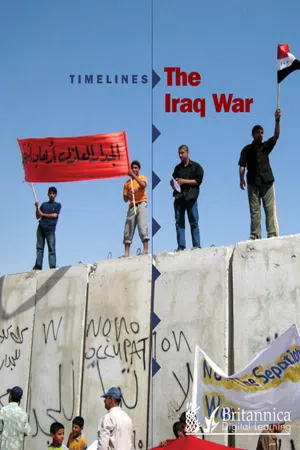
In The Iraq War, significant events that shaped the war are explored, including the background to war, the clashes over weapons inspections, the fall of Saddam Hussein, the worsening violence inside Iraq, the Iraqi elections, and the withdrawal of troops.
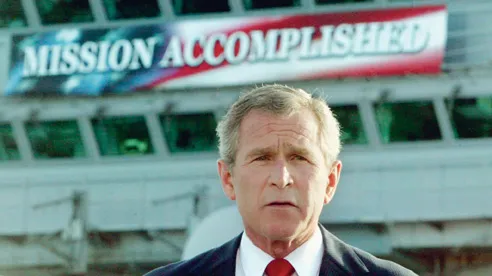
President George W. Bush speaks to crew members of the USS Abraham Lincoln. His message is clearly seen in the background.
On May 1, 2003, President George W. Bush landed on the deck of the aircraft carrier USS Abraham Lincoln in the Persian Gulf. He announced that it was “mission accomplished” for the Allied forces, and that “major combat operations” were finished. President Bush was correct to say that the military invasion was largely complete, but there were still many challenges to overcome before the invasion of Iraq could be considered a success.
CELEBRATIONS AND RESENTMENTS
Many Iraqis celebrated Saddam’s downfall. The Kurds and Shia, who make up most of Iraq’s population, were mostly glad he was gone. In Baghdad’s Firdos Square, a determined crowd hauled down one particularly large and famous statue of Saddam. Men began to beat it with their shoes—an especially insulting gesture in Arab countries. However, very few Iraqis backed the invasion completely:
• Even if they had wanted to get rid of Saddam, many Iraqis wished that it had not taken an invasion by foreign troops to end his rule.
• Sunni Muslims had dominated the government, civil service, and armed forces under Saddam. They largely saw the invasion as a defeat.
• Some Muslim Iraqis wished that non-Muslims had not come to Iraq, which is home to some of Islam’s holiest shrines.
THE SPREAD OF LAWLESSNESS
Saddam had been a cruel ruler, who regularly used violence to keep a tight grip on power. When his regime was defeated, it was not clear what would replace it. Local rulers in some areas began to attack one another, battling over which areas they would control. At the same time, looting became commonplace, with private property and national treasures being stolen. For example, thousands of valuable ancient artefacts were stolen from the Iraqi National Museum and are still turning up for sale around the world today.
TIMELINE
CONFLICT CONTINUES, 2003
March 20, 2003
The invasion of Iraq by coalition forces begins.
April 9, 2003
Baghdad surrenders to the coalition forces.
May 1, 2003
President Bush declares “mission accomplished.”
June 24, 2003
Six British soldiers are killed by a mob in Majar al-Kabir in southern Iraq.
August 19, 2003
A huge bomb explodes at the UN headquarters in Baghdad, killing the UN’s special envoy.
The Ba’ath Party
Until the coalition invasion, the Ba’ath Party and its leader, Saddam Hussein, governed Iraq. The Ba’ath Party was founded in the 1940s with the aim of linking all Arabs together. It developed branches in various countries but was strongest in Syria and Iraq. It came to power in Iraq in 1963 and again in 1968. Under Saddam, it was a mainly Sunni organization, even though most Iraqis are Shia.
CROSS-REFERENCE DE-BA’ATHIFICATION:PAGES22–23
A room in the National Library in Baghdad lies in ruins after looters ransacked it looking for anything of value.
Dismantling Saddam’s Regime
MAY 22, 2003
On May 22, 2003 the UN Security Council agreed to Resolution 1483. The resolution recognized that the United States and Britain were “occupying powers under unified command” and were now responsible for Iraq. In effect, the resolution recognized that the members of the coalition were the new, temporary rulers of Iraq. It also ended UN sanctions against Iraq and transferred the income from Iraq’s oil sales to the Coalition Provisional Authority, which had replaced Saddam’s government.
DE-BA’ATHIFICATION
The Ba’ath Party had run Iraq since 1968 and been a key part of Saddam’s rule. The coalition decided it must be abolished and Ba’ath Party members removed from positions of power. Junior officials were told to leave their jobs. Coalition forces hunted down higher-ranking officials who had played an active part in Saddam’s brutal regime, with the aim of punishing them for their actions.
DISBANDING THE ARMY AND POLICE
Until the invasion, the Iraqi army and police force had been used by Saddam to keep control of the country. Both had used violence against their fellow Iraqis many times, and among the soldiers and policemen were large numbers of Saddam’s supporters. In 2003, the coalition decided to disband the army and police force.
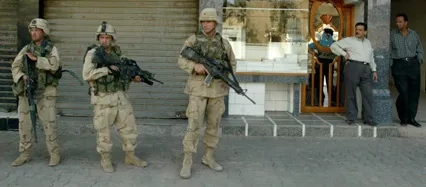
With no effective police force alongside them, coalition soldiers began to struggle to keep control. Some areas of the country, for example, the Baghdad suburb of Sadr City, quickly became no-go zones—areas where coalition forces dared not go in case they were attacked. In Baghdad, almost all non-Iraqis were forced to live inside a heavily fortified area called the “Green Zone” for their own safety.
US soldiers on patrol in Baghdad in May 2003. Coalition forces were beginning to find it increasingly hard to keep order in parts of Iraq.
TIMELINE
SADDAM’S REGIME, 1968–2003
July 17, 1968
Saddam Hussein becomes vice president of Iraq.
July 16, 1979
Saddam Hussein becomes secretary general of the Ba’ath Party and president of Iraq.
April 9, 2003
Baghdad is captured by coalition forces, ending Saddam’s rule.
April 15, 2003
Saddam’s hometown, Tikrit, is captured by coalition forces. Many of Saddam’s most important supporters came from Tikrit, and it was among his most loyal bases.
GROWTH OF THE INSURGENCY
By 2004, the violence in Iraq had steadily become worse. There was an increase in the number of attacks both on coalition forces and on the new Iraqi government. These attacks became known as the insurgency. Insurgents were a combination of local leaders and foreign fighters. Some were Sunnis unhappy at losing control of Iraq, some were local warlords trying to gain as much territory as possible, and some came to attack the United States and its allies, who they saw as the ...
Table of contents
Cover Page
Title Page
Copyright Page
Contents
Defeat and Humiliation: March 3, 1991
Kurdish Safe Haven: April 5, 1991
Weapons Inspection Clashes: October 29, 1997
UNMOVIC: December 17, 1999
Resolution 1441: November 8, 2002
Protests Against War: February 15, 2003
Invasion: March 20, 2003
The Fall of Baghdad: April 9, 2003
“Mission Accomplished”: May 1, 2003
Dismantling Saddam’s Regime: May 22, 2003
Attack on the UN Embassy: August 19, 2003
The Capture of Saddam: December 13, 2003
Abu Ghraib: March 21, 2004
Transfer of Power: June 28, 2004
The Battle for Fallujah: November 8, 2004
The First Elections: January 30, 2005
Attack on the al-Askari Mosque: February 22, 2006
Troop Surge: January 10, 2007
A Divided Government: August 1, 2007
Iran’s President Visits Iraq: March 2, 2008
Withdrawal: December 15, 2011
Key Figures in the Iraq War
Glossary
Further Information
Index
Trusted by 375,005 students
Access to over 1.5 million titles for a fair monthly price.
Study more efficiently using our study tools.
Frequently asked questions
Yes, you can cancel anytime from the Subscription tab in your account settings on the Perlego website. Your subscription will stay active until the end of your current billing period. Learn how to cancel your subscription
No, books cannot be downloaded as external files, such as PDFs, for use outside of Perlego. However, you can download books within the Perlego app for offline reading on mobile or tablet. Learn how to download books offline
Perlego offers two plans: Essential and Complete
Essential is ideal for learners and professionals who enjoy exploring a wide range of subjects. Access the Essential Library with 800,000+ trusted titles and best-sellers across business, personal growth, and the humanities. Includes unlimited reading time and Standard Read Aloud voice.
Complete: Perfect for advanced learners and researchers needing full, unrestricted access. Unlock 1.5M+ books across hundreds of subjects, including academic and specialized titles. The Complete Plan also includes advanced features like Premium Read Aloud and Research Assistant.
Both plans are available with monthly, semester, or annual billing cycles.
We are an online textbook subscription service, where you can get access to an entire online library for less than the price of a single book per month. With over 1.5 million books across 990+ topics, we’ve got you covered! Learn about our mission
Look out for the read-aloud symbol on your next book to see if you can listen to it. The read-aloud tool reads text aloud for you, highlighting the text as it is being read. You can pause it, speed it up and slow it down. Learn more about Read Aloud
Yes! You can use the Perlego app on both iOS and Android devices to read anytime, anywhere — even offline. Perfect for commutes or when you’re on the go. Please note we cannot support devices running on iOS 13 and Android 7 or earlier. Learn more about using the app
Yes, you can access The Iraq War by Paul Mason, Britannica Digital Learning in PDF and/or ePUB format, as well as other popular books in Historia & Historia del siglo XX. We have over 1.5 million books available in our catalogue for you to explore.