Satellites and robotic spacecraft have long travelled where humankind cannot, or dare not, go. By delving into the pages of this book, readers will learn about the technology, people, and organizations that have made fruitful unmanned space missions a reality.
Trusted by 375,005 students
Access to over 1.5 million titles for a fair monthly price.
Although the possibility of exploring space has long excited people in many walks of life, for most of the latter 20th century only national governments could afford the very high costs of launching people and machines into space. This reality meant that space exploration had to serve very broad interests, and it indeed has done so in a variety of ways. Government space programs have increased knowledge, served as indicators of national prestige and power, enhanced national security and military strength, and provided significant benefits to the general public. In areas where the private sector could profit from activities in space, most notably the use of satellites as telecommunication relays, commercial space activity has flourished without government funding.
In the years after World War II, governments assumed a leading role in the support of research that increased fundamental knowledge about nature, a role that earlier had been played by universities, private foundations, and other nongovernmental supporters. This change came for two reasons. First, the need for complex equipment to carry out many scientific experiments and for the large teams of researchers to use that equipment led to costs that only governments could afford. Second, governments were willing to take on this responsibility because of the belief that fundamental research would produce new knowledge essential to the health, security, and quality of life of their citizens. Thus, when scientists sought government support for early space experiments, it was forthcoming. Since the start of space efforts in the United States, the Soviet Union, and Europe, national governments have given high priority to the support of science done in and from space. From modest beginnings, space exploration has expanded under government support to include multibillion-dollar exploratory missions in the solar system and to major space-based astronomical observatories, such as the Hubble Space Telescope.
In 1957, Soviet leader Nikita Khrushchev used the fact that his country had been first to launch a satellite, Sputnik 1, as evidence of the technological power of the Soviet Union and of the superiority of communism. He repeated these claims after Yury Gagarin’s orbital flight in 1961. Although U.S. Pres. Dwight D. Eisenhower had decided not to compete for prestige with the Soviet Union in a space race, his successor, John F. Kennedy, had a different view. On April 20, 1961, in the aftermath of the Gagarin flight, he asked his advisers to identify a “space program which promises dramatic results in which we could win.” The response came in a May 8, 1961, memorandum recommending that the United States commit to sending people to the Moon, because “dramatic achievements in space … symbolize the technological power and organizing capacity of a nation” and because the ensuing prestige would be “part of the battle along the fluid front of the cold war.” From 1961 until the collapse of the Soviet Union in 1991, competition between the United States and the Soviet Union was a major influence on the pace and content of their space programs. Other countries also viewed having a successful space program as an important indicator of national strength.
Even before the first satellite was launched, U.S. leaders recognized that the ability to observe military activities around the world from space would be an asset to national security. Following on the success of its photoreconnaissance satellites, which began operation in 1960, the United States built increasingly complex observation and electronic-intercept intelligence satellites. The Soviet Union also quickly developed an array of intelligence satellites, and later a few other countries instituted their own satellite observation programs. Intelligence-gathering satellites have been used to verify arms-control agreements, provide warnings of military threats, and identify targets during military operations, among other uses.
In addition to providing security benefits, satellites offered military forces the potential for improved communications, weather observation, navigation, and position location. This led to significant government funding for military space programs in the United States and the Soviet Union. Although the advantages and disadvantages of stationing force-delivery weapons in space have been debated, as of the early 21st century, such weapons have not been deployed, nor have space-based antisatellite systems—that is, systems that can attack or interfere with orbiting satellites. The stationing of weapons of mass destruction in orbit or on celestial bodies is prohibited by international law.
Governments realized early on that the ability to observe Earth from space could provide significant benefits to the general public apart from security and military uses. The first application to be pursued was the development of satellites for assisting in weather forecasting. A second application involved remote observation of land and sea surfaces to gather imagery and other data of value in crop forecasting, resource management, environmental monitoring, and other applications. The U.S. and Soviet governments also developed their own satellite-based global positioning systems, originally for military purposes, that could pinpoint a user’s exact location, help in navigating from one point to another, and provide very precise time signals. These satellites quickly found numerous civilian uses in such areas as personal navigation, surveying and cartography, geology, air traffic control, and the operation of information-transfer networks. They illustrate a reality that has remained constant for the past half century—as space capabilities are developed, they often can be used for both military and civilian purposes.
Another space application that began under government sponsorship but quickly moved into the private sector is the relay of voice, video, and data via orbiting satellites. Satellite telecommunications has developed into a multibillion-dollar business and is the one clearly successful area of commercial space activity. A related commercial space business is the provision of launches for private and government satellites. Suggestions have been made that in the future other areas of space activity, including remote sensing and the capture of solar energy to provide electric power on Earth, could become successful businesses.
Building the systems and components needed to carry out both government and commercial space programs has required the participation of private industry, and a number of firms now have substantial space involvement. Often these firms have also been major suppliers of aviation and defense products, a reflection of the common technological foundation for what has become known as the aerospace industry.
Most space activities have been pursued because they serve some utilitarian purpose, whether increasing knowledge or making a profit. Nevertheless, there remains a powerful underlying sense that it is important for humans to explore space for its own sake, “to see what is there.” Since the launch of Sputnik 1 in 1957, Earth-orbiting satellites and robotic spacecraft journeying away from Earth have gathered valuable data about the Sun, Earth, other bodies in the solar system, and the universe beyond. Robotic spacecraft have landed on the Moon, Venus, Mars, and the asteroid Eros, have visited the vicinity of all the major planets, and have flown by the nuclei of comets, including Halley’s Comet, traveling in the inner solar system. Scientists have used space-derived data to deepen human understanding of the origin and evolution of galaxies, stars, planets, and other cosmological phenomena. Although the only voyages that humans have made away from the near vicinity of Earth—the Apollo flights to the Moon—were motivated by Cold War competition, there have been recurrent calls for humans to return to the Moon, travel to Mars, and visit other locations in the solar system and beyond. Until humans resume such journeys of exploration, robotic spacecraft will continue to serve in their stead to explore the solar system and probe the mysteries of the universe.
As the many benefits of space activity have become evident, other countries have joined the Soviet Union and the United States in developing their own space programs. They include a number of western European countries operating both individually and, after 1975, cooperatively through the European Space Agency (ESA), as well as China, Japan, Canada, India, Israel, and Brazil. By the start of the 21st century, more than 30 countries had space agencies or other government bodies with substantial space activities.
THE SPACE ENVIRONMENT
Space, as considered here, is defined as all the reaches of the universe beyond Earth’s atmosphere. There is no definitive boundary above Earth at which space begins, but, in terms of the limiting altitude for vehicles designed for atmospheric flight, it may be considered to be as low as 45 km (28 miles). The lowest practical orbit for an artificial satellite around Earth is about 160 km (100 miles). By comparison, Earth’s natural satellite, the Moon, orbits the planet at a mean distance about 2,400 times greater—at 384,400 km (239,000 miles). Even this distance, however, is small compared with the size of the solar system, where spacecraft must traverse interplanetary distances measured in the hundreds of millions to billions of kilometres, and it is infinitesimal compared with the size of the universe. Earth’s nearest neighbouring stars lie more than 40 trillion km (25 trillion miles) away.
The space that separates cosmic objects is not entirely empty. Throughout this void, matter—mostly hydrogen—is scattered at extremely low densities. Nevertheless, space constitutes a much greater vacuum than has been achieved on Earth. Additionally, space is permeated by gravitational and magnetic fields, a wide spectrum of electromagnetic radiation, and high-energy cosmic ray particles. Until the end of World War II, all deductions about space had been made from observations through the distorting atmosphere of Earth. With the advent of sounding rockets in the late 1940s and then of instrumented satellites, space observatories, probes, and manned spacecraft, it became possible to directly explore the complexities of space phenomena.
Another important environmental attribute of space is microgravity, a condition achieved by the balance between the centrifugal acceleration of an Earth-orbiting spacecraft and Earth’s gravity. This condition, in which there is no net force acting on a body, can be simulated on Earth only by free fall in an evacuated “drop tower.”
ROCKETS
Getting into space requires an enormous amount of power to overcome the pull of Earth’s gravity. Such power is supplied by the intense burning of fuel and the subsequent emission of the exhaust of a rocket engine. A rocket is any of a type of jet-propulsion device carrying either solid or liquid propellants that provide both the fuel and oxidizer required for combustion. (The term is also commonly applied to any of various vehicles, including firework skyrockets and guided missiles as well as spacecraft launch vehicles, driven by such a propulsive device.)
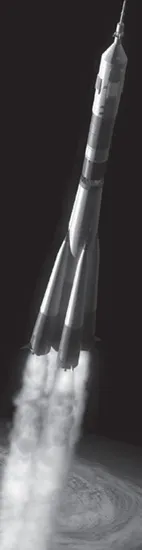
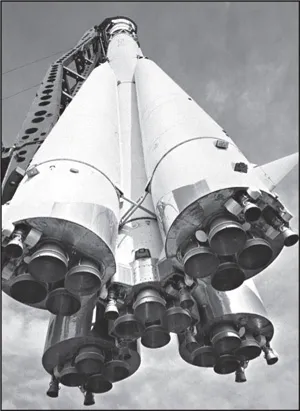
Rocket engines of the Soviet launch vehicle that was used to place manned Vostok spacecraft into orbit. Based on the R-7 intercontinental ballistic missile, the launcher had four strap-on liquid-propellant boosters surrounding the liquid-propellant core rocket. Novosti Press Agency
HOW ROCKETS WORK
The rocket differs from the turbojet and other “air-breathing” engines in that all of the exhaust jet consists of the gaseous combustion products of “propellants” that are carried on board. While the turbojet engine requires air pulled in from the outside, the rocket does not. But like the turbojet engine, the rocket develops thrust through the rearward ejection of mass at very high velocity.
The fundamental physical principle involved in rocket propulsion was formulated by Sir Isaac Newton. According to his third law of motion, the rocket experiences an increase in momentum proportional to the momentum carried away in the exhaust,
where M is the rocket mass, ΔvR is the increase in velocity of the rocket in a short time interval, Δ t,
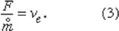
is the rate of mass discharge in the exhaust, ve is the exhaust velocity (relative to the rocket), and F is force. The quantity
ve is the propulsive force, or thrust, produced on the rocket by exhausting the propellant,
Evidently, thrust can be made large by using a high mass discharge rate or high exhaust velocity. Employing high
uses up the propellant supply quickly (or requires a large supply), and so it is preferable to seek high values of ve. The value of ve is limited by practical considerations, determined by how the exhaust is accelerated in the engine and what energy supply is available for the purpose.
Most rockets derive their energy in thermal form by combustion of condensed-phase propellants at elevated pressure. The gaseous combustion products are exhausted through a nozzle that converts part of the thermal energy to kinetic energy. The maximum amount of energy available is limited to that provided by combustion or by practical considerations imposed by the high temperature involved. Higher energies are possible if other energy sources (e.g., electric arc or microwave heating) are used in conjunction with the chemical propellants on board the rockets. Extremely high energies are achievable when the exhaust is accelerated by electromagnetic means. As yet, these more exotic systems have not found application because of technical reasons but probably will be used in some future space missions where requisite electrical power sources can be shared by propulsion and other mission requirements.
The exhaust velocity is a figure of merit for rocket propulsion because it is a measure of thrust per unit mass of propellant consumed—i.e.,
Values of ve are in the range 2,000 to 5,000 metres (6,562 to 16,404 feet) per second for chemical propellants, while values two or three times that are claimed for electrically heated propellants. Values up to 40,000 metres (131,233 feet) per second are predicted for systems using electromagnetic acceleration. In engineering circles, notably in the United States, the exhaust velocity is widely expressed in units of pound thrust per pound weight per second, or seconds, which is referred to as specific impulse. (In the International System of Units [SI], the unit of specific impulse is newton-seconds per kilogram.) Values in the range 185 to 465 seconds are analogous to the range of exhaust velocities noted above for chemical propellants.
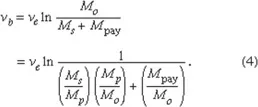
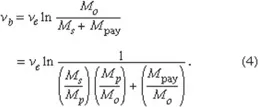
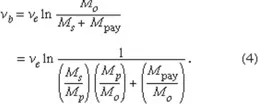
In a typical chemical-rocket mission, anywhere from 50 to 95 percent or more of the takeoff mass is propellant. This can be put in perspective by the equation for burnout velocity (gravity-free flight),
In this expression, Ms/Mp is the ratio of propulsion system and structure weight to propellant weight, with a typical value of 0.09 (the symbol ln represents natural logarithm). Mp/Mo is the ratio of propellant weight to all-up takeoff weight, with a typical value of 0.90. A typical value for ve for a hydrogen-oxygen system is 3,536 metres (11,601 feet) per second. From the above equation, the ratio of payload mass to takeoff mass (Mpay/Mo) can be calculated. For a low Earth orbit, vb is about 7,544 metres (24,751 feet) per second, which would require Mpay/Mo to be 0.0374. In other words, it would take a 1,337,000-kg (2,947,580-pound) takeoff system to put 50,000 kg (110,231 pounds) in a low orbit around Earth. This is an optimistic calculation because equation
does not take into account the effect of gravity, drag, or directional corrections during ascent, which would double the takeoff mass. From equation
it is evident that there is a direct trade-off between Ms and Mpay, so that every effort is made to design for low structural mass, and Ms/Mp is a second figure of merit for the propulsion system. While the v...
Table of contents
Cover Page
Title Page
Copyright Page
Contents
Introduction
Chapter 1: Getting to Space
Chapter 2: Traveling in Space
Chapter 3: Notable Satellites
Chapter 4: Science in Space
Chapter 5: Space Applications
Chapter 6: Space Agencies
Chapter 7: Spaceflight Leaders and Pioneers
Glossary
For Further Reading
Index
Frequently asked questions
Yes, you can cancel anytime from the Subscription tab in your account settings on the Perlego website. Your subscription will stay active until the end of your current billing period. Learn how to cancel your subscription
No, books cannot be downloaded as external files, such as PDFs, for use outside of Perlego. However, you can download books within the Perlego app for offline reading on mobile or tablet. Learn how to download books offline
Perlego offers two plans: Essential and Complete
Essential is ideal for learners and professionals who enjoy exploring a wide range of subjects. Access the Essential Library with 800,000+ trusted titles and best-sellers across business, personal growth, and the humanities. Includes unlimited reading time and Standard Read Aloud voice.
Complete: Perfect for advanced learners and researchers needing full, unrestricted access. Unlock 1.5M+ books across hundreds of subjects, including academic and specialized titles. The Complete Plan also includes advanced features like Premium Read Aloud and Research Assistant.
Both plans are available with monthly, semester, or annual billing cycles.
We are an online textbook subscription service, where you can get access to an entire online library for less than the price of a single book per month. With over 1.5 million books across 990+ topics, we’ve got you covered! Learn about our mission
Look out for the read-aloud symbol on your next book to see if you can listen to it. The read-aloud tool reads text aloud for you, highlighting the text as it is being read. You can pause it, speed it up and slow it down. Learn more about Read Aloud
Yes! You can use the Perlego app on both iOS and Android devices to read anytime, anywhere — even offline. Perfect for commutes or when you’re on the go. Please note we cannot support devices running on iOS 13 and Android 7 or earlier. Learn more about using the app
Yes, you can access Unmanned Space Missions by Britannica Educational Publishing, Erik Gregersen in PDF and/or ePUB format, as well as other popular books in Physical Sciences & Astronomy & Astrophysics. We have over 1.5 million books available in our catalogue for you to explore.