In World War II, the crises leading up to the war, and the battles at sea, on land and in the air are explored. Pages focus on key events, such as: the German invasion of Poland; the Battle of Britain; the attack on Pearl Harbor; and the destruction of Hiroshima.
- English
- ePUB (mobile friendly)
- Available on iOS & Android
eBook - ePub
World War II
About this book
Information
Subtopic
20th Century HistoryIndex
HistoryGermany Invades Poland
1 SEPTEMBER 1939
At 4.45 a.m., German tanks, infantry, and aircraft surged across the frontiers into Poland and began an all-out attack. Britain and France demanded a German withdrawal, and when Hitler failed to respond, they declared war. Australia, New Zealand, Canada, and South Africa—all members of the British Commonwealth—joined the Allied (Anglo-French) side.
In reality, there was little they could do to help Poland in time. And Hitler had made sure that the only great power in Eastern Europe, the Soviet Union, would not oppose him. The majority of the Soviet Union’s population was Russian, but the Soviet state was much larger than present-day Russia and had a long common border with Poland.
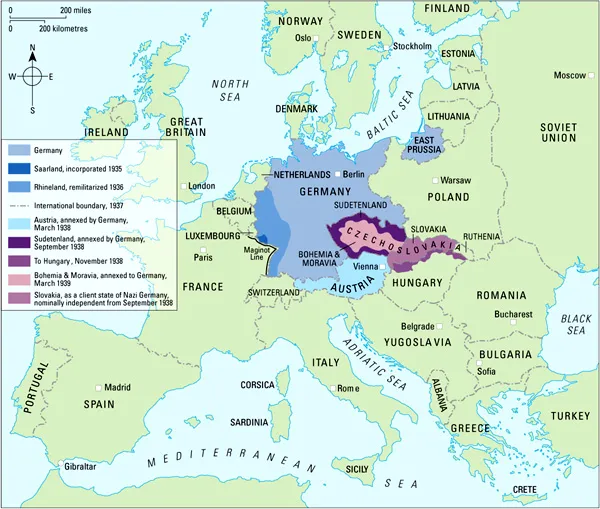
Europe in 1939, just before the German invasion of Poland on September 1. Also shown are Hitler’s principal pre-war foreign policy triumphs.
TIMELINE |
REDRAWING THE MAP 1939 |
March 14, 1939 |
Slovakia and Ruthenia, prompted by Germany, break away from Czechoslovakia. |
March 15, 1939 |
German troops enter Czech territory and establish a German protectorate. |
March 19, 1939 |
Germany annexes Memel, a German-majority area of Lithuania. |
April 7, 1939 |
Italy attacks and quickly overruns Albania. Germany begins a propaganda campaign against Poland. |
May 22, 1939 |
Germany and Italy conclude an alliance, the Pact of Steel. |
August 23, 1939 |
The Nazi-Soviet Non-Aggression Pact is signed. |
September 1, 1939 |
Germany invades Poland. |
September 3, 1939 |
Britain and France declare war on Germany. |
September 17, 1939 |
Soviet forces enter Poland. |
November 30, 1939 |
The Soviet Union and Finland are at war until March 1940. |
NAZI-SOVIET PACT
All of the European powers were hostile to the Soviet Union because of its communist system, in which the state took over all property. Even when they became disillusioned with Hitler, Britain and France were slow to approach the Soviet Union. They relied on the fact that fascists and communists were deadly enemies. But Hitler saw his opportunity and astonished the world by coming to terms with the Soviet dictator, Joseph Stalin. Germany and the Soviet Union signed a non-aggression pact (neither would attack the other) and secretly agreed to divide Eastern Europe between them.
BLITZKRIEG!
The Poles fought bravely against the advancing Germans, but the campaign was over in weeks. In addition to having superior numbers, the Germans employed a devastating offensive technique, the Blitzkrieg (lightning war), based on rapid armored thrusts backed up by air strikes, which threw the opposing forces into disorder. Poland’s situation was already desperate when the Red (Soviet) Army entered the country from the east.
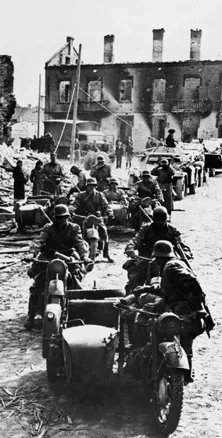
German troops, on motorcycles with sidecars, drive through a Polish village as their victorious army presses forward.
Poland was partitioned between Germany and the Soviet Union. Over the next few months, the Soviets took control of the Baltic states and seized territory from Finland after a short but hard-fought war. But in the West, months passed with so little fighting that the period became known as “the Phoney War.”

CROSS-REFERENCE
CAMPAIGNS IN
POLAND: PAGES 36–37, 38–39, 42–43
Germany Strikes in the West
10 MAY 1940
On May 10, 1940, German armies thrust across the borders of the Low Countries (Holland, Belgium, and Luxembourg), all of them neutral states. The German objective was to push on into France, bypassing the Maginot Line of fortifications along France’s eastern frontier. The Allies had anticipated such an attack, since the Phoney War had ended in April with a German occupation of neutral Denmark and Norway. French and British forces moved into Belgium to support the Belgian army.
THE BREAKTHROUGH
However, the Germans also broke through the Ardennes, a mountainous area in southwest Belgium. Their Blitzkrieg tactics were again brilliantly successful. Panzer (tank) divisions moved westward at great speed until they reached the French coast. They cut off the Allied forces in Belgium, which were driven back, trapped, and only evacuated from Dunkirk to Britain at a heavy cost.
Meanwhile, the German armies pressed relentlessly south, joined by fresh troops who had broken through the Maginot Line. Italy declared war on France and Britain and attacked in the south. Though allied with Hitler, Mussolini knew that Italy was weak and acted only when victory seemed certain. In the face of the German advance, the French government abandoned the capital, Paris, and on June 14 the Germans marched in.
FRANCE SURRENDERS
A new French prime minister took office. The aged Marshal Pétain was a hero of World War I, but he was now deeply defeatist. He immediately negotiated an armistice—in effect a French surrender. By its terms, Germany would continue to occupy northern France, while Pétain headed an authoritarian (non-democratic) regime at Vichy in the south. In theory, Vichy France remained independent, but it inevitably became a German puppet. Other French men and women chose to carry on the fight, joining the Free French movement led by General Charles de Gaulle. Along with other exiles from occupied countries, they gathered in Britain, which now stood alone in Europe against Nazism.
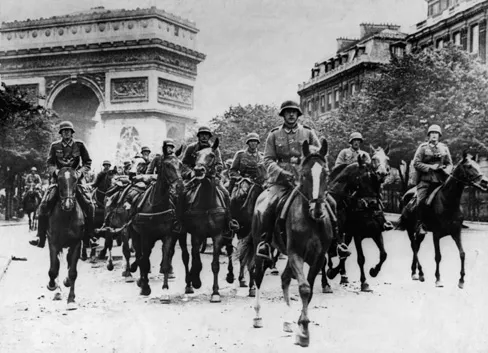
A German cavalry unit parades ...
Table of contents
- Cover Page
- Title Page
- Copyright Page
- Contents
- Munich Agreement—September 29, 1938
- Germany Invades Poland—September 1, 1939
- Germany Strikes in the West—May 10, 1940
- Battle of Britain Begins—July 10, 1940
- Sinking of the Bismarck—May 27, 1941
- Germany Invades the USSR June 22, 1941
- Japan Attacks Pearl Harbor December 7, 1941
- Singapore Falls—February 15, 1942
- Thousand Bomber Raid—May 30, 1942
- Battle of Midway Begins—June 4, 1942
- US Marines Land on Guadalcanal—August 7, 1942
- Victory at El Alamein—October 23, 1942
- Surrender at Stalingrad—January 31, 1943
- Invasion of Sicily—July 10, 1943
- D-Day—June 6, 1944
- Assault on Saipan—June 15, 1944
- Great Red Army Offensive—June 22, 1944
- Warsaw Uprising—August 1, 1944
- Battle of the Bulge Begins—December 16, 1944
- Battle for Berlin Begins—April 16, 1945
- Hiroshima Destroyed—August 6, 1945
- Key Figures in World War II
- Glossary
- Further Information
- Index
Trusted by 375,005 students
Access to over 1.5 million titles for a fair monthly price.
Study more efficiently using our study tools.
Frequently asked questions
Yes, you can cancel anytime from the Subscription tab in your account settings on the Perlego website. Your subscription will stay active until the end of your current billing period. Learn how to cancel your subscription
No, books cannot be downloaded as external files, such as PDFs, for use outside of Perlego. However, you can download books within the Perlego app for offline reading on mobile or tablet. Learn how to download books offline
Perlego offers two plans: Essential and Complete
- Essential is ideal for learners and professionals who enjoy exploring a wide range of subjects. Access the Essential Library with 800,000+ trusted titles and best-sellers across business, personal growth, and the humanities. Includes unlimited reading time and Standard Read Aloud voice.
- Complete: Perfect for advanced learners and researchers needing full, unrestricted access. Unlock 1.5M+ books across hundreds of subjects, including academic and specialized titles. The Complete Plan also includes advanced features like Premium Read Aloud and Research Assistant.
We are an online textbook subscription service, where you can get access to an entire online library for less than the price of a single book per month. With over 1.5 million books across 990+ topics, we’ve got you covered! Learn about our mission
Look out for the read-aloud symbol on your next book to see if you can listen to it. The read-aloud tool reads text aloud for you, highlighting the text as it is being read. You can pause it, speed it up and slow it down. Learn more about Read Aloud
Yes! You can use the Perlego app on both iOS and Android devices to read anytime, anywhere — even offline. Perfect for commutes or when you’re on the go.
Please note we cannot support devices running on iOS 13 and Android 7 or earlier. Learn more about using the app
Please note we cannot support devices running on iOS 13 and Android 7 or earlier. Learn more about using the app
Yes, you can access World War II by Nathaniel Harris, Britannica Digital Learning in PDF and/or ePUB format, as well as other popular books in History & 20th Century History. We have over 1.5 million books available in our catalogue for you to explore.