- 224 pages
- English
- ePUB (mobile friendly)
- Available on iOS & Android
eBook - ePub
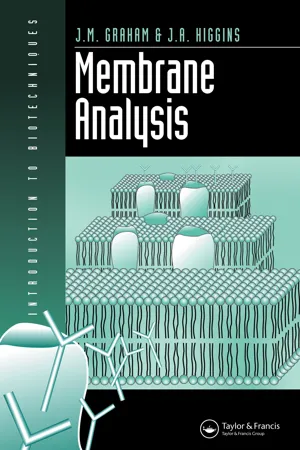
Membrane Analysis
About this book
Membrane Analysis provides a comprehensive review of laboratory methods for membrane study, with an emphasis on isolating membranes, analysing their composition and architecture, and investigating membrane function.
Information
1 General membrane composition and structure
All membranes have an amphipathic nature, i.e. they have a hydrophobic (non-polar) central layer sandwiched between two hydrophilic (polar) surfaces, and the molecules and macromolecules which membranes contain are designed to conform to and maintain this basic structure. The basic unit has a thickness of 5–8 nm. There are three principal components of membranes, lipid, protein and carbohydrate.
1.1 Lipids
1.1.1 General lipid composition
Membranes are composed of a bilayer of amphipathic lipids: although there is evidence from physical studies (NMR spectroscopy and X-ray diffraction) that nonbilayer structures (e.g. hexagonal arrays or micelles) are present, the bilayer structure is the predominant one.
The lipid bilayer:
• is permeable to small nonionized molecules, such as glycerol, urea, water, oxygen and carbon dioxide and to all lipophilic molecules;
• provides a structural framework and the proper environment for the functioning of many membrane proteins.
The total amount of lipid in a membrane is normally expressed as a protein:lipid weight ratio (see Table 1.1). Generally this ratio is >1.0 and in the most metabolically active membranes may approach 4.0. Eukaryotic surface membranes, however, tend to have a lower ratio (i.e. more lipid) than do membranes of cytoplasmic organelles or the prokaryotic cytoplasmic membrane, although only in lipid-rich myelin does the weight ratio fall significantly below 1.0.
Table 1.1. Protein:lipid ratios in membranes
Membrane | Protein:lipid | Membrane | Protein:lipid |
Animal | |||
Myelin | 0.25 | Erythrocyte | 1.1 |
Surface (liver) | 1.5 | Nuclear (liver) | 2.0 |
Rough ER (liver) | 2.5 | Smooth ER (liver) | 2.1 |
Inner mit. (liver) | 3.6 | Outer mit. (liver) | 1.2 |
Golgi (liver) | 2.4 | Sarcoplasmic reticulum | 3.0 |
Retinal rod | 1.0 | ||
Plant | |||
Surface | 0.9 | Chloroplast | 1.9 |
Saccharomyces | |||
Surface | 1.2 | ||
Prokaryote surface | |||
Bacillus | 2.8 | Micrococcus | 2.4 |
Staphylococcus | 2.4 | Escherichia coli | 2.8 |
Outer membrane of Gram-negative bacteria | 2.2 |
Because protein is much denser than lipid, membranes with different protein:lipid ratios may also have different densities – one of the properties that is used to fractionate membranes by centrifugation (see Chapter 3).
Generally lipids can be divided into four major classes:
• free fatty acids;
• esters of fatty acids, e.g. triacylglycerol and phospholipids;
• isoprenoids, e.g. sterols, sterol esters, dolichol and farnesol;
• glycolipids.
Phospholipids are major components of all membranes and, with the exception of myelin, they represent greater than 50% of the total membrane lipid mass. Glycolipids and cholesterol are usually concentrated in the plasma membrane of mammalian cells, while in plants only sterols (mostly stigmasterol and sitosterol) show this preferential localization and glycolipids predominate in the chloroplast. Bacterial membranes may also be rich in glycolipid but, with the exception of mycoplasmas, they lack sterols, and even in mycoplasmas the sterol is derived almost exclusively from the growth medium. It is only relatively recently that isoprenoids other than sterols (dolichol phosphate and derivatives of farnesol and geranylgeranol) have been shown to be important in membranes. The relative amounts of glycolipid, phospholipid and cholesterol in some examples of membrane types is given in Table 1.2.
Table 1.2. Lipid composition of membranes (figures are % of total lipid mass)
Membrane | Phospholipid | Glycolipid | Sterol |
M... |
Table of contents
- Cover
- Half Title
- Title Page
- Copyright Page
- Table of Contents
- Abbreviations
- Preface
- 1. General membrane composition and structure
- 2. The membranes of prokaryotes and eukaryotes
- 3. Preparation of subcellular membranes
- 4. Molecular composition
- 5. Investigating the topology of membrane proteins
- 6. Investigation of membrane lipids
- 7. Protein targetting and membrane biogenesis
- 8. Endocytosis and vesicular trafficking
- Index
Trusted by 375,005 students
Access to over 1.5 million titles for a fair monthly price.
Study more efficiently using our study tools.
Frequently asked questions
Yes, you can cancel anytime from the Subscription tab in your account settings on the Perlego website. Your subscription will stay active until the end of your current billing period. Learn how to cancel your subscription
No, books cannot be downloaded as external files, such as PDFs, for use outside of Perlego. However, you can download books within the Perlego app for offline reading on mobile or tablet. Learn how to download books offline
Perlego offers two plans: Essential and Complete
- Essential is ideal for learners and professionals who enjoy exploring a wide range of subjects. Access the Essential Library with 800,000+ trusted titles and best-sellers across business, personal growth, and the humanities. Includes unlimited reading time and Standard Read Aloud voice.
- Complete: Perfect for advanced learners and researchers needing full, unrestricted access. Unlock 1.5M+ books across hundreds of subjects, including academic and specialized titles. The Complete Plan also includes advanced features like Premium Read Aloud and Research Assistant.
We are an online textbook subscription service, where you can get access to an entire online library for less than the price of a single book per month. With over 1.5 million books across 990+ topics, we’ve got you covered! Learn about our mission
Look out for the read-aloud symbol on your next book to see if you can listen to it. The read-aloud tool reads text aloud for you, highlighting the text as it is being read. You can pause it, speed it up and slow it down. Learn more about Read Aloud
Yes! You can use the Perlego app on both iOS and Android devices to read anytime, anywhere — even offline. Perfect for commutes or when you’re on the go.
Please note we cannot support devices running on iOS 13 and Android 7 or earlier. Learn more about using the app
Please note we cannot support devices running on iOS 13 and Android 7 or earlier. Learn more about using the app
Yes, you can access Membrane Analysis by Dr John Graham,Joan Higgins in PDF and/or ePUB format, as well as other popular books in Biological Sciences & Biochemistry. We have over 1.5 million books available in our catalogue for you to explore.