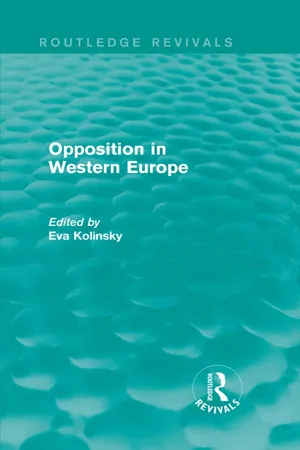
This book, first published in 1987, analysed the state and changing nature of political opposition in Western Europe at the time. For each country covered, it discusses the concept of opposition and the approach adopted by opposition parties. It explores the institutional framework that was in place at the time, the electoral support for opposition, attitudes towards opposition and the criteria for the success of opposition parties. It shows how opposition had changed in nature as a result of both voter re-alignments and also because some interest groups have engaged directly in opposition activities, rather than working through opposition parties as was done previously, thereby increasing the scope of extra parliamentary opposition. Opposition is a fundamental element in democratic politics, and this book therefore throws considerable light on the whole range of political activity in the countries covered. This title will be of interest to students of politics.
- 400 pages
- English
- ePUB (mobile friendly)
- Available on iOS & Android
eBook - ePub
Opposition in Western Europe
About this book
Information
Part I:
Concepts of Opposition
Concepts of Opposition
1
Is There Life after Dahl?
Robert Dahl’s seminal compendium, Political Oppositions in Western Democracies, is now twenty years old. Indeed, the mid-1960s saw a flurry of interest in opposition as an object of academic study. The journal Government and Opposition had been launched a year earlier. Ghita Ionescu’s and Isabel de Madariaga’s Opposition1 appeared in 1968. There were good reasons for the sudden flurry of interest. By the mid-1960s the post-war constitutional and party structures of Europe had stabilised and the time seemed ripe for an evaluation. There was a growth in the comparative study of party systems, especially from the point of view of the cultural and sociological preconditions for civilised political life, as exemplified by Almond and Verba’s The Civic Culture, Lipset and Rokkan’s Party Systems and Voter Alignments and Arend Lijphart’s classic case-study of consociationalism, The Politics of Accommodation.2 All these works addressed three types of questions: what determines the cleavage structures in different types of societies; how enduring are these structures and why; what effect do the answers to those questions have on the way political forces co-operate and co-exist in a society? They were less concerned with the mechanics of political institutions and organisation: tell me your cleavage structure and I will tell you the state of your constitution. Though Dahl himself paid due attention to institutional factors, what interested him most was the ‘role of oppositions’, of ‘one of the greatest and most unexpected social discoveries that man has ever stumbled onto’.3
There was, however, another reason why academic interest in opposition burgeoned in the 1960s. Just as it looked as though the post-war world had indeed settled into a stable routine, existing institutions were challenged by the youth revolt. It began in the United States with the ‘free speech’ revolt at Berkeley and developed into generalised opposition to the Vietnam war. It spread to Europe where, as in America, it quickly became part of a battle of generations on an ever-widening range of issues. In West Germany it became a widespread movement under the name of the ausserparlamentarische Opposition or APO.4 In France it culminated in the student revolt of May 1968. Here was a new radical form of opposition, which challenged not only existing political institutions but existing notions of oppositional behaviour. It exhilarated some and shocked and frightened others, but unquestionably provided a new agenda for students of opposition.
What, then, has happened to opposition, and to our ideas about it, since the 1960s? I should like to suggest answers under four headings:
i) changes in the institutional framework;
ii) changes in patterns of opinion cleavage;
iii) changes in patterns of party competition;
iv) changes in the way opinion is organised and channelled.
i) CHANGES IN THE INSTITUTIONAL FRAMEWORK
This includes the introduction of new constitutions; changes in the electoral system; changes in the separation of powers; changes in executive-legislative relations or the organisation of the legislature; and the creation or abolition of subnational tiers of government.
These changes have not been very numerous. The most important have been the emergence from dictatorship to parliamentary democracy of Greece, Portugal and Spain. All three adopted forms of proportional representation for the national parliament; all three reserve considerable discretionary powers to the head of state, though the prerogatives of the Greek President were curbed in 1985. The Portuguese President is directly elected; in Spain there are direct elections for four regional assemblies — Catalonia, Andalucia, Galicia and the Basque region. Both these non-parliamentary electoral contests have had some effect on patterns of party competition.5
In countries with a continuity of parliamentary institutions, there have been even fewer changes. The only state in which there has been a major change in the electoral system is France, where proportional representation was introduced for the National Assembly elections of 1986 in place of the two-ballot, single-member constituency in force since the establishment of the Fifth Republic. At the time of writing, it looks probable that France will revert to the traditional Fifth Republic electoral system for subsequent elections. Two countries have introduced elected regional councils — Italy in 1970, France in 1986 — neither with any discernible effect on the party system. Regionalisation of a different kind in Belguim — considered below in Section iv — has, however, led to a re-alignment of parties. For the sake of completeness one should also mention the unsuccessful attempt to provide elected assemblies for Scotland and Wales in the United Kingdom in 1979 — a response to, rather than a cause of, a changed pattern of opposition6 — and the periodic creation and abolition of elected assemblies with, however, minimal legislative powers, in Northern Ireland. If any region of Europe deserves the label that Alfred Grosser applied to France in the Dahl volume, ‘nothing but opposition’, it is surely this.
Apart from the establishment of constitutional government in the three Mediterranean states, therefore, few of the changes in oppositional behaviour can be attributed to institutional changes. How far changes in oppositional behaviour have affected the workings of institutions remains to be seen.
ii) CHANGES IN PATTERNS OF OPINION CLEAVAGE
A great deal of scholarly work in the 1950s and 1960s emphasised the historical roots of European party systems and the continuity, often over many generations, of party loyalties. Otto Kirchheimer, for instance, declared in 1957 that ‘continental European parties are the remnants of the intellectual social movements of the nineteenth century. They have remained glued to the spots where the ebbing energy of such movements deposited them some decades ago.’7 This proposition was expanded by Lipset and Rokkan in their ‘freezing’ thesis: ‘the party system of the 1960s reflects with few, but significant exceptions, the cleavage structures of the 1920s’, which in turn owe their existence to ‘the freezing of the major party alternatives in the wake of the extension of the suffrage and the mobilisation of the major sections of the new reservoirs of potential supporters’.8
There was much merit in this thesis. It helped to liberate the social sciences from one of their principal vices, their ahistoricism, and it helped to re-emphasise the force of institutions in fashioning opinion, something that was in danger of being ignored under the impact of the behavioural revolution. It turned electoral geography into electoral geology. But we can also now see some of its weaknesses. It somehow implied that there had been few ‘critical elections’, in V.O. Key’s sense of the expression, since the end of World War I. Behind this was an underestimate of the impact of the Depression and, above all, of World War II on party systems. The discredit, in many European countries, of pre-war middle-class parties led to the emergence of mass Christian Democratic parties where these had previously been weak or non-existent and to the enfeeblement or disappearance of some long-established parties, such as the French Radicals, the Italian Liberals and the majority of Peasant Parties. In addition, the Left, and particularly Communist parties, emerged strengthened from the war.
It could be argued that changes in party organisation are not the equivalent of shifts in cleavage structures, and in some cases this is demonstrably so. The West German Christian Democrats, for instance, were able to take over the old Zentrum electorate en bloc. But in many cases the changes of label also made changes of allegiance possible, altering the membership of sub-cultures and shifting the divisions between them. Since the context of this discussion is the nature of political opposition, it can be said that changes in party structure, even when not accompanied by substantial changes in cleavage patterns, can have a considerable impact on the working of the political systems, as instanced by the new Christian Democratic parties after 1945. The behaviour of members of the sub-culture may therefore be affected, even though its composition remains constant. Indeed, it is a reasonable criticism of the Rokkan school of political sociology that it is excessively influenced by Scandinavian experience and that its findings, while eminently applicable to the smaller democracies of north-west Europe, are not as widely valid as the original claims suggested.
A second weakness of the ‘freezing’ thesis is its implied determinism: once the mass electorates had been mobilised and loyalties institutionalised, there appeared to be no reason why the process should not go on for ever. Yet the great age of Rokkanism, it turned out, was also the threshold of the dissolution of inherited loyalties. No sooner was the ink dry on the Rokkanist scriptures than the process of de-alignment began in most Western European states, a process not so much of a shift in allegiances, but in their diminution; a process that could, but need not necessarily, bring about new movements and new loyalties. It has, in turn, inspired a considerable empirical and theoretical literature.9
The first and most obvious consequence of de-alignment is greater electoral volatility. The second and third, which directly affect the effectiveness of oppositional behaviour, arise from this volatility. On the one hand, existing parties, with an apparently secure base and a long history of stable support, may suddenly suffer rapid decline. The collapse of the British Labour Party from 48 per cent in 1966 to 28 per cent in 1983 is one example of this; the collapse of the French Communists from 21 per cent in 1978 to under 10 per cent in 1986 is another. On the other hand, it becomes easier for new parties, or even new types of parties, to establish toe-holds in the system. One example of this are territorial secession parties, like the Scottish National Party and Plaid Cymru in Britain; another are parties of integral nationalism, of which the French Front National is the most significant instance; a third are ‘new politics’ parties, like the Radicals in Italy and the Greens in West Germany. All these will be considered in greater detail below; they are mentioned now as illustrations of ‘unfreezing’ which, in so far as it has taken place, has had a direct impact on patterns of opposition.
There is one further element in the cleavage structure of European states that is worth...
Table of contents
- Cover
- Half Title
- Title Page
- Copyright Page
- Original Title Page
- Original Copyright Page
- Table of Contents
- List of Contributors
- Preface
- Acknowledgements
- Introduction
- Part I: Concepts of Opposition
- Part II: Opposition and Political Change
- Part III: Opposition Outside Parliament
- Select Bibliography
- Index
Trusted by 375,005 students
Access to over 1.5 million titles for a fair monthly price.
Study more efficiently using our study tools.
Frequently asked questions
Yes, you can cancel anytime from the Subscription tab in your account settings on the Perlego website. Your subscription will stay active until the end of your current billing period. Learn how to cancel your subscription
No, books cannot be downloaded as external files, such as PDFs, for use outside of Perlego. However, you can download books within the Perlego app for offline reading on mobile or tablet. Learn how to download books offline
Perlego offers two plans: Essential and Complete
- Essential is ideal for learners and professionals who enjoy exploring a wide range of subjects. Access the Essential Library with 800,000+ trusted titles and best-sellers across business, personal growth, and the humanities. Includes unlimited reading time and Standard Read Aloud voice.
- Complete: Perfect for advanced learners and researchers needing full, unrestricted access. Unlock 1.5M+ books across hundreds of subjects, including academic and specialized titles. The Complete Plan also includes advanced features like Premium Read Aloud and Research Assistant.
We are an online textbook subscription service, where you can get access to an entire online library for less than the price of a single book per month. With over 1.5 million books across 990+ topics, we’ve got you covered! Learn about our mission
Look out for the read-aloud symbol on your next book to see if you can listen to it. The read-aloud tool reads text aloud for you, highlighting the text as it is being read. You can pause it, speed it up and slow it down. Learn more about Read Aloud
Yes! You can use the Perlego app on both iOS and Android devices to read anytime, anywhere — even offline. Perfect for commutes or when you’re on the go.
Please note we cannot support devices running on iOS 13 and Android 7 or earlier. Learn more about using the app
Please note we cannot support devices running on iOS 13 and Android 7 or earlier. Learn more about using the app
Yes, you can access Opposition in Western Europe by Eva Kolinsky in PDF and/or ePUB format, as well as other popular books in Politics & International Relations & American Government. We have over 1.5 million books available in our catalogue for you to explore.