First published in 1978, this book explores everyday Victorian likes and dislikes, manners, fashions, ideals and illusions. It discusses their changing attitudes to women, children, the poor, the common soldier and their country. It explains the rise and fall of home entertainment, the growth of soccer, racing and cricket to national sports, the rise of public schools and new professions as well as the appeal of missionary work. It is argued that all this happened not because the Victorians were fools, hypocrites or villains, but because they sensibly adapted themselves to peculiar and novel circumstances. This title will be of interest to students of history.
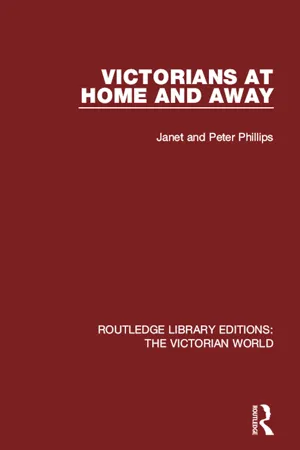
- 228 pages
- English
- ePUB (mobile friendly)
- Available on iOS & Android
eBook - ePub
Victorians at Home and Away
1
ETCETERAS
Etceteras are the you-and-mes of history. They are not Mr Badger’s ‘powerful people, and rich, and great builders’. They are his ‘enduring lot’ who wait and are patient and come back. They are the people and things that remain when the captains and the kings depart.
Victorian etceteras are people choosing the suburb in which to live, the style of their house, the furniture and pictures (or reproductions of pictures) to put in it, the knick-knacks to sit on the mantelpieces. They are people playing croquet on the lawn, singing songs in the drawing-room, listening to Papa or Mama reading aloud to the whole family the latest eagerly awaited instalment of Dickens, and saying family prayers before lighting their candles to go to bed. They are the people marvelling at the Crystal Palace in 1851 and the Queen’s Diamond Jubilee in 1897. They are the soldiers of the Queen walking out in their scarlet uniforms catching the eyes of the girls. They are business offices, shops and railway stations; the excursions organised by Thomas Cook, the seaside hotels, football grounds, theatres, music-halls, concert-halls, the bandstands in winter disconsolately dripping rain from gutters and patiently waiting for summer to bring them back to life with guardsmen playing patriotic marches and tunes from Gilbert and Sullivan. They are the Bible, Hymns Ancient and Modern, books on etiquette, Mrs Beeton’s Household Management, Bradshaw’s Monthly Guide to the Railways. They are what makes ordinary life workable, comfortable and pleasant for the you-and-mes – the Mr, Mrs, Master and Miss Badgers – of the Victorian age.
They do not appear in history’s headlines. The best they can manage is low down on inside pages in small print. This is because most historians are attracted only by the sensational, the spectacular successes and failures of the past. The great eighteenth-century English historian of the decline and fall of the Roman Empire, Edward Gibbon, said that ‘History is little more than the register of the crimes, follies and misfortunes of mankind.’ (Gibbon’s dignified description would apply equally well to the News of the World.) A later outstanding Victorian English historian, Thomas Carlyle, offered another definition: ‘History is nothing but the biography of great men.’ Although their definitions differ, both agree that history is about dramatic happenings, the huge climaxes, the great adventures, what is not usual, and in this, they are typical of their kind. The ink of most historians is dyed with Romanticism or a kind of Gothicism. They may agree that ‘happy is the country that has no history’ but few, if any, would disagree that the historians of such a country would be unhappy, if only because they would be out of a job. With historians, as with journalists, no news is bad business.
Technical reasons join with personal motives to drive historians to high drama in history. It is the unusual that impels people to write the documents from which most historians compose history – memoirs, letters, diaries, statutes, newspaper reports, accounts of battles or elections or Bastilles falling. Only as extraordinary a person as Tsar Nicholas II could note in his diary on the day the Russian Revolution broke out that nothing important happened and the weather was good.
Then, too, a large part of the fascination which history holds for many people is vicarious rubbing of shoulders with the great, or pulling them down from their pedestals, or pronouncing of judgement on them in a lordly (even godlike) manner. Whatever the reasons for their going to history, many historians have an element of the frustrated dramatist in them.
Historians of the distant past were perhaps justified in ignoring etceteras and concentrating their studies on Top People who, after all, did have all the power, wealth and education – and left almost all the written records. But, nowadays, little people are voters whom governments must court and businessmen serve. To appreciate the far-reaching consequences of the rise to importance of little people we need only to take the case of the motor car since World War Two. Only since then have cars been owned for pleasure and convenience by those who are not well-to-do. Cars, and car-owners, have multiplied time and again, and streets and roads have become overcrowded. New streets and roads have had to be built and old ones altered. Parking problems have become very complicated for the motorist and the urban authorities. Parking fees have become a rich source of funds for local authorities and a means of keeping rates down. New jobs have been created, old ones enlarged: town-planners, environmentalists, road engineers, traffic police, garage-owners, motor-mechanics, petrol-pump attendants, tourist agents, the AA and the RAC. Road accidents have exacted an ever-rising toll of millions of pounds every year to pay for hospitalising victims and for insurance premiums and claims for damaged or destroyed vehicles and people. Families who once took their annual holiday regularly at Margate or Skegness or Blackpool now take their car to the Lake District one year and on the Continent the next, with interesting effects on their mental horizons.
It was in the Victorian age that the monopoly of power, wealth and education possessed by the aristocracy and gentry was successfully challenged for the first time. An expanding middle class provided an important new group of consumers as well as aspirants to political power, economic wealth and social status. Workers in field and factory had, as yet, no part of power, wealth or social importance; nor were they consumers of any great importance, so Victorian etceteras tend not to be lower-class. The word ‘Victorian’ tends to summon up a middle-class image – if only because working-class people left comparatively few traces of their doings, especially outside working hours.
Victorian middle-class etceteras left abundant evidence: novels, buildings, clothes, newspapers, poems, paintings, railways, shop catalogues, railway timetables, music, football scores, racing results, medical textbooks, gardening manuals, scientific textbooks, Gilbert and Sullivan programmes, weather forecasts, sermons, insurance policies, death notices. The artistic production – novels, paintings, plays, architecture, poems, music – is important to those interested in etceteras not because of its aesthetic quality but because it tells them something about the desires, fears, ideals, and the dos and don’ts of little people. The person interested in etceteras does not have to be anything of a genius; indeed, ignorance of artistic worth is no disadvantage at all. One can understand Tennyson’s religious doubts without being able to judge the value of his poetry, or appreciate the antagonism against the aristocracy expressed in a Pre-Raphaelite painting without being at all capable of placing it in the artistic Football League table. Bad paintings, bad books, bad buildings may tell as much about commonplace life as good ones – in fact, they may tell more. Very few people are interested in high-class works of art.
This book is based on the assumption that most people in the past were neither fools nor villains. We cannot feel superior, holier-than-thou towards the past because we realise all too well that it will not be long before we, ourselves, belong to it, and we hope that we will not be rejected by the future for being so backward, ignorant and reactionary. If past people were neither fools nor villains, then it follows that they are likely to have had good reasons for doing what may seem to us (in very different circumstances) silly or wicked. Four commonplace illustrations will perhaps serve to show this. When Thomas Hughes, the author of Tom Brown’s Schooldays, was a boarder at Rugby in the 1830s, all the boys drank beer with their meals. This was not due to stupidity or ignorance of the bad effects of alcohol. Beer was drunk because any running water (let alone pure running water) was rare even in London, and available water was unsafe to drink. No one willingly drank water except mixed with alcohol in some form or another, alcohol being a mild germ-killer. Without running water, making tea, coffee or cocoa was not practicable. Only after Victorian sanitary engineers laid water-pipes and purified the water could Tom Brown’s grandchildren safely drink plain water. And only then could school kitchens cope with making nearly a thousand cups of tea, coffee or cocoa every day.
Windows provide two more examples. Victorians are often mocked for obstinately keeping windows closed even in summer. In fact, they had good reasons for doing so. Not only did they fear the house fires which could (and did) result from sudden draughts and gusts of wind making candlelights flare unexpectedly. Also, in towns and cities, suburban streets were not asphalted or sealed in any way and traffic raised persistent clouds of dust in summer which drifted into rooms if windows were open. Again, Victorians were often criticised for their (apparently) obsessive fear of theft shown, for instance, by bars on ground-floor windows. The plain reason for this was that police were non-existent on the beat until late in the nineteenth century, and thieves were abundant where extreme poverty existed side by side with wealth. Dickens’s novel, Oliver Twist (published in 1838), focuses on the criminal part of the population. Oliver is valuable to the thieves because he is small enough to be squeezed through an unbarred window (impassable to people of normal size) and open the back door.
Our final illustration concerns roads and cars. Much supercilious amusement may be had at the expense of the Victorians who seemed to block the progress of the motor car by imposing in 1878 a speed limit of 4 m.p.h. and making it illegal for mechanical vehicles to be on the roads unless a man walked in front with a red flag. In fact it was a very sensible law which was passed before the motor car was invented. Until the close of the century, mechanical vehicles on roads, such as steam traction engines used for ploughing and other farm work or steamrollers (invented in 1859), were large and terribly noisy. Horses meeting them took fright and bolted, endangering the life of riders and of those in the way. Making the vehicles go slowly and advertise their presence in advance with a red flag was a sensible safety precaution and enabled horse-riders or drivers to get a firm grip on the reins or dismount and hold the horse’s head. In 1896 the Act was repealed, not because the horses (or their offspring) had become used to mechanical vehicles, but because practicable cars had been developed by the 1890s and a few were on the road. So, in actual fact, Victorians showed commendable sense and speed in altering the law to suit the motor car and progress.
Perhaps putting oneself in the place of people in the past takes away the urge to put them in their place?
2
THE CRYSTAL PALACE
In England, May was notoriously an uncertain month for weather (and traditionally a bad one for marrying), but 1 May 1851 was fine. There was a light shower as the Queen and Prince Albert drove in their carriage up Constitution Hill on their way from Buckingham Palace to Hyde Park to open the Great Exhibition of the Works of Industry of All Nations. However, the rain only served to make the Exhibition Building’s 900,000 square feet of glass sparkle and glitter the more in the sun, justifying its affectionate, unofficial name – the Crystal Palace.
It would have taken much more than a mere shower to damp the excitement of the huge expectant crowd. While 30,000 privileged people were congregated inside the huge Crystal Palace (its 18 acres of building could easily house them), over half a million less privileged thronged Hyde Park and Green Park. Many had spent the night in the park or in the streets just outside. The wealthier had come in their carriages and slept in them. They breakfasted comfortably with footmen setting out a picnic meal. Some celebrated the occasion by having wine for breakfast. The less wealthy brought makeshift tents or simply slept on the ground. They, too, spent much of the waiting time eating. Enterprising salesmen set up tables or went among the crowds, selling sandwiches, meat-pies, cakes, fruit and ginger beer. Milk was available (at greatly inflated prices) fresh from the cows which were pastured and milked about a quarter of a mile away, within mooing distance of the Crystal Palace, in the fields on the other side of what is now Kensington Road. All along the roads leading to the parks men stood with trays selling shiny commemorative medals of the Crystal Palace. Street musicians played their instruments and sang songs. Acrobats picked up pennies by their agile tricks, and Artful Dodgers picked pockets.
The crowds fixed their eyes on the gaily coloured array of the flags of all the nations atop the roof of the Crystal Palace and waited for the signal that would show that the Queen had opened the Exhibition – the firing of a salute of guns on the north side of the Serpentine. Many were anxious to see whether all the glass would be shattered by the noise of the guns; the Prime Minister, Lord John Russell, had feared it would, and had tried to get the guns moved several miles away, to St James’s Park. Lord John was wrong. Not a pane even cracked.
Once the glass had stood the test, other excitements demanded attention: there was all the entertainment of a day out, and a very special day at that. Some might catch glimpses of important people coming and going, perhaps even a sight of the Queen and the Prince as their carriage returned home down Rotten Row. Nobody but the 30,000 privileged could get into the Exhibition on May Day; but there was plenty of time. It was to remain open for 140 days until 12 October and more than six million admissions were recorded, including one child who was born on the premises. (The population of Great Britain in 1851 was nearly 21 million, 2¼ million living in London.) Some came several times. After May Day the Queen made 29 other visits before the Royal Family went to Scotland for their summer holiday at Balmoral. She came on 3, 7, 12, 14, 16, 17, 19, 20, 21, 22, 27, 29, 30 May; 2, 7, 16, 20, 21, 24, 26, 28 June; 2, 5, 9, 11, 15, 16, 17, 18 July. After all, her dear Albert was an inspiration and driving force behind the Exhibition. For Victoria, it was her beloved husband’s Exhibition. It was his triumph.
It had been a dark, frosty, bitterly cold January morning in 1850 when the Prince set out to preside over the first meeting of the Commissioners for the Great Exhibition of the Works of Industry of All Nations, to take place some time in 1851. The government gave no financial support at all to the venture, and the Exhibition was not even held on government property, but in one of the Royal parks – Hyde Park. In this inaction, government was upholding the prevailing principles of laissez-faire: that the role of government should be minimal, confining itself to the preservation of law and order and the defence of the country; that there should be no interference with trade and industry, these being controlled in the free market-place by the laws of supply and demand; and that taxation should be no more than was needed to pay the judge and jailer, the soldier and sailor.
All the money for the Exhibition was subscribed and the costs guaranteed by private persons. The Duke of Wellington – after the Queen, the best-known person in the land – headed the list of subscribers with a handsome sum. He had made his fortune in war; by 1814 a country grateful for his victories against the French had granted him £500,000 (equal to at least twenty times as much, 150 years later) and made him a Duke (the Duke, as he was ever after known) – and all that was before he had won Waterloo in the next year. In addition, grateful Spaniards had loaded him with presents of money, jewels, plate, paintings by Velazquez, Murillo and other great Spanish artists worth another fortune. Since then, he had almost literally beaten his sword into a ploughshare, studying the art of peace with almost as great success as he had studied the art of war. He had served as Prime Minister. Whether in office or not, he had used his great reputation to help bring about peace-making compromises and reforms in domestic affairs, such as giving the vote to Catholics in 1829. These reforms had offended his own principles, but he knew that their refusal would have brought the country to bitter violence or even civil war. So he counselled not battle, but moderation. It was a nice touch of fortune that the Exhibition opened on 1 May, the Duke’s 82nd birthday. Before going to the opening, he was able to visit the Queen in the morning and receive his birthday wishes and presents; with him he took a birthday present for his godson, the Duke of Connaught, the Queen’s seventh child and third son, born on the Duke’s birthday a year before and named Arthur after him.
The old Duke’s peaceable disposition ensured his admiration for the Exhibition. Its prime purpose, according to Prince Albert and those who thought like him, was peace and the unity of mankind. So all foreign nations were invited to exhibit and half the Palace was given to them. There had been earlier exhibitions in Europe, but all had been exclusively national. None had been unashamedly international. Proud internationalism (or British modesty) received top billing at the head of the official catalogue which quoted Psalm 24: The Earth is the Lord’s and all that therein is.’
No doubt, patriotism played its part at the Crystal Palace. Exhibitors were showing off to foreigners as well as showing their exhibits to them, and British visitors could hardly help enjoying being British. Naturally, too, businessmen, with an eye on the main chance, viewed the Crystal Palace as a magnificent glass showcase not only for their wares to be admired and bought by foreigners but also to advertise in the domestic market the most modern machinery for East Anglian farmers, the latest looms for Lancashire factory-owners, the new envelope-making machine for Yorkshire business houses, striking and artistic statuary to adorn the new public buildings of Midland civic dignitaries, and the richest-looking and most stylish pianos (from Collards, of course) for socially minded London mammas.
Nevertheless, most of these people would have hear-heared Prince Albert’s speech at the Lord Mayor’s Banquet in London in 1850 as he drummed up support for what he wanted to be an international Exhibition. With the earnestness that was so much (and to the Queen, so endearing) a characteristic of his, and with the very faint trace of a German accent in his near-perfect English (which earnestness and emotion always brought to the surface), the Prince said:
Nobody who has paid attention to the peculiar features of the present era will doubt for a moment that we are living at a period of most wonderful transition, which tends rapidly to accomplish that great end, to which, indeed, all history points – the realization of the unity of mankind.
He went on to draw attention to the almost incredible, new methods of communication which were drawing the world together as never before – railways, telegraphs, steamships.
Prince Albert could have underlined his message by noting that it was only after the Duke of Wellington was born in 1769 that James Watt’s steam-engine was invented; it was only in 1776 when the Duke was seven years old that Watt and Boulton produced the first commercial steam-engine; and he was thirteen and in his second year at Eton when Watt invented the double-acting steam-engine. The Duke was 23, had been six years in the army and was a captain when gas first successfully lit a house in 1792. The Prince, himself, and the Queen were both ten years old when Stephenson’s Rocket made its historic journey in 1829, and the first railway telegraph was constructed in 1837, the year of the Queen’s accession. Two years later (the year before Victoria and Albert were married, and only eleven years before the Prince’s speech), the electric telegraph was first used on railways. In 1838, the year of the Queen’s coronation, the s.s. Sirius was the first steamship to cross the Atlantic entirely under steam. Perhaps the Prince considered these points would occur to his listeners without his insisting on them. Instead, he went on to stress how all nations were becoming more and more dependent on each other and none could sensibly close its doors to the trade of others. As a co...
Table of contents
- Cover
- Half Title
- Title Page
- Copyright Page
- Original Copyright Page
- Dedication
- Table of Contents
- List of Illustrations
- 1. Etceteras
- 2. The Crystal Palace
- 3. Old and New
- 4. Guides
- 5. Onward, Christian Soldiers
- 6. Home
- 7. Amusements – Indoors and Out
- 8. The Renaissance of English Music
- 9. For Queen and Country
- 10. The Shock of War
- 11. Postscript – Ways of Finding out More about Victorian Etceteras
- Index
Trusted by 375,005 students
Access to over 1.5 million titles for a fair monthly price.
Study more efficiently using our study tools.
Frequently asked questions
Yes, you can cancel anytime from the Subscription tab in your account settings on the Perlego website. Your subscription will stay active until the end of your current billing period. Learn how to cancel your subscription
No, books cannot be downloaded as external files, such as PDFs, for use outside of Perlego. However, you can download books within the Perlego app for offline reading on mobile or tablet. Learn how to download books offline
Perlego offers two plans: Essential and Complete
- Essential is ideal for learners and professionals who enjoy exploring a wide range of subjects. Access the Essential Library with 800,000+ trusted titles and best-sellers across business, personal growth, and the humanities. Includes unlimited reading time and Standard Read Aloud voice.
- Complete: Perfect for advanced learners and researchers needing full, unrestricted access. Unlock 1.5M+ books across hundreds of subjects, including academic and specialized titles. The Complete Plan also includes advanced features like Premium Read Aloud and Research Assistant.
We are an online textbook subscription service, where you can get access to an entire online library for less than the price of a single book per month. With over 1.5 million books across 990+ topics, we’ve got you covered! Learn about our mission
Look out for the read-aloud symbol on your next book to see if you can listen to it. The read-aloud tool reads text aloud for you, highlighting the text as it is being read. You can pause it, speed it up and slow it down. Learn more about Read Aloud
Yes! You can use the Perlego app on both iOS and Android devices to read anytime, anywhere — even offline. Perfect for commutes or when you’re on the go.
Please note we cannot support devices running on iOS 13 and Android 7 or earlier. Learn more about using the app
Please note we cannot support devices running on iOS 13 and Android 7 or earlier. Learn more about using the app
Yes, you can access Victorians at Home and Away by Janet Phillips,Peter Phillips in PDF and/or ePUB format, as well as other popular books in History & British History. We have over 1.5 million books available in our catalogue for you to explore.