First published in 1986. At any one time in late nineteenth-century England and Wales over one million men and women were described as domestic servants in the occupational category after agricultural work. This title explores several aspects of domestic service in the area of Rochdale, and the servant population is examined to discover who entered the service, at what age, and from what background they came. This title will be of interest to students of history.
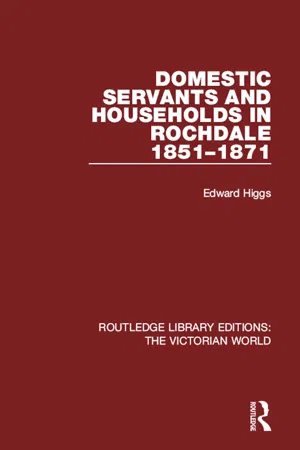
- 424 pages
- English
- ePUB (mobile friendly)
- Available on iOS & Android
eBook - ePub
1 Domestic Service in the Nineteenth Century
DOI: 10.4324/9781315637471-ch-1
I The Domestic Servant in Nineteenth-Century Society
At any one time in late nineteenth-century England and Wales over one million men and women were described as domestic servants in the occupational returns of the contemporary censuses, making service the largest occupational category after agricultural work.1 Such people were to be found in every part of the country, from the West End of London to the industrial towns of Lancashire, forming one of the recurring stereotypes of the Victorian world.
Similar occupational groups could be found throughout Europe at this date. In France in 1866, for example, domestic servants are said to have comprised 29 per cent of the entire occupied female population, and nearly 45 per cent of all working women in Paris in 1901.2 Indeed Laslett has gone so far as to claim that the presence of living-in domestics was one of the factors which differenciated ‘Western’ society in the past from that of East Europe or the Orient.’3
Although the traditional servant class has all but disappeared in Europe it is still of great social importance in modern developing countries. In Peru in 1961, for example, there were 145,000 female domestics, representing 21.4 per cent of the economically active female population.4 In South America, Africa and Asia, domestic service is still one of the most important paid activities open to women and one of the most potent symbols of social status. Even in modern Britain many of the functions of the Victorian domestic are still carried out by the foreign au pair or by the resurgent class of ‘nannies’.
Many scholars have also argued that service had important social functions which add to its importance in the period. It has been claimed that for many women in nineteenth-century Britain, domestic service did not simply represent a source of cash, it was also their introduction to life in the city. In developing industrial economies, such as Britain in the nineteenth century, or South American countries today, domestic service could be seen as a ‘bridging occupation’ between the countryside and the city, providing female migrants with an introduction to the values and life-styles of industrial society, and providing a home and income whilst the traumatic transition was being made.5
The servant was also of paramount importance to his or her employer. Many scholars have seen the employment of domestics as of fundamental importance in defining middle-class status. For Karl Marx the household domestic represented the ultimate example of the use made by the capitalist classes of surplus value, showing that a whole section of society could live as ‘unproductive labour’ at the beck and call of the bourgeoise.6 Mrs Beeton certainly believed that servants could be equated with income since she regarded a single maid-of-all-work as being sufficient for a family on an income of £200 per annum but expected a householder with an income of £1,000 to have six servants.7 Indeed the larger the income the greater was supposed to be the percentage of it spent on this part of the ‘paraphernalia of gentility’. According to one of the nineteenth-century household manuals quoted by J. A. Banks, a family earning £100 per annum might be expected to spend £4 on domestic help, or 4 per cent of its income. A family on £400 was expected to spend £24, or 6 per cent, and a family on £500 was held to spend £74 annually, no less than 15 per cent of its total income.8
An attempt to dismiss the work performed by servants as having no practical function is, however, unfair. Servants were not merely ornaments in the home, they fulfilled defined functional roles and produced necessary goods and services. The servant could provide his or her employer with three of the most sought after components of the ‘good life’ in Victorian society: privacy, cleanliness and free time.
In the nineteenth century the ‘Englishman’s castle’ could only be secure if it was guarded, and this function was performed by the housemaid, or by the resident man servant. The very architecture of the middle-class Victorian house was affected by the need to create the ‘no man’s land’ of the formal hallway where guests were received by the maid and vetted for undesirables. The act of paying calls and leaving one’s card on the hall table exemplified the use of space in the Victorian home as a line of defence against the external world.
When not on guard many domestics were constantly employed in keeping the house clean. The Victorians may have been over-obsessed with soap but the harsh environment of the nineteenth-century city must have caused formidable domestic problems. In the words of F. M. Jones,
The carriage-way was a ribbon of horse droppings converted by rain into a morass which passing wheels threw onto the pavement; hence the polished marble, granite, glazed brick base to buildings lining a highway; hence, too, the crossing sweeper. The block or macadam carriageway slowly ground to dust; the manure dried up and powdered; grit and carbon poured from every chimney.9
Hence the symbolical importance of ‘shine’ in the Victorian home, with its polished brasses, gilt mirrors and glass.
Lastly, the domestic eased the burden of other women in the home. This did not usually mean allowing the rich to live an idle life since many lower middle-class families led lives hardly distinguishable from that of the ‘aristocracy of labour’. The wife of a man earning £2 a week could afford a servant but would not be able to avoid household labour completely. Perhaps the servant would cook and wash whilst the mistress of the household looked after the children. The latter would have presented a very serious burden to many lower middle-class families who might have a shop to tend and whose geographical mobility might have limited access to the support of relatives.
II The Historiography of Domestic Service
Until quite recently little work has been done on the social history of domestic service in this country in the nineteenth century, although several pioneering works have now been published.10 Some of these works, although still of great interest, have tended to rely on anecdotal sources and national statistics which may distort the reality of social relationships in diverse communities.
Any attempt to write a national history of such a wide spread social phenomenon as domestic service is bound to obscure important regional differences. Recent work by geographers has shown that there were very great differences between the local servant populations depending on factors such as the availablity of alternative employment for women, the composition of the local elite who might employ servants, and the rate and nature of immigration into a locality.11 The use of national census statistics may be helpful when comparing servant populations in different countries but may obscure the regional contrasts which explain so much about the economic and social role of service within the national economy.
There are also problems in attempting to write the social history of domestic service from literary sources or even from family documents. The maid-of-all-work who was put out to service at 15 and left at the age of 21 to marry a labourer has left us comparatively few records and the same is true of the shopkeeper who employed her. The most voluminous records were to be found in the households of the rich and it is their servants who have, in general, left us their reminiscences. One recent study of the Victorian servant has drawn so heavily on this type of material that it has become biased towards a certain type of servant and servant employer. Of the 62 employers mentioned whose social standing could be indentified, 29 had titles, 14 belonged to the learned professions, 10 could be described as landed proprietors and four as farmers. Only three were retailers and only one was from the artisan class.12
The aim of the present work is to go beyond the general and anecdotal level of the present literature on this subject. It looks at several aspects of domestic service in one area. The servant population is examined to discover who entered the service, at what age, and from what background they came. The employers of servants are also examined to establish the identity of the ‘typical’ family which made use of their services. An attempt has also been made to quantify the factors affecting the employment of servants by individual households. The rural origins of servants are also shown to be linked to a conscious preference on the part of servant employers.
Having described the servant and servant employing populations, a section dealing with the turnover of servants and the channels of servant recruitment is used to give an insight into the dynamics of change within the apparently static statistical framework. The development of various forms of placement agencies and the importance of personal contacts in the servant market are also discussed.
The results of this analysis are finally used to gauge the validity of the popularly accepted servant stereotypes and the sources from which they are derived. The dynamics of change revealed by this study can in addition help us to understand some of the structural causes of the decline of the servant population in the late Victorian and Edwardian periods.
Notes
- MITCHELL, B. R., and DEANE, P., Abstract of British Historical Statistics, (Cambridge, 1962), 60.
- MCBRIDE, T., The Domestic Revolution, (London, 1976), 13–14.
- LASLETT, T. P. R., Family life and Illicit Love in Earlier Generations, (Cambridge, 1977), 31.
- SMITH, M. L., ‘Institutionalised servitude: the female domestic servant in Lima, Peru’, Unpublished PhD Dissertation, 1971 (British Library Reference: 72–10007), 61.
- BROOM, L. and SMITH, J. H., ‘Bridging occupations’, British Journal of Sociology, Vol. 14 (1963), 321–34.
- MARX, K., Grundrisse. Introduction to the Critique of Political Economy, (London, 1973), 401.
- BEETON, I., Mrs Beeton’s Book of Household Management, (London, 1863), 8.
- BANKS, J.A., Prosperity and Parenthood, (London, 1954), 74.
- JONES, F. M., ‘The aesthetic of the nineteenth-century industrial town’, in DYOS, H. J. (ed.), The Study of Urban History, (London, 1968), 173.
- HORN, P., The Rise and Fall of the Victorian Servant, (Dublin, 1975); MCBRIDE, T., The Domestic Revolution, (London, 1976); EBERY, M. and PRESTON, B., Domestic Service in late Victorian and Edwardian England, 1871–1914, (Reading, 1976). Reading University Geographical Papers, No. 42.
- EBERY, M. and PRESTON, B., Domestic Service in late Victorian and Edwardian England, 1871–1914, (Reading, 1976). Reading University Geographical Papers, No. 42.
- HORN, P., The Rise and Fall of the Victorian Servant, (Dublin, 1975).
2 Methodological Approach
DOI: 10.4324/9781315637471-ch-2
I The Choice of Subject
As was noted in the introduction, much of the recent work published on domestic service in the nineteenth century has been anecdotal and literary in character. This is perhaps to be expected when attempting to analyse an industry which employed so many thousands of people in such small units across the whole country.
A study of such large numbers of individuals lends itself to the use of quantitative methods. Similarly, the distribution of servants in individual households suggests an analysis based on a source in which all such units appear. Such a source exists in the form of the returns made by householders in the course of the taking of the nineteenth-century decennial censuses. Every ten years the local registrars of births, marriages and deaths divided up their districts into enumeration districts and appointed an enumerator for each. This official handed each householder a schedule on which the latter was directed to give information on the name, relationship to household head, marital status, sex, age and occupation of each member of the household. These were collected by the enumerators and destroyed after being copied into books. The latter were fowarded to a Census Office in London where they formed the raw data for various tabulations published in the decennial census reports. When the research for this work was carried out in the mid-1970s the householders’ returns for the censuses of 1841, 1851, 1861 and 1871 were available for public inspection at the Public Record Office.1 Since the 1841 returns are not as detailed as those which follo...
Table of contents
- Cover Page
- Half Title Page
- Title Page
- Copyright Page
- Title Page
- Copyright Page
- Frontmatter
- Contents
- Preface
- Acknowledgements
- 1 Domestic Service in the Nineteenth Century
- 2 Methodological Approach
- 3 Rochdale in the Nineteenth Century
- 4 The Social Position of the ‘Servant’ in the Mid-Nineteenth Century Census
- 5 The ‘True' Servant Population of Rochdale, 1851–1871
- 6 Servant Employers in Rochdale and the Factors Affecting Their Employment of Servants
- 7 Domestic Service and the Rural Woman
- 8 The Effect of Location on Servant Employment
- 9 The Recruitment of Servants in Rochdale, 1851–1871
- 10 Domestic Service in Nineteenth Century Rochdale: Some Implications for Contemporary Historical Research
- Appendix A Coding conventions used in the transformation of sample schedules into numerical data.
- Bibliography
- Tables
Trusted by 375,005 students
Access to over 1.5 million titles for a fair monthly price.
Study more efficiently using our study tools.
Frequently asked questions
Yes, you can cancel anytime from the Subscription tab in your account settings on the Perlego website. Your subscription will stay active until the end of your current billing period. Learn how to cancel your subscription
No, books cannot be downloaded as external files, such as PDFs, for use outside of Perlego. However, you can download books within the Perlego app for offline reading on mobile or tablet. Learn how to download books offline
Perlego offers two plans: Essential and Complete
- Essential is ideal for learners and professionals who enjoy exploring a wide range of subjects. Access the Essential Library with 800,000+ trusted titles and best-sellers across business, personal growth, and the humanities. Includes unlimited reading time and Standard Read Aloud voice.
- Complete: Perfect for advanced learners and researchers needing full, unrestricted access. Unlock 1.5M+ books across hundreds of subjects, including academic and specialized titles. The Complete Plan also includes advanced features like Premium Read Aloud and Research Assistant.
We are an online textbook subscription service, where you can get access to an entire online library for less than the price of a single book per month. With over 1.5 million books across 990+ topics, we’ve got you covered! Learn about our mission
Look out for the read-aloud symbol on your next book to see if you can listen to it. The read-aloud tool reads text aloud for you, highlighting the text as it is being read. You can pause it, speed it up and slow it down. Learn more about Read Aloud
Yes! You can use the Perlego app on both iOS and Android devices to read anytime, anywhere — even offline. Perfect for commutes or when you’re on the go.
Please note we cannot support devices running on iOS 13 and Android 7 or earlier. Learn more about using the app
Please note we cannot support devices running on iOS 13 and Android 7 or earlier. Learn more about using the app
Yes, you can access Domestic Servants and Households in Rochdale by Edward Higgs in PDF and/or ePUB format, as well as other popular books in History & 19th Century History. We have over 1.5 million books available in our catalogue for you to explore.