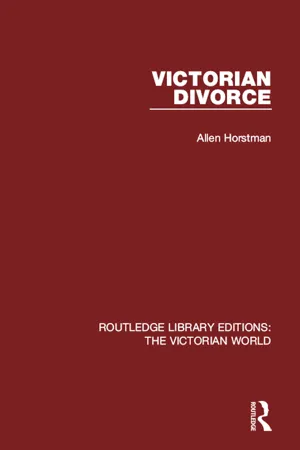
First published in 1985. Beginning from the first documented British divorce in 1670, Professor Horstman traces the development of divorce, the different means by which it came about, and the relation of practice to moral attitudes. Many cases are presented in summary form, and give a vivid picture of the patterns of behaviour and the agonies of conscience that accompanied this last resort solution. Written in a vivid style, the book casts an often startling light on the behaviour of our ancestors of little more than a century ago.
- 196 pages
- English
- ePUB (mobile friendly)
- Available on iOS & Android
eBook - ePub
Victorian Divorce
1The Origins
DOI: 10.4324/9781315637419-ch-1
Lustful or conscience-stricken, or both, Henry VIII, the king with six wives, never did obtain a divorce. Nor did anyone else, royal or no, during his reign or for 130 years after, as divorce was unknown in England. John Manners, Lord Roos, future Earl and later Duke of Rutland, has the honour of the first English divorce. In 1670 his wrecked marriage with Lady Ann Pierrepont, daughter and co-heiress of the Marquis of Dorchester, came before Parliament. Two years earlier he had obtained a private Act of Parliament which declared the three sons Lady Ann bore, after leaving him in 1659, to be bastards; this would keep the boys — ‘spurious issue’ — from inheriting his titles and lands. Parliament favoured him with a second private Act, divorcing him from Lady Ann and permitting him to remarry so as to attempt to maintain his line and titles.
Politicians saw in Roos's divorce a stalking horse for the king. Charles II, childless by his wife, Catherine of Braganza, though father many times by his mistresses, would be succeeded by his brother James, Duke of York and a Roman Catholic. Bishops, on the other hand, worried about the theological propriety of Roos's request as most thought divorce prohibited by the Bible; but the Church of England, with its bishops nearly unanimous against divorce in the 1670s, failed to dissuade Parliamentarians from passing the first divorce. Members of the House of Commons sought, unsuccessfully, a Bill making divorce widely available, echoing calls by the maritally unhappy John Milton over two decades earlier. Roos remarried twice; Charles II did not. Roos finally had a son who succeeded to his titles, though this son died childless. The Roman Catholic Duke of York succeeded to the throne of England but was thrown out of the kingdom during the Glorious Revolution of 1688.1
That Revolution, the crowning achievement of the aristocracy in its efforts to subdue the crown, offered another kind of hope to another aristocrat, Henry Howard, seventh Duke of Norfolk. The premier peer of the realm, Norfolk had watched helplessly since 1685 as his Duchess, Lady Mary Mordaunt, the daughter of the Earl of Peterborough, carried on a liaison with Sir John Germaine. Norfolk, failing in his efforts in 1691 and 1692, returned to Parliament for a divorce in 1701. Lady Mary fought the divorce all along and, as she had been discreet and had produced no children, much evidence had to be presented to prove her adultery. She had lived at Vauxhall under the name Lady Beckman and Sir John had, when visiting, pretended to be her brother. Whenever Lady Mary went to Sir John, she wore a mask. But the Duke and his agents had scoured London to catch her out and eventually they found a French footman and a Dutch cookmaid who would testify about seeing Lady Mary and Sir John in bed together. There followed a display of all the dirty linen to the public, which took a prurient interest in it all. The maid saw them in bed, the footman undressed Sir John, an apothecary brought Sir John a clyster (enema) while they were abed together — all circumstantial evidence necessary to prove the adultery.
After Norfolk failed in 1692, he sued Sir John in a common law court for taking his wife. The Duke, not necessarily more sinned against than sinning, had a mistress, a Mrs Lane, and their conduct so affronted sensibilities that, when he gave a ball in Norwich, no ladies attended for fear of being compromised. Norfolk signed a separation agreement with the Duchess's family who supported her throughout until she quarrelled with them over a political intrigue; Norfolk then saw his chance and took it in 1701. In that year the decade-old evidence was hauled out and supplemented by new discoveries. Also, in a period when religious passions inflamed easily, the childless Duke claimed his Bill was ‘not only for the benefit of the duke, but of the public, as a means to preserveth inheritance of so great an office and honours to persons of the true religion’ — a not subtle reminder that the Duke, a staunch Protestant, would be succeeded by someone from his family, the Howards, long notorious for their Roman Catholicism. Why throw out James II for his religion and then let the premier peerage fall to one of his co-religionists? Upon obtaining his divorce, the 47-year-old Duke promptly died of a fever, childless. His Roman Catholic brother became the eighth Duke of Norfolk.2
While the Duke of Norfolk followed the fortunes of politics before getting his divorce, the Earl of Macclesfield obtained a private divorce Act in 1698. The marriage of Charles Gerard, Lord Brandon and second Earl of Macclesfield, and Anne, daughter of Sir Richard Mason, hit troubled waters immediately and they separated two years after the ceremony, in 1685. Lady Anne married to escape her parents and had a sharp tongue, while Charles was violent — when only 17, he killed a footboy with a blow to the head while drunk — and deeply involved in political intrigue. In 1685 he wrote to his wife:
You have more reason to wonder at my forbearing so long to express the resentment of your behavior to me, than to be surprised that I now resolve to ease both you and myself of so unpleasing a conversation … You have long since spoke with scorn and contempt of me and my family to my face, and expressed that you did not care to have any children by me … This show to [your parents] for I will never live with you so long as I live.3
Imprisoned in the Tower in 1683 for Whig political activities, Charles, after his release, soon saw Traitors’ Gate again after the Rye House plot against the king. Condemned to death for treason, he was saved by the money, jewels, and pleading of Lady Anne. Despite her efforts, he would not have her back and she eventually took up with Earl Rivers, having two children by him in 1695 and 1697. Charles, now Earl of Macclesfield, and childless, sued for divorce and, after obtaining it, died of a fever on Guy Fawkes Day in 1701 without having remarried. He was succeeded by his bachelor brother who died in 1702 and the title became extinct. The Countess married again, though not to Earl Rivers, and lived until 1753.
Three noblemen, all anxious to end their marriages and remarry, exposed aspects of divorce which remained part of English divorce until well into the twentieth century. Religion, with its twin problems of Roman Catholicism and the church-state relationship, publicity and the public's prurient interest, spuri...
Table of contents
- Cover Page
- Half Title Page
- Title Page
- Copyright Page
- Original Title Page
- Original Copyright Page
- Table of Contents
- List of Tables
- Dedication
- Preface
- Abbreviations
- A Note on Language
- 1. The Origins
- 2. Before the Act: Victorian Divorce, Part I
- 3. Resistance: The Church of England
- 4. The Reformers: Lawyers and Politicians
- 5. After the Act Victorian Divorce, Part II
- 6. Victorian Hypocrisy
- 7. Divorce, Hypocrisy and Respectability
- Appendix: The Literature of Divorce and the Family
- Select Bibliography
- Index
Trusted by 375,005 students
Access to over 1.5 million titles for a fair monthly price.
Study more efficiently using our study tools.
Frequently asked questions
Yes, you can cancel anytime from the Subscription tab in your account settings on the Perlego website. Your subscription will stay active until the end of your current billing period. Learn how to cancel your subscription
No, books cannot be downloaded as external files, such as PDFs, for use outside of Perlego. However, you can download books within the Perlego app for offline reading on mobile or tablet. Learn how to download books offline
Perlego offers two plans: Essential and Complete
- Essential is ideal for learners and professionals who enjoy exploring a wide range of subjects. Access the Essential Library with 800,000+ trusted titles and best-sellers across business, personal growth, and the humanities. Includes unlimited reading time and Standard Read Aloud voice.
- Complete: Perfect for advanced learners and researchers needing full, unrestricted access. Unlock 1.5M+ books across hundreds of subjects, including academic and specialized titles. The Complete Plan also includes advanced features like Premium Read Aloud and Research Assistant.
We are an online textbook subscription service, where you can get access to an entire online library for less than the price of a single book per month. With over 1.5 million books across 990+ topics, we’ve got you covered! Learn about our mission
Look out for the read-aloud symbol on your next book to see if you can listen to it. The read-aloud tool reads text aloud for you, highlighting the text as it is being read. You can pause it, speed it up and slow it down. Learn more about Read Aloud
Yes! You can use the Perlego app on both iOS and Android devices to read anytime, anywhere — even offline. Perfect for commutes or when you’re on the go.
Please note we cannot support devices running on iOS 13 and Android 7 or earlier. Learn more about using the app
Please note we cannot support devices running on iOS 13 and Android 7 or earlier. Learn more about using the app
Yes, you can access Victorian Divorce by Allen Horstman in PDF and/or ePUB format, as well as other popular books in History & 19th Century History. We have over 1.5 million books available in our catalogue for you to explore.