This study presents details about the life and philosophy of the founder of Buddhism, Prince Gautama of India or the Buddha, in the form of a poem as told from an imaginary Buddhist character. When originally published in 1926, little was known of Buddhism in Europe and Arnold aimed to inform the west of basic Buddhist concepts and the effects this had on India and Hinduism. This title will be of interest to students of Religion and Asian studies.
eBook - ePub
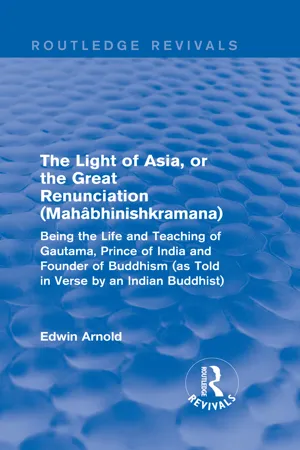
The Light of Asia, or the Great Renunciation (Mahâbhinishkramana)
Being the Life and Teaching of Gautama, Prince of India and Founder of Buddhism (as Told in Verse by an Indian Buddhist)
- 158 pages
- English
- ePUB (mobile friendly)
- Available on iOS & Android
eBook - ePub
The Light of Asia, or the Great Renunciation (Mahâbhinishkramana)
Being the Life and Teaching of Gautama, Prince of India and Founder of Buddhism (as Told in Verse by an Indian Buddhist)
About this book
Information
Book the Eighth
A BROAD mead spreads by swift Kohâna's bank
At Nagara; five days shall bring a man
In ox-wain thither from Benares' shrines
Eastward and northward journeying. The horns
Of white Himâla look upon the place,
Which all the year is glad with blooms, and girt
By groves made green from that bright streamlet's
wave.
Soft are its slopes and cool its fragrant shades,
And holy all the spirit of the spot
Unto this time: the breath of eye comes hushed
Oyer the tangled thickets, and high heaps
Of carved red stones cloven by root and stem
Of creeping fig, and clad with waving veil
Of leaf and grass. The still snake glistens forth
From crumbled work of lac and cedar-beams
To coil his folds there on deep-graven slabs;
The lizard dwells and darts o'er painted floors
Where Kings have paced; the grey fox litters
safe
Under the broken thrones; only the peaks,
And stream, and sloping lawns, and gentle airs
Abide unchanged. All else, like all fair shows
Of life, are fled—for this is where it stood,
The city of Suddhôdana, the hill
Whereon, upon an eve of gold and blue,
At sinking sun Lord Buddha set himself
To teach the Law in hearing of his own.
At Nagara; five days shall bring a man
In ox-wain thither from Benares' shrines
Eastward and northward journeying. The horns
Of white Himâla look upon the place,
Which all the year is glad with blooms, and girt
By groves made green from that bright streamlet's
wave.
Soft are its slopes and cool its fragrant shades,
And holy all the spirit of the spot
Unto this time: the breath of eye comes hushed
Oyer the tangled thickets, and high heaps
Of carved red stones cloven by root and stem
Of creeping fig, and clad with waving veil
Of leaf and grass. The still snake glistens forth
From crumbled work of lac and cedar-beams
To coil his folds there on deep-graven slabs;
The lizard dwells and darts o'er painted floors
Where Kings have paced; the grey fox litters
safe
Under the broken thrones; only the peaks,
And stream, and sloping lawns, and gentle airs
Abide unchanged. All else, like all fair shows
Of life, are fled—for this is where it stood,
The city of Suddhôdana, the hill
Whereon, upon an eve of gold and blue,
At sinking sun Lord Buddha set himself
To teach the Law in hearing of his own.
Lo! ye shall read it in the Sacred Books
How, being met in that glad pleasaunce-place—
A garden in old days with hanging walks,
Fountains, and tanks, and rose-banked terraces
Girdled by gay pavilions and the sweep
Of stately palace-fronts—the Master sate
Eminent, worshipped, all the earnest throng
Watching the opening of his lips to learn
That wisdom which hath made our Asia mild;
Whereto four thousand lakhs of living souls
Witness this day. Upon the King's right hand
He sate, and round were ranged the Sâkya Lords
Ananda, Devadatta—all the Court:
Behind stood Seriyut and Mugallan, chiefs
Of the calm brethren in the yellow garb,
A goodly company. Between his knees
Rahula smiled, with wondering childish eyes
Bent on the awful face, while at his feet
Sate sweet Yasôdhara, her heartaches gone,
Foreseeing that fair love which doth not feed
On fleeting sense, that life which knows no age,
That blessed last of deaths when Death is dead,
His victory and hers. Wherefore she laid
Her hand upon his hands, folding around
Her silver shoulder-cloth his yellow-robe,
Nearest in ail the world to him whose wo
The Three Worlds waited for. I cannot tell
A small part of the splendid lore which broke
From Buddha's lips: I am a late-come scribe
Who love the Master and his love of men,
And tell this legend, knowing he was wise,
But have not wit to speak beyond the books;
And time hath blurred their script and ancient sense,
Which once was new and mighty, moving all.
A little of that large discourse I know
Which Buddha spake on the soft Indian eve;
So, too, I know it writ that they who heard
Were more—lakhs more—crores more—than could
be seen,
For all the Devas and the Dead thronged there,
Till Heaven was emptied to the seventh zone
And uttermost dark Hells opened their bars;
Also the daylight lingered past its time
In rose-leaf radiance on the watching peaks,
So that it seemed Night listened in the glens
And Noon upon the mountains; yea! they write,
The Evening stood between them like some maid
Celestial, love-struck, rapt; the smooth-rolled clouds
Her braided hair; the studded stars the pearls
And diamonds of her coronal; the moon
Her forehead-jewel, and the deepening dark
Her woven garments. 'Twas her close-held breath
Which came in scented sighs across the lawns
While our Lord taught, and, while he taught, who
heard—
Though he were stranger in the land, or slave,
High caste or low, come of the Aryan blood,
Or Mlech or Jungle-dweller—seemed to hear
What tongue his fellows talked. Nay, outside those
Who crowded by the river, great and small,
The birds and beasts and creeping things—'tis writ—
Had sense of Buddha's vast embracing love
And took the promise of his piteous speech;
So that their lives—prisoned in shape of ape,
Tiger, or deer, shagged bear, jackal, or wolf,
Foul-feeding kite, pearled dove, or peacock gemmed,
Squat toad, or speckled serpent, lizard, bat;
Yea, or of fish fanning the river-waves—
Touched meekly at the skirts of brotherhood
With man who hath less innocence than these,
And in mute gladness knew their bondage broke
Whilst Buddha spake these things before the
King:—
How, being met in that glad pleasaunce-place—
A garden in old days with hanging walks,
Fountains, and tanks, and rose-banked terraces
Girdled by gay pavilions and the sweep
Of stately palace-fronts—the Master sate
Eminent, worshipped, all the earnest throng
Watching the opening of his lips to learn
That wisdom which hath made our Asia mild;
Whereto four thousand lakhs of living souls
Witness this day. Upon the King's right hand
He sate, and round were ranged the Sâkya Lords
Ananda, Devadatta—all the Court:
Behind stood Seriyut and Mugallan, chiefs
Of the calm brethren in the yellow garb,
A goodly company. Between his knees
Rahula smiled, with wondering childish eyes
Bent on the awful face, while at his feet
Sate sweet Yasôdhara, her heartaches gone,
Foreseeing that fair love which doth not feed
On fleeting sense, that life which knows no age,
That blessed last of deaths when Death is dead,
His victory and hers. Wherefore she laid
Her hand upon his hands, folding around
Her silver shoulder-cloth his yellow-robe,
Nearest in ail the world to him whose wo
The Three Worlds waited for. I cannot tell
A small part of the splendid lore which broke
From Buddha's lips: I am a late-come scribe
Who love the Master and his love of men,
And tell this legend, knowing he was wise,
But have not wit to speak beyond the books;
And time hath blurred their script and ancient sense,
Which once was new and mighty, moving all.
A little of that large discourse I know
Which Buddha spake on the soft Indian eve;
So, too, I know it writ that they who heard
Were more—lakhs more—crores more—than could
be seen,
For all the Devas and the Dead thronged there,
Till Heaven was emptied to the seventh zone
And uttermost dark Hells opened their bars;
Also the daylight lingered past its time
In rose-leaf radiance on the watching peaks,
So that it seemed Night listened in the glens
And Noon upon the mountains; yea! they write,
The Evening stood between them like some maid
Celestial, love-struck, rapt; the smooth-rolled clouds
Her braided hair; the studded stars the pearls
And diamonds of her coronal; the moon
Her forehead-jewel, and the deepening dark
Her woven garments. 'Twas her close-held breath
Which came in scented sighs across the lawns
While our Lord taught, and, while he taught, who
heard—
Though he were stranger in the land, or slave,
High caste or low, come of the Aryan blood,
Or Mlech or Jungle-dweller—seemed to hear
What tongue his fellows talked. Nay, outside those
Who crowded by the river, great and small,
The birds and beasts and creeping things—'tis writ—
Had sense of Buddha's vast embracing love
And took the promise of his piteous speech;
So that their lives—prisoned in shape of ape,
Tiger, or deer, shagged bear, jackal, or wolf,
Foul-feeding kite, pearled dove, or peacock gemmed,
Squat toad, or speckled serpent, lizard, bat;
Yea, or of fish fanning the river-waves—
Touched meekly at the skirts of brotherhood
With man who hath less innocence than these,
And in mute gladness knew their bondage broke
Whilst Buddha spake these things before the
King:—
OM, AMITAYA! measure not with words
Th' Immeasurable; nor sink the string of thought
Into the Fathomless. Who asks doth err,
Who answers, errs. Say nought!
Th' Immeasurable; nor sink the string of thought
Into the Fathomless. Who asks doth err,
Who answers, errs. Say nought!
The Books teach Darkness was, at first of all,
And Brahm, sole meditating in that Night:
Look not for Brahm and the Beginning there!
Nor him, nor any light
And Brahm, sole meditating in that Night:
Look not for Brahm and the Beginning there!
Nor him, nor any light
Shall any gazer see with mortal eyes,
Or any searcher know by mortal mind;
Veil after veil will lift—but there must be
Veil upon veil behind.
Or any searcher know by mortal mind;
Veil after veil will lift—but there must be
Veil upon veil behind.
Stars sweep and question not. This is enough
That life and death and joy and woe abide;
And cause and sequence, and the course of time,
And being's ceaseless tide,
That life and death and joy and woe abide;
And cause and sequence, and the course of time,
And being's ceaseless tide,
Which, ever changing, runs, linked like a river
By ripples following ripples, fast or slow—
The same yet not the same—from far-off fountain
To where its waters flow
By ripples following ripples, fast or slow—
The same yet not the same—from far-off fountain
To where its waters flow
Into the seas. These, steaming to the Sun,
Give the lost wavelets back in cloudy fleece
To trickle down the hills, and glide again;
Having no pause or peace.
Give the lost wavelets back in cloudy fleece
To trickle down the hills, and glide again;
Having no pause or peace.
This is enough to know, the phantasms are;
The Heavens, Earths, Worlds, and changes
changing them,
A mighty whirling wheel of strife and stress
Which none can stay or stem.
The Heavens, Earths, Worlds, and changes
changing them,
A mighty whirling wheel of strife and stress
Which none can stay or stem.
Pray not! the Darkness will not brighten! Ask
Nought from the Silence, for it cannot speak!
Vex not your mournful minds with pious pains!
Ah! Brothers, Sisters! seek
Nought from the Silence, for it cannot speak!
Vex not your mournful minds with pious pains!
Ah! Brothers, Sisters! seek
Nought from the helpless gods by gift and hymn,
Nor bribe with blood, nor feed with fruits and
cakes;
Within yourselves deliverance must be sought;
Each man his prison makes.
Nor bribe with blood, nor feed with fruits and
cakes;
Within yourselves deliverance must be sought;
Each man his prison makes.
Each hath such lordship as the loftiest ones;
Nay, for with Powers above, around, below,
As with all flesh and whatsoever lives,
Act maketh joy and woe.
Nay, for with Powers above, around, below,
As with all flesh and whatsoever lives,
Act maketh joy and woe.
What hath been bringeth what shall be, and is,
Worse—better—last for first and first for last:
The Angels in the Heavens of Gladness reap
Fruits of a holy past:
Worse—better—last for first and first for last:
The Angels in the Heavens of Gladness reap
Fruits of a holy past:
The devils in the underworlds wear out
Deeds that were wicked in an age gone by:
Nothing endures: fair virtues waste with time,
Foul sins grow purged thereby.
Deeds that were wicked in an age gone by:
Nothing endures: fair virtues waste with time,
Foul sins grow purged thereby.
Who toiled a slave may come anew a Prince
For gentle worthiness and merit won;
Who ruled a King may wander earth in rags
For things done and undone.
For gentle worthiness and merit won;
Who ruled a King may wander earth in rags
For things done and undone.
Higher than Indra's ye may lift your lot,
And sink it lower than the worm or gnat;
The end of many myriad lives is this,
The end of myriads that.
And sink it lower than the worm or gnat;
The end of many myriad lives is this,
The end of myriads that.
Only, while turns this wheel invisible,
No pause, no peace, no staying-place can be;
Who mounts may fall, who falls will mount; the
spokes
Go round unceasingly!
No pause, no peace, no staying-place can be;
Who mounts may fall, who falls will mount; the
spokes
Go round unceasingly!
* * * * *
If ye lay bound upon the wheel of change,
And no way were of breaking from the c...
And no way were of breaking from the c...
Table of contents
- Cover
- Title
- Copyright
- Original Title
- Original Copyright
- Dedication
- Book the First
- Book the Second
- Book the Third
- Book the Fourth
- Book the Fifth
- Book the Sixth
- Book the Seventh
- Book the Eighth
Trusted by 375,005 students
Access to over 1.5 million titles for a fair monthly price.
Study more efficiently using our study tools.
Frequently asked questions
Yes, you can cancel anytime from the Subscription tab in your account settings on the Perlego website. Your subscription will stay active until the end of your current billing period. Learn how to cancel your subscription
No, books cannot be downloaded as external files, such as PDFs, for use outside of Perlego. However, you can download books within the Perlego app for offline reading on mobile or tablet. Learn how to download books offline
Perlego offers two plans: Essential and Complete
- Essential is ideal for learners and professionals who enjoy exploring a wide range of subjects. Access the Essential Library with 800,000+ trusted titles and best-sellers across business, personal growth, and the humanities. Includes unlimited reading time and Standard Read Aloud voice.
- Complete: Perfect for advanced learners and researchers needing full, unrestricted access. Unlock 1.5M+ books across hundreds of subjects, including academic and specialized titles. The Complete Plan also includes advanced features like Premium Read Aloud and Research Assistant.
We are an online textbook subscription service, where you can get access to an entire online library for less than the price of a single book per month. With over 1.5 million books across 990+ topics, we’ve got you covered! Learn about our mission
Look out for the read-aloud symbol on your next book to see if you can listen to it. The read-aloud tool reads text aloud for you, highlighting the text as it is being read. You can pause it, speed it up and slow it down. Learn more about Read Aloud
Yes! You can use the Perlego app on both iOS and Android devices to read anytime, anywhere — even offline. Perfect for commutes or when you’re on the go.
Please note we cannot support devices running on iOS 13 and Android 7 or earlier. Learn more about using the app
Please note we cannot support devices running on iOS 13 and Android 7 or earlier. Learn more about using the app
Yes, you can access The Light of Asia, or the Great Renunciation (Mahâbhinishkramana) by Edwin Arnold in PDF and/or ePUB format, as well as other popular books in Theology & Religion & Buddhism. We have over 1.5 million books available in our catalogue for you to explore.