First published in 1981. This book aims to show Romanticism as a response to certain questions – in literature, art, religion, philosophy and politics – that were being asked increasingly towards the end of the eighteenth century. The essays focus on growth and change (in society and the individual), nature, feeling and reason, and subjectivism – examining how these questions arose, why they were felt to be important and the kinds of answers that, consciously or unconsciously, the Romantics provided. This title will be of interest to students of literature, history and philosophy.
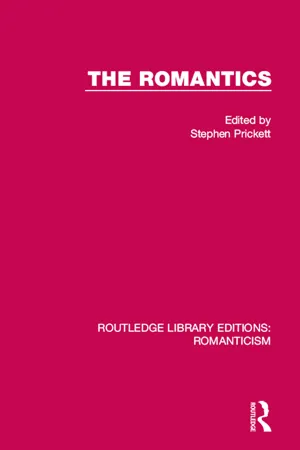
- 276 pages
- English
- ePUB (mobile friendly)
- Available on iOS & Android
eBook - ePub
The Romantics
About this book
Information
1 England 1782–1832: the historical context
DOI: 10.4324/9781315630229-2
Introduction
Romantic England was an England of wars and rumours of wars. Embattled or expansive, seeking opportunity abroad or anxiously watching the need for military force at home, England felt the impact and the various possibilities of war, of invasion, defeat, triumph and militarism. To some war was necessary; to others it was symptomatic of what was rotten in the English polity.
1783 saw the end of the American War of Independence, but the next decade was punctuated by ‘incidents’ – on the Canadian border, the Pacific coast, the Black Sea, in India. Ironically it was in 1792 that Pitt was able to declare that ‘unquestionably there never was a time when a durable peace might more reasonably be expected than at the present moment’.1 A year later began the wars against Revolutionary and Napoleonic France that were to continue, with but brief respite after the Peace of Amiens in 1802, until 1815.
The impact of the war was great. 250,000 men were under arms in 1812; some 100,000 were to remain after 1815. The barracks built in and after the 1790s could hold 150,000 troops. Naval manpower rose from 36,000 to 114,000 between 1792 and 1812. The financial impact of the war is hinted at in Table 1. Government expenditure peaked in 1815 at £112.9 million. In 1811 the war took 16 per cent of gross national income, the same proportion as in 1915.2
| Year | Govt income £m | Govt expenditure £m | National debt £m |
|---|---|---|---|
| 1770 | 11.4 | 10.5 | 130.6 |
| 1780 | 12.5 | 22.6 | 167.2 |
| 1790 | 17.0 | 16.8 | 244.0 |
| 1800 | 31.6 | 51.0 | 456.1 |
| 1810 | 69.2 | 81.5 | 607.4 |
| 1820 | 58.1 | 57.5 | 840.1 |
| 1830 | 55.3 | 53.7 | 798.2 |
The burden of war meant that the age was of necessity interested in quantification, in the possibilities of statistics. Political arithmetic, drowsing for three generations, reawakened. Government commissions became characteristic vehicles for the making of policy and the airing of grievances. The potential of statistics was realized. An adequate census was taken for the first time in 1801. It helped to settle the contemporary argument as to whether the population was rising or falling. Repeated decennially, the census revealed the momentum of population growth (see Table 2).
| England and Wales | ||
|---|---|---|
| m | % increase | |
| 1770 estimate | 7.48 | |
| 1780 estimate | 7.95 | 6.3 |
| 1790 estimate | 8.68 | 9.2 |
| 1801 census | 8.89 | 2.4 |
| 1811 census | 10.16 | 14.3 |
| 1821 census | 12.00 | 18.1 |
| 1831 census | 13.90 | 15.8 |
The population of Scotland grew from 1.61 million in 1801 to 2.36 million in 1831. And the occupational structure was changing, as shown in Table 3.
| % of families | 1811 | 1831 |
|---|---|---|
| Agriculture | 35.2 | 28.1 |
| Trade, manufacture, handicraft | 44.4 | 42.0 |
| Other | 20.4 | 29.8 |
New manufacturing towns embodied the dynamism and twar meant that the age was of necessityhe in-stability of the age. They were emphatically outside of the traditional social structure. The increase in expenditure on poor relief was dramatic. This rise substantially outstripped the growth in population. From some £1½ million per year in the mid 1770s, the amount spent on poor relief reached £4¼ million per year early in the 1800s, £6½ million a decade later, and over £7¼ million by 1820.3 The facts of finance and population show that this was an age of wrenching changes and an age in which government, as employer of men and extractor of money, as oppressor and as saviour, played an ever more important part in national life.
This was an intensely political age. It ended with the prolonged, maybe even potentially revolutionary crisis over the need for a reform of the franchise and of the number and distribution of parliamentary constituencies. This crisis was resolved, though the problems which created it were not solved, by the Reform Act of 1832. The age had opened too with the question of parliamentary reform being aired, and with the crisis over the conclusion of the American war and the resignation in 1782 of Lord North, Prime Minister since 1770. The ministries of Shelburne and Rockingham were short-lived. The Fox-North coalition saw a major constitutional crisis over the conduct of George III, who brought pressure to bear on the House of Lords to reject Fox’s India bill (which, George believed, would throw Indian patronage into Whig hands). Fox and North bitterly attacked George’s choice of William Pitt the Younger to be First Lord of the Treasury (December 1783). Until after the election of 1784, Pitt led a minority government. The events of 1782–4 both flabbergasted and alienated the Whig party. For most of the following half century, the Whig party was the party of opposition. As such it had to mediate – a desperately difficult task – between its aristocratic fastness and the radicals who surrounded it clamorously and indecently as well as honestly and tenaciously.
Throughout the years 1782–1832 the political system was under stress. The demands upon it were immense. It had to organize the fighting of the wars against France. It had to comprehend the condition of the economy (even to ‘solve’ its problems). It had to maintain public order whilst insisting upon individual responsibilities.
And the whole government, the establishment which it represented and embodied, was under challenge. Its legitimacy was doubted, asserted, and doubted again. These debates were rooted in eighteenth-century political culture – in the arguments over political power, its forms, control and limitations which had marked the reigns of William III and Anne, the hegemony of Walpole and then the first troubled decades of George III’s reign. This crisis of authority within the established political system set King against (self-styled) aristocracy, George and Pitt against Charles James Fox and the Whigs. Political argument was given added edge by the coincidence of changes in the economy and by the assertion, apparently confirmed in revolutionary France, of the possibilities of establishing a radically different polity. From outside – or from the fringes of – the political nation, new tones, often angered by economic change and transported by the vistas of justice held to inhere in the notion of ‘rights’, were increasingly voiced. Against this cacophony the political nation split and two tunes alone were heard – that which announced the anti-French theme and that which proclaimed a fanfare for reform. All these lines of argument, passion and conviction came together and separated. As they did so the typical eighteenth-century preoccupation with ‘the state of the nation’ changed indefinably into the typical nineteenth-century concern with ‘the condition of England’. In the process, the realm of the thinkable was greatly extended, and what was thought was quickly published, urged, debated, overthrown. These thoughts and arguments I hope to illustrate in what follows.
Students of literature are wary of claiming that a text is a reflection of society, even of the opinions of the person responsible for it. Historians too must be very cautious in arguing that a letter or a speech reveals more than its author’s mere perception of the needs of the moment, of the state of an argument, or an audience. I do not intend to pin writers or politicians to the remains they have left behind in letter, speech, poem, novel or conversation. Rather I hope to use contemporary evidence to show just how much could be thought, argued and believed, to indicate not the concentration of opinion, not a typical point of view, but rather the range of possibilities.
Doubt rather than confidence, debate rather than deference, involvement rather than indifference: these were characteristic. Perception of change was not yet appreciation of progress. The penetration of the culture by ‘improvement’4 brought confrontation as much as celebration: in 1831 troops were rushed by steamship to quell a popular rising in Merthyr Tydfil; tricolours were waved at the opening of the Liverpool and Manchester Railway. It was only later that ‘improvement’ became ‘progress’ and, for a time, became common rather than contentious.
Man in the economy
The land and ‘the alteration in the times‘
England was the first country to experience an Industrial Revolution. Perhaps ‘an’ rather than ‘the’: the forms have been so diverse, even while the basis remains the same. Emphasizing similarity and discounting variation, some historians have been tempted to speak, on the one hand, of a general process (now world-wide and certainly not specifically capitalist) of ‘modernization’ and, on the other, of pre-industrial or traditional society. But such societies were many and various: England in the mid-eighteenth century was a far more ‘developed’ country than many others have been when on the verge of their, more recent, industrial revolutions. England was not a ‘backward’ country in 1750. Finance capitalism, market agriculture and so on were well developed before then. But this does not mean that the general transformation of the economy – of which the process of industrialization was a part – was accomplished smoothly. The transformation came suddenly, its impact unpredictable, its implications unforeseen.
The agricultural wage labourer was not created in that transformation, yet it profoundly and traumatically affected him, as it affected the proprietor and the tenant farmer. ‘In general eighteenth century conditions encouraged a persistent bias towards larger farms occupied by tenants rather than freeholders.’ Increasing size of farms changed the position of the labourer; the consolidation of ownership struck at the small proprietor, ‘although there were areas of small-scale farming where the numbers of owner-occupiers were little affected by the processes of change’.5 In the structural sense, there was no old order in England. Long-term changes in the pattern of land ownership had precluded that. Yet the cultural relation of gentry, farmer and farmworker in the 1720s or 1730s was very different from that prevailing a century later. And – by improvement, enclosure and a sheer sense of possibility – the face of England was irreparably changed, even dehumanized:
Scarce could any trace of man descry,Wastes of corn that stretched without a bound,But where the sower dwelt was nowhere to be found.(Salisbury Plain, 1793–4, lines 43–5)
Between roughly 1750 and 1850, a tradition of paternalism was severely eroded. Relationships based upon money became correspondingly more important and, crucially, more uncertain. These years see, in the sweeping words of Hobsbawm and Rudé, the end of the ‘ancient belief that social inequality could be combined with the recognition of human rights’. A witness before a parliamentary enquiry in 1830 looked back to the previous state of things:
When I was a boy I used to visit a large Farmhouse, where the Farmer sat in a room with a Door opening to the Servants’ Hall, and everything was carried from one Table to the other. Now they will rarely permit a Man to live in their Houses; and it is in consequence a total Bargain and Sale for Money, and all Idea of Affection is destroyed.6
On the estates of the Stafford family in the West Midlands the farmer no longer had direct access to the Marquis – he went to the agent (’the ...
Table of contents
- Cover Page
- Half-title Page
- Title Page
- Copyright Page
- Table Of Contents
- Illustrations
- Acknowledgements
- Introduction
- 1 England 1782–1832: the historical context
- 2 Romanticism in English art
- 3 The religious context
- 4 The roots of imagination: the philosophical context
- 5 Romantic literature
- Index
Trusted by 375,005 students
Access to over 1.5 million titles for a fair monthly price.
Study more efficiently using our study tools.
Frequently asked questions
Yes, you can cancel anytime from the Subscription tab in your account settings on the Perlego website. Your subscription will stay active until the end of your current billing period. Learn how to cancel your subscription
No, books cannot be downloaded as external files, such as PDFs, for use outside of Perlego. However, you can download books within the Perlego app for offline reading on mobile or tablet. Learn how to download books offline
Perlego offers two plans: Essential and Complete
- Essential is ideal for learners and professionals who enjoy exploring a wide range of subjects. Access the Essential Library with 800,000+ trusted titles and best-sellers across business, personal growth, and the humanities. Includes unlimited reading time and Standard Read Aloud voice.
- Complete: Perfect for advanced learners and researchers needing full, unrestricted access. Unlock 1.5M+ books across hundreds of subjects, including academic and specialized titles. The Complete Plan also includes advanced features like Premium Read Aloud and Research Assistant.
We are an online textbook subscription service, where you can get access to an entire online library for less than the price of a single book per month. With over 1.5 million books across 990+ topics, we’ve got you covered! Learn about our mission
Look out for the read-aloud symbol on your next book to see if you can listen to it. The read-aloud tool reads text aloud for you, highlighting the text as it is being read. You can pause it, speed it up and slow it down. Learn more about Read Aloud
Yes! You can use the Perlego app on both iOS and Android devices to read anytime, anywhere — even offline. Perfect for commutes or when you’re on the go.
Please note we cannot support devices running on iOS 13 and Android 7 or earlier. Learn more about using the app
Please note we cannot support devices running on iOS 13 and Android 7 or earlier. Learn more about using the app
Yes, you can access The Romantics by Stephen Prickett in PDF and/or ePUB format, as well as other popular books in Literature & Literary Criticism. We have over 1.5 million books available in our catalogue for you to explore.