First published in 1987. Many Victorian novels that considered social problems made extensive use of contemporary source material for their descriptions. This book aims to provide a greater acquaintance with this non-literary material — illustrating and exemplifying issues that the authors treated imaginatively. The material is divided into parts dealing with: the industrial north of England, London and the agricultural poor. Extracts from writings that bear directly on the fiction of writers like Dickens and Gaskell are featured, as are Government Blue Books and newspaper reports and articles. This volume also contains articles by Dickens and others, from his magazine, Household Words.
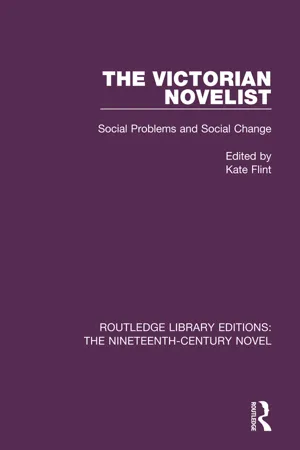
- 284 pages
- English
- ePUB (mobile friendly)
- Available on iOS & Android
eBook - ePub
Part One
The Industrial North and Midlands
1
In Mary Barton, Elizabeth Gaskell discriminates knowledgeably between various types of working-class housing. She demonstrates the difference made by prudent management, possible when at least one income is coming into the house, however difficult times may be, as is the case in the Barton household, and contrasts this with the conditions in which the workless Davenport family live, ill with the fever, their possessions all pawned. Some six or seven feet below street level, their cellar is only as wide as a man’s outstretched arms; window panes are broken and stuffed with rags; a fetid smell is in the air, and there are ‘three or four little children rolling on the damp, nay wet brick floor, through which the stagnant, filthy moisture of the street oozed up’. The family’s fever ‘was (as it usually is in Manchester) of a low, putrid, typhoid kind; brought on by miserable living, filthy neighbourhood, and general depression of mind and body. It is virulent, malignant, and highly infectious’ (Mary Barton, Chapter 6).
Such a description may be compared with the picture of cellar housing given in Joseph Adshead’s Distress in Manchester, 1842. Early in 1840, Adshead directed and superintended an investigation into the circumstances of some 12,000 Manchester families — about a third of the whole population — in order that nearly £4,000 worth of relief could be administered. He followed this by a further inquiry, and this work combines the results of the two. In his preface (p. viii) he states that he does not intend:
to indulge in any declamatory appeals to the feelings of the reader on behalf of the suffering poor; but rather, to trust to the effect upon his cool judgment of a few simple statements … in the hope that these will convince him that the existing distress is of a nature too settled and extensive to admit of mere temporary remedial measures; and that, therefore, the axe must be laid to the root of the evil.
Elizabeth Gaskell set Mary Barton back in 1839. This gave her the dramatic advantage of being able to use the events surrounding the presentation of the Chartist petition in that year. It also absolved her from being read as making an entirely direct charge against the conditions of contemporary Manchester. Appalling though these were, a local Borough Police Act of 1844 had led the city to order sanitary improvements to the houses of over 26,000 people between 1845 and 1847. Yet although in theory this affected many cellar dwellers, as Anthony Wohl points out in Endangered Lives (London, 1983, p. 298) ‘these efforts in the 1840s were largely nullified by the enormous influx of immigrants into the city’.
See also A. Redford, The History of Local Government in Manchester, 3 vols, London, 1939.
Joseph Adshead, Distress in Manchester: Evidence (Tabular and Otherwise) of The State of the Labouring Classes in 1840–42, London, 1842.
(a) pp. 14–16
Adshead submits a table which ‘will afford some idea of the extent to which cellar habitations are used in Manchester:

Although this proportion of the whole number included in the return (and relieved) — upwards of one-fifth — may not appear large when compared with that of other populous towns — (it is considerably less, we believe, than the relative number of cellar habitations in Liverpool) — it must be borne in mind that the cellars which are used as habitations by the poor have no other feature in common with the cellars attached to the middle class of dwelling-houses than that of their being below the level of the street. They are most of them neither drained nor soughed. They are consequently damp, — are always liable to be flooded, — and are almost entirely without the means of ventilation, having rarely but the outlets of door and window at the one side, and these almost hid below the level of the street.
But the above-ground habitations of the indigent poor are little better than the cellars, except in the matter of situation. Nothing in the shape of the meanest comforts of life are visible in them. Decent furniture there is none, — bricks, logs of wood, and other contrivances being frequently used as substitutes for tables and chairs, while the bag of shavings or litter of straw is laid in some corner, to be occupied nightly by its miserable tenants, with all its accumulation of impurities inevitably resulting from the condition and habits of the latter.
And not always are these abodes of squalor and poverty, whether cellars or ground-floor habitations, occupied by the members of one family alone. Frequently, different families occupy opposite corners of the same room, the sexes being no further separated than by the few feet of space which lie between their respective beds of straw. This state of things has come under my own observation repeatedly, in visiting the habitations of the poor. Six or eight persons have I witnessed inhabiting a damp cellar, males and females congregated together, with a line hung along the hovel for the use of the inmates, upon which were suspended, indiscriminately, their torn and dirty apparel; with other scenes of a nature too disgusting for recital.
In other instances, parents and children were found sleeping together in the same bed, without regard to age or sex. The following conversation took place between a member of the Relief Committee, and a poor widow who applied to the Committee for a bed: —
Examiner. Have you a bed?
Widow. I have one.
Examiner. Is not one enough?
Widow. No; I have a son.
Examiner. What age is he?
Widow. Nineteen years.
Examiner. And where has he slept?
Widow. With me; or he must have lain on the floor.
Of course a bed was given for the son.
It would be impossible to over-state the moral and social evils arising from this state of things. The domestic decencies must be utterly unknown where habits like these prevail; and every barrier against profligacy in its coarsest form must be broken down.
In a Parliamentary Report relative to the sanatory regulations of towns, it is observed that ‘where there are children of both sexes, mere decency requires four rooms, — three for sleeping and one for daily use. These are the least that are sufficient to afford to an average family the house room necessary for decency.’ Four rooms the ‘least that is sufficient’, while thousands of families in this town — and tens of thousands in the whole kingdom — have but one room, and that a hovel of the most wretched kind, for all the purposes of life!
(b) pp. 35–9
A feature of Distress in Manchester are the reports which Adshead incorporates from missionaries working in various quarters of the city. This report is notable for the emphasis it places on the hardship of the respectable — as opposed to the ‘intemperate’ — working people.
This anonymous report was made in January 1842 by ‘a gentleman whose attention was directed to the social and moral condition of the labouring classes, with a view to its improvement’ (Distress in Manchester, p. 34).
Dear Sir, — An engagement I had made to oblige a friend rendered it necessary that I should visit the inhabitants of several streets in Ancoats and in the neighbourhood of Oldham-road. As this district is not selected as the most destitute, I believe a few cases I shall state will give a very faithful illustration of the condition of tens of thousands of the manufacturing poor.
Upon the first day of our visitation I called at a house occupied by a poor man, a widower with one child, a boy between seven and eight; they were in a state of extreme poverty; the man is about thirty-five years of age, and professed himself able and most anxious to work, but had not been able to obtain any employment for many months; both were living upon what the child could obtain by begging. Upon quitting this house the man called our attention to an adjoining cellar, occupied by a woman who had been deserted by her husband. This cellar was both very dark and very damp, the roof not more than seven feet high, and the area of the floor not more than twelve square yards; its occupants were this woman and her child, a boy six years old, a widow, a lodger with three children, and a second widow with two children, sister of the woman who tenanted the cellar; these nine individuals are all crowded in a place so dark and contracted as to be unfit for the residence of any human being. It was in this abode of wretchedness that we witnessed a remarkable illustration of the sympathy and compassion of the poor for those who are still less favourably circumstanced. On the day previous to our visit one of these poor women had observed a poor houseless wanderer with two children, ready to sink with hunger and fatigue; this poor creature’s husband had left her three months before to seek employment, which she was sure he had not been able to procure, or, as she said, he would soon have found her and let her know. Her poor hostess had no better accommodation to offer than a dark unpaved closet adjoining their cellar, and here, without bed or bedding beyond a handful of dirty shavings which she used as a pillow, the mother and her famishing children were thankful to take shelter: during the night the younger of the children, an infant eleven months old, died, doubtless from long exposure to cold and the want of that support which the breast of the poor, starved, and perishing mother had failed to supply. When we entered the cellar we saw this victim of want laid out upon a board suspended from the roof, and the other children (some of whom were so poorly provided with clothing as to be unfit to quit the cellar without indecent exposure) standing around; the poor mother had left her remaining child and gone out to beg assistance to inter her infant.
In the next house we entered we found two men, one twenty-seven, the other twenty-five, both weavers, and out of work; they both appeared in delicate health, one, however, much worse than the other; neither of them had been able to earn a shilling for several weeks. To our inquiry how they lived, they replied, ‘We do indeed exist, we cannot say we live.’ One of them produced a dish with potato peelings, which one of their wives had been successful in begging; this they assured us was the only food they had or expected to taste that day. These men were members of a temperance society, were both remarkably intelligent, and we inferred from the kind and patient manner in which they spoke of their poverty and its causes, which they appear perfectly to comprehend, that their minds were considerably under the influence of moral and religious principles. These men were not victims of intemperance, nor improvidence, nor idleness, nor disease, nor anything else which they could have foreseen or provided against; but, reduced and broken-hearted by the impossibility of obtaining work, they and their families are sinking in the midst of misery which they can neither remove nor flee from.
This is a spectacle more calculated than almost any other we can conceive to distress a rightly constituted mind. Men, with physical strength, mental cultivation, and moral principle in active exercise, after having spent their time, and strength, and money, it may be, in learning a trade, starving in the largest manufacturing town in the world for the want of employment! And, why! … Let the supporters of corn laws answer.
We were waited for at the door by a poor woman, who begged that we would visit her husband. We followed her to her home, which we found to be a small room nearly destitute of furniture, but well lighted and very clean. Her husband had been one of the kindest and hardest working men in the world, she said, but for the last two months he had never left the house; he had failed in all his efforts to get employment, and had at last given up the task as hopeless. He did not appear to observe our entrance; and when we spoke to him he appeared not to notice us; he had been for more than a week in a benumbed and helpless state, in which he had scarcely uttered a word; but he had given, in his wild unwonted stare and maniacal expression of countenance, fearful symptoms of mental derangement; his wife attributed his condition entirely to the want of food. Their only income was the wages of a boy who worked in a factory; these wages, at the present high price of provisions, would not supply the boy alone with sufficient food; his mother said that he more frequently returned to his work without tasting food than with a tolerable meal. Her husband had at first, when his own work entirely failed, refused to taste the food purchased with his son’s wages, which he insisted should be reserved for him; but since his intellect had become deranged he seized and devoured with greediness whatever food came within his reach. The poor wife, whose lamentation it was distressing to hear, seemed sinking under an accumulation of sorrows. Our very hearts bled within us at the sight of the wretchedness we could not relieve; and we could not but think that if men who support corn laws were to witness such scenes, the fear, nay the very possibility, that they might, however remotely, be the cause, would be a sufficient reason for an immediate repeal. Should we not expect that they would make haste to wash their hands of the blood of the famishing poor?
Our next visit was to the dwelling of a widow with four daughters, all under fourteen years of age, and a female lodger. They had all been supported by factory labour, but since the destruction by fire of the mill at which they had worked, they had failed in procuring any other employment. The widow herself was in bad health, without the means of obtaining medical aid; in fact, it was her own opinion that it was unnecessary, for she said she was sure that if she had food to eat she should soon be well, but if relief was not speedily administered she would soon die. The lodger entered as we conversed with the widow; she was a young woman, twenty-two years of age; she acquainted us very particularly with the destitute circumstances of the family; they had not had more than one meal per day for many weeks, and nearly every article of furniture, clothing, and bedding had been parted with to obtain it. This young woman had been to purchase the meal for the day; she carried it covered in her gown. At my request she exposed it — a meal for six persons, and the only one for the day — a halfpennyworth of tea, a halfpennyworth of sugar, and two pennyworth of bread, and this she had purchased by pledging her only remaining petticoat!
We were surprised, on entering one house, the inmates of which were miserably poor, to observe what had once been a very elegant cabinet piano. The history of the instrument was this. The family had been in better circumstances. They had kept a provision shop, and in the time of their prosperity had devoted a portion of their gains to the education of their only daughter. The piano had been bought for her use; she had been carried off, in the bloom of her youth, by an insidious disease; and when trade began to fail, the customers were unable to pay, the poor man’s property was lost, and the provision he had made for his child and his own declining years was absorbed in his profitless trade. But in the midst of all his poverty the piano was still retained as a memento of his beloved child.
Many were the families we visited who assured us they had not tasted food that day. Misery and want, hunger and nakedness, are not confined to particular localities: they are widely spread, and are spreading more widely. The number of the destitute is daily increasing. The universal testimony is, that there never was any distress equal to that which exists at present — that all other seasons of distress were trifling in comparison. The intemperate and the improvident, indeed, are the first to suffer in all seasons of distress; but it is long since distress has reached the sober, the industrious, the provident, and the respected among the labouring class.
We visited one house occupied by thirteen persons — father, mother, and eleven children. This house was without the least vestige of furniture; every article, even the lock from the door, ...
Table of contents
- Cover
- Half Title
- Title Page
- Copyright Page
- Original Title Page
- Original Copyright Page
- Preface
- Table of Contents
- Introduction
- Part One: The Industrial North and Midlands
- Part Two: London
- Part Three: The Agricultural Poor
- Secondary Works
- Index
Trusted by 375,005 students
Access to over 1.5 million titles for a fair monthly price.
Study more efficiently using our study tools.
Frequently asked questions
Yes, you can cancel anytime from the Subscription tab in your account settings on the Perlego website. Your subscription will stay active until the end of your current billing period. Learn how to cancel your subscription
No, books cannot be downloaded as external files, such as PDFs, for use outside of Perlego. However, you can download books within the Perlego app for offline reading on mobile or tablet. Learn how to download books offline
Perlego offers two plans: Essential and Complete
- Essential is ideal for learners and professionals who enjoy exploring a wide range of subjects. Access the Essential Library with 800,000+ trusted titles and best-sellers across business, personal growth, and the humanities. Includes unlimited reading time and Standard Read Aloud voice.
- Complete: Perfect for advanced learners and researchers needing full, unrestricted access. Unlock 1.5M+ books across hundreds of subjects, including academic and specialized titles. The Complete Plan also includes advanced features like Premium Read Aloud and Research Assistant.
We are an online textbook subscription service, where you can get access to an entire online library for less than the price of a single book per month. With over 1.5 million books across 990+ topics, we’ve got you covered! Learn about our mission
Look out for the read-aloud symbol on your next book to see if you can listen to it. The read-aloud tool reads text aloud for you, highlighting the text as it is being read. You can pause it, speed it up and slow it down. Learn more about Read Aloud
Yes! You can use the Perlego app on both iOS and Android devices to read anytime, anywhere — even offline. Perfect for commutes or when you’re on the go.
Please note we cannot support devices running on iOS 13 and Android 7 or earlier. Learn more about using the app
Please note we cannot support devices running on iOS 13 and Android 7 or earlier. Learn more about using the app
Yes, you can access The Victorian Novelist by Kate Flint in PDF and/or ePUB format, as well as other popular books in History & 19th Century History. We have over 1.5 million books available in our catalogue for you to explore.