First published in 1979. This study explores the main critical issues that arise out of a modern reading of Scott's work, and treats the major novels in detail. It tackles the questions of Scott's place in literary history and his problems in pioneering the historical novel. As well as examining the greater novels of the Scottish series, the author also deals with the relation between historical fiction and reality, with reference to the Waverley Novels, and Scott's own attitude to history. Also discussed are some of the possible reasons for Scott's failure to depict conflicts in his contemporary society. This book would be of interest to students of literature.
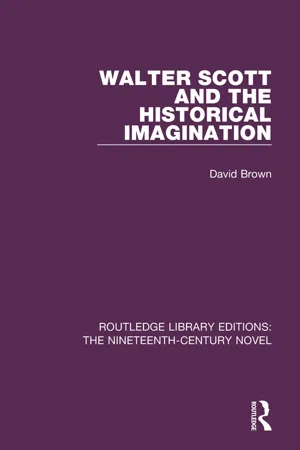
- 248 pages
- English
- ePUB (mobile friendly)
- Available on iOS & Android
eBook - ePub
Walter Scott and the Historical Imagination
About this book
Information
1 Waverley
DOI: 10.4324/9781315625942-1
The full title of Scott’s first novel, Waverley, or ‘Tis Sixty Years Since, warns us that we are about to read a double history: the story not just of one man, but of an historical epoch. The novel is easily divisible into two plots on different scales. On the personal scale, it covers the events of Edward Waverley’s life, and the development of his character from early youth to manhood. On the public scale, Waverley depicts the failure of the Forty-Five Jacobite rebellion to reinstate in Britain an older political order – the Stuart absolutist monarchy, overthrown with James II in 1688. In this chapter I will suggest that the novel’s seemingly disparate plot elements in fact share a common movement, and that by inter-relating them Scott is able to make certain assertions about the fundamental processes of human history.
The history of Edward Waverley is a story of character formed by experience. An early critic makes this point about him_1
we can only say that his wanderings are not gratuitous, nor is he wavering and indecisive only because the author chooses to make him so. Every feature in character is formed by education, and it is to this first source that we are constantly referred for a just and sufficient cause of all the wandering passions as they arise in his mind.
The first six chapters of Waverley deal with the unusual conditions of Edward’s education. Edward is the unwitting casualty of the Waverleys’ disruption as a family after his father abandons their High Tory principles in order to pursue wealth and preferment in the Whig parliament of George II. Brought up in the splendid isolation of his uncle’s home at Waverley-Honour, Edward is completely protected from the realities of the outside world. His uncle, Sir Everard, is a picture of aristocratic impotence in more senses than one: just as he shuns the idea of matrimony after an early disappointment, finding that ‘the labour of courtship did not quite suit the dignified indolence of his habits’,2 so he also resigns his seat in parliament after the accession of George I, effectively withdrawing in disgust from political life. In both cases Sir Everard has opted out of battles in the real world, preferring to preserve his chivalric ideals and political faith in the isolation of a leisured existence. It is in this honourable, but ethereal, atmosphere that Waverley’s ‘education’ takes place. Aunt Rachel’s nostalgia for the family’s Royalist heroes mingles naturally with Sir Everard’s strict notions of honour, and with Waverley’s own Quixotic absorption in romances, to exert their influences on the character of the hero.
Waverley’s enlistment in the army, which ultimately ends his state of innocence, is actually intended to preserve it. When he is forced to leave the vicinity of Waverley-Honour as a result of his infatuation with the socially inferior Cecilia Stubbs, his father specifically rejects the idea of a Grand Tour, viewing the Continent as a place ‘where all manner of snares were spread by the Pretender and his sons’ and which is thus unsuitable for the son of a Whig partisan.3 Ironically, the ‘safe’ option turns out to be the dangerous one, a result that is due at least as much to Waverley’s character as to the circumstances in which he finds himself. His adventures in Scotland, on leave from his hated military duties, allow him progressively to indulge his romantic fantasies at the expense of reality.
With an attraction for the primitive and the picturesque which would have been all too easily appreciated by Scott’s readership, Waverley’s head is carried away successively by the physical grandeur of the country, the Gothic ‘monastic solitude’ of Tully-Veolan, the wild heroism of the Highland clansmen, and finally by the seeming epitome of romantic Scotland, Flora MacIvor. Waverley’s meeting with Flora at a Highland waterfall results in a disastrous infatuation: the encounter takes place, however, in an obviously ironic context:4
It was up the course of this last stream that Waverley, like a knight of romance, was conducted by the fair Highland damsel, his silent guide.… Around the castle, all was cold, bare, and desolate, yet tame even in desolation; but this narrow glen, at so short a distance, seemed to open into the land of romance. The rocks assumed a thousand peculiar and varied forms. In one place a crag of huge size presented its gigantic bulk, as if to forbid the passenger’s further progress; … In another spot, the projecting rocks from the opposite sides of the chasm had approached so near to each other, that two pine trees laid across, and covered with turf, formed a rustic bridge at the height of at least one hundred and fifty feet. …While gazing at this pass of peril, which crossed, like a single black line, the small portion of blue sky not intercepted by the projecting rocks on either side, it was with a sensation of horror that Waverley beheld Flora and her attendant appear, like inhabitants of another region, propped, as it were, in mid air, upon this trembling structure.
If Waverley is like a ‘knight of romance’ at all here, it is only in his imagination. It is through his eyes, of course, that Scott depicts the whole scene. The Highland scenery is transformed into a Spenserian Faerie world, a ‘land of romance’; the Gaelic maidservant (so allusively named Una!) is transmuted into a ‘fair Highland damsel’; rocks turn into giants threatening to block the way, while Flora finally appears as a fairy spirit. Narrative objectivity is maintained here wholly through the ironic presentation: Scott wishes us to share Waverley’s romanticised view of the world only to the extent that we may understand and sympathise with his predicament. The episode is certainly a ‘pass of peril’ for him, reinforcing his illusory idea of his own actions in a way that robs his brain of any vestige of cool consideration.
Waverley’s passion for Flora and his associated obsession with knight errantry are both unmercifully exploited by Fergus MacIvor in his attempts to recruit him to the Jacobite cause. An exactly parallel ‘seduction’ to that practised on Waverley by Flora in the foregoing passage is the scene in which the Pretender overwhelms him with a chivalric appeal for his fealty:5
‘But,’ continued Charles Edward, after another short pause, ‘if Mr. Waverley should, like his ancestor, Sir Nigel, determine to embrace a cause which has little to recommend it but its justice, and follow a prince who throws himself upon the affections of his people, to recover the throne of his ancestors or perish in the attempt, I can only say. …’
This appeal to his ancestor Sir Nigel, the esteemed hero of Aunt Rachel’s most poignant tale, is the one most likely to strike Waverley to the heart. Scott comments drily that the Prince’s ‘words and his kindness penetrated the heart of our hero, and easily outweighed all prudential motives.’6 Flattered by the condescension shown to him, unused to Charles’s courtly manner, mindful of his uncle’s loyalty to the Stuart cause and most of all, of his own position, an outcast from his regiment and interdicted by the established government, Waverley devotes himself to following the Prince in a flood of emotional loyalty. It takes the remainder of the novel for Waverley to disengage himself from this double commitment – to Flora and the Prince – commitments that are parallel examples of Waverley’s impulsive, romantic character.
Waverley’s fate, however, cannot be considered in isolation from the broader historical situation of 1745, against which Scott places his hero. This is the other ‘half’ of the novel, which has not often been examined in any depth, even though attempts to see the narrative of Edward Waverley as the sole unifying design of the novel are bound to fail. Thus Stewart Gordon, who has taken the ‘individual fate’ plot-line as far as it can go, is finally forced to admit that the most striking episodes which conclude the novel, the trial and execution of Fergus and Evan Dhu, are strictly ‘inappropriate according to this reading of the work’.7
The fact is, of course, that against the ironic narrative of Waverley’s ‘progressive enchantment and disenchantment’, Scott sets a strikingly realistic picture of Scottish society and the political events of 1745. Often this picture contrasts strongly with the view of things we are given through Waverley’s eyes. The scene in which Waverley passes through the village of Tully-Veolan, on the way to the Baron of Bradwardine’s house, is a good example. Scott begins with a finely objective description of the depressed hamlet:8
As Waverley moved on, here and there an old man, bent as much by toil as years, his eyes bleared with age and smoke, tottered to the door of his hut, to gaze on the dress of the stranger, and the form and motion of the horses, and then assembled with his neighbours, in a little group at the smithy, to discuss the probabilities of whence the stranger came, and where he might be going.
This naturalistic depiction of peasant life would not be out of place in Maupassant. Yet the scene is gradually transformed as we come to see it through Waverley’s eyes:
Three or four village girls, returning from the well or brook with pitchers and pails upon their heads, formed more pleasing objects; and, with their thin short-gowns and single petticoats, bare arms, legs and feet, uncovered heads, and braided hair, somewhat resembled Italian forms of landscape. Nor could a lover of the picturesque have challenged either the elegance of their costume, or the symmetry of their shape; although, to say the truth, a mere Englishman, in search of the comfortable, a word peculiar to his native tongue, might have wished the clothes less scanty: the feet and legs somewhat protected from the weather, the head and complexion shrouded from the sun, or perhaps might even have thought the whole person and dress considerably improved by a plentiful application of spring water, with a quantum sufficit of soap.
The ambiguity of this description is obvious. On the one hand is the romantic English response to the ‘picturesque’ – obviously Waverley’s response; on the other, the rational, Augustan observation of the poverty and dirt of the village. When Scott continues, he temporarily abandons Waverley in order to describe the villagers with an unusual power of observation and analysis:
The whole scene was depressing – for it argued, at the first glance, at least a stagnation of industry, and perhaps of intellect. … Yet the physiognomy of the people, when more closely examined, was far from exhibiting the indifference of stupidity: their features were rough, but remarkably intelligent; grave, but the very reverse of stupid; … The children, also, whose skins were burnt black, and whose hair was bleached white, by the influence of the sun, had a look and manner of life and interest. It seemed, upon the whole, as if poverty, and indolence, its too frequent companion, were combining to depress the natural genius and acquired information of a hardy, intelligent, and reflecting peasantry.
In this passage, Scott is suggesting that the state of the peasantry in Tully-Veolan is far from ‘natural’: that it is, in fact, a social result of the village’s economic depression. Waverley, of course, sees none of this. As the village recedes, so his irrepressible dreams return. Typically, as he enters upon the decayed grandeur of the baron’s feudal estate, his usual associations envelop him again, and erase the unpleasant impressions of the village. For Waverley, the grounds of the baron’s mansions are a retreat from the drabness of the village, with which he imagines they have nothing to do:9
The solitude and repose of the whole scene seemed almost romantic; and Waverley … walked slowly down the avenue, enjoying the grateful and cooling shade, and so much pleased with the placid ideas of rest and seclusion excited by this confined and quiet scene, that he forgot the misery and dirt of the hamlet he had left behind him.
The ironic sting in the tail of the sentence, however, ensures that the reader does not also forget the village.
Instead, we become progressively aware of the gulf between the appearance of things to Waverley and the reality of the situation. In the aftermath of the creagh, for example, having joined Evan Dhu to track down Donald Bane Lane, Waverley is left for a while by himself on the banks of a loch. Sitting in darkness, he immediately begins to exercise his fancy, imagining himself another Marco Polo on a perilous journey to the den of a romantic bandit, ‘a second Robin Hood, perhaps’ Scott comments:10
What a variety of incidents for the exercise of a romantic imagination, and all enhanced by the solemn feeling of uncertainty, if not of danger! The only circumstances which assorted ill with the rest, was the cause of his journey – the Baron’s milk-cows. This degrading incident he kept in the background.
Robin Mayhead has pointed out that Scott satirically punctures Waverley’s illusions here, but he does not quite do full justice to the irony of the passage.11 For, just as Waverley fails to see that the ramshackle state of the baron’s home is intrinsically connected with the depressed state of the village of Tully-Veolan through a decaying social system, so he here fails to perceive that, far from being just a romantic ‘incident’, the creagh is an integral part of the economic system which supports the Highland clans. It is highly significant that the first contact we see between the Baron of Bradwardine and Clan Ivor is antagonistic, for the only way Fergus can provide for the huge number of clansmen in his ‘tail’, while keeping up the open hospitality displayed at the feast Waverley attends, is if the clan survives at the expense of the feudal estates like Tully-Veolan, either by raiding them or by blackmailing their owners. Milk-cows, in other words, instead of being ‘incidental’, are the main means of subsistence, and the prime cause not only of Waverley’s journey but of much of the Highland way of life.
The baron’s hostility towards Fergus over ‘blackmail’ at the time of Waverley’s arrival at Tully-Veolan, coupled with the Baron’s references to his family’s former open warfare with Clan Ivor (one result of which is a lasting enmity between him and one old clansman), further suggest to the reader that the creagh is in fact only the tail-end of an ancient dispute between the clans and the feudal estates that has continued, on and off, for centuries. The long-standing antipathy of the clansmen to the baron’s own retainers, and vice versa, is never entirely eradicated, even when both groups attempt to bury their differences in order to take concerted action in the Prince’s cause. Their mutual hostility surfaces very quickly during the march into England, as a result of Waverley’s quarrel with Fergus over Flora. Only Charles’s exemplary diplomacy on this occasion averts a potentially disastrous clash between the two main factions of his supporters, and the incident serves as an excellent reminder of the essential fragility of the Jacobite alliance.
It is on account of this history of conflict between clan and feudal estate, and not just because Clan Ivor is known to be behind the creagh, that Scott has Evan Dhu appear at Tully-Veolan as ‘An Unexpected Ally’ in the tide of Chapter XVI. His meeting with Bradwardine serves to explain to the reader (though not to Waverley, of course) that these previously opposed social orders are prepared to combine to face a common enemy. In their opening parley, the Baron and Evan Dhu appeal to the common feature of both their cultures: the aristocratic hierarchy based on birth, which they both respect absolutely, and which is threatened for both of them by the power of the emergent middle classes in the Hanoverian parliamentary system. Thus, to Evan’s richly metaphorical offer of conciliation, the Baron replies, with suitable dignity12
that he knew the chief of the clan Ivor to be a well-wisher to the King, and he was sorry there should have been a cloud between him and any gentleman of such sound principles, ‘for when folks are banding together, feeble is he who hath no brother.’
This alliance between ‘gentlemen’ finds its natural political expression in their support of the supreme representative of the old hierarc...
Table of contents
- Cover Page
- Half Title Page
- Title Page
- Copyright Page
- Title Page01
- Copyright Page01
- Table of Contents
- Acknowledgments
- Author’s note
- Chronology of the Waverley Novels
- Introduction
- 1 Waverley
- 2 Guy Mannering
- 3 The Antiquary
- 4 Old Mortality
- 5 Rob Roy
- 6 The Heart of Midlothian
- 7 The Bride of Lammermoor
- 8 Redgauntlet
- 9 Historical authenticity in the Waverley Novels
- 10 Scott’s outlook on history
- Notes
- Bibliography
- Index
Trusted by 375,005 students
Access to over 1.5 million titles for a fair monthly price.
Study more efficiently using our study tools.
Frequently asked questions
Yes, you can cancel anytime from the Subscription tab in your account settings on the Perlego website. Your subscription will stay active until the end of your current billing period. Learn how to cancel your subscription
No, books cannot be downloaded as external files, such as PDFs, for use outside of Perlego. However, you can download books within the Perlego app for offline reading on mobile or tablet. Learn how to download books offline
Perlego offers two plans: Essential and Complete
- Essential is ideal for learners and professionals who enjoy exploring a wide range of subjects. Access the Essential Library with 800,000+ trusted titles and best-sellers across business, personal growth, and the humanities. Includes unlimited reading time and Standard Read Aloud voice.
- Complete: Perfect for advanced learners and researchers needing full, unrestricted access. Unlock 1.5M+ books across hundreds of subjects, including academic and specialized titles. The Complete Plan also includes advanced features like Premium Read Aloud and Research Assistant.
We are an online textbook subscription service, where you can get access to an entire online library for less than the price of a single book per month. With over 1.5 million books across 990+ topics, we’ve got you covered! Learn about our mission
Look out for the read-aloud symbol on your next book to see if you can listen to it. The read-aloud tool reads text aloud for you, highlighting the text as it is being read. You can pause it, speed it up and slow it down. Learn more about Read Aloud
Yes! You can use the Perlego app on both iOS and Android devices to read anytime, anywhere — even offline. Perfect for commutes or when you’re on the go.
Please note we cannot support devices running on iOS 13 and Android 7 or earlier. Learn more about using the app
Please note we cannot support devices running on iOS 13 and Android 7 or earlier. Learn more about using the app
Yes, you can access Walter Scott and the Historical Imagination by David Brown in PDF and/or ePUB format, as well as other popular books in Literature & English Literary Criticism. We have over 1.5 million books available in our catalogue for you to explore.