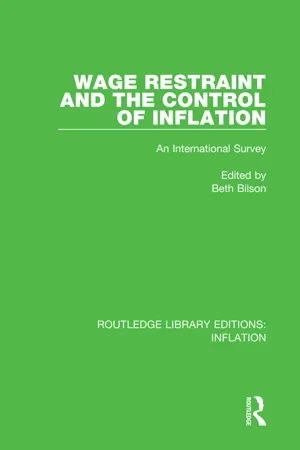
Since 1945 preventing runaway wage inflation has been regarded as a key policy in managing an economy in a successful way. The exact nature of pay control has varied from country to country and from time to time. This book, originally published in 1987, examines pay control policies in major Western economies. It surveys developments from 1945 and explores the aims of pay policies and discusses the problems of implementation, comparing the different kinds of policies. By comparing the performance of these different approaches the book assesses the merits and pitfalls of the different approaches.
- 196 pages
- English
- ePUB (mobile friendly)
- Available on iOS & Android
eBook - ePub
Chapter One
United States: Control in the Free Market
Introduction
Despite an ideological aversion in the United States to the direct setting of wages and prices by government, such programmes, in various forms and degrees of intensity, have appeared periodically from the time of the American Revolution. However, the implementation of guidelines or controls has always been viewed as a short-term expedient for containing particular bouts of inflation. Moreover, American policy makers have typically avoided use of the expression ‘incomes policy,’ symbolizing, among other things, the view that government ought to avoid a permanent role in the setting of wages and prices. Despite this position, general wage-price guidelines, controls, or freezes have been in effect during roughly one-third of the past 50 years. Formal wage-price restraint programmes over the period include:
- 1942–1946: World War II; wage-price controls (Roosevelt-Truman administrations);
- 1951–1953: Korean War; wage-price controls (Truman administration);
- 1962–1966: Voluntary wage-price guidelines (Kennedy-Johnson administration);
- 1971–1973: Wage-price controls (Nixon administration);
- 1978–1980: Voluntary wage-price guidelines (Carter administration).
Although this chapter focuses on formal and economy-wide wage policies, the reader should keep in mind that the federal government in the United States intervenes into the wage and price setting process in a variety of other ways. Prices in certain industries - public utilities, for example - are regulated by either state or federal agencies. Absent formal controls or guidelines, the President or another high-ranking administration official may intercede when major wage settlements or pricing decisions are seen to be inflationary. Of course, wage and price policies are not always directed at limiting inflation; minimum wage and ‘fair trade’ laws, first enacted during the Depression, specify wage and price floors, though most fair trade laws have now been repealed.
This chapter will treat the subject of wage and price restraint programs in the United States in three parts. First, the theoretical arguments regarding the usefulness - or dangers - of incomes policies, as formulated in relation to the American economy, will be considered. The second section of the chapter will trace the evolution of American policy from the Second World War through the Reagan administration, focusing on particular programmes and the forces shaping those programmes. Finally, incomes policies in the United States will be evaluated in terms of past successes and failures and future usefulness.
Theory and Policy
An understanding of American wage and price policies and assessments of these policies requires that we review alternative theoretical perspectives on inflation and its relationship to aggregate economic activity. Differing perspectives are considered here, with emphasis on policy implications.
The Phillips Curve and Institutional Analysis: Early Formulations
The work of A.W. Phillips1 and Richard Lipsey2 on the apparent relationship between the unemployment rate and nominal wage inflation in Great Britain had a profound effect on American thought. The ‘discovery’ of the Phillips relation coincided with the emergence and establishment of Keynesian thought as the dominant force in the formation of American economic policy. Although the Phillips relationship was not completely consistent with Keynesian theory in its original form (which did not posit an inflation/unemployment trade-off), it nonetheless implied that nominal wages and prices had relatively permanent effects on the real level of economic activity. Thus, ‘full employment’ was not seen to be achieved at some determinant, equilibrium level of employment (or unemployment); rather, policy-makers could choose from a menu of unemployment and inflation rates, their choices depending upon the perceived social costs and benefit of increasing prices versus those of diminished output and employment.
The Phillips curve gained prominence in America as the result of a paper by Paul Samuelson and Robert Solow.3 There followed a series of empirical studies designed to assess the validity of the Phillips relationship in the American economy, the most notable being Perry’s estimation of a multi-equation model depicting the interrelationships among wages, prices, and profits.4 American scholars did not buy fully the argument of a longterm, relatively fixed relationship between wage inflation and unemployment, as presented by Phillips. This reluctance was attributable, in large part, to the debate over ‘cost-push’ and ‘demand-pull’ theories of inflation. The assumption of a stable Phillips curve was clearly consistent with the demand-pull school of thought, which saw inflationary pressures as dependent on change in the demand for labour. Cost-push pressures, on the other hand, were thought to arise from institutional forces, especially collective bargaining, union power, and administered prices under imperfect competition. Changes in market structure, intermarket mobility, and union power and wage policies could be expected to impact on wage inflation exogenously, leading to structural changes in the Phillips curve. Given the evident power of American unions in the early 1960s, it is not surprising that the institutionalist argument carried considerable weight.
In addition to market structure and union power considerations, institutionalists maintained that wage-setting practices in both union and non-union settings could create or accentuate inflationary pressures. A central theme of institutionalist analysis was the notion of wage spillover and pattern bargaining. Dunlop, for example, proposed the existence of ‘wage contours’ - groupings of firms and industries in which general wage levels moved in relative unison.5 Wages were seen to be deter mined initially in the ‘key’ firms, bargaining units, or industries within a particular cluster, with market conditions affecting the relevant wage- setting unit laying an important role in the process. The unemployment rate was hypothesised to have a transitory effect on the relative distribution of union-management bargaining power, with union power enhanced in periods of low unemployment. In addition, the cost of living, an employer’s ability to pay, and exogenous sources of union power suchas the degree of unionisation or employer product market concentration, were also often hypothesised as determinants of wage settlements in key units. Wages determined in key units were hypothesised to set the pattern for non-key units within the cluster. Thus, market conditions in non-key units were seen to play a secondary role, at best, in the determination of wages in those units. In other words, the Phillips relationship, albeit modified, held for key, but not non-key, units. Key units were thought to be in those heavily unionised sectors of the economy in which employers enjoyed considerable product market power, while non-key units were seen to be in weakly organised or nonunion sectors in which firms had little product market power. Empirical support for the spillover hypothesis came in the form of intensive case studies of wage-setting practices6 and, later, multivariate statistical analyses.7
An idealised version of the institutionalist wage-setting process, within a particular wage contour, would be of the following form:


where: w(k), w(nk) = wage change in key, non-key units; Un(k) = unemployment rate affecting key units; p = change in consumer prices; R(k) = profit rate of firms in key units; X(k), X(nk) = composite of other exogenous influences affecting key, non-key units.
In its strong form, the spillover argument posits that b(l) approaches unity; consequently, wage changes in key groups are nearly completely transmitted to non-key groups. Wage increases translate into price changes via some cost adjustment process:

where: w = economy-wide, average change in wages; q = economy-wide average change in productivity.
The wage and price adjustment processes depicted in these equations suggest that both cost-push and demand-pull forces may either concurrently or separately lead to inflation. Demand-pull forces, however, were viewed as working through transitory shifts in the distribution of bargaining power between union and management rather than through market adjustments to excess labour supply or demand. Despite the demand-side influences included in the model, cost-push pressures were clearly seen as dominant in the institutionalist analysis. Cost-push pressures could initiate an inflationary epoch, as could demand-pull pressures; moreover, cost-push pressures could accentuate or perpetuate inflationary epochs long after excess demand had diminished. In particular, the institutionalist perspective suggested the possibility of a wage-price spiral that could not be explained in terms of neoclassical market processes. The intensity and destabilising potential of the wage-price spiral would depend upon the elasticity of wage inflation with respect to price inflation, as with, for example, a(2) in Equation (1.1). Thus, stabilisation policies that depended exclusively on the manipulation of conventional monetary and fiscal variables were apt to be ineffective unless supplemented by policies addressing the institutional sources of inflation. Consider the following scenarios that might arise in this system:
- Transitory inflation (demand-induced): Excess demand in key units increases key wage inflation, leading to increased nonkey wage inflation. Price inflation increases by the average change in wage inflation, minus any offsetting productivity gains. Higher wages in key sectors lead to increased unemployment in key sectors, resulting in lower key wage inflation. Assuming a(2)<1.0, then inflation and unemployment return, ceteris paribus, reasonably quickly to predisturbance levels.
- Transitory inflation (cost-induced): An increase in union power resulting from shifts in exogenous variables affecting key unit settlements (i.e., X(k)) leads to increased key wage inflation, which is transmitted to non-key units. Price inflation increases by the average change in wage inflation, minus any offsetting productivity gains. Higher wages in key sectors lead to increased unemployment in key sectors, resulting in lower key wage inflation. Assuming a(2)<1.0, then inflation returns, ceteris paribus, reasonably quickly to pre-disturbance levels. However, unemployment is likely to remain higher than pre-disturbance levels.
- Protracted/accelerating inflation: Depending upon the values of the coefficient of the model, either demand- or cost-induced inflation may lead to a protracted bout of possibly accelerating inflation -the wage-price spiral in its classic and most pernicious form. In order for this to occur, price elasticity in the key sector equation, i.e., a(2), must approach a value of 1.0 and/or the unemployment/wage change relationship must be relatively weak in key unit settlements. In addition, price elasticity terms may appear in the non-key unit functions, as would be the case, for example, with cost-of-living indexed contracts. Thus, wage increases would be reinforced through price increases. Efforts by employers in relatively noncompetitive, key unit industries, endeavouring to raise profit margins by increasing prices, could also initiate an inflationary epoch -‘profit-push’ inflation. The unemployment presumably created by escalating wages and prices would exert a counter-balancing influence; however, since non-key sectors are not influenced (or only weakly influenced) by market conditions, and since key unit contracts may only be renegotiated every two or three years, demand-side pressures could only slow inflation in the very long term. Consequently, once initiated, an inflationary epoch would tend to be protracted. The greater the value of the price elasticity terms, the greater would be the equilibrium level of inflation. If the elasticity terms equalled or exceeded 1.0 in both the wage and price adjustment functions, then the system could become unstable, with continually accelerating rates of inflation.
The processes depicted in Scenarios 1 and 2, especially the former, are fairly consistent with the conventional Phillips curve framework. Assuming reasonably rapid key unit adjustments to changes in the unemployment rate, then fiscal and monetary tools would be appropriate to stabilise inflation and unemployment. Yet, by the early 1960s, multiyear labour contracts were quite common in the United States,8 thus dampening the unemployment/wage change relationship. There had also been considerable experimentation with price inflation indexation in labour contracts, especially during the Korean War. Even in the absence of explicit cost-of-living adjustment (COLA) clauses, many thought past experiences with inflation or ‘catch-up’ pressures resulting from under-anticipated i...
Table of contents
- Cover
- Half Title
- Title
- Copyright
- Original Title
- Original Copyright
- CONTENTS
- Acknowledgments
- Introduction
- 1. United States: Control in the Free Market
- 2. Great Britain: A Seedbed of Policy Options
- 3. Australia: New Wine in Old Bottles
- 4. Canada: The Perfect Environment?
- 5. The Federal Republic of Germany: Life Without An Incomes Policy
- Abbreviations
- Contributors
- Index
Trusted by 375,005 students
Access to over 1.5 million titles for a fair monthly price.
Study more efficiently using our study tools.
Frequently asked questions
Yes, you can cancel anytime from the Subscription tab in your account settings on the Perlego website. Your subscription will stay active until the end of your current billing period. Learn how to cancel your subscription
No, books cannot be downloaded as external files, such as PDFs, for use outside of Perlego. However, you can download books within the Perlego app for offline reading on mobile or tablet. Learn how to download books offline
Perlego offers two plans: Essential and Complete
- Essential is ideal for learners and professionals who enjoy exploring a wide range of subjects. Access the Essential Library with 800,000+ trusted titles and best-sellers across business, personal growth, and the humanities. Includes unlimited reading time and Standard Read Aloud voice.
- Complete: Perfect for advanced learners and researchers needing full, unrestricted access. Unlock 1.5M+ books across hundreds of subjects, including academic and specialized titles. The Complete Plan also includes advanced features like Premium Read Aloud and Research Assistant.
We are an online textbook subscription service, where you can get access to an entire online library for less than the price of a single book per month. With over 1.5 million books across 990+ topics, we’ve got you covered! Learn about our mission
Look out for the read-aloud symbol on your next book to see if you can listen to it. The read-aloud tool reads text aloud for you, highlighting the text as it is being read. You can pause it, speed it up and slow it down. Learn more about Read Aloud
Yes! You can use the Perlego app on both iOS and Android devices to read anytime, anywhere — even offline. Perfect for commutes or when you’re on the go.
Please note we cannot support devices running on iOS 13 and Android 7 or earlier. Learn more about using the app
Please note we cannot support devices running on iOS 13 and Android 7 or earlier. Learn more about using the app
Yes, you can access Wage Restraint and the Control of Inflation by Beth Bilson in PDF and/or ePUB format, as well as other popular books in Economics & Business General. We have over 1.5 million books available in our catalogue for you to explore.