This collection of essays, first published in 1987, provides a sociological treatment of many musical forms – rock, jazz, classical – with special emphasis on the perspective of the practising musician. Among the topics covered are the legal structures governing musical production and the question of copyright; recording and production technology; the social character of musical style; and the impact of lyrical content, considered socially and historically.
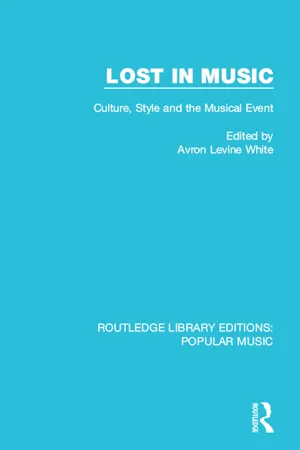
- 268 pages
- English
- ePUB (mobile friendly)
- Available on iOS & Android
eBook - ePub
About this book
Information
WORDS AND MUSIC
Why do songs have words?
In 1918 the chairman of Chappell & Co., Britain’s largest music publishing company, wrote a letter to the novelist Radclyffe Hall. She had complained of receiving no royalties after a song for which she had been the lyricist, ‘The Blind Ploughman’, ‘swept the country.’ William Davey replied,
Dear Miss Radclyffe Hall,
I yield to no one in my admiration of your words for ‘The Blind Ploughman’. They are a big contributing factor to the success of the song. Unfortunately, we cannot afford to pay royalties to lyric writers. One or two other publishers may but if we were to once introduce the principle, there would be no end to it. Many lyrics are merely a repetition of the same words in a different order and almost always with the same ideas. Hardly any of them, frankly, are worth a royalty, although once in a way they may be. It is difficult to differentiate, however. What I do feel is that you are quite entitled to have an extra payment for these particular words, and I have much pleasure in enclosing you, from Messrs Chappell, a cheque for twenty guineas.1
Davey had commercial reasons for treating lyrics as formula writing, but his argument is common among academics too. In the 1950s and 1960s, for example, the tiny field of the sociology of popular music was dominated by analyses of song words. Sociologists concentrated on songs (rather than singers or audiences) because they could be studied with a familiar cultural research method, content analysis, and as they mostly lacked the ability to distinguish songs in musical terms, sociologists, by default, had to measure trends by reference to lyrics. It was through their words that hit records were taken to make their social mark.
The focus on lyrics didn’t just reflect musical ignorance. Until the mid-1960s British and American popular music was dominated by Tin Pan Alley. Tin Pan Alley’s values derived from its origins as a publishing centre and the ‘bland, universal, well-made song’ (Whitcomb’s description) remained central to its organisation even after rock ‘n’ roll.2 In concentrating on pop’s lyrical themes in this period, sociologists were reflecting the way in which the songs were themselves packaged and sold. Most of these songs did, musically, sound the same; most lyrics did seem to follow measurable rules; most songwriters did operate as ‘small businessmen engaged in composing, writing or publishing music’ rather than as ‘creative composers’.3 Etzkorn, one of the few sociologists to research lyricists not lyrics, discovered in 1963 that
The composing activity of songwriters would seem to be constrained by their orientation towards the expectations of significant ‘judges’ in executive positions in the music business whose critical standards are based on traditional musical cliches. In their endeavour to emulate the norms of successful reference groups, songwriters (even with a variety of backgrounds) will produce compositions virtually homogeneous in form and structure, thereby strengthening the formal rigidity of popular music.4
And this simply confirmed what analysts anyway took for granted – that it was possible to read back from lyrics to the social forces that produced them.
Content analysis
The first systematic analyst of pop song words, J.G. Peatman, was influenced by Adorno’s strictures on ‘radio music’ and so stressed pop’s lyrical standardisation: all successful pop songs were about romantic love; all could be classified under one of three headings – the ‘happy in love’ song, the ‘frustrated in love’ song, and the ‘novelty song with sex interest’.5
For Peatman, this narrow range reflected the culture industry’s success in keeping people buying the same thing, but most subsequent content analysts, writing with a Cold War concern to defend American commercial culture, have taken pop market choices seriously. Thus in 1954 Mooney accepted Peatman’s starting point – pop as happy/sad love songs – but argued that they ‘reflected, as love songs always do, the deepest currents of thought; for as values change, so change the ideas and practice of love’.6
Mooney’s argument was that pop song lyrics reflect the emotional needs of their time. The history of the American ‘mood’ can thus be traced through the shifting themes of popular songs: from 1895 to 1925 song lyrics were ‘abandoned and unorthodox’ and reflected the patriotism, proletarianism and hedonism of the rising American empire; from the 1920s to the 1940s songs were ‘negativistic and rather morbid’ and reflected the disillusion, the quiet despair of the Depression; in the 1950s pop reflected a new zeal, as ‘the mass mood’ invested the post-war consumer boom with Cold War fervour; and, in a later article, Mooney continued his readings into the 1960s, putting stress on songs’ importance as a record of new sexual mores.7
Mooney related changing images of sex to changes in the class origins of pop – in the 1930s songs expressed the middle-class attitudes of their middle-class authors, by the 1960s they expressed the freer mores of their working-class performers – but his general point is that songs can be read as examples of popular ideology. Tin Pan Alley, he suggested in 1954,
has responded to and revealed the emotional shifts of its public: sheet music and phonograph records are among the few artefacts which afford insight into the inarticulate Americans of the twentieth century.8
‘The people’ in a mass society may no longer make their own music, but choosing which songs and records to buy is still a means of cultural expression. Hits meet a popular need and so pop lyrics have changed over the century, despite corporate control of their production.
Mooney’s survey of American cultural history is unsystematic, and he seems to choose his songs to support his thesis rather than vice versa, but his ‘reflection theory’ of pop lyrics has been shared by most of the more scientific content analysts who followed up his work. American sociologists have used song words, in particular, to chart the rise of a youth culture, with new attitudes to love and sex and fun, and to document the differences between 1950s and 1960s romance. In both eras the love drama passed through four acts – search, happiness, break-up, isolation – but 1960s pop stressed hedonism, movement, freedom (not dependence), choice (not fate). Courtship no longer led to marriage (relationships had a natural history, died a natural death); happiness meant sexual happiness; love was no longer an ‘elusive quarry’ but a passing, to-be-seized opportunity.9
The theoretical assumption here is that the words of pop songs express general social attitudes, but such song readings depend, in practice, on prior accounts of youth and sexuality. Content analysts are not innocent readers, and there are obvious flaws in their method. For a start, they treat lyrics too simply. The words of all songs are given equal value; their meaning is taken to be transparent; no account is given of their actual performance or their musical setting. This enables us to code lyrics statistically, but it involves a questionable theoretical judgment: content codes refer to what the words describe – situations and states of mind – but not to how they describe, to their significance as language.
Even more problematically, these analysts tend to equate a song’s popularity with public agreement with its message – the argument is that songs reflect the beliefs and values of their listeners. This is to ignore songs’ ideological work, the way they play back to people situations or ideas they recognise but which are inflected now with particular moral lessons. The most sophisticated content analysts have, therefore, used lyrics as evidence not of popular culture as such, but of popular cultural confusion.10 Songs, from this perspective, articulate the problems caused by social change, so that Di Maggio, Peterson and Esco, for example, analyse post-war Southern history by looking at the tensions revealed by country music lyrics since the 1950s: country love songs continued to take the ideal of romantic love for granted, but increasingly explored the argument that ‘a battle between the sexes is inevitable’; country drink songs described alcohol as both a solution to and a cause of emotional problems; country work songs celebrated ‘the strong self-reliant worker’, while despairing at the effects of the factory routine – ‘by day I make the cars/and by night I make the bars.’ Country lyrics, in short, reflected contradictions, as old communal values were used to measure the quality of the lives of the urban working class. The authors conclude that songs ‘reflect’ their listeners’ concerns at the level of fantasy – such reflection means, in fact, giving people new shapes, new symbolic forms for their hopes and anxieties.11
Mike Haralambos has treated the history of black American song in this period similarly. Blues lyrics, he suggests, were essentially passive, bitter, sorrowful and fatalistic; soul words concern activity, pride, optimism and change:
Whereas blues concentrates almost entirely on experience, usually the experience of failure, soul songs state the ideal. Moral principles are laid down, rules of conduct advocated, right and wrong involved. Blues merely states this is the way it is, and this is how I am suffering. By comparison, soul music implies life is not to be accepted as it comes, hardship is not to be borne, but life is to be made worth living.12
Haralambos argues that soul represented a lyrical as well as a musical merging of blues and gospel, as the free-flowing language and imagery of the church were applied to the socially realistic narratives of the blues. The resulting songs both drew on and gave shape to the new mood and vocabulary of 1960s ghetto streets. In the words of disc jockey Job Cobb:
‘We’re Rolling On’ and songs like that gave a lot of people, and even a lot of civil rights organisations, hope and great strength, and made people believe in it, because actually within the record itself, it was telling you like what to expect, and what happened thus far, so like hold your head up high and keep on going, your day will come.13
This interpretation of lyrics as a form of ideological expression – asserting ideas in order to shape them, describing situations in order to reach them – complicates the concept of ‘reflection’ (these songs reflect ideals as well as realities) but retains the assumption that popular songs are significant because they have a ‘real closeness’ with their consumers.14 The implication, in short, is that such readings only make sense of ‘folk’ forms; only in country music, blues, soul, the right strands of rock, can we take lyrics to be the authentic expression of popular experiences and need. In the mainstream of mass music something else is going on.
Mass culture
Most mass cultural critiques of pop songs words derive from 1930s Leavisite arguments. Pop songs are criticised for their banality, their feebleness with words, imagery and emotion; the problem is not just that lyrics picture an unreal world, but also that pop ideals are trite: ‘One and all these refer to the world where June rhymes with moon, where there is no such thing as struggle for existence, where love does not have to be striven for through understanding.’15
In The Uses of Literacy, Richard Hoggart argues, similarly, that real needs to dream are being satisfied by debilitatingly thin fantasies, concepts of well-being defined in terms of conformity. Mass culture has turned visions of the extraordinary into clichés of the ordinary, and pop song lyrics have been subordinated to the performing conventions of ‘forced intimacy’ – ‘the singer is reaching millions but pretends he is reaching only “you”.’ Love, the dominant topic of pop songs is represented now as a solution to all problems, ‘a warm burrow, a remover of worry; borne on an ingratiating treacle of melody, a vague sense of uplift-going-on’.16
For Leavisites, the evil of mass culture is that it corrupts real feelings. Wilfrid Mellers (Scrutiny’s original commentator on popular music) notes that pop songs ‘do insidiously correspond with feelings we have all had in adolescence’.
Though these songs do not deny that love will hurt, they seek a vicarious pleasure from the hurt itself. So they create an illusion that we can live on the surface of our emotions. Sincere, and true, and touching though they may be, their truth is partial.17
The critical task is, therefore, to discover ‘the amount of “felt life” in specific words and music’, and Mellers and Hoggart agree that pop songs should not be dismissed without a proper hearing. Other Leavisites have been less generous. Edward Lee, for example, denounces the romantic banality of pop lyrics in terms of its social effects (citing the divorce rate in his disdain for silly love songs) and this argument about the corrupting consequences of the hit parade has been take...
Table of contents
- Cover Page
- Half Title page
- Title Page
- Copyright Page
- Original Title Page
- Original Copyright Page
- Contents
- Acknowledgements
- Introduction
- The Social Character of Music Performance as ritual: sketch for an enquiry into the true nature of a symphony concert
- The social interpretation of modern jazz1
- Towards a sociology of musical styles
- Words and Music Why do songs have words?
- The price you pay: an introduction to the life and songs of Laurence Price
- Convention and Constraint in Working Life Popular music and the law – who owns the song?
- A Professional Jazz Group
- Convention and constraint among British semi-professional jazz musicians
- Recording Music Technology in the art of recording
- Coda: making musical sense of the world
Trusted by 375,005 students
Access to over 1.5 million titles for a fair monthly price.
Study more efficiently using our study tools.
Frequently asked questions
Yes, you can cancel anytime from the Subscription tab in your account settings on the Perlego website. Your subscription will stay active until the end of your current billing period. Learn how to cancel your subscription
No, books cannot be downloaded as external files, such as PDFs, for use outside of Perlego. However, you can download books within the Perlego app for offline reading on mobile or tablet. Learn how to download books offline
We are an online textbook subscription service, where you can get access to an entire online library for less than the price of a single book per month. With over 1.5 million books across 990+ topics, we’ve got you covered! Learn about our mission
Look out for the read-aloud symbol on your next book to see if you can listen to it. The read-aloud tool reads text aloud for you, highlighting the text as it is being read. You can pause it, speed it up and slow it down. Learn more about Read Aloud
Yes! You can use the Perlego app on both iOS and Android devices to read anytime, anywhere — even offline. Perfect for commutes or when you’re on the go.
Please note we cannot support devices running on iOS 13 and Android 7 or earlier. Learn more about using the app
Please note we cannot support devices running on iOS 13 and Android 7 or earlier. Learn more about using the app
Yes, you can access Lost in Music by Avron Levine White in PDF and/or ePUB format, as well as other popular books in Mezzi di comunicazione e arti performative & Musica. We have over 1.5 million books available in our catalogue for you to explore.