When rock 'n' roll began its ascendancy in the 1950s the older generation saw it as dangerous, renegade, threatening the moral stability of a nation. Young people saw it as freedom, and most importantly, as their music. The teenage revolution was here, This book, first published in 1982, traces the roots of this cultural transformation, its emergence in rock 'n' roll and other media, and shows just how violent the confrontation was by looking at contemporary newspaper reports.
- 156 pages
- English
- ePUB (mobile friendly)
- Available on iOS & Android
eBook - ePub
Rock 'n' Roll
About this book
Information
1 Into the 1950s
I love those dear hearts and gentle people
That live in my home town –
I know those dear hearts and gentle people
Will never ever let me down …
Dinah Shore, 1950
Before rock’n’roll, that song seemed to sum up what pop music was all about. It was certainly tuneful, but mostly it was sentimental music for adults to feel at home with. Of course there were children’s songs, like ‘Rudolph The Red-Nosed Reindeer’ and ‘How Much Is That Doggie In The Window?’ But if you were a teenager leaving school, earning money for the first time, and wanting to go out and spend it on enjoying yourself, there was no music which you could really call your own. The Top Twenty was full of slow ballads, string orchestras and sing-along novelty songs like ‘Where Will The Dimple Be?’ and ‘I See The Moon’ (‘the moon sees me’ was the next line!).
Excitement? There wasn’t a lot. In America, ‘singing idols’ Guy Mitchell and Frankie Laine looked old enough to be your father. In Britain, Dickie Valentine and Lita Roza were part of large dance bands. It was all much too predictable and polished. There was hardly a guitar in sight.
Johnnie Ray, too, was an early 1950s ‘heart-throb’, but he was a little different. In 1952 his record ‘Cry’ topped the charts. Like most of his songs, it was full of emotion – you could hear his voice break with misery. On stage he would fall to his knees and cry real tears. His nicknames were ‘Prince of Wails’ and ‘Cry Guy’! He was tall and thin, and an accident when he was ten had left him half-deaf. But he didn’t try to hide his deaf-aid as other stars might have done. It turned out to be an asset for it added to the emotion and his fans loved him all the more.
He was a star right up to the arrival of Elvis Presley. At first the two were compared, for though their music was quite different they did have one thing in common: they both felt what they were singing about. Earlier pop singers, like Perry Como, had been almost polite, crooning songs without showing too much involvement. Ray was the first million-selling pop singer to get inside his songs and put his own emotions on show. The singer was becoming more important than the song, and the image greater than the singer.
It’s in every jumpin’ honky-tonk wherever you look, It’s heard on every corner, and it’s even in the Book
In the early 1950s the first music with some guts to catch on in Britain was piano-boogie: music with a bouncing beat and a non-stop rolling rhythm from the left hand playing the bass notes at a fast eight beats to the bar. Tennessee Ernie Ford had a hit with ‘Shotgun Boogie’, but it was Merrill E. Moore from California whose records sounded best. It wasn’t yet rock’n’roll, but it was certainly ‘news for dancin’ feet’. It was strong, lively and loud, and a long way from the slushy orchestras and cumbersome big bands down at the local dance-hall.
In Britain, Moore’s music appealed most to one particular group of young people: ‘In ’53/’54 his Bell Bottom Boogie/House Of Blue Lights was a hot favourite … with the first generation of London Teddy Boys.’
The Teddy boys
Kids came back from evacuation to find their home surroundings in ruins, especially in London which was hit worst of all. In many cases their fathers were still away from home clearing up the last remnants of the war, and consequently the kids were able to do almost as they liked. Street gangs sprang up as a substitute for home life.
Tennessee Teddy
By the 1950s, the clothes the gang-members wore were an up-dated copy of men’s fashion in the reign of King Edward VII before the First World War. Originally the new extravagant style was meant for rich young men-about-town. But, although it was expensive, the working-class youths of south London began to wear it and adapt it – tightly fitting trousers (‘drainpipes’), fancy waistcoats, and a long, drape jacket which had sleeves that reached over the fingertips, and velvet on the turned-back cuffs and round the back of the collar. At first the newspapers called them ‘Edwardian youths’, but soon came the more popular label, ‘Teddy boys’.
Added to the basic suit later came thick crepe-soled shoes – ‘brothel-creepers’. Round the neck, over a sometimes black shirt, they wore a thin, straight tie – or a bootlace like one of the black-jacketed, cheroot-smoking baddies you saw in cowboy films dealing cards off the bottom of the pack and shooting anyone who dared call him a cheat.
And that was the image that went with the style. Sullen, mean and dangerous-looking, it owed a lot to westerns and gangster films. It was topped off with the most outlandish hair-styles: long and heavily greased, combed back round each side ending in a DA (meaning ‘duck’s arse’ because that’s what it looked like from the back!). At the front it was piled up and back, or fell forward over the forehead in an ‘elephant’s trunk’. There was even a vogue for Mohican cuts: shaved on both sides leaving a wide strip of crewcut hair from front to back.
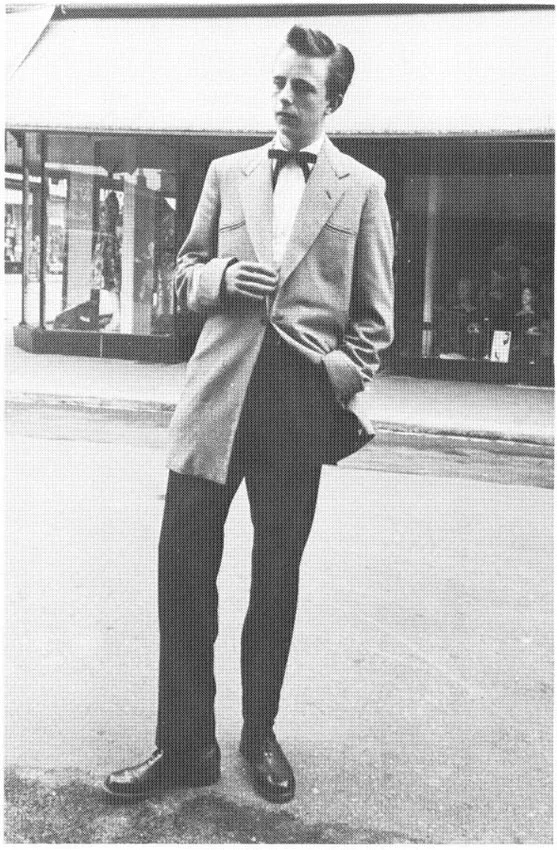
Teddy boy styles in Newcastle, 1955
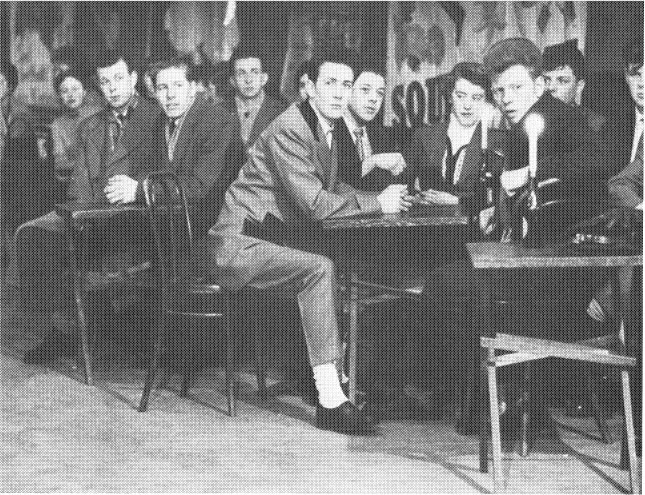
Tottenham, May 1954
The Teddy boys looked at you in a sharp and tense, ‘don’t-come-too-close’ way: ‘Don’t step on my blue suede shoes,’ sang Elvis and Carl Perkins in 1956. They seemed always on edge, but somehow relaxed and unmoved too. Like their American contemporaries who tried to look like film star Marlon Brando, you saw them leaving the dance-hall, the pub or the cinema and ‘stopping for a second on the sidewalk as if they were looking for someone who was looking for a fight.’ Glancing into a shop window they might put up a hand to check that their hair was still correctly swept back before swaggering off down the street – ‘each one of us, in his own mind, a cinema close-up’.
At about the same time came news of a rise in the number of crimes committed by young people. Teddy boys were seen as criminals terrorising their home areas. The newspapers were full of unflattering stories about them, and often reporters’ imaginations ran away with them:
The Daily Sketch exposes the Sunday night gang menace
THE TEDDY BOYS MAKE THIS A TOWN OF FEAR
By Owen Summers
Kingston-upon-Thames, Surrey
Sunday night
This is a town of fear – fear of the new Teddy Boy gangs. These ‘Edwardian’ youths, the throw-outs of districts glad to see their backs, swarm in at the weekends. Publicans employ squads of ‘strong arm’ men, cinema managers seek police protection, local girls keep out of the town on Sunday nights. Police cars are circling round the main streets tonight as I piece together the fantastic story of Teddy Town.
Daily Sketch, 3 May 1954
All over the country, cinemas, dance-halls, youth clubs and pubs refused entry to anyone wearing Teddy boy clothes. They were the first large youth group to prompt such a hysterical reaction from society about the way they looked.
The ‘affluent society’
So what kind of society was it that produced the Teddy boys and into which rock’n’roll exploded in the mid-1950s?
For young people it wasn’t just a question of dressing up. It was a reaction against the suffocating nature of society at the time. The Second World War had ended in 1945, but Britain took a long time to emerge from its shadow. Wartime rationing (which meant that you were allowed to buy only a small, fixed amount of, say, butter or meat per week), had lasted for years. It didn’t finally disappear until 1954, the year Bill Haley recorded ‘Rock Around The Clock’.
There were still wars of a kind being fought. If you were in the forces there was a good chance of finding yourself on active service in Malaya, Korea, Kenya, Suez or just keeping the peace (though it wasn’t very peaceful) in Cyprus. Very likely you’d have been in uniform anyway, even if you weren’t sent to any of those places. National Service continued right through the 1950s: like it or not, you had to spend two years in the Army, Navy or Air Force. If you’d left school at fifteen you faced three years at whatever job you could get, knowing that it would come to an end on your eighteenth birthday when your call-up papers arrived in the morning post.
If you were earning money, you quickly realised that hardly anything was produced with you in mind. There were plenty of clothes, for example, for adults and children, but none for you if you were in between the two. The whole idea of being a teenager was a new one. You were still expected to dress like your parents, enjoy the same entertainments, like the same music, even hold the same opinions. It was like getting old before you knew what a good time you could have being young.
But times were changing. Wages were going up. By the mid-1950s the average teenager’s weekly spending money was over twice the total weekly wage he would have received in 1938. Having more money to spend, more things to buy and more leisure-time to enjoy them (the five-day working week was new in the 1950s) was leading to a feeling of affluence. Life was definitely better than it had been in the drab 1940s. More families could afford washing machines, record players and the new tape recorders. Few people owned television sets in 1950, but ten years later it was the centre-piece of most British homes.
As TV-watching grew, cinema audiences dropped. But going to the pictures was still important. There you could forget there was nowhere much else to go and that many towns and cities were still full of bomb-sites. You could escape into the fantasy-world of films. It was the cinema which first became preoccupied with youth – just at the time when young people were starting to be more aware of themselves and becoming more assertive.
But at first it was hard for young people to identify with the film stars – they didn’t look young enough. They were too fixed in their attitudes: they couldn’t possibly portray the tenseness and uncertain sensitivity of growing up.
Marlon Brando and James Dean changed all that. In The Wild One Brando was leader of a motor-bike gang accused of terrorising an American town. By the end he was the local hero, having defeated an even nastier gang of bikers led by Lee Marvin. Wearing leather jacket and jeans, Brando appeared to be playing himself: he was the gang-leader, not an actor playing the part. James Dean went one better. In Rebel Without A Cause he was a misunderstood teenager, outlawed by his fellow-students at high school, and forced to compete in a game of ‘chicken’ in which his opponent drives off the edge of a cliff and is killed. Dean finally wins respect and understanding through the protection he gives to a weaker classmate.
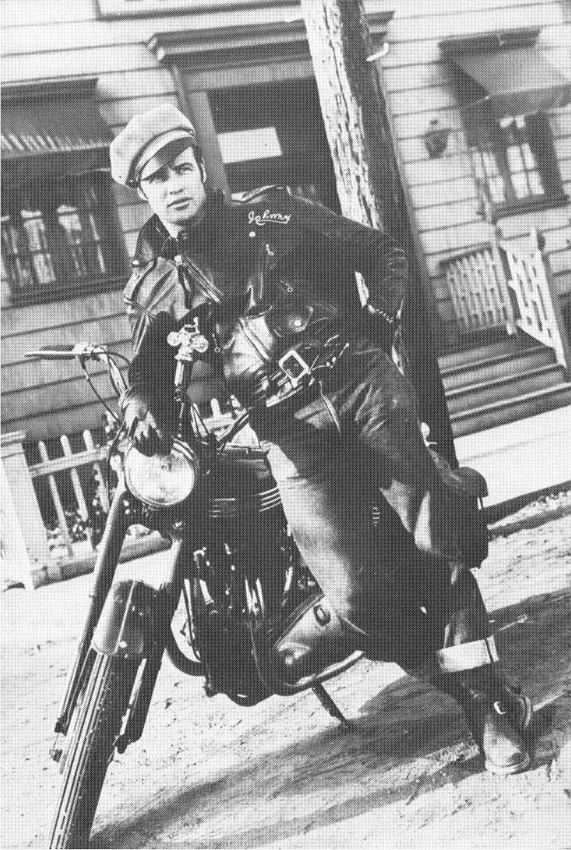
‘What’re you rebelling against, Johnny?’ ‘Whadda ya got?’ – Marlon Brando in The Wild One
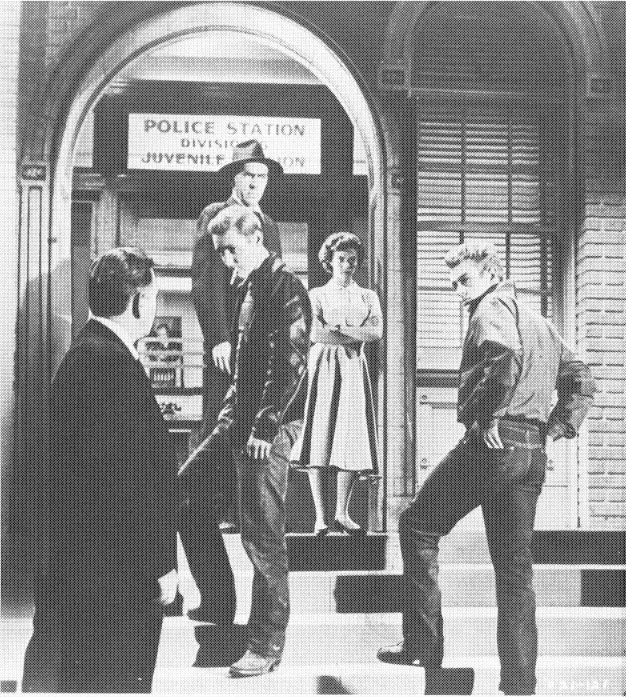
James Dean, collar up, hands in pockets in Rebel Without a Cause
Brando and Dean were more than just film star heroes. They seemed to have the same fears and enjoy the same things as you. Like the rock’n’roll singers to come, they were young and within reach. When you watched them in the cinema you were them, but, more important, they were you. Dean died soon afterwards, late on a September afternoon in 1955, when his Porsche sports car collided with another vehicle. He was only twenty-four. He wasn’t a rock’n’roll star, but he had the same sort of magnetic appeal. More than Johnnie Ray, but not as much as Elvis to come, James Dean was of the post-war world.
The trouble was, you wanted some action and excitement of your own. Brando and Dean were O.K., but what was missing was the music to go with them: something which helped you give vent to that frustration at having nowhere to go but dance-halls and pubs geared to adults, at feeling independent but not being allowed the freedom – and at having the money but nothing to spend it on. Elvis later sang: ‘If you’re looking for trouble/You’ve come to the right place.’ The ‘right place’ was rock’n’roll.
2 Rock around the clock
A 24 year old labourer who kicked in a pane of glass in a greenhouse said in a statement: ‘I am sorry I broke it. It’s just rock, rock and roll.’ He signed the...
Table of contents
- Cover
- Half Title
- Title Page
- Copyright Page
- Original Copyright Page
- Dedication
- Table of Contents
- 1 Into the 1950s
- 2 Rock around the clock
- 3 Country music
- 4 Rhythm’n’blues
- 5 Good rockin’ tonight
- 6 Hail, hail rock’n’roll: America in the mid-1950s
- 7 Rock island line: Britain in the mid-1950s
- 8 Back in the USA: America in the late 1950s
- 9 This rock’n’roll has got to go …
- 10 Shakin’ all over: Britain in the late 1950s
- 11 It doesn’t matter any more
- 12 Rock’n’roll is here to stay
- Glossary of musical terms
- Sources and acknowledgments
- Some suggestions for further reading and listening
- Index
Trusted by 375,005 students
Access to over 1.5 million titles for a fair monthly price.
Study more efficiently using our study tools.
Frequently asked questions
Yes, you can cancel anytime from the Subscription tab in your account settings on the Perlego website. Your subscription will stay active until the end of your current billing period. Learn how to cancel your subscription
No, books cannot be downloaded as external files, such as PDFs, for use outside of Perlego. However, you can download books within the Perlego app for offline reading on mobile or tablet. Learn how to download books offline
Perlego offers two plans: Essential and Complete
- Essential is ideal for learners and professionals who enjoy exploring a wide range of subjects. Access the Essential Library with 800,000+ trusted titles and best-sellers across business, personal growth, and the humanities. Includes unlimited reading time and Standard Read Aloud voice.
- Complete: Perfect for advanced learners and researchers needing full, unrestricted access. Unlock 1.5M+ books across hundreds of subjects, including academic and specialized titles. The Complete Plan also includes advanced features like Premium Read Aloud and Research Assistant.
We are an online textbook subscription service, where you can get access to an entire online library for less than the price of a single book per month. With over 1.5 million books across 990+ topics, we’ve got you covered! Learn about our mission
Look out for the read-aloud symbol on your next book to see if you can listen to it. The read-aloud tool reads text aloud for you, highlighting the text as it is being read. You can pause it, speed it up and slow it down. Learn more about Read Aloud
Yes! You can use the Perlego app on both iOS and Android devices to read anytime, anywhere — even offline. Perfect for commutes or when you’re on the go.
Please note we cannot support devices running on iOS 13 and Android 7 or earlier. Learn more about using the app
Please note we cannot support devices running on iOS 13 and Android 7 or earlier. Learn more about using the app
Yes, you can access Rock 'n' Roll by Dave Rogers in PDF and/or ePUB format, as well as other popular books in Social Sciences & Media Studies. We have over 1.5 million books available in our catalogue for you to explore.