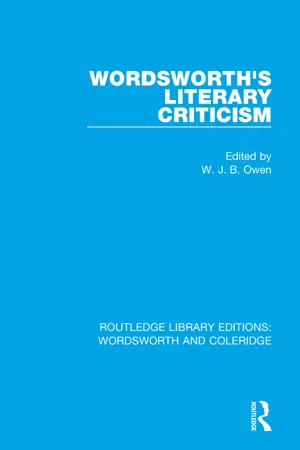
First published in 1974. Wordsworth, with Coleridge, is the major literary critic of the Romantic period. This volume assembles all of Wordsworth's formal critical writings and a selection of critical comments from his correspondence. These documents are invaluable for Romantic poetry at large, and his theories — particularly on poetic diction, ordinary language and the nature of the creative process — inspired lively critical debate. This book discusses the nature and origin of Wordsworth's criticism in general, and the literary tradition from which they sprang. The texts are succinctly annotated and there is a select bibliography. This book will be of interest to students of literature.
- 236 pages
- English
- ePUB (mobile friendly)
- Available on iOS & Android
eBook - ePub
Wordsworth's Literary Criticism
About this book
Information
1 Preface to The Borderers 1796–7
DOI: 10.4324/9781315623504-1
Written, according to Wordsworth’s own account, when he was composing the play which it expounds, i.e. in late 1796 or early 1797 (PW, i. 343–4). The Preface survives in two manuscripts preserved in the Wordsworth Library, Grasmere, both probably to be dated about 1800. An inaccurately transcribed text, based on one of the manuscripts, was printed by Ernest de Selincourt in Nineteenth Century and After, c (1926), 723–41, and reprinted in his Oxford Lectures on Poetry, Oxford, 1934, 157–79. A slightly improved text appears in PW, i. 345–9. The text given here is from Prose, i. 76–80. For details see the apparatus there printed, the textual introduction (Prose, i. 75), and the commentary (Prose, i. 81–6).
Let us suppose a young man of great intellectual powers, yet without any solid principles of genuine benevolence.1 His master passions are pride and the love of distinction—He has deeply imbibed a spirit of enterprize in a tumultuous age. He goes into the world and is betrayed into a great crime.—That influence on which all his happiness is built immediately deserts him. His talents are robbed of their weight—his exertions are unavailing, and he quits the world in disgust, with strong misanthropic feelings. In his retirement, he is impelled to examine the reasonableness of established opinions, & the force of his mind exhausts itself in constant efforts to separate the elements of virtue and vice. It is his pleasure & his consolation to hunt out whatever is bad in actions usually esteemed virtuous, & to detect the good in actions which the universal sense of mankind teaches us to reprobate. While the general exertion of his intellect seduces him from the remembrance of his own crime, the particular conclusions to which he is led have a tendency to reconcile him to himself. His feelings are interested in making him a moral sceptic, &, as his scepticism increases, he is raised in his own esteem. After this process has been continued some time, his natural energy & restlessness impel him again into the world. In this state, pressed by the recollection of his guilt, he seeks relief from two sources, action & meditation. Of actions, those are most attractive which best exhibit his own powers, partly from the original pride of his character, and still more because the loss of authority and influence which followed upon his crime was the first circumstance which impressed him with the magnitude of that crime, & brought along with it those tormenting sensations by which he is assailed. The recovery of his original importance & the exhibition of his own powers are therefore in his mind almost identified with the extinction of those painful feelings which attend the recollection of his guilt. Perhaps there is no cause which has greater weight in preventing the return of bad men to virtue than that good actions being for the most part in their nature silent & regularly progressive, they do not present those sudden results which can afford a sufficient stimulus to a troubled mind. In processes of vice the effects are more frequently immediate, palpable, and extensive. Power is much more easily manifested in destroying than in creating. A child, Rousseau has observed, will tear in pieces fifty toys before he will think of making one.2 From these causes, assisted by disgust and misanthropic feeling, the character we are now contemplating will have a strong tendency to vice. His energies are most impressively manifested in works of devastation. He is the Orlando of Ariosto, the Cardenio of Cervantes, who lays waste the groves that should shelter him.3 He has rebelled against the world & the laws of the world, & he regards them as tyrannical masters; convinced that he is right in some of his conclusions, he nourishes a contempt for mankind the more dangerous because he has been led to it by reflexion. Being in the habit of considering the world as a body which is in some sort at war with him, he has a feeling borrowed from that habit which gives an additional zest to his hatred of those members of society whom he hates & to his contempt of those whom he despises. Add to this, that a mind fond of nourishing sentiments of contempt will be prone to the admission of those feelings which are considered under any uncommon bond of relation (as must be the case with a man who has quarrelled with the world), the feelings will mutually strengthen each other. In this morbid state of mind he cannot exist without occupation, he requires constant provocatives, all his pleasures are prospective, he is perpetually chasing a phantom, he commits new crimes to drive away the memory of the past. But the lenitives of his pain are twofold: meditation as well as action. Accordingly, his reason is almost exclusively employed in justifying his past enormities & in enabling him to commit new ones. He is perpetually imposing upon himself, he has a sophism for every crime. The mild effusions of thought, the milk of human reason, are unknown to him. His imagination is powerful, being strengthened by the habit of picturing possible forms of society where his crimes would be no longer crimes, and he would enjoy that estimation to which, from his intellectual attainments, he deems himself entitled. The nicer shades of manners he disregards, but whenever, upon looking back upon past ages, or in surveying the practices of different countries in the age in which he lives, he finds such contrarieties as seem to affect the principles of morals, he exults over his discovery, and applies it to his heart as the dearest of his consolations. Such a mind cannot but discover some truths, but he is unable to profit by them, and in his hands they become instruments of evil.
He presses truth and falshood into the same service. He looks at society through an optical glass of a peculiar tint; something of the forms of objects he takes from objects, but their colour is exclusively what he gives them; it is one, and it is his own. Having indulged a habit, dangerous in a man who has fallen, of dallying with moral calculations, he becomes an empiric, and a daring & unfeeling empiric. He disguises from himself his own malignity by assuming the character of a speculator in morals, and one who has the hardihood to realize his speculations.
It will easily be perceived that to such a mind those enterprizes which are the most extraordinary will in time appear the most inviting. His appetite from being exhausted becomes unnatural. Accordingly, he will struggle so []4 to characterize & to exalt actions, little and contemptible in themselves, by a forced greatness of manner, and will chequer & degrade enterprizes great in their atrocity by grotesque littleness of manner, and fantastic obliquities. He is like a worn out voluptuary—he finds his temptation in strangeness, he is unable to suppress a low hankering after the double entendre in vice; yet his thirst after the extraordinary buoys him up, and, supported by a habit of constant reflexion, he frequently breaks out into what has the appearance of greatness; and, in sudden emergencies, when he is called upon by surprize & thrown out of the path of his regular habits, or when dormant associations are awakened tracing the revolutions through which his character has passed, in painting his former self he really is great.
Benefits conferred on a man like this will be the seeds of a worse feeling than ingratitude. They will give birth to positive hatred. Let him be deprived of power, though by means which he despises, & he will never forgive. It will scarcely be denied that such a mind, by very slight external motives, may be led to the commission of the greatest enormities. Let its malignant feelings be fixed on a particular object, & the rest follows of itself.
Having shaken off the obligations of religion & morality in a dark and tempestuous age, it is probable that such a character will be infected with a tinge of superstition. The period in which he lives teems with great events, which he feels he cannot controul. That influence which his pride makes him unwilling to allow to his fellow-men he has no reluctance to ascribe to invisible agents: his pride impels him to superstition and shapes out the nature of his belief: his creed is his own: it is made & not adopted.
A character like this, or some of its features at least, I have attempted to delineate in the following drama. I have introduced him deliberately prosecuting the destruction of an amiable young man by the most atrocious means, & with a pertinacity, as it should seem, not to be accounted for but on the supposition of the most malignant injuries. No such injuries, however, appear to have been sustained. What are, then, his motives? First, it must be observed that to make the non-existence of a common motive itself a motive to action is a practice which we are never so prone to attribute exclusively to madmen as when we forget ourselves. Our love of the marvellous is not confined to external things. There is no object on which it settles with more delight than on our own minds. This habit is in the very essence of the habit which we are delineating.5
But there are particles of that poisonous mineral of which Iago speaks gnawing his inwards,6 his malevolent feelings are excited, & he hates the more deeply because he feels he ought not to hate.
We all know that the dissatisfaction accompanying the first impulses towards a criminal action, where the mind is familiar with guilt, acts as a stimulus to proceed in that action. Uneasiness must be driven away by fresh uneasiness, obstinacy, waywardness, & wilful blindness are alternatives resorted to, till there is an universal insurrection of every depraved feeling of the heart.
Besides, in a course of criminal conduct every fresh step that we make appears a justification of the one that preceded it, it seems to bring back again the moment of liberty and choice; it banishes the idea of repentance, and seems to set remorse at defiance. Every time we plan a fresh accumulation of our guilt, we have restored to us something like that original state of mind, that perturbed pleasure, which first made the crime attractive.
If, after these general remarks, I am asked what are Rivers’s7 motives to the atrocity detailed in the drama? I answer: they are founded chiefly in the very constitution of his character; in his pride which borders even upon madness, in his restless disposition, in his disturbed mind, in his superstition, in irresistible propensities to embody in practical experiments his worst & most extravagant speculations, in his thoughts & in his feelings, in his general habits & his particular impulses, in his perverted reason justifying his perverted instincts. The general moral intended to be impressed by the delineation of such a character is obvious: it is to shew the dangerous use which may be made of reason when a man has committed a great crime.
There is a kind of superstition which makes us shudder when we find moral sentiments to which we attach a sacred importance applied to vicious purposes. In real life this is done every day, and we do not feel the disgust. The difference is here. In works of imagination we see the motive and the end. In real life we rarely see either the one or the other; and, when the distress comes, it prevents us from attending to the cause. This superstition of which I have spoken is not without its use; yet it appears to be one great source of our vices; it is our constant engine in seducing each other. We are lulled asleep by its agency, and betrayed before we know that an attempt is made to betray us.
I have endeavoured to shake this prejudice, persuaded that in so doing I was well employed. It has been a further object with me to shew that, from abuses interwoven with the texture of society, a bad man may be furnished with sophisms in support of his crimes which it would be difficult to answer.
One word more upon the subject of motives. In private life what is more common than, when we hear of law-suits prosecuted to the utter ruin of the parties, and the most deadly feuds in families, to find them attributed to trifling and apparently inadequate sources? But when our malignant passions operate, the original causes which called them forth are soon supplanted, yet when we account for the effect we forget the immediate impulse, and the whole is attributed to the force from which the first motion was received. The vessel keeps sailing on, and we attribute her progress in the voyage to the ropes which first towed her out of harbour.
To this must be added that we are too apt to apply our own moral sentiments as a measure of the conduct of others. We insensibly suppose that a criminal action assumes the same form to the agent as to ourselves. We forget that his feelings and his reason are equally busy in contracting its dimensions and pleading for its necessity.
A TragedyOn human actions reason though you can,It may be reason, but it is not man;His principle of action once explore,That instant ‘tis his principle no more.Pope.8
Notes
- For parallels between the Preface and The Borderers, and discussion of difficult passages, see Prose, i. 81–6.
- See Emilius … Translated from the French by Mr. Nugent, London, 1763, i. 57–8: ‘A child wants to throw whatever he sees into disorder and confusion; he breaks every thing he can lay his hands on; he seizes a bird just in the same manner as he would grasp a stone, and squeezes it to death, without knowing what he does… . And if he seems to have a greater bent to destroy, it is not through perverseness; but because the action that creates or forms, is slow; and that which destroys, being more rapid, is better suited to his vivacity.’
- Orlando Furioso, xxiii. 131–5; cf. Don Quixote, Book 111, chs 9–10.
- In both manuscripts a blank space appears after ‘so’, apparently for the insertion of a word on which the author had not decided or which the scribes had failed to read in their exemplar. The sentence as it stands is complete without ‘so’.
- The sense is doubtful, and probably the second ‘habit’ has been written for some now irrecoverable word such as ‘man’ or ‘character’.
- Othello, 11. i. 308–9: ‘the thought …/ Doth like a poisonous mineral gnaw my inwards.’
- Rivers is the name given to Oswald in the play as represented by de Selincourt’s manuscript B of the play, of which one manuscript version of the Preface forms a part: see PW, i. 343–4.
- Pope, ‘Epistle to Cobham’, 35–8.
Table of contents
- Cover Page
- Half Title Page
- Title Page
- Copyright Page
- Title Page
- Copyright Page
- General Editor's Preface
- Contents
- Preface
- Abbreviation
- Introduction
- 1 Preface to The Borderers 1796–7
- 2 Advertisement to Lyrical Ballads 1798
- 3 Preface and Appendix to Lyrical Ballads 1800, 1802
- 4 Note to ‘The Thorn' 1800
- 5 Letter to Charles James Fox 1801
- 6 Letter to John Wilson 1802
- 7 Letter to Lady Beaumont 1807
- 8 Letter to S. T. Coleridge 1809?
- 9 Essays upon Epitaphs 1810?
- 10 Preface to The Excursion 1814
- 11 Preface of 1815 1815
- 12 Essay, Supplementary to the Preface 1815
- 13 Letter to Catherine Clarkson 1815
- Bibliography
- Index
Trusted by 375,005 students
Access to over 1.5 million titles for a fair monthly price.
Study more efficiently using our study tools.
Frequently asked questions
Yes, you can cancel anytime from the Subscription tab in your account settings on the Perlego website. Your subscription will stay active until the end of your current billing period. Learn how to cancel your subscription
No, books cannot be downloaded as external files, such as PDFs, for use outside of Perlego. However, you can download books within the Perlego app for offline reading on mobile or tablet. Learn how to download books offline
Perlego offers two plans: Essential and Complete
- Essential is ideal for learners and professionals who enjoy exploring a wide range of subjects. Access the Essential Library with 800,000+ trusted titles and best-sellers across business, personal growth, and the humanities. Includes unlimited reading time and Standard Read Aloud voice.
- Complete: Perfect for advanced learners and researchers needing full, unrestricted access. Unlock 1.5M+ books across hundreds of subjects, including academic and specialized titles. The Complete Plan also includes advanced features like Premium Read Aloud and Research Assistant.
We are an online textbook subscription service, where you can get access to an entire online library for less than the price of a single book per month. With over 1.5 million books across 990+ topics, we’ve got you covered! Learn about our mission
Look out for the read-aloud symbol on your next book to see if you can listen to it. The read-aloud tool reads text aloud for you, highlighting the text as it is being read. You can pause it, speed it up and slow it down. Learn more about Read Aloud
Yes! You can use the Perlego app on both iOS and Android devices to read anytime, anywhere — even offline. Perfect for commutes or when you’re on the go.
Please note we cannot support devices running on iOS 13 and Android 7 or earlier. Learn more about using the app
Please note we cannot support devices running on iOS 13 and Android 7 or earlier. Learn more about using the app
Yes, you can access Wordsworth's Literary Criticism by W.J.B. Owen in PDF and/or ePUB format, as well as other popular books in Literature & English Literary Criticism. We have over 1.5 million books available in our catalogue for you to explore.