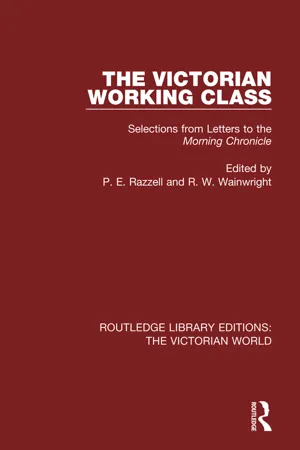
In 1849, the Morning Chronicle, a leading Victorian newspaper, embarked on a social investigation of working class life in England and Wales. Set in the immediate context of concern over Chartism and the cholera epidemic, its intention was to provide a full and detailed description of the moral, intellectual, material and physical condition of the industrial poor.
First published in 1973, this book reflects through the survey the highly complex nature of nineteenth-century social structure throughout England and South Wales, covering descriptions of contrasting political orientations, work and leisure patterns, sex and family, education and religion. In doing so, it provides a classic introduction to the social structures of the working class during the nineteenth century.
This book will be of interest to those studying Victorian history and sociology.
In the majority of mills labour begins at six o'clock a.m. throughout the year. In a certain number the engine during the dead winter months does not start until half an hour later. As a general thing, however, the Manchester operative is up and stirring before six. The streets in the neighbourhood of the mills are thronged with men, women and children flocking to their labour. They talk and laugh cheerily together. The girls generally keep in groups with their shawls twisted round their heads, and every few steps, in the immediate vicinity of the mill parties are formed around the peripatetic establishments of hot coffee and cocoa vendors. The factory bell rings from five minutes before six until the hour strikes. Then—to the moment—the engine starts, and the day's work begins. Those who are behind six, be it but a moment, are fined two pence; and in many mills, after the expiration of a very short time of grace, the doors are locked, and the laggard, besides the fine, loses his morning work.
Breakfast hour comes round at half after eight o'clock. The engine stops to the minute, and the streets are again crowded with those of the operatives who live close by the mills. A great many however take their breakfasts in the factory, which, as a general rule, supplies them with hot water. The practice of the people taking their meals in the mills, though I believe contrary to the letter of the law, is quite necessary, owing to the distance which many of the workpeople live from their place of labour, and to the short times—only half an hour—allowed for the meal. Its constituents are generally tea and coffee, with plenty of bread and butter and in many cases a slice or so of bacon. At five minutes to nine the factory bell sounds again, and at nine the engine starts again. The work goes on with the most perfect method and order. There is little of any talking, and little disposition to talk. Everybody sets steadily and tranquilly about his or her duties, in that calm methodical style which betokens perfect acquaintance with the work to be done, and perfect skill wherewith to do it. There is no hurrying or panting and toiling after the machinery. Everything appears—in ordinary phrase—to be “taken easy”; yet everything goes rapidly and continuously on….
… In Manchester everybody, master and man, dines at one o'clock. As the chimes sound, all the engines pause together, and from every workshop, from every industrial establishment—be it cotton, silk, iron, print works or dye works—the hungry crowd swarms out, and streets and lanes, five minutes before lonely and deserted, are echoing the trampling of hundreds of busy feet. The Manchester operative in prosperous times need never want, and seldom does without a dinner of what he calls “flesh meat”. This he sometimes partakes of at home, sometimes at a neighbouring cook-shop; occasionally he has it brought to him at the mill. A favourite dish with the operatives is what they call potato pie—a savoury pasty made of meat and potatoes, well seasoned with pepper and salt, and roofed in with a substantial paste. Many of the men, after despatching their dinner, which they do comfortably in half an hour, spend the other moiety of their leisure in smoking or lounging about, until the never-failing bell proclaims that time is up, and that the engine and its attendant mechanism are ready to resume their labours. The work then proceeds until half after five o'clock, at which hour all labour finally ceases; the periods of toil having been from six o'clock until half-past eight o'clock, from nine o'clock until one o'clock, and from two o'clock until half-past five o'clock, making an aggregate of ten hours. This arrangement, however, although very general, is by no means universal. Some of the mills do not open until seven o'clock, and half-past seven o'clock, while a few prefer commencing at eight o'clock, after their people have breakfasted, and making but one stoppage during the day. There seems, however, to be a general and I think a very well-founded opinion, that this division of ten hours is a bad one, inasmuch as it protracts the time of working until late in the evening, and casts the additional leisure, which it was the object of the Ten Hours Bill to secure to the workpeople, into the middle of the day, when they cannot well be expected to settle down to those domestic pursuits and means of self-improvement, which I am assured they are most eager to seize and avail themselves of, when they have a reasonable space to come and go upon between the closing of the mills and bedtime.
I stood to-day at the principal door of Messrs. Birley's establishment, watching the hands take their departure. It was curious to observe how each sex and age clung together. Boys kept with boys, men with men, and the girls went gossiping and laughing by, in exclusive parties of their own. I chanced to overhear a proposition confidentially made by one of these young ladies as she passed me to a comrade. There was not much in it, to be sure; but the proposal, at all events, showed that the fatigues of the day had by no means the effect of preventing a personal brushing-up for the evening. “I say, Jane,” said the damsel in question, “I tell you what—you come home and braid my hair, and then I'll braid yours.” The out-door dress of the men is comfortable and respectable. Velveteen jackets and shooting coats seem to be in great favour, with waistcoats and trowsers of dark fustian cloth. The people are uniformly well shod; and their general appearance is that of unostentatious comfort.
Letter III
The house of the Manchester operative, wherever it be—in the old district or in the new—in Ancoats or Cheetham or Hulme—is uniformly a two storey dwelling. Sometimes it is of fair dimensions, sometimes a line fourteen feet long would reach from the eaves to the ground. In the old localities there is, in all probability, a cellar beneath the house, sunk some four or five feet below the pavement, and occupied perhaps by a single old woman, or by a family, the heads of which are given to pretty regular alternation between their subterranean abode and the neighbouring wine vaults. In the modern and improved quartiers, the cellar retires modestly out of sight, and is put to a more legitimate use as a home for coals or lumber. Nothing struck me more, while visiting and comparing notes in the different operative districts of Manchester, than the regularity with which the better style of house and the better style of furniture went together; it being always kept in mind that, so far as wages are concerned, the inhabitants of one locality are almost, if not quite, on a par with those of another. But the superior class room seemed, by a sort of natural sequence, to attract the superior class furniture. A very fair proportion of what was deal in Ancoats was mahogany in Hulme. Yet the people in Hulme get no higher wages than the people of Ancoats. The secret is that they live in better built houses, and consequently take more pleasure and pride in their dwellings.
I visited several of the better class houses in Hulme, and shall sketch, in a few lines, the parlour of the first which I entered, and which may be taken as a fair specimen of the others. The room was about ten feet by eight, and hung with a paper of cheap quality and ordinary pattern. In at least two of the corners were cupboards of hard wood, painted mahogany fashion, and containing plates, teacups, saucers, etc. Upon the chimney-piece was ranged a set of old-fashioned glass and china ornaments. There was one framed print hanging upon the wall—a steel engraving of small size, reduced from the well known plate of the “Covenanter's Marriage”. Beside this symbol of art was a token of allegiance to science, in the shape of one of the old-fashioned tube barometers, not apparently in the most perfect state of order. There were two tables in the apartment—a round centre one of ordinary material, and a rather handsome mahogany Pembroke. Opposite the fireplace was one of those nondescript pieces of furniture which play a double part in domestic economy —“a bed by night, a wardrobe all the day”. The chairs were of the comfortable old-fashioned Windsor breed; and on the window-ledge were two or three flower-pots, feebly nourishing as many musty geraniums. The floor was carpet-less—a feature, by the way, anything but characteristic. In the passage, however, was laid a piece of faded and battered oil-cloth. The general aspect of the place, although by no means a miracle of neatness, was tolerably clean and comfortable.
… In the majority of the streets, inhabited by operatives the front room on the ground floor is used both as parlour and kitchen. Sometimes a second room, of small dimensions, opens back from it, and when such an apartment exists, it is generally seen littered with the coarser cooking and washing utensils. I have described the principal “public” room in a house of the first class in Hulme; let me sketch the generic features of the tenements in the older, worse built, and in all respects inferior quarter of Ancoats. Fancy, then a wide-lying labyrinth of small dingy streets, narrow, unsunned courts, terminating in gloomy cul-de-sacs, and adorned with a central sloppy gutter. Every score or so of yards you catch sight of one of the second and third class mills, with its cinder-paved courtyard and its steaming engine-house. Shabby looking chapels, here and there, rise with infinitesimal Gothic arches and ornaments, amid the grimy nakedness of the factories. Now a railroad, upon its understructure of arches, passes over the roofs; anon, you cross a canal, with wharfs and coal-yards, and clusters of unmoving barges. In most cases the doors of the houses stand hospitably open, and young children cluster over the thresholds and swarm out upon the pavement; you have thus an easy opportunity of noting the interiors as you pass along. They are, as you will perceive, a series of little rooms, about ten feet by eight, more or less, generally floored with brick or flagstones—materials which are, however, occasionally half concealed by strips of mats or faded carpeting. A substantial deal table stands in the centre of each apartment and a few chairs, stools and settles to match, are ranged around. Occasionally, a little table of mahogany is not wanting. Now and then you observe a curiously small sofa, hardly intended for a full-grown man or woman to stretch their limbs upon; and about as often one side of the fireplace is taken up with a cradle. Sometimes there is a large cupboard, the open door of which reveals a shining assortment of plates and dishes; sometimes the humble dinner service is ranged on shelves which stretch along the walls; while beneath them are suspended upon hooks a more or less elaborate series of skillets, stewpans and miscellaneous cooking and household matters. A conspicuous object is very frequently a glaringly painted and highly-glazed tea tray, upon which the firelight glints cheerily, and which, by its superior lustre and artistic boldness of design, commonly throws into the shade the couple or so of tiny prints, in narrow black frames, which are suspended above it. A favourite and no doubt useful article of furniture is a clock. No Manchester operative will be without one a moment longer than he can help. You see here and there, in the better class houses, one of the old-fashioned metallic-faced eight-day clocks; but by far the most common article is the little Dutch machine, with its busy pendulum swinging openly and candidly before all the world. Add to this catalogue of the more important items of ‘meublement’ an assortment of the usual odds and ends of household matters, deposited in corners of window-ledges or shelves—here a box, there a meal or flour barrel—now and then a small mirror gleaming from the wall— now and then a row of smoke-browned little china and stone-ware ornaments on the narrow chimney-piece—in general a muslin window-screen, or perhaps dingy cotton curtains—and not infrequently a pot or two of geraniums or fuchsias, rubbing their dry twigs and brown stunted leaves against the dim and small-paned lattice. Picture all these little household appliances, and others of a similar order, giving the small room a tolerably crowded appearance, and you will have a fair notion of the vast majority of the homes of the factory operatives, such as they appear in the older and less improved localities of Manchester. The cellars are, as might be expected, seldom furnished so well. They appear to possess none of the minor comforts, none of the little articles of ornament or fancy furniture which more or less you observe in the parlours. The floors seem damp and unwholesome, you catch a glimpse of a rickety-looking bed in a dark airless corner, and the fire upon the hearth is often cheerlessly small, smouldering amongst the unswept ashes.
Decidedly, the worst feature of the house tenements is the (in some districts) invariable opening of the street-door into the parlour. One step takes you from the pavement to the shrine of the Penates. The occupant cannot open his door, or stand upon his threshold, without revealing the privacy of his room to all by-passers. This awkward mode of construction is objectionable in other respects, as tending, for example, to be a fruitful source of rheumatic and catarrh-bestowing draughts. But, as I have stated, the new houses are almost invariably furnished with a decent lobby, a characteristic which of itself places them 50 per cent above those built after the old fashion.
Manchester Operatives
from Knights’ Cyclopeadia of the Industry of All Nations
Saturday is generally the great weekly epoch of cleansing and setting things to rights in the homes of the Manchester workpeople. The last day of the week may, indeed, be generally set down as a half holiday amongst all the industrial population exclusive of artisans and tradespeople. At the ordinary dinner hour, there is a vast stir amongst the denizens of counting-houses and warehouses, many of whom have country establishments to visit upon the Saturday, and one o'clock sees a simultaneous starting of scores of heavily-laden omnibuses bound for every suburb and village of and round Manchester. The mills knock off work at about two or half after two o'clock, and if you visit the class of streets which I have been attempting to describe an hour or so thereafter, you will marvel and rejoice at the universality of the purification which is going forward. Children are staggering under pails and buckets of water, brought from the pump or the cock which probably supplies a small street. Glance in at the open portals, and you will witness a grand simultaneous system of scouring. The women, of course, are the principal operators—they are cleaning their windows, hearthstoning their lintels, scrubbing their furniture with might and main. The pater familias, however does not always shirk his portion of the toil. Only last Saturday I came upon two or three lords of the creation usefully employed in blackleading their stoves.
Every evening after mill hours these streets, deserted as they are, except at meal times, during the day, present a scene of very considerable quiet enjoyment. The people all appear to be on the best terms with each other, and laugh and gossip from window to window, and door to door. The women, in particular, are fond of sitting in groups upon their thresholds sewing and knitting; the children sprawl about beside them, and there is the amount of sweethearting going forward which is naturally to be looked for under such circumstances. Certainly the setting of the picture is ugly and grim enough. A black, mean-looking street, with a black unadorned mill rising over the houses, and a black chimney pouring out volumes of black smoke upon all— these do not form very picturesque accessories to the scene, but still you are glad to see that, amid all the grime and dinginess of the place, there is no lack of homely comforts, good health and good spirits….
… Unhappily the bulk of Manchester arose during a period in which … master and man more commonly regarded each other as mutual enemies rather than as mutual dependants whose best interest it was to be mutual friends. A vast population suddenly sprang up round the mills. This population had to be housed, and they fell into the hands of unchecked speculators, who ran up mobs of filthy and inconvenient streets and courts, utterly unheeding, or perhaps profoundly ignorant of the sanitary and social guilt of their doings. In the cases of the country mills, I am told that the case is very different. There the cottages of the labourers are in many, if not in most, instances the property of the millowner, and the isolated and disciplined character of the population render it exceeding easy to exercise a wholesome social influence over them. I promise myself pleasure from a visit to one of these communities.
In Manchester, however, the constant flux and reflux of poor population, seeking successfully or unsuccessfully for work, and provided with wretched and demoralizing accommodation, renders the city hardly a fair test of the social condition created by the factory system….
… “I have worked, sir,” said an intelligent “cardroom hand” to me—“I have worked in that mill, sir, these nineteen years, and the master never spoke to me once. I think if he did I would be gratified like, and go on working with better heart.” “The masters”, said another man, from another mill, “are afraid that if they speak to us they will be losing their authority; and so they say the overlookers and the managers must see to everything; but we would often like to speak to the masters themselves. We could often tell them a many things.”…
… I said before, however, and I repeat now, that matters in this respect are decidedly upon the mending tack. The tone of the masters and the men in their business relationship is, I am assured on all hands, incredibly improved. Unions, trade combinations, and strikes have gone greatly out of fashion. The men shake their heads doubtfully if you bring up the subject, and refer—many of them did, at least, in my communications with them—a long list of defaulting secretaries and treasurers who had levanted with the funds of too many of the combinations. Besides, a system of amicable conference upon the subject of wages is springing up. Some time ago, a deputation of four of the female weavers in a very large mill, the name of which I am not at liberty at this moment to give, waited upon the partners, and presented the following memorial very neatly lithographed:
Respected Sirs—We, the workpeople in your employ, approach you with great respect, and beg most respectfully to solicit an advance of wages of 10 per cent. During the recent depression of trade, we patiently submitted to the reductions then made—reductions which we could ill afford to endure; and now that trade has revived, we trust that you will restore us to the full amount of reductions to which we were then subjected. In making this appplication we are not unmindful of the fact, that the interests of masters and men are so interwoven that one cannot suffer without the other. Notwithstanding our opinion upon this point, we believe the time has come when we are justified in making this application, and hope to find to it a ready response.
A long argument was the result. The Price Current in that day's Manchester Guardian was appealed to, and calculations gone into to show the impossibility of raising the rate of wages without paying the increase out of capital. The result was, that the deputation professed itself satisfied, and withdrew, acknowledging that the partners were in the right.
“Four years ago,” said the manager of the mill in question, “it would have been a turn-out and a strike.”
… I have personally conversed with at least two dozen young men and women who have learned to read and write since the passing of the Ten Hours Bill. Night schools for adults are now common; most of these have libraries attached to them. The men and boys learn reading, writing, and cyphering; the women and girls, in addition to these branches of education, are taught plain, and are in many instances teaching themselves fancy needlework.
I have seen, no later than yesterday,… a most gratifying exhibition, illustrative of the good use to which the young women put their evening time. Upon a hint that samples of the industry of over hours would be acceptable, I was invited the next day to inspect a counter in a mill near the Oxford-road, which was actually heaped up with specimens of crochet work, netting, sampler sewing, and a whole series of copy-books.
Manchester is known as being of late years a decidedly musical place. Since the passing of the Ten Hours Bill, a great Monday night concert for the operative c...
Table of contents
Cover Page
Half Title Page
Title Page
Copyright Page
Original Title Page
Original Copyright Page
Table of Contents
List of Illustrations
Preface
Introduction
Introduction
I Rural Districts
II The Metropolitan Districts
III Manufacturing Districts
Appendix Complete list of letters published by the Morning Chronicle
Index
Trusted by 375,005 students
Access to over 1.5 million titles for a fair monthly price.
Study more efficiently using our study tools.
Frequently asked questions
Yes, you can cancel anytime from the Subscription tab in your account settings on the Perlego website. Your subscription will stay active until the end of your current billing period. Learn how to cancel your subscription
No, books cannot be downloaded as external files, such as PDFs, for use outside of Perlego. However, you can download books within the Perlego app for offline reading on mobile or tablet. Learn how to download books offline
Perlego offers two plans: Essential and Complete
Essential is ideal for learners and professionals who enjoy exploring a wide range of subjects. Access the Essential Library with 800,000+ trusted titles and best-sellers across business, personal growth, and the humanities. Includes unlimited reading time and Standard Read Aloud voice.
Complete: Perfect for advanced learners and researchers needing full, unrestricted access. Unlock 1.5M+ books across hundreds of subjects, including academic and specialized titles. The Complete Plan also includes advanced features like Premium Read Aloud and Research Assistant.
Both plans are available with monthly, semester, or annual billing cycles.
We are an online textbook subscription service, where you can get access to an entire online library for less than the price of a single book per month. With over 1.5 million books across 990+ topics, we’ve got you covered! Learn about our mission
Look out for the read-aloud symbol on your next book to see if you can listen to it. The read-aloud tool reads text aloud for you, highlighting the text as it is being read. You can pause it, speed it up and slow it down. Learn more about Read Aloud
Yes! You can use the Perlego app on both iOS and Android devices to read anytime, anywhere — even offline. Perfect for commutes or when you’re on the go. Please note we cannot support devices running on iOS 13 and Android 7 or earlier. Learn more about using the app
Yes, you can access The Victorian Working Class by P. Razzell,R. W. Wainwright,P. E. Razzell in PDF and/or ePUB format, as well as other popular books in History & 19th Century History. We have over 1.5 million books available in our catalogue for you to explore.